If you missed my latest podcast episode last week, here’s a summary of the thoughts that have been burning in my mind and heart.
Rapid implementation without the right education, support, and strategy can turn a promising ICU initiative into the flavor of the week.
Revolutionary change in the ICU does not happen because leaders send a memo, host grand rounds, or schedule a weekend symposium.
It happens when clinicians understand why the change matters, what it looks like in practice, and how to make it work safely for individual patients.
This is especially true for sedation, delirium, and mobility transformation.
Many leaders are now recognizing the harms associated with deep sedation and immobility.
As such, there is growing interest in the ABCDEF Bundle, early mobility, delirium prevention, and Awake and Walking ICU™ models.
That growing awareness is encouraging. But awareness is not implementation.
Implementation without adequate preparation, strategy, and support for teams can create frustration, resistance, burnout, and even mutiny.
The Problem With Rapid and Superficial Implementation
Recently, two respiratory therapists who are both strong advocates for early mobility shared their concerns about their organization’s new mobility initiative.
The program was expected to launch within approximately three weeks.
Executive leadership delegated the work to a nursing director, who then asked ICU clinicians to determine how to make it happen.
But before the team had received comprehensive education, practiced together, or developed a shared plan, clinicians were suddenly asked to mobilize patients.
During one early attempt, several people gathered in a patient’s room expecting a mobility demonstration, and one of the respiratory therapists was invited without having been involved in the initial screening or planning.
The patient was six days post-craniotomy, had not yet been mobilized, and was barely responsive.
Although the patient clearly needed mobility, the team had not fully anticipated the patient’s ventilatory and hemodynamic needs.
The patient became hypotensive and did not tolerate sitting at the edge of the bed. Ultimately, the team used a Hoyer lift to transfer the patient to a chair.
Was this a failure? Not necessarily.
The attempt provided valuable clinical information, as the patient had tolerated low ventilator support while lying in bed but could not maintain the work of breathing when upright.
That response revealed important information about respiratory muscle function, orthostatic tolerance, and readiness for progression.
But the team’s concern was valid: The attempt felt haphazard, and there had been insufficient preparation, planning, and shared knowledge.
A difficult first experience can quickly reinforce existing beliefs, like:
- “This is unsafe.”
- “This is too labor-intensive.”
- “We tried it, and it didn’t work.”
- “Our patients are not candidates.”
- “This is just another initiative that will disappear.”
And that is how a potentially promising transformation becomes the next flavor of the week.
You Cannot Hold Clinicians Accountable for What They Have Not Learned
Pervasive myths regarding sedation and “best care” for patients on mechanical ventilation continue to erode culture at the bedside.
The video below is a compilation of several common social media videos with ICU nurses declaring their “ICU non-negotiables” pertaining to what they would want for their care if they were intubated in the ICU.
With beliefs fed by myths regarding sedation, why would nurses ever want to have patients awake, communicative, autonomous, and mobile?
I presented to a health system recently and a nurse approached me and said, “I used to always say I wanted all the sedation possible. I had no idea the harm that we were doing. Now I would insist on being awake and mobile!”
I commonly see leaders expecting a change in practice without first supporting a change in:
- Knowledge
- Beliefs
- Clinical perspective
- Workflow
- Communication
- Technical skills
- Interdisciplinary collaboration
- Confidence
This is a major implementation error.
We would never expect a resident physician to watch a short video about chest tube placement and then independently perform the procedure without education, observation, simulation, supervision, and competency validation.
Yet ICU teams are often expected to watch a brief presentation about early mobility and immediately mobilize complex, ventilated, delirious, weak, and hemodynamically unstable patients.
Sedation, delirium, and mobility management involve far more variables than many other bedside procedures.
Clinicians must be able to assess and respond to:
- Communication barriers
- Pain and anxiety
- Agitation
- Delirium
- Withdrawal
- Ventilator synchrony
- Respiratory muscle weakness
- Hemodynamic instability
- Neurologic injury
- Baseline mobility
- Current strength and endurance
- Lines, drains, and devices
- Family involvement
- The patient’s goals and preferences
This requires clinical reasoning – not simply checking a box.
Leaders erroneously assume that their bedside clinicians already have this knowledge, preparation, skills, and capacity.
But no matter how long it’s been since your team first implemented the ABCDEF Bundle, do not assume that they know why, when, and how to keep patients awake and mobile as a standard.
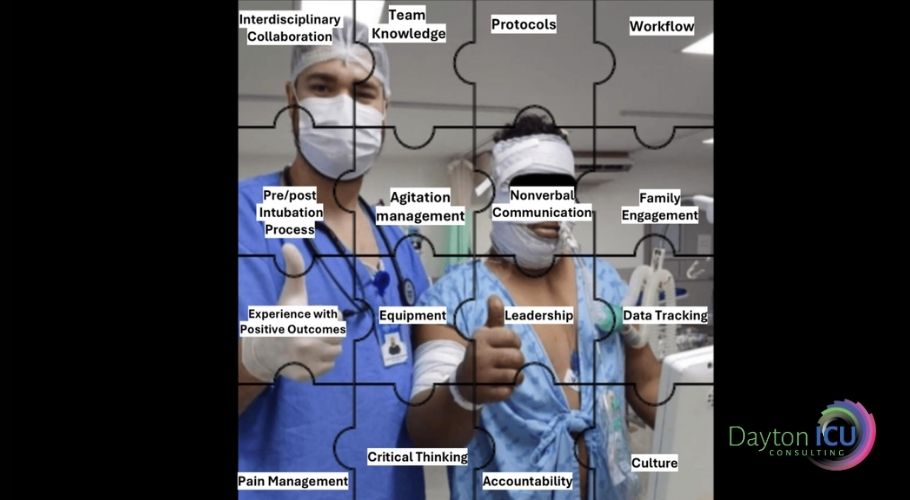
Awake and Walking ICUs™ are like a jigsaw puzzle.
You may have many of the right pieces, but without the image on the front of the box, how will your team members know what to do with that pile of pieces?
And how will they know which pieces are missing?
Do you even know?
The ABCDEF Bundle Requires Deep Understanding

The ABCDEF Bundle is not a conveyor belt of disconnected tasks, as each element influences the others.
It is difficult to remove sedation without providing patients with meaningful alternatives for anxiety, agitation, dyspnea, claustrophobia, communication, and discomfort.
It is difficult to mobilize patients successfully if they are sedated, delirious, profoundly weak, or experiencing uncontrolled pain.
And it is difficult to prevent delirium if the team continues to view sedation as the default solution for every patient who is intubated.
The team must understand the full picture, including:
- The history and evolution of ICU sedation and immobility
- The risks and long-term consequences of deep sedation
- Delirium as acute brain failure
- ICU-acquired weakness as muscle failure
- Survivors’ experiences during and after critical illness
- Why spontaneous awakening trials fail
- Why spontaneous breathing trials fail
- How to troubleshoot failed trials
- Appropriate indications and contraindications for sedation
- Agitation prevention and management
- Communication strategies for nonverbal patients
- Ventilator management during mobility
- The role of the diaphragm and respiratory muscles
- The risks of bed rest and immobility
- Each discipline’s role in sedation, delirium, and mobility
- How to individualize care for each patient
Without this shared foundation, teams may perform the visible parts of the bundle while missing its purpose.
Mobility Should Not Be a Back-End Cleanup Operation
A common implementation strategy is to mobilize patients only after they are stable.
This often means waiting until:
- Vasopressors are discontinued
- Ventilator settings are minimal
- The patient passes a spontaneous breathing trial
- The patient is extubated
- The patient is awake and cooperative
- Physical and occupational therapy are available
But by that point, the patient may already have developed significant delirium, diaphragm dysfunction, muscle wasting, orthostatic intolerance, and loss of functional independence.
Mobility then becomes a rehabilitation afterthought – a difficult attempt to restore what could have been preserved.
A more effective approach is what’s known as prehabilitation.
Prehabilitation means doing things that preserve cognition, strength, respiratory muscle function, communication, and mobility early on, before complications develop.
This may include:
- Reducing sedation as soon as clinically appropriate
- Promoting communication shortly after intubation
- Involving family members
- Optimizing pain, agitation, and withdrawal management
- Using mobility as part of delirium and ventilator management
- Verticalizing patients early when appropriate
- Engaging respiratory therapists, nurses, physicians, PT, OT, and families
- Incorporating mobility throughout the day – not only during a brief therapy session
The goal is not simply to get a patient into a chair.
The goal is to prevent the patient from becoming a profoundly weak, delirious, immobile body who requires an entire team in order to move.
Do Not Choose Only the “Easy” Patients
When teams lack confidence and knowledge, they often identify patients who already appear stable as the best mobility candidates.
But mobility is not merely something that becomes possible because a patient is stable.
Mobility can help patients become more stable and prevent complications such as:
- Reintubation
- Prolonged ventilator dependence
- ICU-acquired weakness
- Delirium
- Orthostatic intolerance
- Loss of independence
- Extended rehabilitation stays
The question should not be “Which patients are already doing well enough to walk?”
Instead, you should ask, “Which patients are at greatest risk of harm from immobility, and how can we safely adapt mobility to their needs?”
That does not mean mobilizing every patient in the same way.
It means developing the expertise to determine whether a patient will benefit from:
- Sitting
- Dangling
- Standing
- Stepping
- Verticalization therapy
- Ventilator adjustments
- More frequent, shorter mobility sessions
- Additional medical optimization before progression
The Importance of Hands-On Support
Education alone is not enough.
Clinicians need opportunities to practice together, receive feedback, and build efficiency.
Consider the practice of proning during the early days of COVID-19, for instance.
Many teams initially required eight people and 45 minutes to prone a patient. But with experience and competency, some teams eventually reduced that process to three people and 10 minutes.
The improvement did not come from a memo. It came from:
- Repetition
- Coaching
- Deliberate practice
- Team coordination
- Shared problem-solving
- Competency development
And early mobility requires the same investment.
At first, it may take more people and more time. But leaders must create the bandwidth for clinicians to learn without feeling punished for moving slowly or asking questions.
Leadership should be present at the bedside to:
- Watch the team perform the process
- Help manage barriers
- Learn what the work actually requires
- Provide additional hands when needed
- Invite feedback from every discipline
- Celebrate learning – not only perfect outcomes
- Use difficult cases to improve the next attempt
And over time, your team will become faster, safer, and more confident.
A More Sustainable Implementation Model
A successful transformation should include several phases.
1) Assess the Current State
Before launching, leaders should understand:
- Current sedation practices (What is actually happening at the bedside – not just what is documented)
- Delirium screening and prevention
- Mobility practices (What timing, level, and dose of mobility is actually being performed, not just what BMAT is documented)
- Existing protocols and order sets
- Staff knowledge and skills (Does the whole team know how to score the RASS accurately? Do they know what are true contraindications to mobility? Do they know how to use safe patient handling equipment to progress patient engagement and level of mobility? Do they know how to optimize ventilator management for patient comfort and safety? Do they know which communication tools to use for which patient?)
- Staffing and equipment barriers
- Team morale
- Baseline outcomes
- Previous implementation attempts
Leaders must identify not only what is missing, but also what the team already does well.
2) Build Shared Knowledge
Education should include every member of the interdisciplinary team – not only selected champions. That includes:
- Physicians and advanced practice providers
- Nurses
- Respiratory therapists
- Physical and occupational therapists
- Speech-language pathologists
- Pharmacists
- Nursing assistants
- Families and caregivers, when appropriate
The focus should go beyond definitions and documentation requirements.
Teams need to understand the clinical reasoning behind these practices and how to apply them to real patients.
3) Practice Together
Simulation and bedside coaching allow teams to clarify:
- Who screens the patient?
- Who leads the mobility plan?
- Who manages the ventilator?
- Who monitors hemodynamics?
- How will the patient communicate?
- What will happen if the patient becomes agitated?
- What are the stop criteria?
- How will the team respond to intolerance?
- How will the plan be communicated across shifts?
This is where role clarity and confidence are developed.
4) Provide Sustained Support
Transformation requires ongoing reinforcement.
And that means leaders should establish:
- Regular case reviews
- Feedback mechanisms
- Unit-based champions
- Ongoing discipline-specific coaching
- Data review that informs improvement, not punishment
- Follow-up education
- Bedside mentorship
- Opportunities to revise workflows and protocols
A two-day symposium may start the conversation. But it cannot independently transform your entire ICU.
Listen to the Revolutionists
The respiratory therapists who raised these concerns were not resisting change.
They were desperate for the change to succeed.
They had seen what was possible, they understood the consequences of sedation and immobility, and they wanted their colleagues to have the knowledge and support necessary to provide better care.
All things considered, when frontline clinicians say an initiative is being implemented poorly, leaders should not automatically interpret that as resistance.
It may be a warning, and they may be trying to tell you:
- They do not understand the purpose.
- The strategy is not working.
- They are repeating the same implementation errors of the past and will have the same results.
- The team doesn’t actually know how to make this happen.
- The workflow is not realistic.
- The right disciplines are not involved.
- The patients are being selected for the wrong reasons.
- Clinicians lack the skills to manage predictable barriers.
- The initiative is moving faster than the team can safely learn.
- The program is at risk of becoming another abandoned project.
These voices are not obstacles. They are implementation partners.
The ICU Revolution Needs More Than Enthusiasm
Most leaders who support sedation, delirium, and mobility transformation are acting with good intentions.
But good intentions do not replace preparation.
If you want clinicians to change practice, provide them with:
- A clear understanding of why the change matters
- The knowledge required to make sound clinical decisions
- Hands-on opportunities to practice
- Interdisciplinary role clarity
- Adequate staffing, equipment, and time
- Ongoing coaching and feedback
- Leadership that understands the realities of bedside care
Do not expect a unit to become an Awake and Walking ICU™ in three weeks.
Do not ask clinicians to perform skills they have never practiced.
Do not reduce transformation to documentation compliance.
And do not blame nurses, respiratory therapists, physical therapists, or physicians when an initiative fails because leadership did not provide the conditions required for success.
The ICU revolution is worth pursuing.
But it must be implemented with humility, expertise, patience, and respect for the complexity of the work.
So, make sure to listen to your revolutionists, learn what your team needs, provide the front of the puzzle box – and help them build it together.
Is your ICU ready to turn good intentions into lasting change?
Book a free consultation today to explore how we can help your ICU become an Awake and Walking ICU™.