Episode 215: Penthouse Incarceration - Anjan's Journey Through Post-ICU Recovery

Episode 215: Penthouse Incarceration – Anjan’s Journey Through Post-ICU Recovery

Anjan Chatterjee shares his journey from surviving a traumatic brain injury and medically induced coma to facing the hidden challenges of ICU recovery. He describes severe physical loss, hallucinations, brain fog, and months of isolation — revealing that surviving critical illness is only the beginning of recovery. Episode Transcription [00:00:00] This is the Walking Home

Learn More > from Episode 215: Penthouse Incarceration – Anjan’s Journey Through Post-ICU Recovery

Episode 214: Translating the ICU with Stephen Ramsey- Part 2

Episode 214: Translating the ICU with Stephen Ramsey- Part 2

In Part 2 with Stephen Ramsey, physical therapist and ICU mobility expert, the discussion dives into a complex cardiothoracic ICU case Stephen presented at APTA’s CSM conference. Using the MENTOR framework, Stephen walks through how rehab clinicians should approach critically ill patients — from chart review to interdisciplinary communication to real-time clinical decision-making. Episode Transcription

Learn More > from Episode 214: Translating the ICU with Stephen Ramsey- Part 2

Episode 213: Translating the ICU with Stephen Ramsey- Part 1

Episode 213: Translating the ICU with Stephen Ramsey- Part 1

Kali Dayton officially welcomes Stephen Ramsey — CVICU physical therapist, creator of the Ramsey Protocol, and lead author of the ELSO guidelines — as the newest member of the Dayton ICU Consulting team. In this kickoff episode of Translating the ICU, Kali and Stephen explore why physical therapists and occupational therapists are often rotating generalists

Learn More > from Episode 213: Translating the ICU with Stephen Ramsey- Part 1

Episode 212- Awake and Walking ICUs- What's in it for Nurses?

Episode 212: Awake and Walking ICUs- What’s in it for Nurses?

We know that the ABCDEF Bundle gives patients the best chance to survive and thrive. Yet, persistent hesitation regarding “increased RN workload and burden” remain significant barriers. Is this belief true? Are sedation and immobility better, easier, and safer for nurses? Let’s dive into Awake and Walking ICUs and what’s in it for nurses. Episode

Learn More > from Episode 212: Awake and Walking ICUs- What’s in it for Nurses?

Episode 211: The Proper Care and Feeding of Families and Survivors - Cathy and Eli's Journey Through an Amniotic Fluid Embolism and ECMO

Episode 211: The Proper Care and Feeding of Families and Survivors – Cathy and Eli’s Journey Through an Amniotic Fluid Embolism and ECMO

Critical illness impacts not only the patient in the bed but also their entire family during and after the ICU. Eli and Cathy Garrison join us to share their young family’s course of twists and turns of an amniotic fluid embolism to long-term disability. Episode Transcription [00:00:00] This is the Walking Home From the ICU

Learn More > from Episode 211: The Proper Care and Feeding of Families and Survivors – Cathy and Eli’s Journey Through an Amniotic Fluid Embolism and ECMO

Episode 210- Beds Are Evil- Revolutionizing ICU Recovery with Personalized Nutrition, Exercise, and Anabolic Therapy with Dr. Paul Wishmeyer

Episode 210: Beds Are Evil: Revolutionizing ICU Recovery with Personalized Nutrition, Exercise, and Anabolic Therapy with Dr. Paul Wishmeyer

In this groundbreaking episode, Dr. Paul Wischmeyer returns to share the incredible developments in ICU nutrition and rehabilitation that are transforming patient recovery. As both a critical care physician and ICU survivor, Dr. Wischmeyer brings unique insight into what it takes to truly help patients recover from critical illness. Episode Transcription [00:00:00] This is the

Learn More > from Episode 210: Beds Are Evil: Revolutionizing ICU Recovery with Personalized Nutrition, Exercise, and Anabolic Therapy with Dr. Paul Wishmeyer

Episode 209: Pioneering the Role of a Licensed Mental Health Therapist in the ICU with Stephanie Jacques, LMT

Episode 209: Pioneering the Role of a Licensed Mental Health Therapist in the ICU with Stephanie Jacques, LMT

What if we had an expert continually present in the ICU dedicated to caring for the mental and spiritual health of families, patients, and staff in the ICU? How would this impact stress, grief, and trauma in the ICU? How would this kind of support impact patient and family experiences, outcomes, and staff morale and

Learn More > from Episode 209: Pioneering the Role of a Licensed Mental Health Therapist in the ICU with Stephanie Jacques, LMT

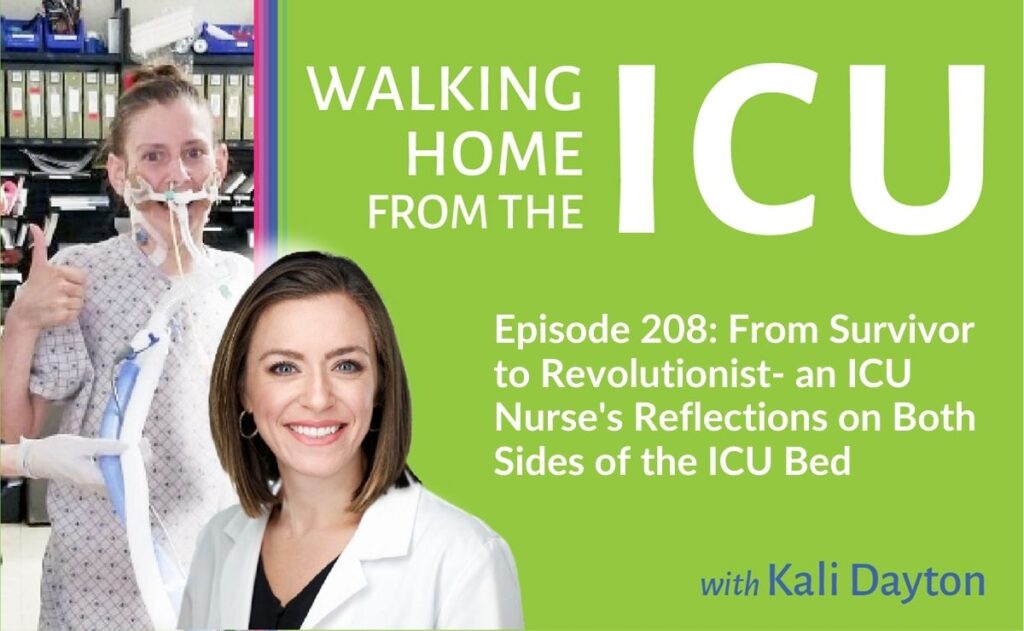
Episode 208: From Survivor to Revolutionist- an ICU Nurse's Reflections on Both Sides of the ICU Bed

Episode 208: From Survivor to Revolutionist- an ICU Nurse’s Reflections on Both Sides of the ICU Bed

Erika Breivogel’s journey through the ICU as a patient forever changed her as a person as well as transformed the care she now gives as an ICU nurse. In this episode she inspires up with her reflections of ICU culture vs. patient reality and what moves her to keep fighting the ICU revolution. Episode Transcription

Learn More > from Episode 208: From Survivor to Revolutionist- an ICU Nurse’s Reflections on Both Sides of the ICU Bed

Episode 207: Elevating ICU Culture, Practice, and Outcomes Through Verticalization Therapy

What does verticalization therapy look like at the bedside? What does it take to get the entire ICU team engaged in optimizing verticalization beds? Jessica Cafferty, OTR/L and Jennifer Babb, PT, DPT join us to share case studies and insights into verticalization therapy in their ICUs! Episode Transcription [00:00:00] This is the walking home from

Learn More > from Episode 207: Elevating ICU Culture, Practice, and Outcomes Through Verticalization Therapy

Episode 206: Humanizing the Neuro ICU with Compassion, Teamwork, and Verticalization Therapy

Episode 206: Humanizing the Neuro ICU with Compassion, Teamwork, and Verticalization Therapy

With the complex mobility needs of patients in the neuro ICU, how did Dr. Tarek Dakakni standardize patient standing for 8 hrs a day? As acting medical director, how did Dr. Dakakni bring all disciplines together to customize care and optimize outcomes for each patient as a person? Dr. Dakakni joins us now to share

Learn More > from Episode 206: Humanizing the Neuro ICU with Compassion, Teamwork, and Verticalization Therapy

Over the last few years I have become aware of the PICS (post-intensive care syndrome) condition and the very serious negative impact that it has on our ICU survivors. I have become much more aware of the potential negative impact of anxiety, depression, PTSD and cognitive dysfunction. Many patients whom we consider saves in the sense they leave the ICU alive have many issues that most people would consider far from a successful experience. Their lives are often dramatically changed in a very negative fashion.

I am a professor of medicine and have been an ICU director for over forty years. What I find very disturbing in my own experience and that of many other intensivists is that this outcome is generally considered acceptable; the patient survived and will get better with time. We have little access to these patients and almost zero information about their condition unless they are unfortunate enough to return to our ICUs. Very few of us have a PICS clinic where we would have a chance to better understand the challenges that some of our patients encounter, and there are very few systems in place to provide feedback to us as ICU clinicians. Therefore, we are blissfully ignorant of the many challenges that a substantial number of our survivors encounter. This is a major problem. The vast majority of ICU survivors and their families will experience cognitive, emotional and physical symptoms which often have devastating impacts on their lives. At this time, with PICS clinics being a rarity, there is no reasonable mechanism for intensivists to have a solid perspective on the frequency and severity of this condition.

How patients and their families are treated in the ICU often has a major impact on how the patient and families survive post discharge. It is generally agreed that most sedation infusions, particularly benzodiazepines, frequently have higher incidences of delirium and post-discharge dysfunction. There are a few hospitals in this country where sedative infusions are rarely used and the incidence of the complications described above are dramatically decreased. I have visited one of these hospitals and was amazed to see how effectively patients on maximum ventilator support can be managed, even walking without sedative infusions. In an effort to explore this treatment option in greater detail I have identified Kali Dayton. She is a nurse practitioner who has practiced in this Awake and Walking ICU for many years and is an amazing source of information on this topic. After extensive discussion with many colleagues, administration and many others, and reviewing the major potential benefits of the program for our patients, we have decided to introduce this program into our hospital.

Peter J. Murphy, MD, FCCP, MRCPI, BSc

READ MORE TESTIMONIALS >

DOWNLOAD THIS VALUABLE FREE REPORT

Perception Versus Reality: Debunking The Myths About Medically-Induced Comas

By clicking the Subscribe button, you agree to this site's Privacy Policy. Your information is always kept safe.