SUBSCRIBE TO THE PODCAST


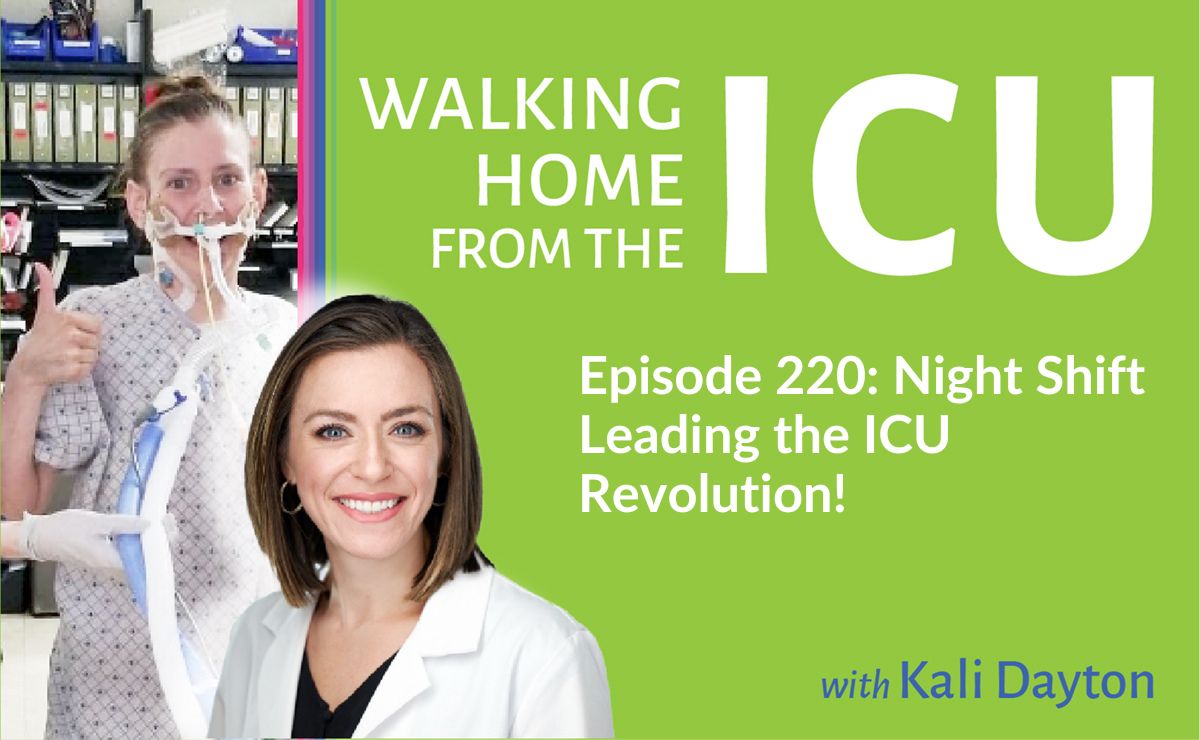
In this episode, nocturnes ,Dr. Dani Thomas shares with us the power of night shift to leave antiquated culture in the dust and lead evidence-based care in the ICU.
Episode Transcription
Podcast Interview with Dani
[00:00:00] This is the Walking Home from the ICU podcast. I’m Kali Dayton, a nurse practitioner and ICU consultant. I help teams create awake and walking ICUs through evidence-based sedation and mobility practices. By hearing from survivors, clinicians, and researchers, we’ll explore how to give ICU patients the best chance to walk out of the ICU and go home to survive and thrive.[00:00:30]
Welcome to the ICU revolution.
As a nurse
I worked around half of my time on night shift throughout 11 different ICUs. I remember in the Awaken Walking [00:01:00] ICU, the NPs and founders of this process of care, Polly Bailey and Louise Bastion, would review how the night shift went, and particularly what mobility was done, as soon as they clocked in on the morning shift.
If I didn’t get mobility done on my shift, they would come to the bedside at six fifty AM and ask me how the shift went and what stopped mobility from happening. To me, it felt like they were asking, “Uh, if your patient is still alive, why didn’t you [00:01:30] get them sitting at the edge of the bed, walking in the room or walking the hall?”
We would report what we did for mobility and hours of sleep to the next shift with the same importance as lines, tubes, drains, or ventilator settings. Then day shift nurses would report hours of sleep and multidisciplinary rounds with the same importance as that day’s creatinine level. The night shift crew is always a vibe, but in the Awaken Walking ICU, those first few hours of the shift, we didn’t have time to chat and hang.
We [00:02:00] were a well-run machine working together to get everyone mobilized, bathed, and tucked in for the night with the goal of around ten o’clock. Everyone was everyone’s patients. That was the culture. Many of our docs would hang out with us at the nurse’s desk and chat, teach, support, and bond.
I remember Dr. Woods would go room to room and check on each patient to make sure they were ready for bed, grabbing them warm blankets, turning the lights down, talking to them. There was nothing beneath [00:02:30] her. This was part of her routine on her shift. It was becoming a travel nurse that I became exposed to this culture or mentality of, “Those are day shift problems.”
I wish I had known then, like I know now, how much night shift matters. What night shift does or does not do can make or break patient outcomes. As a new nurse in the Awaken Walking ICU, they had us go between day and night shift so that [00:03:00] we could learn as much as possible from both shifts because they knew
that night shift needed to consist of A quality players. Becoming an NP and having much more continuity of care and then training teams throughout the past 17 ICUs, my appreciation and reverence for night shift has only grown more and more. This is why we train night shift from 9:00 PM to 11:30 PM because awakened walking ICUs is not just a day shift thing.
Yet [00:03:30] I’ve had to face that this is yet another cultural barrier the revolution has to overcome. When Dr. Danny Thomas, a revolutionist and now a dear friend, reached out to me as a nocturnist, I instinctively thought for a second, “Ah, too bad he’s on night shift. This is gonna be a tough one.” Instead, Dr.
Thomas leaned into the night shift vibe and has shown how night shifters who are empowered can become leaders in this revolution. I’m excited to have I’m [00:04:00] excited to have Dr. Thomas share with you how a nocturnist and his night shift crew is showing us how it’s done
Audio Only – All Participants: Dr. Thomas, thank you so much for coming on the podcast. Can you introduce yourself to us? Certainly. Yeah. It’s my pleasure to be here. Thank you so much for having me. I’m called Danny. I’m called Danny Thomas. I am an osteopathic physician, and I happen to work in critical care.
I’m trained in pulmonary critical care. And I happen to be working at the same institution for the last [00:04:30] 14 years. It’s a just over 400, I think it’s 420 beds or so, level two trauma center with two discrete intensive care units. A mixed medical surgical ICU and then a cardiovascular ICU.
And then we have another intermediate care unit as well where all the patients are monitored. And what tipped you on to this revolution? How did this, how did you get exposed to it, and what sparked your interest about it? I think it was back in 2013 or 2014, [00:05:00] there was a campaign through the Society of Critical Care Medicine called ICU Liberation.
And at that time, I was very new in my position, and I thought that sounded like a fantastic way to stave off PICs. And so I brought it to the attention of our nursing manager team, and it really went nowhere. And so fast-forward over a decade, and one of [00:05:30] our nurses, Monique, who I had worked with at the bedside for a number of years she in her nursing training had developed a pet project of delirium.
And over the years she would send me presentations that she had created on delirium and teaching pieces for the nurses on delirium and the, … Perhaps a year ago now, I don’t remember exactly the timing, she she was like, “Dani, we have to do this.” And I was like, “What, do what?” And she was like, “Check out this [00:06:00] podcast.”
And I so I was introduced to your podcast and and she was like, “It’s called Awake and Walking.” And so I investigated and I was like, “Oh, this is like ICU Liberation on steroids. This is actually where it’s at.” And so I was like, “Yes, we have to do this.” And at this ti- at that time, I was a decade into my, a decade older in my position and at the time felt y- it was totally achievable.
So I guess that was really the difference. And we’re always telling those key revolutionists, find your physician [00:06:30] allies, right? Physician allies. Yes. Totally. You obviously want to make a team-wide systemic change, but there’s a lot of power in the physicians being bought in and being willing to do this.
When a physician is there saying, “We’re going to do this,” the team is much more likely to do it. And what I’ve historically seen is, one, we wait for the physicians to take initiative, and oftentimes they don’t really carry this perspective of having patients fully awake and mobile. [00:07:00] Or it’s such a drastic change to what they’ve ever done themselves, that they’re scared to even try or intimidated or the second option is- They want it, they support it, but they feel like it’s just a nursing rehab thing, and they don’t necessarily really need to engage with it.
They’re like, “Ugh the nurses won’t do it. If the nurses would just walk patients, if they would just turn sedation off, I’d be fine with that.” But it’s up to them. It’s kind of the culture. They may not fully say that, but that [00:07:30] is what I’ve observed. So now Monique came, and you’re her physician ally.
You’ve wanted this for a while. You are probably more informed about PICC than most intensivists, especially historically. I think awareness is growing. What were your next steps? I know you guys are still on this journey, but what’s been your strategy to support your team in making these changes? Yeah. So the understanding that we [00:08:00] need what was required?
What would be, what would… Just sit back and ask, what would be required to create a complete cultural transformation? And in, in designing, what actually do we want? What would we love to have here in our ICU and how can we best serve our patients? So the first thing that I did was I created a, a, a sort of a cognitive map on how to get from where we’re starting until we’re, [00:08:30] living out this vision.
So I created a vision. And as, as a result of that the next piece that came to me was really in order for this to go anywhere, I have to have all of my physician, nurse practitioner, and physician assistant colleagues, everybody on our critical care service on board. Because in the absence of having all of the quote, unquote, “leaders” on board it’s just, it’s, as you said it’s gonna be hands off and not really gain any traction.
So I first presented [00:09:00] a case-based presentation to my colleagues and got a, at least a verbal, and some of them a written buy-in that they are absolutely willing to to learn about this, to proceed, and to make this an achievable goal. So that was the first step. And then- Can I put a plug in?
I used a quote from that presentation that you gave. Share with us your big one-liner that shook the internet when I posted it. I don’t know if I can quote it exactly, but it’s it’s [00:09:30] something to the effect that if you don’t really want to work with awake and communicative critically ill patients, then there is an entire world of veterinary medicine open to you It’s completely available to you And you know what people said to that?
There were lots of comments saying, “My animals can communicate with me.” And I’m like, yes, that is… What? They can’t talk, but yet they can communicate? Are we connecting the dots here that could be a s- the same principle [00:10:00] for humans as well? Hey, we are just big animals. And I love that’s, that is the approach that you’re taking with your colleagues of we’re not just, we’re not going, we’re not just talking about awakening breathing trials of the early 2000s.
No. You were like, “We as providers should be expecting and establishing the standard to be awake and communicative.” Correct. From the get-go. From the get-go, which I think is really a powerful approach to [00:10:30] take. That’s what I teach with my teams. A lot of times I’m trying to brainwash the nurses and everyone else to be comfortable with that concept and okay with it, ’cause it’s hard to engage as physicians.
So to have a fellow physician be like, “This is what we’re doing. You in or you out?” It it sounds like it was hard for them to dispute. E- everybody said yes. I mean- everybody said yes. And also, as a… Th- it seems like every w- when embarking on this [00:11:00] initiative, not necessarily having ever created anything like this before, it’s it’s in my humble perspective, really incumbent upon those that are in guiding or leadership positions, which f- from my perspective, leadership is simply making motion happen where m- motion wasn’t gonna happen before.
And that requires, the, the absolute requirement for that is to be the one that actually holds the vision, right? You hold this vision regardless [00:11:30] of what’s going on at the level of fact, what’s g- what’s going on at the level of actual circumstance, and you have that North Star, and you return to that North Star.
That’s sort of your guiding principle. And so with that in mind, all of the next steps reveal themselves, right? Like, when I made my map, I don’t have a, I don’t actually have a step one, step two, step three. It’s a, “We’re gonna do this, and then we’ll figure out the next piece,” right? We’re gonna do this, and then the next piece will open up.
So in, in doing so, [00:12:00] the, the w- the way that it is now, I actually was talking to my medical director this past week, and he was just so pleased with what he has noticed in the intensive care unit in general, because his comment was, “I don’t know what you’re doing, but it’s happening organically,” and it feels like it’s really it’s really happening in a natural way.
And so that’s been [00:12:30] the modus operandi here. And I think it’s noteworthy to share that you are a nocturnist. Indeed, yes. I’m a night shift doctor. Which is so cool because I’ve done night shifts a lot, right? And now that I’ve trained so many night shifts, I’ve lived and I’ve witnessed this shared mentality of that’s day shift stuff.
That’s… Even in the comments on social media, if there’s someone- Yeah … in the video walking and [00:13:00] intubated, night shifters w- night shifters will say, “And this is why I work night shift.” And I got that… I learned that phrase, this is a day shift problem, from nocturnists. Yeah. We call it, like we lovingly call it DSOs.
Those are day shift opportunities. However, I have noticed there have been several patients that we have mobilized at night, and that has been their only mobilization in their 24-hour period, in their 48-hour period, is the night shift work that [00:13:30] was done. I know that you have physical and occupational therapists screaming in their cars right now and banging the steering wheel.
They’re… I know that they’re like, “Oh my gosh, if my… if we could get our night shift to do that-” … I can only imagine how much more I could do during the day shift,” right? And also just it validates that this is not just a PT/OT thing. But what’s your strategy? So I’m always trying to imagine what it’s like for people that have never seen this happen- [00:14:00] Yeah
that have only known patients to be sedated and non-communicative and very difficult to mobilize if they get mobilized. And then even on day shift, right? People that are like, “Yeah, I’ve seen it happen. I’ve seen PT and OT do things or whatever.” Yeah. But then take it to night shift. You have a lot…
some new grads on night shift. You have lifelong night shifters. Yep. So mobility has not been part of their thing, let alone maybe you had awakening trials at 5:00 AM, but they’re a quick on and off switch. So how did [00:14:30] you have the audacity to be like- Yeah … “Let’s experiment”? Like who did you do this on fir- the first time, or if you can remember?
How did you coach your team through, “Let’s take off sedation. Now let’s get him moving”? How did that happen? Yeah. I wouldn’t necessarily say there’s any audacity with it. However it comes w- from the understanding that in order to create change that hasn’t been generated before, it first starts with mindset, and really placing [00:15:00] heavy emphasis on mindset during rounds.
And so for a number of months, we didn’t. All I did was when the nurse would rou- like we do evening rounds, and so the nurse presents the patient. So a routine question for me soon became What is their level of activity that they achieved today? And, th- they would share and say if they didn’t move at all, wh- what’s the barrier to their activity?
And it [00:15:30] quickly became evident to me that there were a lot of fake barriers, a lot of perceived barriers that just aren’t, in reality at the level of fact, aren’t present. So shifting that mindset over time on the rounds. And now it is not all of the nurses, but I would say a l- I would say probably at least a third of the nurses now when they do their presentation, they spontaneously include the level of activity.
They [00:16:00] spontaneously incl- And they cheerlead about it. Or if it was something that didn’t happen on day shift, they’re like and day shift didn’t get them up, and so we’re gonna…” And so- so that’s been really rewarding. So it s- first starts with mindset, and then, garnering the skill set to appropriately, safely mobilize these patients at a level that we have.
I am certainly not a physical or occupational therapist. I am not a physical therapist, and my expertise is not in mobilizing critically ill patients, right? It’s in the minutiae of taking care of critically ill patients. So how can I support people in doing something that [00:16:30] I don’t really know how to do myself, right?
And then the th- the third piece is just doing it, the action to it. And so what that looks like in real life is, at the beginning it was congratulating a nurse for running around the hospital to find a pack of Uno cards because their trauma patient was willing to play Uno. And so sitting down and playing Uno with their patient.
And then because they were engaged and they felt like somebody cared about them and they played Uno, that kid got up the next day, [00:17:00] right? Before it was just like, “Oh, I hate my life. This sucks. I’m just gonna lay in bed and internalize.” And then they started to be engaged in their own care, right?
So really with these mindset shift pieces. And to answer your question what was the first one? How did it start? I honestly don’t remember. I do remember we had a patient who had open heart surgery, and she had sustained a stroke after her open heart surgery. And it was pretty early on after [00:17:30] that stroke, maybe within the first two weeks, I would say, and it was clear to me that she wasn’t moving.
Nobody was mobilizing her. And so we made it a priority that she would be seated at the edge of the bed, and that was going to be her goal. And it took probably … It probably took about three nights of rounding consistently saying what’s the barrier? What’s the [00:18:00] barrier? And there was always something that came up.
And then the next day when I rounded, I heard that during the day she got up at the edge of the bed and everybody cheered. They actually, they sent me a picture about it. Aw. And and it’s also leaked out into my other colleagues, right? So I only work some of the time. I’m not on service continuously.
And I got a picture from the other week’s shift mobilizing this trauma patient in a cervical collar, at, with a walker [00:18:30] standing up at the edge of their bed with their breathing tube and everybody was so pleased with themselves just- On night shift. On night shift. On night shift.
So bad rat. I mean- On night shift … yeah. On night shift. That’s the… And so night shift has taken the initiative before day shift. Yes. Usually it’s day shift being like- W- and they have so many more resources during day shift. So- You have more PTs- Yeah … OTs. I think oftentimes we have more RTs during the day.
You just have [00:19:00] more people. There’s more rounding. I love that you guys are doing night rounds. Yeah. Claps for that because a lot of teams aren’t doing night rounds, and there’s- Oh, yeah. Night rounds- … so many missed opportunities there … are so helpful. They’re so helpful. A- and that you take those rounding episodes, it’s, those rounding sessions as an opportunity to educate, and I’m sure you’re educating on lots of different things.
You have established that r- like mentor relationship. Because when you put your new grads onto night shift, and you don’t have rounds, and you don’t have that kind of mentorship [00:19:30] available, you stunt the growth and then, and impact the safety of the entire team. Yes. What happens on night shift truly does matter despite the cultural myths, and then you’ve just built upon that.
And so the night shift in the cul- culture that you’ve already been creating, it becomes a propeller for the ICU team as a whole.
If you’ve been listening to this podcast, you’re likely convinced that sedation and mobility practices in [00:20:00] the ICU need to change. The ICU community is facing incredible difficulty with the trauma from the pandemic, staffing crisis, and burnout. We cannot afford to continue practices that result in poor patient outcomes, more time in the ICU, higher healthcare costs, and greater workload for the ICU team.
Yet the prospect of changing decades of beliefs, practices, and culture across all disciplines of the ICU is a daunting task. How does this [00:20:30] transformation start? It can begin with a consultation with me to discuss your team’s current practices, barriers, and to formulate a plan to help your ICU become an awake and walking ICU.
I help teams master the ABCDEF bundle through education, consulting, simulation training, and bedside support. Let’s work together to move your team into the future of evidence-based ICU care. Click the link in the show notes of this episode to find out [00:21:00] more.
Audio Only – All Participants: Yeah, and the rest of the services, too. I remember walking down the stairs one morning as I was leaving the hospital, and the car- one of the cardiothoracic surgeons was walking up the stairs to come in.
And she was like, “Oh, my gosh, thank you so much for mobilizing patient X.” And what we had done was this gentleman had a balloon pump in for a few [00:21:30] days after his open heart surgery, and he was failing his spontaneous breathing trials. And so what I did was I just encouraged the nursing staff to do what they do with all of their patients.
They just, this one just happens to have a breathing tube. In the CV ICU, it’s standard practice that after they get extubated, they’re sitting at the edge of the bed, and they’re mobilized within four hours. Just because he had been failing a breathing trial didn’t mean that he couldn’t still mobilize, and so I just reinforced that with the team and made [00:22:00] it an imperative that this morning, w- we are going to wake him up.
He’s awake. We are not going to use sedation through the evening. He’s going to sleep naturally, and then in the morning, sit him at the edge of the bed. Sitting him at the edge of the bed, he coughs, he mobilizes all of his secretions. He gets extubated rapidly in the, that day, and she’s like, “Thank you so much for moving him.”
I was like, “Oh, yeah, he coughed out all his crap, and now he’s going.” It’s just like- You fixed the problem … just what he needs. It’s the perfect [00:22:30] medicine. And does your team realize that they, the mobility got him extubated? Is that a mentality or- how do you teach during those episodes to say, “Here’s why it happened.
This is not a fluke.” Yeah. That- that’s a good question. So that has been, I think one of the big learning curves for our ser- for our team, is that up until now there’s been this thinking that if someone is on mechanical ventilation, if someone is on CRRT, if [00:23:00] someone is, really too sick and they need an organ supported, then goodness forbid they’re entirely too sick to even move, right?
Which is just not always true. And so creating small wins where it is possible, and just choosing the right patients to begin with. So I don’t know if this is answering your question or not, but now we… It is not uncommon. So before we started this initiative, [00:23:30] pretty much everybody on CRRT stayed in bed, completely in bed.
And now it is not uncommon for people to be in the chair while they are receiving their CRRT. And indeed, I remember the first time that we did this, I was, I emailed the nurse giving, offering gratitude for mobilizing the CRRT patient, having her stand and march in place and then get into her chair for her session.
A- and and he was like, “Oh my gosh, her daughter was shocked.” Her daughter was [00:24:00] com- because o- obviously it’s oh, my mom is a person, right? Oh, I can see there, there’s life here. It’s not just like a, a body in the bed that things are being done to. It’s a person that things are being done through and with and for.
Yeah. And sending out those kudos, that, those, that recognition- … is a really powerful tool. I’ve seen other intensivists do that, other revolutionists. I think it’s sub- kinda subliminal messaging of “This was a [00:24:30] very good thing.” Obviously we want it to become the standard, but right now it feels like it’s above and beyond, and they really should have recognition, and we should be celebrating every little win.
But there’s something about having an intensivists take notice and take the time to send that to an individual that really provides reinforcement that, yeah, I don’t think the- it’d be the same from a nurse manager. I know that’s helpful, but when it’s from a fellow colleague it’s really powerful.
Yeah. They… I- [00:25:00] it’s certainly not a unique idea. I stole it from, directly from your podcast. And it has really been very helpful because when they do email me back, they email me about how they are now enthusiastic about their job, how they love the teamwork, and they love the actual the changes they’re making in the patients’ lives, which is, why they got into this in the first place, and then I send it to their nurse manager, and some of them I send to administration, too. [00:25:30] And and they get boosted from that. And it helps also to to cause it to happen again on a recurring basis I think part of the reason this revolution is gonna go so much further in this generation than it did in the previous, early 2000s, 2010s is because we’re having hopefully a shift in culture from this hierarchical, physicians are like the cloud in the sky, whatever they say, go they’re above all else.
They come in, briefly visit the unit and peace out to [00:26:00] this collaborative team where we’re equals. We all bring something of value to the team. And so I think that’s really what it takes to move this forward. And I- I’ve noted in you this humility and this hunger for learning. You came to UCSF’s Humanize the ICU symposium, where it was all disciplines were invited and welcomed. Probably half of them were PTs and OTs, and there were like, or maybe like I think three-fourths or more- Yeah … they were nurses, [00:26:30] and then you were the lone intensivist, which we were pretty… We wanted more intensivists to come, but there’s been this perception of I already know how to do this.
This information is below me. It’s old news. This is an RN rehab thing. So I’m sure that humility, eagerness to learn is just who you are as a person. But what kind of things, why has this education been valuable to your practice as an intensivist, even a nocturnist, right? Oh, Kali, it’s because… so one of the things that I learned [00:27:00] quite some time ago now is to really approach everything with beginner’s mind.
And one of the, I think I’m a keep it simple, stupid kind of person, and in my understanding there are basically two emotions. There are emotions of fear and there are emotions of love. And- [00:27:30] And as I go through a practice of critical care medicine, historically it was very easy to be guided by fear, right?
What’s gonna kill my patient next? What, y- what’s gonna kill them the fastest? That was basically my thinking process. And at the level of fact, that’s still my thinking process, right? You kinda… it’s required. It’s ICU. Yeah, it’s ICU. However what’s what does that not leave any room for?
That doesn’t really leave any room for humanism. And so what is this [00:28:00] initiative? This actually, this cultural transformation of, bringing human- i- bringing humanism to the bedside, as Wes Ely says, is a way of loving the person in the bed, right? So bringing humanism to the bedside is a way of loving the person in the bed.
And for me, that’s what it’s about. Because I practice and I’ve always practiced according to the golden rule. If that was me, [00:28:30] if that was my dad, if that was my partner, if that was my kid, what would I want for them? What would I want for them? And so understanding that, and that, that covers strokes big and small.
That, that spans everything from the way that you initially begin to speak about the patient instead of describing this person in the bed as the head trauma, it’s, that’s not. This is Stacy. She rides horses. She got f- she fell off her horse, and [00:29:00] she’s got a symptom, right? Just from the way that we talk about patients to the way that we understand our work here.
What is our work? Is our work to manage floppy bodies in a bed? No. Our work is not to manage floppy bodies in a bed. Our ma- our work is humans helping other humans, being the best humans they can be regardless of their circumstance, situation, or condition. So if you are critically ill, if you are on [00:29:30] the brink of existence as we know in this consensus reality, what is the best way that you can live into that?
What is the best way that you can live your life in this situation, right? So if you’re critically ill, does that mean that you get to play with your grandkids, right? Is, if you’re critically ill, does that mean that you get to flop around in a bed withering away, right? I don’t pretend to know for every single patient but holding this vision of what is the absolute best that we could [00:30:00] serve to do this, to do justice for this patient.
What can we actually do here to help this patient, to help this family, to bring back the person that disappears in the setting of critical illness sometimes. Does that make sense? Oh, 1,000% and beautifully put. I think especially when you’re doing such high-level medicine and there’s so much science behind it we miss the humanity- Yeah
and the human in the bed, and the overall perspective and objective. And one of the things that [00:30:30] I’ve loved about this journey of the revolution is they’re not two different worlds. You know what I mean? Like- … there’s so much science behind this as that, that validates the humanity and vice versa. It’s not like we’re gonna disregard their essential organs for survival so that we- Right
do this fluffy kumbaya voodoo stuff. Like it is like- Which I think it’s, that’s how it’s perceived a lot. It’s like we don’t have time for that because we are just trying to save their lives, and we’re like, actually, [00:31:00] if we- This is saving their life. We are saving their life in a huge way, like right now in the ICU today, this week, as well as changing their lives or sustaining their lives for years to come.
And that’s a perspective I feel like many intensivists don’t have. And when they assume that they know, it really blocks their ability to learn and go beyond what’s normal. So what would you say to, as I train teams and I’m like, “Okay, everyone’s gonna participate in this education,” what would you say to those [00:31:30] intensivists who were like, “Blah, blah, nurses are gonna do this thing”?
How would we maybe engage them in being open to more information and a different perspective from what they’ve learned throughout their vast education? What’s coming through to me now, and this isn’t my lived experience, but actually just having a patient talk to them, right? Just having somebody that they have taken care of share exactly what happens with them.
I am [00:32:00] remembering now, This habit that I’ve gotten into when I admit patients who can speak and communicate, I- it’s not uncommon that they’ve been critically ill in the past. And so now I actually take the time to query and be a safe person that is present where they can feel like they can share that thing that they can’t tell anybody else about what happened in the ICU.
And collecting and gathering these stories [00:32:30] over time now, sharing those with my colleagues and hearing it from this kind of first-person perspective. And then they know that person, ’cause they helped to take care of that person later on, right? So it’s like no that Impella were- was a train for them the whole time, and they felt like they were being run over by a train, right?
So just small things like that actually just it brings it home. It’s a story that connects directly to [00:33:00] the things that they overlook. And and so that’s what’s coming through to me right now. But as far as discrete advice in training other teams it is actually, you think that you’re doing everything that you can.
You think that you’re doing everything according to the evidence. You think that you’re doing your best job. Really? Are you? There’s actually a whole nother level available. Do you actually want to be the intensivist that just goes [00:33:30] with the flow and does what everybody else is doing and gets mediocre outcomes, or do you actually wanna make a difference in people’s lives?
Do you actually wanna do what you probably got into medicine to do, which was to help people, not to do your shift and go home, right? Do you actually wanna… Do you wanna level into who you could actually be? And not everybody’s gonna be there, right? But but just offering that as something that is really achievable and [00:34:00] doesn’t take a tremendous amount of effort.
I would say in this entire initiative, my entire approach up until now has been just asking myself over and over, “What if this could be easy? What if this could be easy?” And then the pieces that are easy, they highlight themselves. So And your team’s still so new in it, but- Yeah … you’ve achieved so much.
What, you’ve walked, what, nine [00:34:30] intubated patients on night shift- Eight … your team has? Eight, okay. But and it just never would’ve happened if there wasn’t an intensivist that was willing to ask those questions. Why not, what if, could there be more? And then be willing to try something new and involve and support, really support and inspire your colleagues.
I just- I’ve learned so much from you, Dani watching you in the symposium and you’re, like, pen flying as you take avid notes. Sometimes I thought, “Will this information be [00:35:00] too basic for Dr. Thomas?” You know what I mean? But but I th- I could tell that you were going beyond just the statistics.
You were getting inspiration. You were connecting this at a higher level. And that just, I hope to be that avid of a learner and be open to new information for years to come. So thank you so much for everything that you have shared with us and that you’re doing with your team, and I hope that we’re gonna follow up in a year or two, and we’re gonna see where your team is at, where you’re gonna be like, “We’ve gotten to the point where it is easy, it is standard.”
But thank you [00:35:30] for hanging tight while it’s still not easy. You’re going against the tide, and you’re not alone in that, but we salute you. So many thanks. And I sincerely appreciate your guidance and your support and your willingness to speak with me. It’s been really invaluable, every touchpoint that we’ve had along the way.
Thank you so much. You as a revolutionist and other people like you that are, like, lone wolves initially- … are why I do this, why we still do the [00:36:00] podcast. And you’re not alone. And it’s amazing to consider that you’re changing lives for generations to come. Long after you leave your unit, leave your profession, hopefully never but you’re s- you’re humanizing the ICU for you’re creating ripples throughout the community.
So you’re not alone. Hang tight and we’ll circle back. And congratulations to your team for the progress and the steps that you guys have made already. Yeah. It’s all them. It’s really all them. So thank you so much, Kali.
To schedule a consultation for your ICU as well as find supportive resources such as the free ebook, case studies, episodes, citations, and transcripts, please check out the website.
Transcribed by https://otter.ai
SUBSCRIBE TO THE PODCAST