SUBSCRIBE TO THE PODCAST


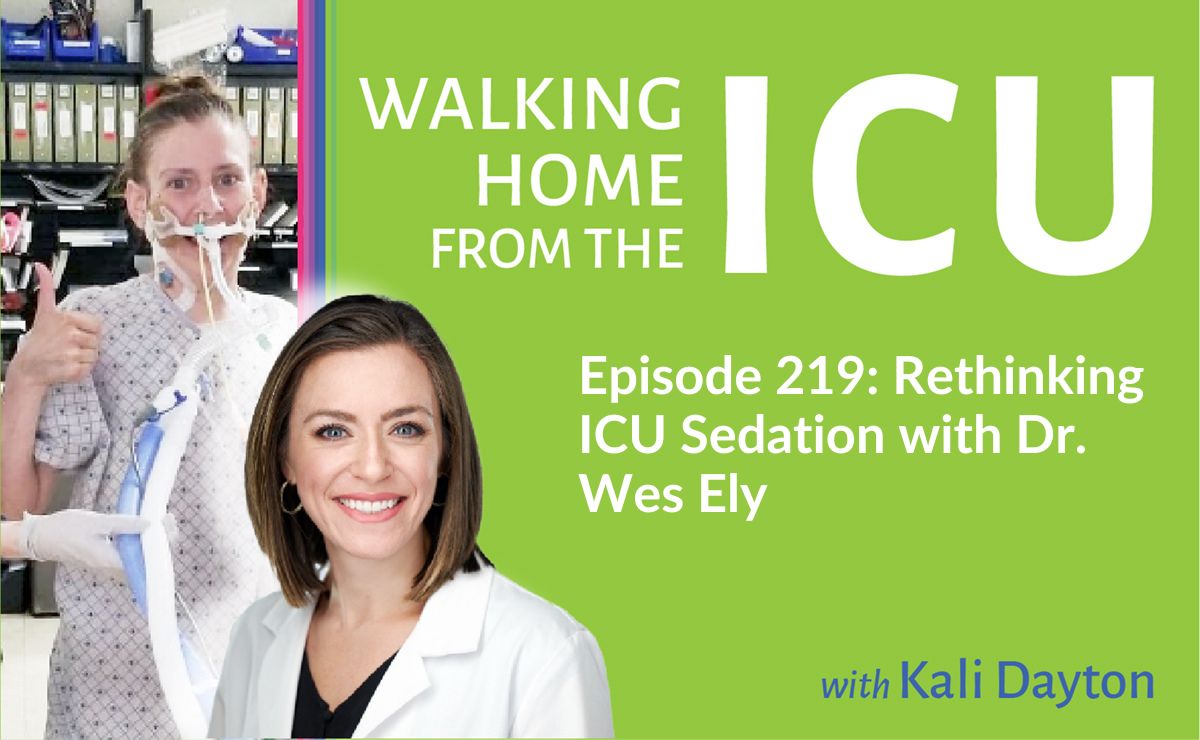
In this conversation, Dr. Ely traces the origins of spontaneous breathing trials (SBTs) and spontaneous awakening trials (SATs) back to the 1990s, when every ICU patient was placed on benzodiazepine and opioid drips as a matter of course. He explains how standardizing the weaning process cut ventilator days by two, halved complication rates, and saved $5,000 per patient — and how the landmark ABC trial, published in *The Lancet*, became the first study to demonstrate a life-saving benefit from stopping sedatives entirely.
Episode Transcription
[00:00:00]
This is the Walking Home From the ICU podcast. I’m Kali Dayton, a nurse practitioner and ICU consultant. I help teams create awake and walking ICUs through evidence-based sedation and mobility practices. By hearing from survivors, clinicians, and researchers, we’ll explore how to give ICU patients the best chance to walk out of the ICU and go home to survive and thrive.[00:00:30]
Welcome to the ICU [00:01:00] revolution.
Last month, I was thrilled to bring the Awake and Walking ICU Symposium content to UCSF’s annual Humanize the ICU conference. I was so inspired to meet revolutionists from around the Bay Area and even country who dedicated two days to meet with fellow interdisciplinary revolutionists.
We had physicians, NPs, nurses, PTs, and OTs. The fact that the rehab department of UCSF hosted the event attracted a lot of PTs and [00:01:30] OTs, which was such a treat. Hopefully, next year we have a stronger RT presence and even more participants from all disciplines. The event was full of didactic with lots of case studies, group discussions with half of the day on both days dedicated to skill stations for awake and walking ICU skills such as agitation management, nonverbal communication, CAM and RASS, ventilator management, sedation pharmacokinetics, safe patient handling, interdisciplinary communication for sedation, and a [00:02:00] station for interdisciplinary collaboration for mobility and a simulation session.
It was so neat to have so many different disciplines and teams represented and to work on each member’s role and to learn from everyone’s perspective and expertise. There was a spectrum of experience and compliance with the ABCDEF bundle across all these teams.
Many shared barriers and frustrations for validation, as well as strategies, tips, ideas, and inspirations that we all learned from. Stay tuned as some of the presentations and [00:02:30] content from this event may find its way online. I am grateful to those that attended and look forward to upcoming events such as the Tidewater AACN Chapter Chapter Conference in February, link to registration will be in the show notes, and an RWJ Barnabas event in New Jersey in April with details to be announced.
Let me know if you’re interested in bringing an event like this to your system. For this UCSF conference last month, Dr. Wes Ely recorded a discussion with his insights on SATs and [00:03:00] SBTs myths versus evidence. This episode contains the audio from that discussion as it was too powerful not to share with you, the revolutionists who need more arrows in your quiver to pass on to your colleagues
Introduction
Audio Only – All Participants: Dr. Ely, thanks for joining us.
Do you mind introducing yourself to us? I’d be happy to introduce myself. And I first wanna thank all of you who are there at the meeting for caring so much about our patients, and about improving the [00:03:30] way that we care for patients, uh, who are critically ill, and by extension, patients we will never even meet.
Because what you do today will affect the culture of how your patients in your institutions are cared for, and then down the line, even when you finish, if you help create that new and healthy culture of critical care, when you’re done and gone, future patients will get better care as well. My name is Wes Ely.
You can see I’m an older, gray-haired physician. I am, uh, I’m s- I’ve been practicing medicine for 30 years. [00:04:00] I’m 62, and I’m a critical care professor at Vanderbilt University and at the VA here. So I work in both of the institutions here. Um, and we’ve been doing research for around 30 years in the area of delirium, sedation, mechanical ventilation, protocolization for patients who have severe sepsis, ARDS, or any need for critical care.
And over my years as an investigator, both as a, a, as a scientist and a physician, [00:04:30] it’s been a privilege to be part of some of the instrumental clinical trials and observational cohort studies, which have helped us to understand how do you measure delirium, how do you, uh, predict whether or not somebody is going to have long-term cognitive or functional impairment after the ICU, what we now refer to as the post-intensive care syndrome.
The Malignant Normality
Audio Only – All Participants: And how do we make changes that improve upon what had become a malignant normality? Let’s use a term that actually adequately [00:05:00] describes how far off course we got. When, when, when ICUs were founded in the 1950s and ’60s, for the next 40 years, it evolved Using what we thought were benevolent ways of caring for human beings, but it wasn’t actually benevolent.
We proved through thousands and thousands of patients and hundreds of clinical trials that we were being malevolent. We were creating injury in human beings who were being cared for in the critical care units, and I [00:05:30] refer to what I even did myself as a malignant normality, accepting the status quo as good enough.
And, and let’s be clear what that status quo had become: deep sedation, prolonged immobilization, treating patients as if they were inanimate objects in the ICU, and leaving them with an acquired brain injury, an acquired muscle and nerve disease that affected them for many, many years to come, maybe even for the rest of their lives.
And I [00:06:00] remember I had a young, uh, woman who was a mother of three who pointed her finger at me and said, “Dr. Ely, you didn’t do your job. I can’t care for my children anymore. I’ve had to retire early, and I’m in my late 30s, and I can’t care for my family anymore. You didn’t do your job.” And I felt very convicted because I knew that I had contributed to her ongoing injury in life, and there is a better way, my friends, and you’re learning about it at this course.
I’m excited to be a, a small, [00:06:30] tiny widget in your course. And today, Kali and Heidi are gonna ask me questions, and we’re gonna, the three of us, discuss some of these things that have evolved now through clinical trials. And don’t think this is warm and fuzzy. It’s science, and it’s a better way. How about that for an introduction, Kali and Heidi?
Is that okay? Fantastic. Dr. Ely is, you know, one of the grandfathers of ABCDEF bundle, delirium research, and intervention in the ICU. So it’s, it’s such a treat to be able to pick your brain [00:07:00] about some of the history of ABCDEF bundle. I think understanding where we come from helps guide where we’re headed.
Origins of SATs & SBTs
Audio Only – All Participants: So, you know, the 1990s, like you were talking about, we were doing morphine drips, Ativan drips. We were doing 12 … 10 to 12 milliliters per kilogram on the, the ventilator, causing a lot of damage to the lungs, but also to the brain and the body. And so you founded SBT, spontaneous breathing trials. Tell us about what inspired you to do that.
Well, Kali, [00:07:30] when I was a younger intensivist, every one of our patients in the ICU, and I mean every one of them, was on a benzodiazepine drip and a morphine drip or a fentanyl drip. It was, everybody was on opioids and gabaergic drugs. And when those patients received those drugs, they were sent down to the bottom of the ocean in terms of consciousness to a degree that prevented them from ever communicating to us as clinicians, usually for four or five days until we would start to lighten things up.
And when we did [00:08:00] lighten things up, they would wake into a tremendously dense fog of delirium. Of course, we didn’t have a tool by which to measure that until 2001 when we published The CAM-ICU, uh, and Joana Scrobik published the ICDSC. But in the 1990s, mid 1990s, uh, when I was a chief resident, I thought to myself, Dell computer, Ford Motor car, none of these companies would allow every single patient to be managed so differently.
They were all sedated [00:08:30] heavily, but the way of weaning the patients was handled differently by every different attending, and it just didn’t make any sense to me. And I thought, “We should standardize this.” So we designed a randomized control trial where the standardization became doing a screening trial and then followed up by a spontaneous breathing trial.
And we proved that if you took the doctor out of it and allowed the respiratory care practitioner or respiratory therapist to do that standard tool every day of screening and then the spontaneous breathing trial, that you would get [00:09:00] people off the ventilator two days earlier and shave the complication rates in half and save $5,000 per patient.
And then a few years later, JP Kress at University of Chicago did the same exact experiment, except instead of stopping the ventilator, they stopped sedation. And they called it a sedation vacation, sedation holiday, but I didn’t like that term because I didn’t think it fit in clearly with, with what would could become a lingo, a, a rememberable [00:09:30] alphabetical bundle.
And so we renamed that to a spontaneous awakening trial, and then it became an awakening trial, step A, a breathing trial, step B. And they’re not independent tests. I mean, you are, you, you are doing them one at a time, yes, turning off sedation. If somebody tolerates it, then you turn off the ventilator. But they are integrally linked, and the entire point of both of them is to liberate the human being from iatrogenic injury, which they are gonna [00:10:00] receive if they get too much in the way of s- ongoing sedation and ongoing mechanical ventilation that they don’t need And this is what’s so fascinating to me, because here we are, you know, 20-plus years later, and certain words like sedation vacation, holiday, interruption.
Even the word like daily awakening trial carries this implication to the bedside of we’re automatically going to start sedation, continue it, but take really brief breaks to see if we can extubate. You’re telling us about the roots of SATs and [00:10:30] SBTs. Then the rest of the bundle was built out to help us focus on actually preventing and treating screening for delirium, mobility, family engagement.
But this, um, this codependent relationship has led us to think, and I even saw this in a policy I just read from a hospital, is SATs are for ventilator liberation, which I don’t disagree, but it even carried the words of, if an SBT fails, sedation can be resumed, control settings can be resumed on the ventilator, and it [00:11:00] will be repeated the next day.
The Sedation Vacation Problem
Audio Only – All Participants: Let me chime in on that because, you mentioned the word sedation vacation again, which I had said, and think about how wrong that term is. First off, a vacation is a luxury, right? A vacation is optional. Why should we consider removing sedation, which can, which can pummel the neurons in the brain and help create a, a, an acquired dementia?
We have a name for this now called ADRD, Alzheimer’s disease and related dementias. So the [00:11:30] RD’s, the related dementias, are the, those are the millions of people out there who have now an acquired, a rapidly acquired dementia, not just from sedatives, but definitely partially from sedatives and the, the underlying disease like the sepsis, the micro clots, the lack of blood flow in the capillary beds, et cetera.
But all those things add up to cause millions of neurons to be lost. So it shouldn’t be referred to as something optional or a vacation. This should be an obligatory removal of sedation every single day to see if it’s tolerated. [00:12:00] And if the patient doesn’t tolerate it, it should not be resumed at the same amount that it was before.
It should be resumed at, at half that amount. That’s the way we did our original trial. The ABC trial, which was published in The Lancet, was the first trial to ever show a life-saving benefit from stopping sedia- sedatives. And that trial was done such that when you stop the sedatives, you either kept them completely off or restarted them at half the dose.
That’s the way that trial proved a life-saving benefit. my [00:12:30] question is with the sedation awakening. So number one, in rounds, I rarely hear the harms of sedation managed. I feel like the purpose of the sedation awakening is often presented as part of a weaning process. And so I find awakening trials often being things like, “Well, we’ve turned the propofol down from 50 to 20 and their eyes are opening, so that’s our awakening trial.”
The other thing I often hear is how they, of [00:13:00] course, need some sedation. It always makes the patient more comfortable. But I feel like within all those conversations that present sedation as compassionate, providing comfort, needing to be lowered, not turned off completely, I find in those conversations, which are far more prevalent than I ever hear the conversation saying sedation is harmful, um, i- is lost the purpose, the whole purpose of removing the, the sedation.
Because to me, when you’re taking the sedation off, you’re trying to [00:13:30] learn what’s happening with the patient. And when something suddenly looks off on the ventilator of the, or the monitor, what that’s telling you is not re-sedate the patient. What that’s telling you is we need to change something, right?
Right. So we’re- So let me, let me, let me chime in there … we’re missing things that should be prompting a change- Yeah … in our care. Am I right? Think about, think about it like this. Uh, if you were, if somebody were to give you a drug right now, just any drug, and, and you didn’t need the drug Okay? There’s only one possibility [00:14:00] that would occur if you did not need that drug, and that would be the potential for a downside, uh, side effects, and adverse reaction.
Okay? If you don’t need the drug, you don’t need the drug. And in the ICU, if you don’t need the sedative, the only possible thing that can occur from that medication is harm. So we take an oath of primum non nocere, first do no harm, and the only way to find out if somebody needs a drug is to stop it. And the way we designed the Spontaneous Awakening Trial is not a wean.
It’s a [00:14:30] complete shutoff. And we debated about this a lot, but what we wanted to do was separate the groups, you know, randomize them, and then separate them. And in a randomized trial, you want to separate the groups. And when we did the total shutoff in the ABC study, which we’ve learned about this many times since, is we cut, we cut the overall amount of propofol that was given in those ICUs for those patients in, in the intervention group 50% less.
Now, that doesn’t mean that the patients got their propofol turned down by 50%. It means [00:15:00] that it was totally shut off, and over the course of all of their ICU stays, the, the g- the total amount of propofol that was given to those units was literally cut in half, and the same is true with the fentanyl. That resulted in people being alive at the end of one year.
One out of every seven people extra alive. That’s a number needed to treat of seven. That’s a very low number needed to treat, meaning you’re saving a lot of people’s lives by doing this. Um, the, the idea of weaning the sedation [00:15:30] is killing them with kindness. This is, this is a, a, a bait and switch. Our brain is thinking, “I’m doing something benevolent.”
Benevolence is intending good. Beneficence is actually doing good. So it is be- uh, maybe b- intended benevolence to slowly remove a sedative drug, or even cut it down by half. But it is not in- indeed beneficent. It’s not actually doing good. Doing good would be get rid of the drug. Let the [00:16:00] person completely clear this drug out and see how they tolerate it.
If you’ve been listening to this podcast, you’re likely convinced that sedation and mobility practices in the ICU need to change. The ICU community is facing incredible difficulty with the trauma from the pandemic, staffing crisis, and burnout. We cannot afford to continue practices that result in poor patient outcomes, more time in the ICU, higher healthcare costs, and greater workload for the ICU [00:16:30] team.
Yet the prospect of changing decades of beliefs, practices, and culture across all disciplines of the ICU is a daunting task. How does this transformation start? It can begin with a consultation with me to discuss your team’s current practices, barriers, and to formulate a plan to help your ICU become an awake and walking ICU.
I help teams master the ABCDEF bundle through education, consulting, simulation training, and bedside support. Let’s work [00:17:00] together to move your team into the future of evidence-based ICU care. Click the link in the show notes of this episode to find out more.
Audio Only – All Participants: And what’s so interesting is that during the original trial, one of our nurses said, “Oh, see that person over there? Um, we turned the drug off and they didn’t do so great, so [00:17:30] we turned it all the way back up.” And I said, “Well, why’d you do that? We should- we’re s- the protocol says to turn it halfway back up.”
And she said, “Well, I just thought we should go all the way.” And I said, “Well, turn it off again. Let’s see what happens.” And I stat- sat there and waited, and we turned it completely off. Patient did fine. Um, and by the way, I looked around the unit and I was worried, “Oh, wow, maybe we’re not doing an, an experiment.
Maybe there’s… Everybody’s actually staying on the amount of drugs that the control group is staying on.” But I looked around the unit that day and I saw [00:18:00] patients awake, and looking around, and communicating with their family members, and even reading. And I thought to myself, “Oh, wow, we’re changing the culture here.
This is, this is actually doing something, but it’s not doing something if you just inch it down like an inchworm. You have to shut it off to allow the person to wake completely up,” and now I know whether or not you actually need it, and most of the patients don’t. But I think part of the problem becomes is how people are defining if you need it or not, [00:18:30] right?
What does it mean that they don’t need it? What does it mean that the patient does need it? The only requirement for the, for the drug at all anyway should be, are you, are you unable to provide the supportive care for, that the patient needs without a sedative? So if you can be on a ventilator and get 90-plus percent sats without the sedative, then that’s a way cleaner approach to providing mechanical ventilation than thinking, “Oh, they’re on a ventilator, therefore they need to be deeply sedated.”
[00:19:00] No. Why do I want to create a second organ dysfunction just ’cause they have respiratory failure? Kali, what do you, what do you hear about when people say our patient failed a SAT? Because I hear tachycardic, I hear high blood pressure. I hear they just looked really uncomfortable, and they were, like, gagging on the ET tube And those are often r- r- rationales for turning the sedation back on.
But Kali, you talked to some- Kali, talk to us about what you as an IC- as a, as a very [00:19:30] seasoned, veteran, bedside clinical ICU nurse, w- how would you approach that same circumstance? Well, working in an awake and walking ICU, the timing of those awakening trials was shortly after intubation. So for a long time, we didn’t give paralytics, so we would give induction meds, just those pushes, those boluses, and then they would just wake up while we’re securing their endotracheal tube, doing the chest X-ray.
We’re already in the room. That’s when they’re coming out. Now that we’re using paralytics, we do run a drip [00:20:00] until two hours later and then turn it off, and then we’re reassessing for do they actually need sedation? Is there an indication? Yet, now that I’ve trained 16 teams and seen what the cultural norm is and what the perception is out there, things like in the original SAT criteria, it says that agitation is a f- criteria for failure, but that’s very subjective.
And so I see the word agitation being used for anyone that opens their eyes, moves, and/or grimaces. So we’re having a RASS plus one being failed [00:20:30] and sedation resumed. Um, and it’s also really hard. The timing really impacts it as well because when you start … When you run sedation for a while, and you’re not really trying to get sedation off and have them awake and communicative until we’re trying to extubate, the rates of delirium and the panic and the true agitation RASS three, four that emerges in those scenarios is at such a high volume, it’s really hard to get teams to want to do that.
And that’s something I think sometimes, uh, providers, physicians don’t always understand because I still see teams doing 5:00 [00:21:00] AM wake-ups. One nurse is by themselves. The patient’s been sedated for, you know, three, four, five, 10 days, and now we have this whole mess of a scenario. There’s no RT at the bedside to adjust the ventilator, to, to help them calm down.
The family’s not there. So the failure criteria becomes really messy when culturally it’s any kind of, any sign of distress merits sedation. But-
Clinical Stories
Audio Only – All Participants: Let me tell you a clinical story. Mm-hmm. I have permission to tell this story. And, and, uh, her, her story is featured in Every Deep-Drawn Breath, this, this narrative non- [00:21:30] this narrative nonfiction book that I wrote about patients.
And her, her name is Janet Keith. And Janet was a woman in her late 50s who came in with, uh, necrotizing fasciitis of her face. And she, uh, eventually got about 50% of her face removed, developed ARDS, rip-roaring sepsis, septic shock, uh, and, uh, and high oxygen demand with a high PEEP On day one of being intubated, she told- she remembered me [00:22:00] whispering to her, “You are going to walk today.
You’re gonna be out of this bed. You’re gonna be walking.” She had just been intubated about six hours earlier, and she was walking every day on the ventilator, despite the fact that she was going- she went back to the OR 21 times. And we, every time in between the operations, we’d wake her up, have her totally alert and communicative and walking.
So eventually, when she g- the day she passed her first SBT, she got [00:22:30] extubated. And, and on that day, I have a picture of her where she is about 75 feet down the hall, walking by herself, extubated. Now, you know darn good and well that that woman would never have been able to walk double-digit days into mechanical ventilation had she not been walking all the other days.
Because there’s a price to pay for keeping somebody sedated like that, and the price is the dense delirium, which you just mentioned, and also the 10, 15% muscle loss that she would have had. [00:23:00] But she didn’t have the muscle loss, and she didn’t have the delirium because mobility and family are the two main treatments of delirium.
But you can’t mobilize until you’re off sedation. So it becomes a triumvirate of get rid of the sedation so that you can communicate to family so that you can walk. And those three things become, really, the holy trinity of getting people safely off of critical illness, which is remove the sedatives, mobilize the person, and have their family, the loved ones there to remind them of the beauty of their life [00:23:30] And I just want to add to your story, Wes, that part of delirium is a lack of motor control.
So even our patients who have strength, when they’ve had a long course of sedation and they’re cognitively impaired as a result, no matter what age, I have 20-year-olds come into our ICU that have been on long, deep sedation. And they have the strength. They were young. They still have muscle [00:24:00] on their body, but they literally have no capability of telling their nervous system to recruit that muscle anymore.
And so just the process of trying to help them move, Kali often calls us the cleanup crew or the SWAT team. Um, we now have a really difficult to mobilize patient because even when they have strength and it seems like, well, it doesn’t matter, they were young, we preserved their strength, um, their brain can’t tell their body to move in a coordinated [00:24:30] fashion.
Kali, tell me what’s on your mind, and then I’m gonna come back to something Heidi just said about patients coming in from outside hospitals on lots of drugs. I’ll come back to that. But what’s on your mind, Kali? Well, what you shared really I wish was standardized. I think when, um, we stick to SATs are for ventilator liberation, I- you’re talking about being able to liberate for the ventilator when they’re ready to liberate.
The mentality at the bedside is The, the SBT criteria of a PEEP of equal to less than eight, 50, 40%, you know, those parameters then [00:25:00] influence when we’re actually turning sedation off because we’re only doing awakening trials to do an SBT. But you flipped it, right? You’re like, standard management of mechanical ventilation should include the ability to communicate, to mobilize, to engage with family.
So I, I pose it as question- That’s the goal … that’s the goal, and that should be the standard with exceptions, and those should be validated, medically indicated exceptions. But I feel like with the past way of [00:25:30] teaching, even the algorithm from 2008, it has this SAT, SBT flowing together. And I understand why that was done.
I just think now in 2026, we carry the same picture in our minds of they’re all together, therefore, until we’re extubating, we don’t need to have them awake. But you’re flipping this to say, we do … We turn off sedation so that we can mobilize them. Let me give you- another story. This is in the COVID era. In the middle of COVID, I had a woman who, and I have permission to use this story as well. I would never use a [00:26:00] person’s story without writ- signed written permission, but I won’t mention her name. Um, had just delivered a baby And, uh, and her husband was outside the room in PPE wanting to go in to see her, and she had ARDS, post, uh, p- postpartum ARDS, puerperal sepsis.
And she had been on, for two days, the ventilator and high-dose propofol at about 50, uh, with, with high FIO2s and high PEEPs. And I was sitting in the room, and I was looking at the nurse, and I said I, what, what happened in my brain was, [00:26:30] this woman is gonna die if she doesn’t remember why she has to live. I, I mean, she has a, her fourth baby, her husband, her family.
She’s got to remember her why to live. Like, like, like Frankl said in Man’s Search for Meaning, if a person has a why to live, they can get by with almost any how. And I looked at the nurse and I said, “You know what we have to do, right?” And she said, “No.” I said, “We’re turning these, this sedation off.” She, she’s like, “Uh, what?
This is COVID. You know, this person’s a high of O2.” But I said, I said, “She has got to wake up and [00:27:00] talk to her husband. She’s got to communicate to her husband. If she doesn’t, she is not gonna live.” And we proceeded to turn her propofol all the way off, do an actual SAT. Notice I, I said actual SAT, like not a fake one where you’d wean it.
And, um, and the husband came in, and when she awoke and she saw her husband and he said to her, “Honey, I need you at the house. I need you with the babies. I need you. We gotta have you home,” you could tell something clicked in her. And within 24 hours she was w- standing up and walking around the room, in the COVID room.
She was … [00:27:30] We made them stay in the room because it was COVID. But she was walking what I call the horseshoe, around the bed like this. And I think that’s, that, that wake-up, that family visit, that mobility saved that woman’s life. And I’m not crediting myself with it, I’m crediting the culture that we have created that can, that can create a space for that.
Reminds me of a COVID patient we had that, um, obviously they’re so isolated that we had open visitation prior to COVID, and here we are deprived of this really important tool for our patients, and they could only come in if they’re terminal, right? [00:28:00] So this patient was terminal, like this was the time to say goodbye.
The family came. The family coming in turned everything around. The, the patient was maxed out on everything. That was it, and the family coming made it so that … There’s no other explanation. That was the only thing that changed. The family came in, two days later he was extubated. Um, but- It’s remembering your why to live, and you can’t remember your why to live if you’re at the bottom of the ocean of sedation.
So, so let’s say somebody comes in from an outside hospital and they’re on four [00:28:30] drugs that, that are psychoactive drugs. Uh, you know, ketamine, Versed, um, a benzo
or propofol, and pr- Don’t forget the fentanyl drip. Yeah, fentanyl drip and a, and an antipsychotic. Antipsychotic. What, what do I, how do I handle that? I, I tell you what I do, is I say
to myself, “This is a neuropsychological soup. We have now messed with every neurotransmitter in this person’s brain just about. There’s no rationale for what’s happening inside this person’s brain. We’ve done it. It’s iatrogenic injury, and we’re turning all this stuff off.” You know, excuse my French, but I’ll say SHI, you know.
We’re turning all this stuff off and we’re gonna see what this person [00:29:00] actually needs, and we’ll add something back at half the dose if required. And what I mean by required is- Do they dangerously desaturate? By the way, that COVID patient did desaturate, 100%. She did, she did desaturate, but she desaturated in the high 80s.
And I said to the team, I said, “I am absolutely willing for this person to, to, to have a suboptimal oxygen saturation for her to gain an awareness of her husband, her family, and her, her why to live.” [00:29:30] So there are trade-offs, okay? But most of the time for SATs, we keep people in the 90s, of course. There are exceptions.
A- and, and when this person comes in from the outside hospital on all these drugs, I turn it all off. I let them see where they are. I realize that they’re, if, if this is an ocean, they’re down here, and their, their brainwaves, if I measure them with an EEG, are, are usually burst suppressed, which we proved that iatrogenic burst suppression with sedatives is a independent predictor of death.
Independent predictor of death after [00:30:00] adjusting for severity of illness and age and comorbidities, that just getting a burst suppression in the brain, which is due to over-sedation, is a higher likelihood of dying. So I’m gonna let them get un-burst suppressed, make their, make their consciousness rise up, come up to the surface of the water, let them peek over the water, look up, and see where we are.
And oftentimes they don’t need any sedation. But if they do, it might be half the previous amount of one of those drugs. That’s how I get things restarted and reshuffled when I get somebody [00:30:30] in from the outside. what you could do is assume that when they come in, they need all this.
That is a terrible assumption. What do you say? Well, the other assumption though, Wes, is that they’re gonna go into withdrawal if we turn it all off. So we end up with these algorithms of these, what are for me painfully slow to watch, uh, weaning strategies so that we prevent withdrawal.
That then leaves me trying to mobilize a half-sedated [00:31:00] person Which is actually, from my standpoint, everyone considers that a safer way of me mobilizing the patient when actually I believe it’s a more dangerous way to mobilize the patient. Um, and it’s certainly a lot more sweat and anxiety for the physical therapist when we are being asked to mobilize, dependent assist, a half-sedated patient because their eyes are [00:31:30] open when we turn off some of the drugs, and we don’t want to turn down all the drugs because we will send them into withdrawal.
I think that what, the, the risk of withdrawal is so low compared to the amount of drug given to try and prevent it. It’s gonna be a scary day when we ever are given external information from a crystal ball about the amount of injury we created trying to prevent withdrawal.
Wait until they experience the [00:32:00] withdrawal and then deal with it, because the vast majority of patients won’t go into withdrawal, and, and when they do go into withdrawal, the control of it is, is usually accomplished with so much less drug than would have ever been required from these protocols.
The CIWA protocol has got to be divided from the drug given. So measure CIWA fine, measure a score, but do not link it to a benzodiazepine drug. And I also ask clinicians, like, “How do you [00:32:30] know what’s withdrawal and what’s delirium? How different do they behave?” And I, I think there are some nuances, but I like to have them hold that up in their minds, comparison, because it’s so easy to interpret with delirium as withdrawal, and then we panic, we re-sedate them, and then we take away the tool to treat the delirium, and we’re giving deliriogenic meds for delirium.
Um, but there’s this mentality of the bundle is so overwhelming, it’s such a change, we’re just gonna go very gradually, one letter at a time. [00:33:00] So then now we’re taking off sedation without the tool to manage that agitation that we’ve created, and now we’ve got a huge challenge. So what are your, what’s your thought about one letter at a time, start with SATs and SBTs only?
Yeah. I’ve ta- I’ve heard a lot of people say to themselves, “Person power is an issue. We don’t have enough personnel to do all this. We’re gonna just do a tiny bit of it.” And what you’re doing is actually making it harder on yourself, way harder. It’s, it’s … Because these things are inextricably linked, and you can’t, as I said earlier, you can’t [00:33:30] engage the F unless the person can pay attention.
They can’t pay attention unless they’re off drugs and not delirious. You can’t mobilize if you’re deeply sedated. So it’s all linked together. It’s way more effective, cost-effective, and clinically effective if you implement the entire bundle as a, as an approach to humanistic care. This is the way to love another person in the ICU.
And let’s, let’s remember that we got into the, into, into medicine because we [00:34:00] love humanity. We love people. We, we want to help other people. So really this all comes back to human touch, caring, human dignity. And if we are going to uphold and uplift the other person, we have to do the entire bundle, because i it is one entity which, which addresses the beauty and the truth of the human being, the full human being, mind, body, and spirit.
All of that has to come together. We can’t inch worm one letter at a time and, and think [00:34:30] we’re gonna accomplish for our patients what they need done for them.
Implementation Strategy
Audio Only – All Participants: As a founder of the early SBTs, part of SATs, what do you tell revolutionists who are trying to now move into the standardization of promptly awake, mobile, um, when they’re up against providers that have a very antiquated interpretation of SATs and SBTs?
I tell them, “Don’t, don’t try to do this in all beds at once. Take this on a PDSA cycle, small tests of change. Find one bed, one patient, [00:35:00] one nurse, one doctor who are willing, and let’s go to that bedside by Tuesday morning.” And Heidi and I taught this all over the country with the IHI’s, um, bundle teaching, uh, consortium.
And, and once, once you do it in one bed, one nurse, one patient, you learn from it. And you do a plan study, do study act. On Wednesday, you come back, you learn more. And over weeks and months, you’re playing the long game. Over weeks and months, you expand that culture change out to the whole unit. But at first, you start with bite-sized [00:35:30] morsels And I would add this strategy, those first few patients you select, it’s gonna be most advantageous to find patients that are a little sim- simpler, right?
One organ failure, patients that are already cognitively intact prior to intubation, and then do this right after intubation. Let’s be clear about this. Rather than saying, “In our whole unit we’re gonna start SATs”- And then we’ll, then we’ll add SBTs a month later.
So dribbling in one letter at a time. Don’t do that. Instead, start at one bed and do the whole [00:36:00] thing. And learn how to do the whole thing because it all comes together for the patient’s good. And then expand that one person to a second person and a third person. But don’t start with one letter at a time.
Start with the entire bundle on an individual person. And do it early, ’cause there’s a such an impact to the team when you catch someone early enough to have them writing on a clipboard, communicating their needs, able to move their own bodies. The team is like, “Oh, that’s not like a five-person sling to the side of the bed.
That’s [00:36:30] actually not so scary or hard.” Yeah. Well- It’s not, because you haven’t waited for them to, to accrue the muscle and nerve damage and the delirium. The … If you look at the entire body of literature on mobility, what you find is that there is a mixture of positive and negative studies. And what you see is that of the positive studies, the early mobility, which means also sedation, uh, cessation, of spontaneous awakening trials, were done in one to two days.
When you wait to five days and later, it’s a flail and a [00:37:00] failure, and those are the studies that are negative. In the studies where it’s implemented early, what Haley, what Kali just said is accurate. Well, I also think, Wes- Mm-hmm … in the studies you’re referring to, it often fails when the sedation is a vacation time.
So what happens is the physical therapist goes to the bedside, and the nurse goes, “Oh, yeah, yeah, we want to do PT. I’m gonna turn the propofol off at, uh, 12:00 noon. Are you and the RT available then to mobilize the patient?” [00:37:30] And one of my problems with the whole conduction of SATs and, and the, the rest of the bundle is that, um, the sedation vacation happens.
The PT is told to come to the bedside when the sedation vacation happens. The RASS score that is recorded is a zero because when you look at the patient, their eyes are open and do not close, and when you ask them a basic question, they nod their head. And everyone’s like, “Great, that’s a RASS zero. Look, I, I turned the propofol off.
Well, [00:38:00] I have a little bit of dex running because they’re still kind of anxious, but they really need that dex. It helps them, you know, tolerate everything and feel more comfortable. Okay, go ahead and do your mobility thing.” And so then I’m, like, struggling to get this really sedation, uh, drunk patient up out of bed, and it’s like a lift to the chair.
And so I’m hauling this patient over to the chair, and I’m trying to get them to interact with the family and communicate. Someone will hand them a clipboard. They don’t have the motor control to hang onto a [00:38:30] pencil. And everyone’s like, “Well, oh, well, yeah, they can’t really write on the clipboard. Yeah. Oh, well, no big deal.”
The patient sits in the chair for an hour Someone then slings them back to bed because they’re tired, and then to help them rest, the propofol goes back on Oh, my gosh. And that is a very standard practice of mobility. Um, i- and it’s amazing to me. And the thing is, is that, yes, that’s starting on day five very often.
Um, and, and that’s when it does [00:39:00] not work. Because what we do is whack-a-mole. I will… The sedation will stay on all night long to help the patient sleep and rest, and then I will come back the next day and we’ll just keep repeating the cycle until we finally pull the tube. But now we’ve done all the damage you- So much damage is done, yeah
described. Um- Well, I know we’re… I,
Closing
Audio Only – All Participants: I wanna create space for this audience to talk about what we just discussed. So I’d like for us to bring this to a close. I’ll let Kali do that. But I want, deliberately wanna make sure that in [00:39:30] this hour, that there is time for the audience, you, to challenge, uh, Kali and Heidi, who will be there in the room with you, and, uh, and, and ask them other questions.
I think this has been hopefully stimulating for you. And, uh, challenge us. See, you know, tell us what you thi- what you disagree with, and let’s, let’s have a real conversation. Thank you so much, Dr. Ely. My privilege to be here. And y’all go do your best for the patients. They need you.
[00:40:00] Schedule a consultation for your ICU as well as find supportive resources such as the free e-book, case studies, episode citations, and transcripts. Please check out the website [00:40:30] www.daytonicuconsulting.com.
To schedule a consultation for your ICU as well as find supportive resources such as the free ebook, case studies, episodes, citations, and transcripts, please check out the website.
Transcribed by https://otter.ai
SUBSCRIBE TO THE PODCAST