SUBSCRIBE TO THE PODCAST


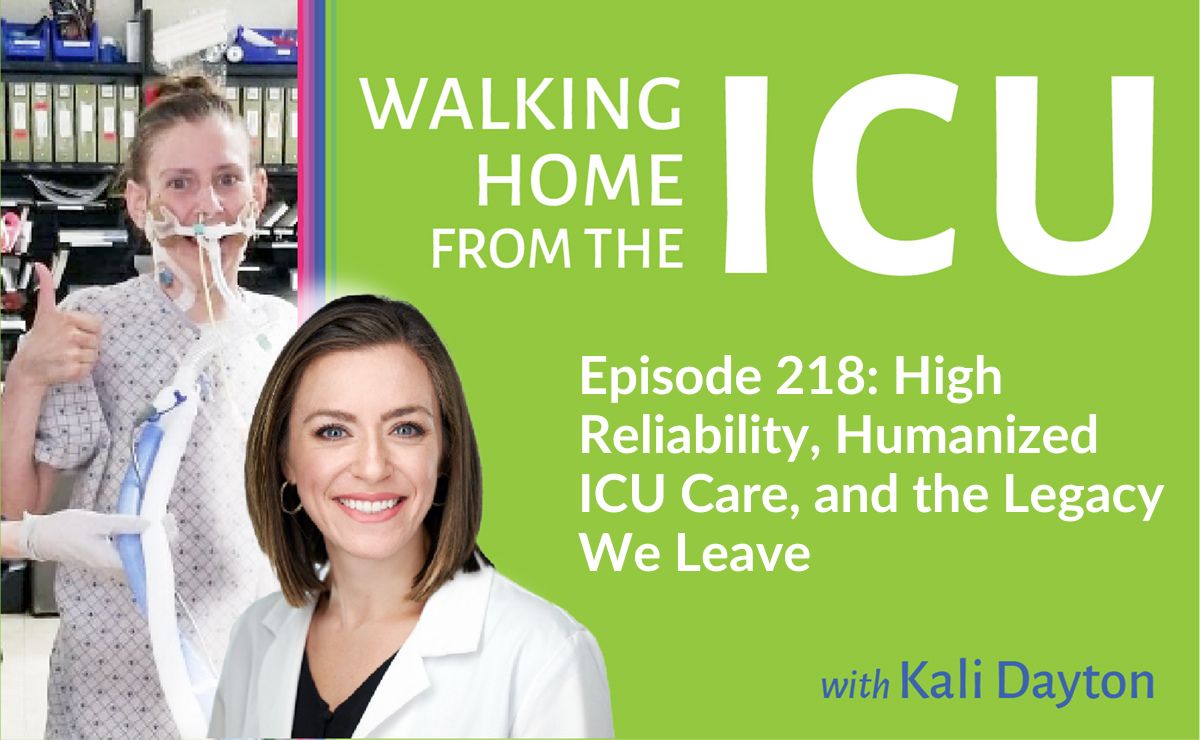
In this episode, Kali interviews patient safety expert Alan Bennett. Alan shares how his work in safety and mobility initiatives directly influenced Nate’s care, highlighting the lasting impact clinicians can have on patients and families. Listen in as they discuss interdisciplinary teamwork, family involvement, delirium, early psychiatric assessment, and compassionate end-of-life care.
Episode Transcription
[00:00:00] This is the Walking Home From the ICU podcast. I’m Kali Dayton, a nurse practitioner and ICU consultant. I help teams create awake and walking ICUs through evidence-based sedation and mobility practices. By hearing from survivors, clinicians, and researchers, we’ll explore how to give ICU patients the best chance to walk out of the ICU and go home to survive and thrive.[00:00:30]
Welcome to the ICU [00:01:00] revolution.
Throughout my consulting journey, I’ve been learning about building environments of high reliability within the ICU, a topic that would immediately have me checked out like ten years ago, but now this consumes much of my waking moments. High reliability environments create layers of safety for patients and can relieve the burden of protecting patients from delirium to ICU-acquired weakness from those [00:01:30] lone revolutionists.
Every member of the team should be able to show up for their shift, receive their assignment, and enter into a process of care in which the care provided by colleagues during the shifts prior were safe, evidence-based, and focused on helping patients survive and thrive rather than checking boxes during their shift.
This would minimize the challenge of being the first one to truly do an awakening trial after days of sedation and delirium, [00:02:00] being the first to mobilize after days to weeks of bed rest, or the first to really care about delirium after patients have been deep in the delirium abyss all weekend.
As we create high reliability environments in which awake and mobile and humanized care is the norm, we transform lives for generations to come. The impact of your revolutionary efforts may even circle back to your own world, life, and family, as it truly could be any of us in that ICU [00:02:30] room as a patient or loved one at any time.
I’ve had the honor of brushing shoulders with a high reliability expert, Alan Bennett. In this episode, he shares with us his career’s work and how this eventually played into his life’s darkest and most painful moments. This episode comes with a trigger warning as it touches on topics of self-harm and suicide.
I know this topic is hard for most of us in many different ways, but if you safely can, please listen to [00:03:00] Alan as his message is so important, insightful, and even healing for those of us that have faced these situations in our careers, families, and even personal lives.
Audio Only – All Participants: Alan, thank you so much for coming to the podcast. Can you introduce yourself to us? Yeah, Kali, good to see you. My name is Alan Bennett. I’m the son of a son of an engineer. My mom was a nurse.
My dad was a rocket scientist. So often in healthcare when we do certain things, we say, “This is not [00:03:30] rocket science,” and I know what that looks like, and most of the work is actually not as complicated, which doesn’t mean that it’s not hard, though. I’m a father of two, a person of faith. I’ve been in Virginia my whole life, kinda homegrown Virginia guy.
And I used to say my career objective had to do with certain impacts and things like that, and now I’ve simplified that. Basically, reducing human suffering and im- proving the quality of people’s lives using [00:04:00] high reliability principles that are built to last, and then with that in mind, leave, leaving a legacy behind that, that lasts.
So in a nutshell, that’s who I am. I’m getting married in the fall as well, so I’m looking forward to that. Congrats. Appreciate that. Yeah, you’ve had a really a full few years. So you’ve been working for Press Ganey, working in high reliability environments- … focused on healthcare, and then you had a very personal and real experience- [00:04:30] in those very same systems. Do you mind telling us about your journey in the ICU? Yeah. I’d say it, I… it transformed me as a human, a pers- a, personally and professionally. My background in the automotive industry, I felt like I was making an impact protecting customers from harm that could be caused based on the vehicles they were driving, and then moved into healthcare.
And so for about a decade was the initial patient safety director, and then workforce safety executive for a health system on the [00:05:00] East Coast. I left there in 2019 and joined Press Ganey Consulting. And I had a, I think looking back, I feel like I accomplished a lot. Sometimes you don’t realize how much you’ve done until you just stop and reflect for a minute, so I would encourage everybody to do that, ’cause you’d be surprised how much you actually have gotten done in your work.
But my son attempted to take his own life in March of 2025, and I say attempted ’cause he jumped off of the top story of our house. [00:05:30] He fell victim to a mental health crisis that caught us all really off guard. He seemingly, he had everything that, that life would have to offer. He’s 25. He was an athlete at Virginia Tech.
Practicing architect, a thriving architecture career ahead, had a wonderful partner that they probably were gonna get married not too far down the road. Strong person of faith. Seemingly had everything that life could- imagine, singer-songwriter, guitar player publicly was [00:06:00] really prolific. And, I think that when people have suicidal ideation, sometimes they don’t really want to take their own life.
They just want certain things to end. And so for him, it wasn’t as simple as an attempt because he lived 52 days in the ICU. So He was found on the ground behind our house quickly enough, because I felt like something was brewing, but long story short we got to him quickly enough. Four pints of blood on the way to the hospital and basically were [00:06:30] able to stabilize him enough to go through spine surgery because he was then paralyzed from his chest down.
52 days in the ICU, surgical ICU. He eventually passed away April 30th of 2025. We went in and there was snow on the ground and we came out, the cherry trees were blooming. We missed an entire season. But the impact that he had on all of the people surrounding him was unfathomable.
I feel like tragically I know him better now [00:07:00] than I did when he was alive because so many stories are being told that, I think him in his humility he didn’t tell because it felt like it would have been bragging in a way. He was so humble. But, 52 days in the ICU and we covered every one of those shifts, 104 12-hour shifts in the process of that.
You get to know healthcare really well. And so I got to see it from the, I guess from the other side of the bed. You would say in the large regional medical [00:07:30] center wh- that was part of the system where I was an executive in the corporate office, so this regional medical center, I knew so many people that one thing I got to see was the result of a lot of the projects.
The PI initiatives and the RCAs that I’d worked on directly impacted my son’s care. In this hospital we had a rash of pneumothoraxes, probably 2017. And a case I worked on trying to address that, we wound up implementing the CorTrac imaging guided system for [00:08:00] feeding tube insertions.
So the imaging guided system, you could see where the tip of the feeding tube is located so you could avoid pneumothoraxes. And then to see my son, Nate, being the recipient of the CorTrac system blew my mind. And then for him, moving, repositioning for somebody who has that level of paralysis, high risk of pressure injuries in the ICU, right?
So that moving, repositioning is critical. But the patient healing and mobility project that I led for the health [00:08:30] system he was the recipient of the Maxi Slides and the inflatable boots to keep the pressure injuries off of his heels. The wedges, the, the cardiac chair became his ticket to get out of bed trying to do rehab.
The first time he was able to get outside was in that cardiac chair, and that was about six weeks in. And in his final days, the last four or five days where he was in a hospice- taking him out to the courtyard ’cause now it’s sunny and nice in that cardiac chair with that feeding tube and other things that, [00:09:00] that I’d worked on w- say it was heartwarming or overwhelming is an understatement.
I had no idea the legacy that, that I would be leaving that impacted my son that someday I would say, eight years after I left that health system I had no idea the legacy I was leaving. And that’s a message for everybody that is involved in care clinically or otherwise, is that the legacy that you leave is gonna one day impact somebody that you love very much that’s in that, that’s in that bed.
You probably just don’t know it yet, [00:09:30] but eventually the work that you’re doing is gonna leave that legacy Yeah, I think something that I hear with revolutionists a lot is that we all have this sense of sobriety that it could be any of us or any of our loved ones in that bed, and that the changes that we advocate for, that we’re bringing to the system, could easily come right back to us.
Or by not engaging in the revolution, we could all fall victim to it. And I feel [00:10:00] like in so many ways, healthcare workers already fall victim to what Dr. Ely calls this delirium factory and this dehumanization of medicine. How did … what kind of things helped you as a family member during that really
There aren’t words that I could even pick to probably capture how, I- I want to say dynamic, like how hard, how sacred, how soul-wrenching that whole experience was. And [00:10:30] whenever someone like your son is under our care, we all feel it. That is hallowed ground in that room. We all see ourselves in that patient or in you as a father at the bedside.
So what kind of things helped you during your journey that the healthcare workers did? I was part of the team. And, and I initially, I think the a little bit of the buzz on the unit a couple of days in, the trauma surgeon caught up with me and [00:11:00] he said, “Hey, I know you go way back here. You’re friends with the CEO.”
And the, the executives from the health system heard that we were there and would make the rounds and check in with me, and so there was a bit of a buzz that I was a VIP family member. And the, depending, that could be helpful and that could be a hindrance. And in this case, it was not helpful ultimately because the trauma surgeon said, “You have to be careful because the nurses know that you’re the, you’re a VIP, well-connected person.
[00:11:30] And just as a heads-up, you want to make sure that they’re not getting apprehensive arou- when you’re around.” Because, again, 104 12-hour shifts, we were there every day. I spent the night almost every night on the couch in that ICU room. And so for me your worst nightmare is that the nurses on the unit are walking on eggshells, second-guessing, apprehensive.
I wanted them to practice care with confidence and competence and not question themselves or am I watching over their shoulder. And so because I [00:12:00] was the loving dad at the bedside, I was there at the bedside quite often. And so the safe word with the, the staff there was boogie. If I’m in the way, say boogie and I’ll get back, I’ll boogie my way back to the couch, ’cause the last thing I want to do is get in the way.
And so I bent over backwards not to be the VIP guy but to be a, an observant and engaged father. And so that’s the path that I took. It wasn’t that I was a, I was representing a health system, and I think that’s a tricky thing, when you are that, [00:12:30] and I think, sometimes the decision when we’re in a health s- he- healthcare, do you wear your badge or not?
And I would say probably the recommendation would be not to. Now, e- every now and then, you have, you might have to play that card, but I think to be a m- a member of the team and not have some kind of power distance, you have to be careful there that… one of the most powerful things I observed, and I tell this story now around, around healthcare if I’m feeling sturdy, if I’m feeling sturdy enough to tell the story.
The interdis- in [00:13:00] the interdisciplinary unit care rounds, IPOC is easier to say. The IPOC rounds would come around between 8:30 and 9:00 every day, and you could tell when they were moving because there’s a little bit of an energy. And I would meet them at the door to my son’s room, and the trauma surgeon would kick off by saying, for example, “Nurse Caroline, you’re the boss.
Tell us what’s going on with patient Nate in the last 24 hours.” And that wa- that I cannot ex- I cannot express how powerful that [00:13:30] is when the trauma surgeon who is the head of the, the unit says that to a nurse, how empowering that is to that nurse. It just squashes the power distance and authority gradient.
“Nurse Caroline, you’re the boss. Tell me about our patient, Nate.” There’s a team there, and it’s not like I see in many health systems where the physician’s making the rounds and debrief at the nurse’s station So they would they would dialogue back and forth. He had pharmacy there, a nurse practitioner, at least one if not two.
[00:14:00] He had dietary was often there. Depending on the need, the social worker was there. But he had a cohort of people and then someone taking notes in the EMR dialoguing back and forth brainstorming, “Hey, we want to make sure that he is alert enough to try to do some physical therapy today.
What are the medications he’s on that might be sedating?” And they would have this dialogue in front of me, and eventually they would come around to me and say, they would say, “Hey, Dad, what questions do you have?” And I would be able [00:14:30] to participate in their IPOC huddle. And I remember one day in particular, I noticed that his trach tube in order to m- make, help with progression and get him accepted into rehab, they went from a size nine to a size seven trach, and his stoma around the, the trach tube didn’t seal after s- after several days.
And you know how that should work is that you, it should seal up very quickly, and to me that was a red flag. Little did I know the dietician had already been [00:15:00] analyzing that. But I said, “Hey, I think, tissue health is nutrition based, for these kinds of patients in the ICU.
Are we doing everything that we can for his nutrition?” And the dietician said, “I know. That’s really m- that’s really upsetting me. I’m very competitive, and I can’t figure out what’s going on there. We’ve been trying different things.” And she said, “I’m gonna call the Shepherd Center in Atlanta,” which is a world-class spine center, “and see what advice they may have.”
And so the next morning at the huddle, they were able to debrief with [00:15:30] me. She held up a bag of nutrition that was like 3,500 calories and 400 grams of protein. They had overnighted it from the Shepherd Center. They were gonna try to get Nate’s nutrition up to get his tissue healing better. In- inputs and outputs and all of that can be very complicated, but he had lost a ton of weight.
He went in super fit, and I think that’s probably why he lasted so long is his heart literally outlived his body as he stopped healing. One of the things you worry about in the ICU is [00:16:00] succumbing to secondary conditions, but the fact that they were able to pull me in, I never felt bothersome asking questions.
Y- s- little things I was picking up on, like some people with his inflatable boots, there’s a little kickstand that comes out- To keep your feet upright. And some of the nurses knew that and some did not, because that’s a PT function. Those are the experts. And so if you don’t put the kickstands out on the base of the heel boot, the boot [00:16:30] there your feet can tilt over.
And so you don’t want in there for too long because then it’s going to be an act of therapy to right them back up again. And so I … The nurses had no issue with me saying, “Hey can I show you this little kickstand thingy? Do you know about that?” And some of them did, some of them didn’t. But I never felt like I was being intrusive.
The receptiveness was unimaginable. When I left there eight years before, to be candid, I didn’t think that was possible. The power distance, the authority gradient, which was [00:17:00] nonexistent, the continued use of the patient healing and mobility program, the devices and all of that I think when I left in 2019, I would’ve said 50/50 chance at best that would’ve continued and they had taken it to the next level.
But for me, I guess bottom line is that I was an active member of the care team, and that, that was unexpected. And I actually include this in part of the definition of an awake and walking ICU. That, yes, we don’t give sedation unless there’s a reason to, [00:17:30] patients are doing their highest level of mobility, and families are part of the team.
Yeah. So they let you stay overnight, which I always mention that too- … is that there are no visitation restrictions that- That’s not often the case. It depends on the situation. But I think for Nate they did allow some others as well. So I noticed that it wasn’t just me, because that was a question that I had.
I did wind up with a fantastic room that had a couch. It just so happened that I started off in one room and they [00:18:00] saw the intent of us wanting to stay, and so when that other room became available, they moved us over into a better room. But others were allowed as well. Probably, I would say it might depend a little bit, but I was not the only one.
And I kn- I was ob- I was observing. I was not als- I was also not the only family member that was allowed to participate in the IPOC rounds because that, you want your family member to be treated like a VIP, but you also want every patient to be treated like a VIP. My son was in the bed, [00:18:30] but every, every other patient in the ICU was a father, mother, sister, brother, son, or daughter.
And so what I was able to observe is that, that care was equivalent Across the board, so I felt very fortunate. I think if we had, if we’d had some, I don’t know, some flare-ups or something behaviorally, that probably would’ve, frowned upon us spending the night. But I think overall, I’d like to think that we were helpful and advocates, it’s complicated when [00:19:00] you’re there for so long, and initially it was trying to s- get stabilized so that he could survive the spine surgery, which was a major undertaking, and then after that he was on some pretty hard-hitting medications. He eventually had to get put back under with vecuronium and versed, the paralytic, and so when he came off of that, he had delirium, and so he was pulling at his lines. And so I think that they were accepting of all the help that we could provide, ’cause like during the night, [00:19:30] you have a sitter. It can be really complicated with sitters. A sitter might come in thinking, depending on how well they’re prepared, they might be coming in thinking, “I’m gonna be hanging back to make sure they don’t fall,” not realizing that, oh wow, this is somebody’s picking at his lines with delirium.
They’re literally hallucinating. And so it’s a, a completely different level of responsiveness on behalf of the sitter. And so the fact that we were there, I think I appreciated every minute. And what was it like for [00:20:00] you to have your own son going through delirium? What did you know of delirium, and what was that experience to live it with your son?
When I was there in the health system, I worked very closely with the geriatrician, who was the service line chief for long-term care, Dr. Kyle Allen, who is now, I think, back up at Summa in Ohio. And he and I worked together on rolling out some delirium prevention protocols. And so I think the research would say, based on the work that he had done, that about [00:20:30] 30% of delirium is preventable.
And so the… You have precipitating factors. It could be urin- urinary tract infections, so fevers and things like that, changes in, in meds and locations. These can all induce that. And so of course Nate d- he didn’t have a UTI, but he had every other precipitating factor for delirium. So in my mind, I knew pretty quickly that he was gonna be at risk of that.
And when he started the hallucinating, waving his hands in the air and l- staring off, He’s non-verbal at [00:21:00] this point but, when your grandmother has a UTI and she goes into the ICU, and all of a sudden now she sees bugs on the wall or saying things that are hallucinating, that’s delirium.
And if you can recognize it, you can get ahead of it a little bit. So when it happened, I… Again, a lot of it is not preventable, but when you understand it better, you have a different level of empathy. So it’s tough, he wound up in the mittens, so you couldn’t get ahold of his lines, but he doesn’t know what he’s doing.
And so I think [00:21:30] having the patience when you understand what he’s going through, the patience that he’s not doing this on purpose, this is a condition, then you can have pat- patience with a C, and, you obviously were more prepared to understand and navigate delirium interventions and having that patience and empathy.
How would you- I suggest, coming from also a higher liability background Can ICU [00:22:00] teams standardize getting family members up to date as far as educated, understanding how to prevent and how to intervene on delirium, their role, and even at some point what the long-term repercussions of that delirium might be?
How do we standardize that? It’s a tough one, because I think the family member wants them to be comfortable. But we, when you’re thinking of like medications, Precedex and Versed and Valium or morphine or whatever that might [00:22:30] calm them down or- Or make it look like they’re calmed down.
But their mind- Chemically restrain them … chemically restrained, and their mind is still racing. And so my son, when he first got there, he could write on a little whiteboard, and one of the unexpected things is that my mother, his grandmother w- they were very close because my son Nate used to go to their house every Sunday at Virginia Tech.
And a lot of the times he would run from campus to their house, which was like 10 miles. So he [00:23:00] would run the 10 miles, and my mom and dad would bring him back, but every Sunday, probably 150 times, he would go there. But my mother developed Parkinson’s and m- myasthenia gravis, and so she became non-verbal.
And so they they were able to FaceTime, writing on their little whiteboard, sharing the whiteboards back and forth “I love you,” and stuff like that. And so it was this- Oh, my gosh … absolutely precious. And then my mom passed away in August, soon after my, my son. But the, the [00:23:30] temptation to want them to be, to appear comfortable and not be anxious or in pain can work against you ultimately in terms of mobility and pressure ulcer, and moving, repositioning.
And so the family member might think, “Can we give him more for his pain? He looks anxious. He looks like he’s uncomfortable,” not realizing that might delay his phys- his rehab, which ultimately could, we could pay a high price for that. So early mobility [00:24:00] is critical, the balance between comfort and mobility.
And then Nate, once he saw the cardiac chair, what he wa- what he was able to use that to get out of the bed, he wanted the cardiac chair over and over again. But I would have to guess. I’d have to get out the letter board and point, and then he could give me an eyebrow. And it was C-H-A, okay, chair, cardiac chair.
You want out. And so they would sit him up, and of course, because he’s paralyzed from the chest down, [00:24:30] and I think ultimately probably four, four or five vertebrae, a little too high paralysis. It was just too much for him. But he- they’d sit him up and he would do his best to stabilize, and they could get him in a cardiac chair.
But ultimately he just wasn’t quite capable of doing that. But the sedation would work directly against that activity So I think for me, and I know I’m giving you long-winded answers. They’re probably not as scripted as I could be, but I think the balance between the family’s heartfelt [00:25:00] need for comfort and pain management versus the, the recovery, the balance with mobility versus sedation is a really tenuous trade-off.
But you actually, you captured one of the very important roles of a family member in this kind of scenario in which you sat there with your letter board. You figured out how he responded to confirm the letter- … that would help guide finding the answers and what he actually wanted as he was getting [00:25:30] worked up, anxious.
Yeah. He needed something, and you had all the time in the day – … to sit there and troubleshoot it with him, and you found a way to do that, and you were given tools, like a letter board. That’s, communication is so challenging for these patients that are non-verbal, and someone like him, where now he does not have the upper body coordination or strength- Yeah
or capacity to write text. It happens very quickly under sedation on top of a primary neurological injury. And so that [00:26:00] is such an important role for the families to help the patient communicate and articulate their needs. Did the nurses walk you through that, or was that your instinct? It was a combination of things.
So I’d gotten my mother the little dry erase board, like a year before this. So I had the dry erase board idea in mind. I didn’t know about the letter board and the way that we could use those together because initially Nate was able to write on the board. As an [00:26:30] architect, his penmanship was ne- next level, as you can imagine.
… That declined pretty quickly. When he ultimately crashed and he was full-blown on the ventilator and he almost didn’t make it. Sorry, my, my dogs are doing Gladiator in the back. He wound up being re-intubated. And as you probably know statistically in the ICU, I think it’s like maybe 20, 20%, maybe 18% of patients get re-intubated.
That’s [00:27:00] not good. If you’re to the point where you’re that vulnerable that you’re re-intubated, it’s a game of probabilities, and so I knew that, that was, that he was in trouble when he got re-intubated, and then that’s when the the vecuronium kicked in, is they had to basically chemically induce coma.
One aspect of that, or I guess timing window, is that while he was on the paralytics for eight days- His younger brother was, got married, and so that was two weeks [00:27:30] after Nate was in the ICU, and Nate was supposed to be his younger brother’s best man in the wedding, and so the, it was layers and layers of things.
So basically the Friday, it might have been, I think March 15th or something like that, went from the ICU to the rehearsal dinner location. We had to host that, and then back to the ICU, and then then the following day to the wedding, which was about 90 minutes away in the Outer Banks of North Carolina and stuff.
And so the, the back and forth kind of stuff. But when he came [00:28:00] off of the the paralytics and now had seps- not sepsis. Goodness that’s one thing he didn’t have. The the delirium, he could no longer write, and that’s when the, the letter board became key. And he could… ’cause he had tremors to the point where, and then tremors and I think Precedex, if I’m not mistaken, was the was the medication we were on for that.
But again, the balance between controlling one thing versus creating an unintended consequence of [00:28:30] impacting rehab or getting the Passy Muir valve to work, and try to do speech therapy. All of these trade-offs, it was- It’s like we want him to be calm, and that calm usually is defined by a RASS zero or lower, preferably lower for many nurses.
But then you have this, all this conflict, and it creates all these challenges to communication. Yeah. And then if you’re not there and now he’s [00:29:00] getting worked up and he wants to say something, and that’s a huge challenge. It’s, nurses don’t have the time, and maybe not oftentimes the skill to go through a letter board and figure out did you raise your eyebrows, did you not?
Yeah. And then as he gets more panicked, then the Precedex goes up. And now- Yeah … PT and OT come in to work with him, and now he’s too sedated. It’s a constant, and this is, really captures a very common scenario of we are masking their needs with sedation, and therefore [00:29:30] send, sending them on a different trajectory.
So the role that you played in, when you were there, giving him access to communication was imperative. And what did it mean to you? I’m sure you were- humbly aware that him being alive at that point was a miracle- Yeah … that nothing was guaranteed. So being able to communicate with him, what did that mean to you now looking back?
[00:30:00] They, I would say two things. One is they joined us in the journey of faith and optimism. They knew that we were a faith-based family, and that Nate was an incredibly strong Christian, and he had a Bible verse that I wrote up on the whiteboard, and it’s Jeremiah 29:11 which now I have one tattoo on my chest, and it’s Nate and his guitar and that Bible verse.
But they j- they joined us in that. And that help- that helped a lot. They were very patient. And I would say [00:30:30] they were always probably four or five days ahead of us, seeing… They could see what was coming before… They could see the peaks and valleys before we could. And when they saw maybe gloom, they were more just quiet.
They didn’t try to discourage our optimism and faith, and we had a couple of huddles to talk about that “What are you seeing that I’m not? Because I’m seeing these positive signs, and I just get the sense, the pink elephant in the room, [00:31:00] is that you’re more worried than I think we as a family are.”
And- They were so skilled in those conversations. And a lot of the nursing staff were early mid-20s. They were the same age as, as my son Nate there in the bed. It was m- mind-blowingly competent for young people. As you get older, it’s like, gives me… it’s encouraging that we were able to do as much a- of that kind of faith-based approach to it as we [00:31:30] wanted to without any encumbrance from them.
And I know I’m forgetting your question. Remind me again what your question was. I would like to answer it. Oh, just knowing that faith is so important, ’cause that’s something we always need to respect more, and just the value of communication. ‘Cause I always say these patients are in their most- Yeah
vulnerable, critical, and potentially final- … moments of their lives. So looking back, those were his final moments. I- And easily he could have been without a way to communicate. So what… he was- [00:32:00] Yeah, so- … communicating. He was telling his grandmother how much he loved her. Yeah. He would find a way for them to connect, to communicate.
Yeah, he wore a- How has their communication impacted his journey? He wore a bracelet. He wore a bracelet that I’d given to him. I’d given him a bracelet on Father’s Day one time that had an inscription on a Bible verse on the back of it, and so he wore that until he got to the ICU, and I d- I had to eventually we had to take it off.
And then when he passed, I gave that to my grandmother. To my mother. And so he wore n- she wore Nate’s bracelet before she [00:32:30] passed, and then I got it back, come full circle. But, the beauty part about him being coherent eventually, because they did continue to give him psych- psychotherapy and try to get to a diagnosis.
They were eventually able to… So it was doc on a stick, the psychiatrist rolling down the hallway with a psych tech and, The psychiatrist was going into his room on the screen, right? And he said, “Hey, hold on a second. Is that Dad?” And I said, “Oh, yeah, are you the, [00:33:00] the psychiatrist who are gonna be taking care of Nate?”
He goes, “Yeah. Do you do you mind if I talk to you before I see Nate?” And I said, “I would love to tell you the story because right now we’re looking for a clear diagnosis.” This is about four days in probably, and been a bit of a challenge because he was non-verbal. And so I think that’s seen as a deterrent to getting a good diagnosis.
If he can’t communicate to tell you what he’s thinking, then he– you can’t tell does he have intent, suicidal ideations, harm to self and others, and all that. And so I spent about [00:33:30] an hour with a psychiatrist and left there with a diagnosis, bipolar type 1 with manic episodes. And so immediately had a medication therapy plan.
And so two weeks in after– from that point, you could see a- almost like Nate, like almost like his lights come on, like the spark back in his eyes as he’s gaining clarity. And so one of his… In reading his journals one of the, root causes of his suicide attempt [00:34:00] was feeling like he’s lo- he had lost connection with God.
He could no longer hear God’s voice, and for him that was a crisis of faith. And, so once I could see this clarity, we were able to fill him with love and remind him that he’s already earned God’s love. It’s something that is there by grace, and faith are you saved, and so I think being able to fill him full of love and reassure him that his faith was intact, we were able to give that gift back to [00:34:30] him, the gift that he gave to the world.
He was known as the encourager and a, a ray of light in every room that he entered. And so that was the way his friends thought of him, as the encourager, non-judgmental guide. So we’re able to give that love back to him, and so he’s able to pass away knowing that his faith was intact. So they continue to give him the psych, the, the psych diagnosis and the medications needed to help him right the ship.
So [00:35:00] he had several paths of recovery, mental health as well as physical. So that was a huge part of it. I think if it wasn’t for that, the, the story would be different. If he had passed away when he hit the ground at minute number one, the legacy would be different.
The– or my understanding of the legacy. I wouldn’t have known about that. I wouldn’t have known that the things that we worked on together in that health system actually had survived and thrived. I wouldn’t have known any of that. And so I think [00:35:30] the, the mul- multiplying factor here is that now I know the legacy, and it changes the way that I see the work and the way that I communicate.
And so when I’m working with clients now across the country in health systems, like every week I’m talking about safety events or high reliability work and root cause analysis or process improvement, the message is completely different. It’s you’re leaving a legacy, so stay connected to the work. M- Try to regain your meaning and purpose, because the work you’re doing is not just for [00:36:00] that person in the bed, because that is also somebody’s loved one.
But your love- your loved ones one day are gonna be affected by the care and the work that you’re doing right now. So it’s changed, completely changed the way that I see the work. And this story reminds me of what Dr. Ely says. He quotes Humanizar Lucy is a movement in Spain called Humanize the ICU, but they say, “Every person is a world.”
And so it [00:36:30] easily could have– your son could have been seen as a neurological injury. Oh, the SCI patient. Instead, they saw him as a human. So I think even having psychiatry consulting four days into that admission is so commendable. To be saying, “Yes, he’s got a spinal cord injury. He’s got surgery.
We’ve got all these things. He’s on a ventilator, all these things. But [00:37:00] also his mental health is life-threatening.” That is critical. We need to care for him emotionally, spiritually. We need to care for his family, giving you a way to communicate with him and work through those things during those pivotal moments that end up being final moments.
It just could have been so different. And yes, we always want the outcome of people going home, going on to live their lives. That’s the outcome that we want, that we pray for.
Sorry. [00:37:30] No, it’s fine. Sometimes the miracles that are the biggest in the ICU- Yeah … is the healing and the peace that can come even when the outcomes are not what we as a team or as a family want. And sometimes we as clinicians can get in the way of those opportunities with antiquated practices, but focusing on humanizing the care, allowing dad to be in the room, stay the [00:38:00] night, giving those tools for communication, focusing on the whole picture, not just the primary diagnosis, that can transform your life as a surviving family member for years to come Absolutely.
He let us play light instrumental music. I hung a Bluetooth speaker from his IV pole And I could play that from my iPad over by the couch. And that was something that we had to monitor, making sure that wasn’t [00:38:30] getting in the way as well. When he went onto hospic- hosp- when they took him off the ventilator, he, they anticipated that he was gonna pass away within a couple of hours, and they all said, “Yes, just like Nate to now live five days off of life support.”
And it makes you wonder is this the right thing to do? If he’s this strong, but, literally he was actively passing away. But we were able to get him out in the c- into the courtyard where it was now springtime, and it was [00:39:00] beautiful, and there’s a time where being out there, there was a couple of doves that landed three feet from him, and we were watching, and his girlfriend was also an excellent guitar player. That’s how they met. Nate and Nate and Eaton met at, in church, and they were they were leading the service with their guitars, and that was their common bond. So she was playing and singing songs that they had written together, and that was all enabled by the staff there the charge nurse and PT helping get Nate out into the courtyard to get some [00:39:30] sun before he passed away.
This is like next level stuff. They got to know him so and the family that a big cadre of them came to his ceremony of life in June to honor his life. His company gave him a lifetime achievement award. They read something and said, “Nate you’ve done more in your life than most people do.”
It was precious. But I don’t feel like they did that just for us. It was so genuine, the environmental services worker there, Sean [00:40:00] was a ray of light. Got to know him really well, and I’m the godfather of his grand- grandbaby. Wow. So that’s also part of the legacy, it’s like Nate’s living on through these experiences and relationships that still last, and, I thought about high l- liability of protocols, guidelines, things like that, right? Which are part of it. But you were describing an environment which every patient matters. [00:40:30] It’s not just, “Oh, Alan Bennett’s here. He’s with Press Ganey. He did all these things, and we gotta put on our best behavior.”
Yeah. This is who they are as a clinician. They treat every patient that way. I worked in such an environment. I remember, Yeah, I remember you saying that. Yeah, I had a… I just, I’m thinking of a patient that was unhoused, had lots of psychiatric stuff. She had breast cancer but refused treatment, and so just her whole chest cavity was tumorized.[00:41:00]
And hospice came to get her, and she started to pass at that time. And and this is early on in my career. I think I was, like, 22 at the time. And still remember it so clearly of just saying, “Go away. We’ll- I’ll take care of her.” And I had her on my lap, and I sat there in the bed, because there was no family, no one, and sang to her while she died.
And I look back at that, because I was so uncalloused, but I think I’ve worked in so many different environments now [00:41:30] where that wasn’t the norm. There wasn’t the high reliability of this person who… A- and she was awful to the staff. You would try to take her blood pressure, and she would bite you. She would throw- things at you, right? She was that person. But in that moment, it didn’t matter to me. But I w- I worked an environment where we still saw her as a daughter of somebody. Somebody- Yeah … loved her along the way, and she’s worth loving. And so as we humanize the entire environment, every patient does matter.
And we find those opportunities, and that’s what [00:42:00] fills our cups, even and especially- cared for a patient like y- like your son it is it’s so enriching but also so hard. That’s something that’s… he, they carry him with them- Yeah … throughout their entire rest of their career, and it could become a very heartbreaking negative thing that causes moral injury and burnout and heartbreak for years to come.
Or then the scenario and the interventions they [00:42:30] did to be in the courtyard with the guitar playing, that could also be so healing for us as clinicians to say, “That was not- … I showed up today to save a life- … and I did something very different,” but it was just as important. Making those final moments matter.
It was it was un- unbelievable. I’m sure therapeutic for everyone just to feel the, the heartfelt moments and care. I think there’s research now that suggests that [00:43:00] not depersonalizing, that’s the risk you run when you start getting burnout is you depersonalize.
You check out a little bit emotionally because you’re in this survival fight or flight mode, the amygdala hijack, but you’re depersonalizing. There’s some research now that suggests that actually connecting with people’s care and suffering can actually help you stay connected and reconnect to meaning and purpose, and ultimately then fill your bucket.
And, the high reliability aspect of it, definition of high reliability, you look at it [00:43:30] a couple of different ways. It’s zero harm to patients, those who care for them, and your business operations. Another way to look at it is doing the right thing with intention each and every time. And so the effect of it is when you are physically and psychologically safe, and we don’t take those for granted, but when you’re physically and psychologically safe, you’re freed up to give more of an emotional investment based on your belief system.
And so now you have empathy. You’re in the moment. You can be [00:44:00] attentive. You can listen. You can problem solve and get to know your patients as humans rather than the hip and knee in 502. It’s the master gardener who’s been sidelined based on the hip problem that they’ve had. And so when you’re able to do that- reconnect with your empathy, then everything goes through the roof.
And, getting into the metrics that health systems care about, the length of stay, CAUTI, CLABSI, C. diff, MRSA, likelihood to recommend your hospital, all of those [00:44:30] things skyrocket. But it’s the unleashing of your belief system. The barriers are of physical and psychological safety, so high reliability can set the stage to free you up to give your best care, which also reconnects you, coincidentally, to your meaning and purpose.
And so that’s what I saw there, was the teamwork and trust that had developed based on what we’d call the, the virtuous cycle, ’cause everything, every rep makes you stronger. That’s what I witnessed, and high reliability [00:45:00] is that platform that can unleash that. So it seems a little bit new agey and soft and touchy-feely, but it really is based on science and the collaboration and teamwork that you can achieve through it.
You’ve captured so much of my experience as a travel nurse. I came from that kind of environment where every Nate in the bed mattered, right? To being a travel nurse where, yes, there was sedation and immobility, but there were a lot of other [00:45:30] problems, and that’s partially why they had travel nurses, and it was just a lot of the medical management was scary, and I was new, and just running into a lot of situations where I did not feel safe.
And obviously I didn’t like that care, but also I didn’t like who I became. I didn’t like that my focus was just on making sure that everyone just barely stayed alive that shift throughout the unit. It was I couldn’t have those sacred moments anymore, and I was so empty. And I love Rona Adash is an intensivist who [00:46:00] had septic shock, or non- septic shock.
She had she had shock. She was on the po- podcast, and she talks about how giving a part of ourselves as clinicians actually fills us. But what you say is so true. We cannot, we can’t hone into that humanization, those tender things, that humane care if we are so beaten down by a system that just focuses and only allows us to do the documentation and do the tasks.
And barely, we’re barely able to do that. [00:46:30] When we look at safety events in our monstrous Press Ganey database one of the takeaways is that of an individual failure mechanism, how we experience errors as humans critical thinking is the number one type of in- individual error. And what happens is that when you’re in task orientation mode, you’re losing situational awareness and you do- you don’t have a questioning attitude about something doesn’t seem right, it probably isn’t.
Trusting your instincts as a [00:47:00] clinician. And so those rote tasks, just trying to survive the day, work against the quality of care. And so you have to be able to step out of the whirlwind for a moment systematically to reengage with what’s happening. And so better processing of information and getting out of survival mode.
And these are things that if you walk into a unit or a meeting, you can feel if the culture is sideways. You can feel it. It’s like there’s an energy which has [00:47:30] been studied. Not gonna go down that rabbit hole at this point. Some other day maybe but you can tell. So your travel nurse example of if you have a toxic culture where you can’t speak up without fear of repercussion, people with options will exercise them, and your pipeline coming in with recruitment won’t fill the gap created by people…
the exodus out the back. So all things being equal, the- a healthy culture with teamwork and trust and those things that you build within a team that’s [00:48:00] gonna, that’s gonna retain people and provide much better care. And the, the statistics are we have the receipts. So we can see the data I’m always hoping that the teams that I’ve trained track their retention, ’cause my theory is this whole transformation requires us to evaluate and address and fill in the other cracks in the foundation, the gaps, the things that we need to be stable in order to build upon to create an awake and walking ICU.
And as we do that and we improve [00:48:30] teamwork and dynamics and safety and- Yeah … efficiency and all these things, and humanize the care, that people will want to stay, because they will know- We see this, … they are their best clinician in that ICU. It’s so true. There’s a discretionary space on the unit that cannot be filled by technology, and I heard a brilliant speaker last week or the week before.
I- that’s probably my most common phrase this year, is last week or the week before. I don’t know where I am as the days. [00:49:00] I’m in some health system. But he runs an AI company, and he said, “One thing that we haven’t figured out how to do yet is to replicate the nursing workflow using AI. It is too variable.”
He said, “We’re not e- not even in the foreseeable future can we replicate that using AI.” And he said absolutely how reliability is critical, and that was really in- re- reassuring for me, because it’s the reliable human that fills that discretionary space. It can’t be filled by our technology. [00:49:30] It’s like the, if you’re vacuuming your living room, there’s a corner there you can’t get to with a vacuum cleaner.
You need to sweep it out, the schmutz that’s there, and it’s like the role of the, the high reliab- highly reliable human in the ICU. It’s to fill those gaps and those, the variation day to day that can’t be filled by the, the bundles and the technologies. So the role there is is, it’s never gonna go away in my mind.
The high- highly reliable human can’t be automated entirely. My [00:50:00] hope is that these technological advancements help get all the other clutter and barriers that prevent us from doing hands-on, humane, compassionate- Yeah … meaningful care, get those things out of the way so that nurses are freed up to do what really matters and what actually brings value to the patient and to the, the whole team.
That’s what I hope. I, w- no way can technology ever replace nurses, because this is… it requires human touch. [00:50:30] But we can take care of everything else so that the nurses are empowered rather than prevented from providing that kind of care. We hear often we have to hardwire that process. And to me, okay, let’s do that.
But you can’t hardwire humans, but you might be able to heart wire, play on words. Ba-dum-chi, the H-E-A-R-T, because you can hard- heart wire a belief system. And so if they’re caring more based on a belief system that aligns [00:51:00] with the individual mission, vision, values, aligns with the organization, then the leader, you can take a step back and people do the right things for the right reasons.
And that’s how you get the experience that I saw there at that, at the ICU of my f- my former health system. 52 days is a, that’s a large N in terms of sample size, and I can honestly say, and I say this around the country now, I’ve seen what world-class care looks like, because I would not change, I don’t think, one single thing about the care that he [00:51:30] received in 104 12-hour shifts.
I… we’re not looking for perfect care under perfect conditions. We’re looking for care that you would accept as a family member, as a l- for a loved one, and I saw that. And I don’t think I’d change a single thing about it. Nobody, we didn’t get the outcome that we wanted, but I accept it.
And the, the gift that Nate gave the world, we were able to give back to him before he passed because of the care that they provided there, what they let us do as a family member Thank you so [00:52:00] much for sharing Nate’s legacy, Nate’s story, your story, and for all the work that you’re doing to improve higher liability in these environments.
Anything else you would share with the ICU community? Just remember that you’re leaving a legacy, and it hurts when you lose a patient that you’ve gotten to know and that you care for. But your impact is something that you cannot even estimate the value of your impact. And just stay strong and don’t step back from it.
Re- just stay connected to your meaning and purpose [00:52:30] ’cause you are reducing human suffering and improving the quality of lives and of patients and the family members in the community. So hang in there. You’re making a difference. Thank you so much. That means so much coming from a father whose son died in the ICU.
Yeah. That you can say that they really did alleviate suffering. Well- And that’s something that I think ICU clinicians need to hear. So thank you.
[00:53:00] To schedule a consultation for your ICU, as well as find supportive resources such as the free e-book, case studies, episode citations and transcripts, please check out the website [00:53:30] www.daytonicuconsulting.com.
To schedule a consultation for your ICU as well as find supportive resources such as the free ebook, case studies, episodes, citations, and transcripts, please check out the website.
Transcribed by https://otter.ai
SUBSCRIBE TO THE PODCAST

 When patients are so ill that they require a ventilator in the ICU, the antiquated approach of heavy sedation and immobilization should be avoided in order to help prevent the immense burden of physical and cognitive disabilities suffered during survival. To understand this better, listen to Walking Home From The ICU. You will see what ICU consultant Kali Dayton provides to your team.