SUBSCRIBE TO THE PODCAST


Revolution in sedation, delirium, and mobility culture in the ICU requires more than a memo, grand rounds, or a weekend symposium. Leaders who provide minimal support without teaching teams the how and why but expect a drastic change in care and outcomes risk a mutiny. Leadership and implementation strategy can inspire innovation, humanity, and transformation OR can leave clinicians bitter, burned out, and shut down.
Listen to the insights from revolutionist’s concerns about their leaders’ current implementation attempts.
Episode Transcription
[00:00:00]
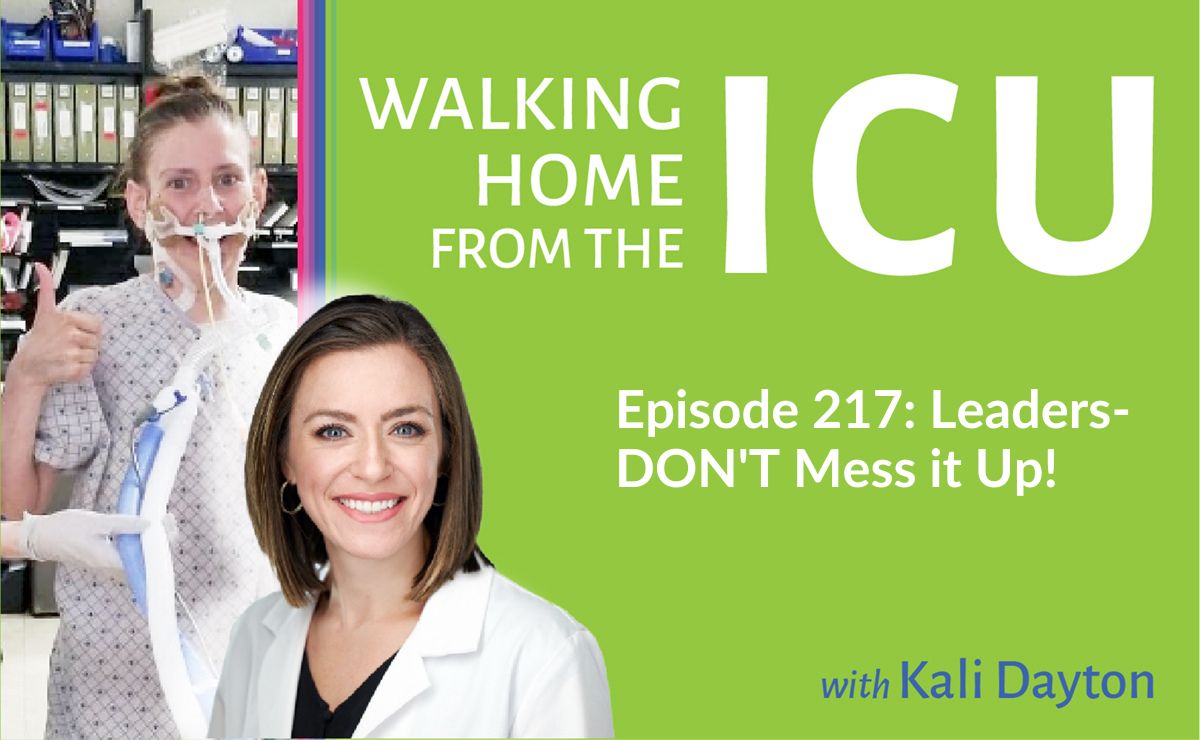
This is the Walking Home From the ICU podcast. I’m Kali Dayton, a nurse practitioner and ICU consultant. I help teams create awake and walking ICUs through evidence-based sedation and mobility practices. By hearing from survivors, clinicians, and researchers, we’ll explore how to give ICU patients the best chance to walk out of the ICU and go home to survive and thrive.
Welcome to the ICU revolution.
Okay, this is an entirely impromptu [00:01:00] episode. Um, you know those moments when you already have way too much to do, and you can’t possibly get it all done, but something comes along that suddenly seems to supersede all other priorities, and you cannot rest until it’s done? This episode is that moment for me today.
I just had a call that really captured so much of what I’ve been thinking, feeling, hearing, and seeing and really musing over the past few years, but especially this year. See, um, I started this podcast and having online conversations in 2020 and then doing presentations on awake and walking ICUs in 2021.
I have seen a shift in awareness and openness when it comes to sedation and mobility management. It– initially it was, “That’s insane, unsafe, not possible, no way,” to now it’s either, “Yeah, we already do that,” when they don’t even [00:02:00] know what that really is supposed to be, or, “Okay, no problem. Yep, let’s do it.
We’ll have you do a grand rounds presentation, and then we’ll launch.” As if it was that easy. Send out a memo, do a day symposium with a few presentations, remind people to chart their CAM and RASS, and it will be done. Certainly, when I started doing virtual grand rounds presentations for teams in 2021, I may have had a similarly oversimplified perspective.
It almost seemed that simple working at the bedside of my awake and walking ICU.
Like it was, just don’t turn sedation on and get them up a little after intubation. I was confident that the biggest gap was that people didn’t know what was possible, but once they knew, they would just jump in and do it. Just because I had worked in an awake and walking ICU for seven years as an RN and NP did not mean that I knew what all went into it, let alone how to create it.[00:03:00]
That culture and expertise had already been established for about 15 years before I entered the scene in 2012. When I started doing consulting was when I realized that awake and walking ICUs are like a jigsaw puzzle that have numerous pieces to it. Many ICUs have a lot of the pieces and are still missing key pieces.
But most ICUs don’t have the front of the box. They’re not sure where to put those pieces and can’t figure out which pieces are missing. This is not a jab at anyone’s capacity or intentions.
I mean, when else is leadership expected to lead such a huge transformation in something they have never done or experienced? How do you navigate that? Historically, the ABCDEF bundle has been done through a train-the-trainer model. When Society of Critical Care Medicine received a large grant to implement the bundle throughout 68 facilities, they brought a few champions from each facility for training at [00:04:00] Vanderbilt and then sent them back to their hospitals to implement what they had just learned.
At this point, I’ve trained 16 teams, and I marvel with admiration at the courage of those champions expected to take practices from automatic deep sedation, often with benzodiazepines to awake and mobile without ever having done or experienced it themselves.
We owe so much to those early pioneers and saw that innumerable lives were saved from the changes they brought.
We also need to recognize that very few teams made it all the way. In the 2019 study from that grant with over 15,000 patients, only 8% of patients received all of the elements of the bundle, and only 12% of them, intubated or not, were standing bearing weight.
Yet they were using less sedation for a shorter duration, leading to less harm and mortality. But were we yet doing the most good? Was automatic sedation and immobility with later [00:05:00] SATs and maybe some eventual mobility easy or fun yet? Then COVID hit, and a lot of that work was scrapped. We lost seasoned clinicians who had experienced those ABCDEF bundle transformations.
Practices regressed to those of the 1990s, and new clinicians learned COVID care and now have been teaching that to the incoming generations. Thanks to revolutionists, there has been a growing awareness of the harms of sedation and immobility, and especially of the financial benefits of the ABCDEF bundle among leadership.
That’s good. There’s growing interest in implementing the bundle, and that’s what we want. But execution is what I want to share some thoughts on. I had an appointment pop up on my calendar with two incredible respiratory therapists, RT A and RT B.
RT B had previously taken a contract as a traveler at Johns Hopkins and had eye-opening experiences that totally changed her perspective on sedation, mobility, and [00:06:00] the RT role in changing patient outcomes. RT A had read some of my articles on LinkedIn and is a total revolutionist and advocate. They’re both entirely bought in.
However, the reason for the call is because their team is suddenly implementing early mobility. Great, right? Except they are concerned about how it is happening and have identified strategies that their leadership is employing that we all agreed run a risk of becoming huge barriers to success.
What they shared I have also seen been attempted and be ineffective in other systems. Now, I recognize my own bias as implementation is now my business and career, so take that with a grain of salt. But at the same time, I’ve now trained sixteen teams. I learned a lot along the way. My perspective and insights are not what they were in 2020 when I was working in the original awake and walking ICU.
I approach this topic as a nurse who has worked in an awake and walking ICU for seven years, [00:07:00] spent two years in 10 other normal ICUs, and now trained 16 ICUs, many of which had already previous implementation attempts. So let’s go through the concerns and what we can learn from them. One is an approach of rapid and superficial implementation.
Let’s talk about what that means starting with rapid. Now, if you’ve heard me speak, you know that I have a lot of reservations about the traditional approach of don’t rock the boat, let’s do one letter of the bundle at a time since this is a bundle and every letter impacts the other letters. Um, it’s like using a VAP bundle and saying we don’t need to sit the head of the bed up because we’re doing oral care.
It doesn’t work that way. You really can’t go so slow that you can’t use the other tools of the bundle. For example, I think it is insane to take sedation off without being able to use mobility since that is a huge part of helping patients with their anxiety, agitation, dyspnea, [00:08:00] claustrophobia, delirium, et cetera.
I think it is really hard to have people awake, strapped to the bed with their backs on the bed for days to weeks. That is so ineffective and you just cannot have patients off of sedation without mobilizing them in one way or another. So I have a problem with going too slow. On the other hand, understanding what all goes into this, we cannot go too fast either.
These RTs said that the early mobility program was being implemented in three weeks. Their executive leadership team wanted to work on this and delegated the task to their director of nursing who was firing it off to their ICU clinicians to figure out. They heard about this in a meeting and then RTA was suddenly pulled into a patient’s room expecting a mock mobility practice only to realize that they had numerous people in the room ready to mobilize the patient with this RT being invited to the room without being a part of the real screening, discussion, and planning.
The patient they chose to initiate mobilization on was [00:09:00] on day six post-craniotomy. He had not been mobilized the entire team, and she said that prior to initiating mobility, he was barely responsive and not visually tracking. Now, I agree that this patient absolutely needed to be mobilized, but the RT felt that this was done a bit haphazardly and that the patient needed an increase in ventilator support prior to and during mobility that either didn’t happen or at least wasn’t discussed and planned for.
The patient became hypotensive and did not tolerate being at the edge of the bed. They ultimately Hoyer’d the patient to the chair. The RTs felt like starting in the neuro ICU, especially with a patient so late in the game without a strategic team-wide planning and approach, this was not a great first attempt.
Now, just because the patient didn’t tolerate it, didn’t fully sit up, stand, or walk, that doesn’t mean that this was a failure. This actually gives a lot of feedback. The patient was on low ventilator support for ten hours that previous day, but [00:10:00] then could not maintain the work of breathing on those settings while sitting up.
This tells us more about the status and strength of their respiratory muscles than a traditional SBT. I personally would struggle to walk by this patient’s room and not be dead set on getting them up, but I can see their concerns. It’s not that mobility shouldn’t be attempted with this patient, but that many steps were needed to be taken before that moment.
They felt there was a significant deficit in key knowledge needed to be successful for this patient. This is where it was feeling superficial. Their leadership is expecting a change in practices without supporting a change in knowledge, beliefs, perspective, workflow, and skills.
Perhaps in the early days of the ABCDEF bundle, the hope was that we could create a streamlined conveyor belt that would work for task robots without requiring critical thinking or variation, that this would create high reliability.
The more I do this, the more I disagree. The ABCDEF [00:11:00] bundle is most successful with high reliability when the team has a deep and high level knowledge and understanding of the why and how. This allows them to customize and therefore optimize care and the utilization of each of the ABCDEF bundle tools for the needs of each patient.
Leadership needs to stop harping on SATs and SBTs when the team still sees sedation as sleep, safe, comfortable, humane, or as Heidi Ingle puts it, the Chardonnay at the end of the day, and therefore essential for every intubated patient. Check out this compilation of thirteen nurses who posted social media videos about their ICU non-negotiables of what they would want if they were intubated.
This does not automatically mean that their patients are getting deep sedation, but my Instagram survey confirmed that eighty-six percent of you felt that personal preference influences the care we provide at the bedside. So here’s what they [00:12:00] said
“I want to be a RASS of minus fucking 30, okay? Propofol 50, fentanyl at 200, PRN, Dannys, norcos, oxydon’ts, the whole lot. Give me everything. Skip the sedation vacation. Patient refuse. I’ll give you a look, you’ll know. Patient refuse the sedation vacation. Keep me knocked out. I don’t want to remember a thing.
I don’t want to hear anyone even utter the word Precedex around me. Don’t do it. Propofol, max it all the way. RASS negative five. Do not under any circumstances wean the propofol. I want to be on a propofol drip, a fentanyl drip, a ketamine drip. Do not use Precedex under any circumstances. Sedate me. Sedate me.
Fentanyl, propofol, I don’t care. Sedate me. Give me propofol and fentanyl and don’t play with me. Please. Give me propofol. Get me fentanyl. Knock me out. Versed, whatever. RASS negative five me. [00:13:00] Dilantin IV ’cause I want it, I want it to be a thing after me. I don’t want to remember nothing. I don’t want to hear nothing.
I don’t want to, I don’t want to wake up. Just, just let me be. Let me have my little vacation. Please don’t let them put me on Precedex and think that’s gonna do something. Snow me. Y’all know what I mean. Snow me. Max me out on the prop as long as my pressures are holding up. I’ve been sleep deprived for a decade so I want to get the best sleep of my life.
Put me on prop, fentanyl, ketamine. Versed, propofol. I want to leave spontaneous awakening trial. Please keep me sedated for, I say the whole entire time I’m intubated. I don’t need, um, SBTs every single day. I don’t want to do weaning trials every day. If I RASS-cle, make it negative five. Prop and fent, need them on board, max out and do not let my lines run dry.
If I am intubated and sedated, I want prop only, fentanyl, no dex. I want to be a RASS of negative three, not like totally snowed, but not [00:14:00] really that arousable either and none of this SAT stuff”
Now, these RTs who are huge mobility advocates felt like their team didn’t really know why they were doing it and therefore didn’t have a consistent knowledge of the tools to critically think through when and how to mobilize patients. This is a sign of consistent error I see in leadership attempts to implement the ABCDEF bundle.
Leaders usually don’t know what they don’t know, which makes it hard to know what their team needs to know to be successful. Here’s my summarized list of knowledge that I think every team– that I think every member of the team needs to have. A history of sedation and immobility, why we are where we are and where we are headed, the risks, repercussions, and reality of sedation and immobility, delirium as acute brain failure, a life-threatening and life-changing organ failure, ICU-acquired weakness as muscle failure, also a life-threatening and life-changing organ failure, [00:15:00] survivors’ experiences during and long after sedation and immobility, why SATs fail, why SBTs fail, and how to troubleshoot them, agitation management, pre-, inter-, and post-intubation strategies, nonverbal communication strategies, actual indications for sedation, actual contraindications to mobility, how to optimize medical management to facilitate successful mobility, the role of gravity in survival and the bed as a microgravity environment, the high risks of bed rest and immobility, the diaphragm and respiratory muscles as vital players in ventilator liberation and survival, what everyone’s role is in sedation, delirium, and mobility management, and the chance to practice it together This three-week quick launch is a testament to the lack of respect for the intricate skills and interdisciplinary teamwork that goes into making mobility happen.
We would never tell a resident physician to watch a YouTube video on chest tube placement and [00:16:00] then expect them to just go do it at the bedside. But we expect that of the team when it comes to mobility. And leaning into that analogy further, most patients have fairly consistent anatomy. It is one clinician placing the chest tube with the same similar procedure each time, right?
But when it comes to sedation, delirium, and mobility management, you now have a million more variables in terms of communication, agitation management, ventilator management, baseline mobility capacity, current mobility capacity and tolerance, and numerous team members playing a part in this important procedure.
But how often do we follow the same educational models as other skills of didactic observation, simulation training, then bedside mentorship and competency checkoff? Instead, we’re treating it like a new IV set or a glidescope, a quick superficial in-service and then the expectation to just go and do it.[00:17:00]
The only similarity in these implementations is that when it does not go well, the end user will be super turned off to the new device or procedure and will run back to what is familiar and what they’ve always done. This is the risk you run with superficial implementation. The RT is worried that this experience with his first attempt would leave a sour taste in their colleagues’ mouths, that they would see it as a failure and be even more hesitant to try it again.
Successful implementation of anything requires accountability. But you cannot hold your team members accountable for what they’ve never learned. If you have not taught them the why, when, and how to take sedation off, don’t talk to them about SATs. If you haven’t taught them the why, when, and how to mobilize patients, you can’t just expect to walk around your unit and see patients sitting in chairs and walking the halls.
If you haven’t taught your team agitation management strategies, then you can’t blame [00:18:00] nurses for delirium when using the only tool in their toolbox, which is sedation. If your team doesn’t know when and how to have patients awake, communicative, and mobile promptly, don’t expect them to turn sedation off of everyone and mobilize a unit full of delirious and weak bodies.
You will have a mutiny on your hands
rTs were anticipating that their team would be better against leadership. Here’s what they said Well, this is how you become the flavor of the week.
Like, that’s the thing is like we really want this to be successful and go somewhere, but the way that we’re going about it, it’s going to die- honestly, like I see mobility as my dream.
Like, that’s what I have been talking about forever and ever and ever. I mean, I have a folder on my desk of ICU mobility, you know, info. Like, I’ve, I’ve wanted us to do this for a really long time, and I just want us to do it right. Like, I don’t… I know that this will die in implementation if it’s not done correctly.
They also didn’t feel that their [00:19:00] team had the tools to really talk about the huge role of ventilator management during mobility, why that patient struggled, and how to plan and anticipate better next time.
They didn’t even feel like leadership was giving them the chance and space to teach their own respiratory therapy colleagues these principles, let alone the rest of the team who also needed to have this knowledge. But we really are gonna have to spearhead all the things of ventilation that as you work in this field, you often forget.
You often forget there’s another way to do this that doesn’t look so bad, that is not so harmful. But I think the reason why we, we really wanted to reach out to you is because we just do not feel like this process is being thought about the right way for success. We- Well- It, it’s been thrown together in three weeks.
I don’t care what anybody, this has been a three-week thing. That’s exactly what’s happened.
This superficial implementation and knowledge gap likely played into the timing that the team was focusing on [00:20:00] initiating mobility.
Here’s what RT B had to say about their team’s focus on patients who seemed like the only good candidates because they seemed perfectly stable they, they’re thinking because this is a patient that won’t be re-intubated and won’t end up on a BiPAP, they’re a good person to walk, where what I’ve been trying to say is, “No, because we’re walking, they won’t be re-intubated, and they won’t be on a BiPAP.”
Mm-hmm. They’re looking at it the reverse- one of the points of this is to prevent them from being re-intubated and going on the BiPAP, to prevent them from having to go to Shepherd’s for four months to rehabilitate their muscles.
I said, “You all are looking for the patient that doesn’t look like they’re gonna be a candidate for this, and this is a tool to prevent them from being a candidate for all of these other complications that involve with being on the vent and getting them off.” That is our biggest thing, is we see so many gaps- in what we’re [00:21:00] doing and the things that we’re doing to contribute to making these patients who are already in a bad situation worse.
this speaks to the next string of concerns, which is the overall strategy for mobility. Without knowing the high risks of sedation and immobility and the true objectives of mobility and having the tools to do a risk versus benefit analysis for each patient, mobility is likely always going to be the back-end cleanup, the rehabilitation afterthought.
Once basal pressures are off, ventilator settings are minimal, preferably after the SBT and hopefully after extubation, then we will mobilize them. Mobility will always be a challenge with this approach. Instead of only looking to mobilize patients as a treatment to delirium and ICU-acquired weakness, leadership needs to help teams apply a strategy of prehabilitation to prevent delirium and ICU-acquired weakness so they can actually experience patients [00:22:00] being awake shortly after intubation, having their cognition and motor skills intact to write or text, and move their own bodies without needing an entire army.
This will require the team to know how to optimize medical management, humanize care, involve the family, high-level agitation, ventilator, pain, withdrawal management, all skills that are not refined when a team is used to the sedation band-aid. You can’t just rip off the band-aid all of a sudden without those tools and skills ready at hand without a total mess.
This has been the flaw of SATs, especially at 5 a.m. It’s not about not giving sedation. It’s about what you do instead. If your team doesn’t know how to provide this care early on as a standard, why are you expecting them to be excited about flopping flaccid bodies to the edge of the bed with five people during their propofol hangover, crane them to the chair just to have them really come out of the propofol fog [00:23:00] and get wiggly in the chair once PT and OT are gone?
This is not a good strategy. This strategy shows a disconnect from leadership to the bedside clinician. This is why they roll their eyes at these initiatives because it’s not practical. It is stressful for clinicians and can be unsafe for patients. It will always be so much easier for everyone to prevent delirium and ICU-acquired weakness rather than treat it after it happens.
Now, we can’t always prevent it, but we will have more bandwidth for the patients that do develop these complications when we have a standard strategy of prehabilitation. Part of the strategy needs to be tools that will help improve the burden on the staff and efficacy. The patient they mentioned, six days post-craniotomy, barely responsive, super weak.
Let’s dive into that. So neuro patients are so important to mobilize, but also a challenging start. Because their primary neurological injuries can cause mobility challenges. [00:24:00] Maybe starting with an MS ICU or trauma ICU would be a better place to start because they’re more likely to be cognitively and physically engaged in traditional mobility, right?
Okay, but let’s talk about a more efficient strategy for this specific patient. I’m going to be general because I wasn’t there and I don’t know the specifics, but in general, this patient probably should have been on a verticalization bed promptly. They likely had intracranial hypertension of some sort, and verticalization therapy would have helped manage their ICPs.
And considering that verticalization therapy decreases medical interventions by fifty percent, maybe they could have prevented a craniotomy. Maybe, right? So if they had the patient on a verticalization bed promptly, they could have been able to drastically prevent or minimize the diaphragm dysfunction and orthostatic hypotension that the patient developed.
They may have been able to address the patient’s disorder of consciousness days before by having the patient be verticalized.
Instead [00:25:00] of having five plus team members in the room, this patient could have been getting gravity, bearing weight, et cetera, with one team member pushing a button early and often on all shifts. Talking to these RTs, said they would much rather verticalize a patient while doing their vent check and pulmonary treatments than spend weeks putting percussive vests on these kind of patients.
Perhaps this patient could have been extubated long before day six, since he had already been on minimal ventilator settings. Maybe he’d have a head start on rehabilitation with more muscle mass and cognitive function preserved, not to mention verticalization tolerance. This kind of strategy is far more effective and efficient than sliding patients to the cardiac chair or hoarding to the recliner.
Examples of other shifts in strategy that I use include setting the expectation of having most patients able to communicate shortly after intubation rather than daily SATs. Focusing more on how patients communicate rather [00:26:00] than the documented RASS level. Sharing the responsibility of agitation prevention and management throughout the team rather than on the shoulders of nurses.
Treating sedation like an antibiotic. When we order it, we need to specify the indication for it. We only order it when it is needed. Using mobility as behavior, agitation, delirium, and ventilator management throughout the team each shift rather than just the twenty minutes with PT and OT five days a week.
Creating PT and OT as separate high-level specialties who are part of the ICU team, not just rotating visitors. Awakening trial should happen when there’s no longer an indication for sedation, which for most patients is after the RSI paralytic wears off two hours after intubation. The RT, RN, and family then work on helping the patient communicate, acclimate to the tube and ventilator, and identify and treat their needs.
So these are examples of the different pieces of the puzzle that really need to come together to create an [00:27:00] awakened walking ICU. If your team has never seen the front of that puzzle box, why are you throwing pieces into their hands and expecting them to know where the pieces go? As a leader, do you know where they go?
Do you know which pieces you have and which ones are missing? When team members have that foundational knowledge, they can use these tools with critical thinking to really ask, “Are we just checking a box, or are we providing benefit to the patient?” Yet when there’s not a shared team-wide knowledge, collaboration, and efficient strategy, and implementation doesn’t go well, then teams chalk this attempt off as another flavor of the week. Leadership will then say of RTs and RNs, “Well, we couldn’t get them to do it.”
Like my interview with a medical director in twenty nineteen when I said if they hired me, I’d be coming to overhaul the team. He said, quote, “Yeah, research has said stuff about that, but you’ll never get our nurses to do that.” Ultimately, this [00:28:00] says way more about his leadership than his nurses. These concerns from RTs came from a place of desperation to succeed and practice this way, not out of finding any reason not to do it.
Here’s what RT said.
We just know how important this is, but it’s just not being done right. Yes … if, if there’s something that is meaningful that is driving it, then once they see how impactful it is and they see how things are changing, then it is so much easier to get people- Mm-hmm … on board. Mm-hmm.
Because I can tell you honestly, and this is just my gut feeling, at where we currently stand, what, the way we are currently going about this, there will be every excuse under the sun thrown at why- Yep … we cannot do this. Correct. So it’ll be, “Oh, well, we had to go up on pressers an [00:29:00] hour ago.” Mm-hmm. “So that person’s not a candidate.”
Yep. I mean, and literally, like nobody will be a candidate by the time everybody gets done throwing the excuses. Mm-hmm. And that’s not … I’m not, that’s not a slam towards anybody. That’s just- It’s the truth … that’s just, it’s the truth and that’s just- the way the culture currently is.
Now, I don’t mean to slam on leadership as I’ve seen absolute heroism from amazing leaders. I deeply believe most are bought in for the right reasons but have been given limited education and support, right? Even our highest medical authorities still provide brief education and advocate for a train-the-trainer model.
So why would clinical leaders question that? It’s what we’ve always done, right? I’ve been trying to learn from and build on past initiatives. I don’t want to make this about me or my services, but I, um, I do want to share the level of support that I think are the very basics of what teams [00:30:00] actually need to have a full and sustainable transformation.
I’m gonna break it down to four phases that I use. Phase one, I sit down with every member of the clinical leadership to understand their knowledge, their team’s skills, experience, morale, staffing barriers, needs.
I look over all their protocols, order sets, policies. I have them do data collections, manual audits, and case studies to identify their baselines and gaps. Then all of the clinical leaders meet together with me to discuss their gaps and needs. Phase two, I use that information to adapt four webinars to the needs, population, and specialty of ICU of that team.
These webinars go deep into the why, what awake and walking ICUs are, what the ABCDEF bundle is supposed to be, delirium, mobility. And then we have a roundtable discussion with clinicians from other ICUs of all disciplines that have been through this transformation to answer the team’s questions and address their concerns.
These webinars are mandatory for every single member of the team from physicians to [00:31:00] CNAs. Phase three, we come on-site, myself and an RT or PT or OT, depending on the needs and status of the unit. We participate in rounds and weigh in on plan of care. We get a feel for the unit, provide bedside coaching, et cetera.
We then do three simulation sessions per day. They’re usually two, two and a half hours. We do two sessions during day shift and one with night shift for three to four days with the goal of training every single member of the team, MDs, ABPs, CNAs, SLPs, PTs, OTs, RNs, and pharmacists. We get their input about the gaps and needs as well as establish a feedback process and create goals.
This is their chance to share all their concerns, put it on the table. We we sift through it all, and they’re practicing hands-on through their own kind of scenarios to make plans and establish their role clarity and how this is actually going to go. Phase four, we do daily phone calls with the project manager to review the status and needs of the unit.
The goal [00:32:00] is to help leadership learn how to support and lead their team. An RT expert, does RT coaching with the RT department, PT and OT does coaching with the rehab department, all to provide ongoing support and increasingly higher-level education. We have follow-up calls with leadership and champions, as well as follow-up visits for the next two years to make sure that there is ongoing sustained progress. I share this not for marketing, but to show what ensuring that each member of the team knows the how and why might look like.
Even when I do symposiums, I preface, remind, and emphasize that my one or two days with the system does not replace the support needed for each member of the team to really make changes. I know we love doing a quick weekend to check the box and then expect a radical transformation at the bedside.
But the train the trainer model does not work like this. These symposiums plant seeds, create conversion among participants who are usually clinical leaders and your shining star champions. But they don’t necessarily change [00:33:00] the knowledge, beliefs, perspectives, skills, and practices of an entire team, and especially not your late adopters who need the most support.
We can get a lot done with a two-day symposium in terms of getting key decision-makers on the same page and identifying gaps and developing next steps.
The next steps they decide on are usually revolving around how to then bring that knowledge and perspective to the rest of their teams before they even start on changing practices. So in defense of revolutionists who are desperate for engagement from their colleagues, leaders, don’t mess it up.
Do not treat this like all these other initiatives. Educate yourselves first on the deep-rooted culture, history, logistics, complexities of awakened walking ICUs so you can have some empathy and a touch of reality when you approach your teams with this.
After that kind of education on the why and somewhat of the how, [00:34:00] make sure you provide bedside hands-on support. Think of this like pronation at the beginning of COVID. I use that example a lot because when we first started, many teams say that they required about eight people and forty-five minutes to prone patients.
And now I say, “Okay, we’ve got a patient that weighs two twenty. How many people do we need to go prone? Let’s go.” And they say, “Three people.” Right? So that decrease in people, resources, and time required to do that procedure of proning came with experience, expertise, and competency. Do not expect your team to watch videos, learn these things, whatever, and then suddenly go to the team and be really efficient and competent.
You need to provide extra support, extra hands to allow them the luxury and the time to go a little bit slower, to [00:35:00] think deeper, to navigate all the line management and all the things that are not right now muscle memory and second nature to them. This is a new skill, and you as a leader need to make sure they have enough time and bandwidth to safely and effectively develop those skills, that they get the chance to become efficient.
And down the road, instead of needing four people and half an hour to get a patient to the chair, they will likely need one, maybe two people and ten minutes, five minutes to get a patient to the chair. So, be realistic. Be there. Watch them do it. Help them do it. Learn yourself how to do it.
Provide that hands-on support yourself so that you know more of what it takes to make it happen. You can better lead it. Make a plan to ensure that each member of the team is supported in the why and the how, and that most certainly is going to take more than three weeks. I’m not sure what else to say other than don’t mess it up. Listen to your revolutionists. Learn from and [00:36:00] look beyond the ABCDEF bundle of 2013, and use this opportunity to create a true and sustainable transformation that will benefit your patients and team for generations to come.
Welcome to the ICU revolution.
To schedule a consultation for your ICU as well as find supportive resources such as the free ebook, case studies, episodes, citations, and transcripts, please check out the website.
Transcribed by https://otter.ai
SUBSCRIBE TO THE PODCAST