SUBSCRIBE TO THE PODCAST


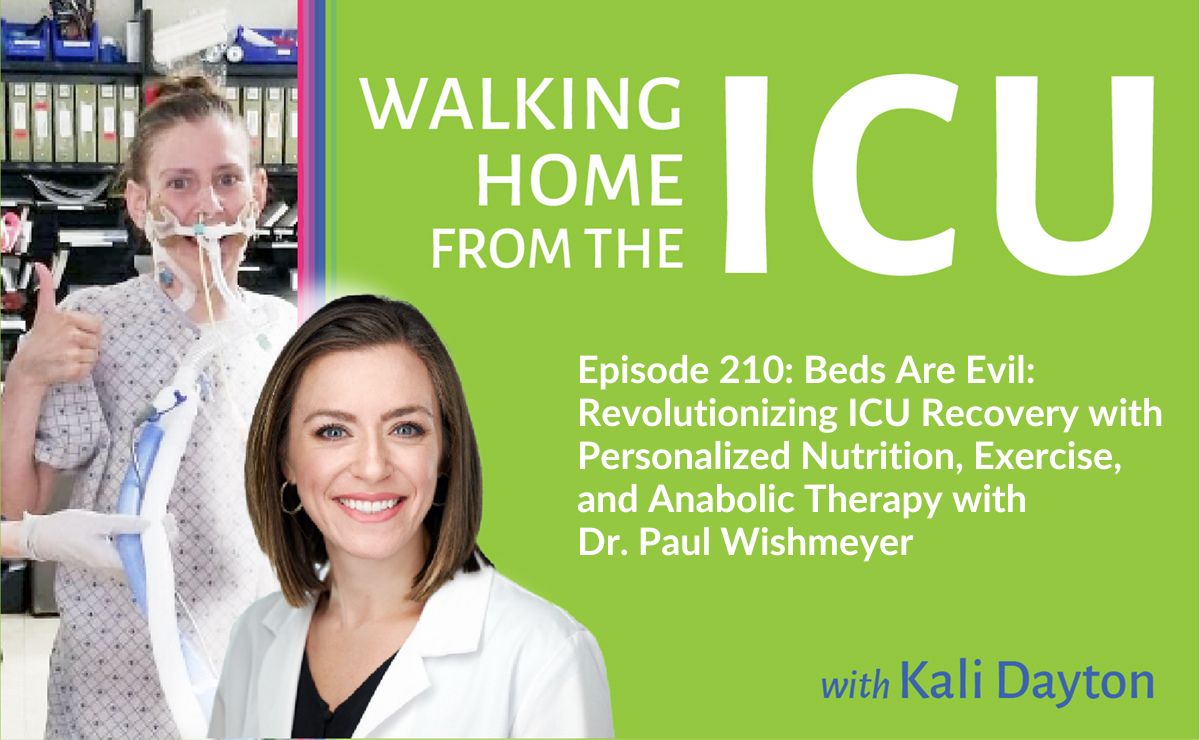
In this groundbreaking episode, Dr. Paul Wischmeyer returns to share the incredible developments in ICU nutrition and rehabilitation that are transforming patient recovery. As both a critical care physician and ICU survivor, Dr. Wischmeyer brings unique insight into what it takes to truly help patients recover from critical illness.
Episode Transcription
[00:00:00] This is the Walking Home From the ICU podcast. I’m Kali Dayton, a nurse practitioner and ICU consultant. I help teams create awake and walking ICUs through evidence-based sedation and mobility practices. By hearing from survivors, clinicians, and researchers, we’ll explore how to give ICU patients the best chance to walk out of the ICU and go home to survive and thrive.
Welcome to the ICU revolution.
2026 is an exciting time to be in critical care medicine. The revolution is growing. The tides are shifting. I can see it in forms of increased podcast listeners, online engagement, we’re doing symposiums [00:01:00] in hospital systems. More teams are lining up for training, and when I get to work with these teams, they are so much more open, prepared, and ready to transform.
Thank you for all you do out there. This episode, I’m thrilled to have Dr. Wishmeier back on. If you haven’t heard his episode about his intimate experiences with both sides of the ICU bed, go listen to episode 111. He joins us again to share incredible developments in the world of ICU nutrition and rehabilitation.
Revolutionists, this is going to blow your mind. Great. Dr. Wishmeier, thank you for coming back on the podcast. Do you mind refreshing us on, on who you are and what you do? So it is great to be back, Ali, and, and thank you for the amazing work you do, helping so many of our ICU providers and patients improve their recovery and our care of them as they recover.
But yes, I’m a professor of anesthesiology and surgery at the Duke School of Medicine at Duke University. And then I also direct the [00:02:00] TPN and Nutrition Service here at Duke, where I’m also the co-director of the Duke Clinical Nutrition Fellowship, which is a fellowship of any of you who wanna learn more about nutrition, that we run.
It’s taught by international professors from around the world. It’s taught in about 28 different modules over about a year, and we have attendees, 50 to 60 physicians and other healthcare providers around the world that join the fellowship, and we teach them clinical nutrition. It’s been really exciting to be part of and to watch it grow.
And then I also have just been named to the board, the physician board for nutrition, so the National Board of Physician Nutrition Specialists, and so actually that was just last week. And so I’ve been very passionate about trying to bring the role of nutrition back into medila- medical education, back into physician practice and education.
I think it’s sort of becoming a crisis, and physicians are trained to do it, and so that’s something that I’m really proud of. But then, of course, I work in the ICU as a surgical and trauma critical care clinician, [00:03:00] ICU physician. I’ve been an ICU physician, gosh, for 25, 30 years now, and I’ve worked in all different ICUs, medical, surgical, cardiac, burn, trauma.
I’ve really worked just about every kind of ICU but a neuro ICU, I suppose, although we take care of plenty of neuro patients in our trauma side. And then my research, as many of you may know, is on use of nutrition and exercise and other interventions to help patients prepare and recover from critical illness and surgery, other insults and injuries and illnesses.
So my passion is clearly in the post-ICU recovery and the post-hospital recovery and the prehabilitation, how we prepare patients for known critical care and surgical and, and other illness hits like bone marrow transplant, and how can we perhaps put a real dent in this post-ICU weakness that plagues so many of our patients And your last episode that you did, what, years ago, I think A couple years, two, maybe three, yeah Yeah, that’s wild.
Yeah. Uh, you shared [00:04:00] so much intimate insight into your own journey as an ICU patient and survivor, and it’s just, from my perspective on the sideline, it’s amazing to see how your life experiences have inspired where you put your efforts and research towards, and the empathy that you bring to the bedside, but also the community at large.
I love what you’re doing on social media. That’s been … I can see how much awareness and education that’s brought to all ICU clinicians, as well as survivors. As I’ve trained teams and I sit down with the dieticians, I ask them, you know, Paul Wischmeyer- Mm-hmm … and they’re like, “Oh my gosh, yes.” I mean, and, uh- Oh
yes, obviously it’s a celebrity, but also with a deep appreciation for almost like the reinforcement that you bring in, right? That you bring in validity of their discipline and the impact of their interventions as part of critical care, not just a fluffy side thing that we can circle back and get to at some point later on when the patient’s not sick anymore.
Like Paul Wischmeyer brings in, this is critical care. This is how we save lives. And so I can [00:05:00] see how you’ve emboldened and impacted these clinicians in these ICUs I’ve been working with. And so I’m so appreciative of that. And you just don’t stop. You just keep going. I’m- I just feel like I … When I look, like, hear little bits of your resume, I’m like, I feel tired- Me too.
because even when you consider, you mentioned that you’re, like you’ve been in and out of the hospital annually most of your life- Yeah … and then you just keep doing all these things. So this episode, I’m really excited to dive into some of the really exciting developments that you’ve had with your teams- Yeah
and what you’ve been working on. So tell us everything. Yeah. I think you really hit on what drives me and why I do this, and it’s like you said, it’s my experience as an ICU patient, as a surgery patient, as a hospitalized patient, and one that multiple times in my life I’ve been in the ICU and suffered that post-hospital, post-ICU disability weakness, PICs.
You know, I think s- so many good names now we can define it by that we used to just think it was just what happened to people, but now we realize it’s something we have to address and treat. And I [00:06:00] think it was my experience through my life, having to prepare and recover every day, basically, from critical illness and surgery, knowing that to- tomorrow I might end up in the operating room in the ICU again, that I think through my research, but really through my personal experience leading to my research, is- began to teach me that there are, I think, very clear-cut, reproducible, teachable, generalizable things we can do for our patients, both before they’re hospitalized, people that are, say, are anticipating a transplant or a large cancer intervention, and things we can do after people have been in the ICU or had a major surgery that are specific and personalized to them in the areas of nutrition, in the areas of exercise, and in the areas of anabolic agents and anabolic nutrients.
And so along those lines, really a lot of it based on my learning how to recover from critical illness. As you said, I was in the ICU just a few years ago and was probably the [00:07:00] sickest I’d ever been in my life. I, I… Some people know I’ve had 27 major abdominal surgeries, and in 2022, in the spring, had an elective surgery that, that turned very bad when I ended up perforating my bowel and getting septic and peritonitis, was on the ventilator, and ending up with a GI fistula, which so many people know that have cared for GI fistula patients that sometimes these patients never get better, spend years in the hospital and in and out of the hospital.
And thankfully, even though my previous hospitalizations I had gotten very weak and lost 20, 30, 40 pounds in a matter of a week or two or three, in this hospitalization, knowing I was having this big surgery, I prepared differently and really began to focus using some of the things we’ve done, our research studies for the NIH and the Department of Defense, that’s what my research is funded by, using some of the techniques we use in our research for myself to prepare for this big surgery.
And amazingly, as some of you have heard me talk about, whereas I normally would lose 20 or 30 pounds and become profoundly weak in the first few weeks of the hospital stay, even in the first two weeks, [00:08:00] this hospital stay I’d look in the mirror and I didn’t seem to be losing weight, and I didn’t seem to be losing strength.
And somehow through this whole month in the hospital, chunk of it on, in the ICU and on a ventilator, I lost five pounds. I lost three kilos, and I gained it all back in the first few weeks on TPN. I was on TPN for three months after hospitalization because of the fistula. You know, and I had a fistula drain, I have an open wound, all the things, but was able to immediately go back to exercising, to doing resistance training and lifting weights, and all while on IV nutrition and gained all the weight back and actually my strength didn’t change at all either.
I was just as strong. And when I give my lectures, I like to show at the end, I went back to my surgeon eight weeks after my ICU and hospital discharge after surgery, and said, “My wife and I, we dance Argentine tango and Latin dance competitively, and we have a competition. In our competition dance, we’ve been training for a year now.
I lift her over my head five times.” And my surgeon said to me, “Well, does your wife weigh more than five pounds?” And I said, “A little bit more.” “Double that.” [00:09:00] And, uh, she said, “Do you think you can do it?” And I said, “I think I’m strong enough. I think I can do this.” And eight, nine weeks after these operations and ICU stay, I was dancing and lifting her over my head five times like I’d never had surgery, never been in the ICU.
And so it made me realize that we’ve taught, and I’ve taught for 25 years now, that it’s impossible to go through a major ICU stay, a major surgery, a major hospitalization and not lose strength, not lose weight, not have the ICU-associated weakness that comes with that. And I thought that just was part of the physiology we all experience as humans, but that’s not true.
It doesn’t have to happen, and we can do things, and you as the audience out there who care for these patients can do things to prevent it. And it really comes down to personalizing. We finally have the ability to personalize nutrition, personalize exercise, and personalize recovery. And so we’ve started at Duke a service called the STRONGER Service, and that’s a long acronym that goes into surgery and [00:10:00] ICU rehabilitation and prehabilitation.
And it’s the idea that we can use new technologies to personalize how we do, for instance, one nutrition. We can use metabolic carts and indirect calorimetry. There’s new devices that hopefully many of the hospitals out there are getting the new Q energy device, and I will disclose I do work with Baxter and the companies that make it, and actually helped design it as part of a grant that we got to Aspen and a society in Europe to build a better metabolic cart.
And we can personalize exactly the number of calories, which is what I did. I’d been feeding myself for years. I’m writing my own TPN, I’m the TPN director, and I thought 2,000-2,500 calories was enough. It wasn’t. My resting energy expenditure is 3,000 calories, and I was losing so much weight because I was underfeeding myself.
Yeah. We can often underfeed or overfeed patients, both of which lead to bad outcomes and loss of muscle and disability. And so I needed 4,000 calories. My resting energy expenditure was 3,000 with the rehab and PT I was doing. I gave myself a TPN with [00:11:00] 4,000 calories. I’ve never written one like that since, but that’s what I needed.
And that was one of the- Well, you’re a very muscular person, right? But still- Everybody’s different … no dietician would have just eyeballed 4,000 calories- No … even for you. No. And I think that was the first of a number of things I discovered about myself, and I’m beginning to discover in this service caring for patients Either waiting for or recovering from major insults in ICUs stays, that we have to get that right.
And when you get that right, it really changes everything. And so 4,000 calories and enough protein was really key. And then we also have devices now, muscle ultrasound, the muscle sound device we work with that can measure muscle mass, muscle glycogen, and muscle quality. And so we can see day to day, week to week of a patient’s muscle is improving or getting worse, and not just its size, but also its quality, which is fat infiltration, which you can have a lot of muscle, but if it’s fat infiltrated, think of like a, a, a marbled steak, like a really rich, fatty, fatty [00:12:00] steak.
Mm-hmm. That’s, that fat in the m- is that’s the fat in the muscle that inhibits muscle function in a lot of our diabetic and obese patients especially. Mm-hmm. And so even though they may have mass, they don’t have quality, and both lead to dysfunction and weakness and disability. And so we can measure that daily if we want, and then we can also measure muscle glycogen, which tells us is the patient eating and is the body utilizing the nutrients we’re giving them in the muscle.
Like, when a patient gets septic and their CRP jumps, their muscle can’t take up nutrients and their muscle glycogen will drop. But people always say, “Well, when can we feed them more? When are they out of the acute phase?” Well, when the muscle glycogen begins to rise, which we can measure in two minutes at the bedside.
It’s a device about as big as, about as big as my fist maybe. It’s a little sound probe that plugs into your iPhone, and you can put it in your pocket and it measures this so much like ultrasound does so much for us in the ICU and other areas. We can tell if a patient’s using the nutrition we’re giving them.
And so between that and bioimpedance analysis, which is the big f- fancy body composition device we use, we can tell week to week how a patient’s progressing or [00:13:00] regressing, and if what we’re doing is working or not. And then finally, we can personalize exercise through in-hospital room, in-ICU room cardiopulmonary exercise testing with a mask, a Bluetooth mask that fits on the patient’s face, and six minutes with a step test, which we found even patients on Impellas and VADs and CRT and balloon pumps can do.
I’ll tell you about a patient later where we had some great success, and nobody thought he could do a six-minute test like an Olympic athlete would do, but he did it for us multiple times, and it really helped us personalize his exercise. We take the heart rates at VO2 peak, which we can get in anybody’s hospital room, and we design interval training they can do in the hospital bed with a physical therapist To the exact heart rates their body needs to be at, and we can do this at home.
We have a big trial going with the NIH right now where this is being studied where we take post-hospital, post-COVID patients, post-ICU patients, and we get these numbers. We give them an iPhone, an iWatch, and they get coached by a physical therapist who’s in Florida. He coaches Vanderbilt, Wesley, and Matt [00:14:00] Mark’s side, Ohio State, uh, Kentucky, and our patients all remotely.
And we can double people’s VO2 peaks, even 70-year-olds who’ve never exercised, in six, eight, 12 weeks. And so we have these abilities now, much like our Olympic athletes and professional athletes do. Why don’t our ICU patients deserve the same? And so we’ve developed a service now that’s doing all these things like we do in our research trials for the NIH and the Department of Defense.
So who is coming to the bedside and utilizing these tools? So I come to the bedside, and then I’m often joined by exercise physiologists or some of my dieticians who have skills in some of these testing. Some of our dieticians are highly skilled in ultrasound, the muscle ultrasound assessments, the metabolic cart assessments.
But, uh, in many cases now, I’m doing all these tests at the bedside myself. Uh, so a physician could do this, a PA could do this, an NP could do this. I [00:15:00] think, you know, even a dietician can do a lot of these tests. Our research dieticians do this in our research trials, all these tests on their own. And so again, this is teachable to anyone- Mm
and it’s reliable and reproducible. And so we’re writing a protocol right now actually to study the assessments and have people consent so that we can really begin to collect data, and then my research team can really start to get involved and be more engaged. But the dream would be a service that I have myself, a physical therapist, a dietician, uh, and an APP, I think, where we could meaningfully see more patients.
I haven’t opened up the floodgates at Duke yet to see as many as I could because it’s just me right now. Yeah. But I’m teaching fellows and other physicians to do this. Again, none of these things are things that can’t be taught to someone in a very reasonable amount of time. So I’m doing so much implementation science, right?
I- Yeah … spoke to teams, and we’re working on sedation delirium and mobility management And always trying to bring the nutritional side of it, right? So I have some experience- Yeah … in how do you standardize a new protocol, how do you change the culture? How do you give- [00:16:00] Yeah … someone stewardship of a piece of this puzzle and make sure that it gets done, that the rest of the team accepts it, utilizes it- Yeah
relies on it, applies it. So yeah, I, my, my wheels are just turning of I like the idea of having dieticians be able to do that. Mm-hmm. But we’d have to change a lot of the staffing with g- a lot of times- Interesting. Yeah … we’re over a whole hospital, so there are lots of considerations. But every team I go to I’m always asking, “Do you have metabolic carts?
Do you have metabolic carts? Do you have…” Yeah, yeah, yeah. And I finally got a team that did, and I had sent you that protocol. Yeah. Because the protocol was pretty conservative, it really wasn’t being used. So I see a lot of similar gaps like we do with sedation, and mobility, and delirium. With even the older guidelines or uh, innovations that we’ve had in the nutritional world, we have a lot of implementation gaps.
And I love that you mentioned making sure the physicians are educated on it, because I think that’s part of it, right? Yeah. The dieticians may- go to Aspen and go to the conferences and read these works and stay up-to-date on everything, and then they go to the bedside and they’re [00:17:00] excited, and the rest of the team’s like, “Yeah, well, they’re obese, we don’t have to feed them right now,” and they move on, right?
Oh, devastating. So there’s a lot of frustration with all these innovations that are coming, and this sounds like the dream. Like, this really sounds like what should be the standard. And I can only imagine, I hope down the road you guys are able to, as you implement this in other teams, look at the financial impact of it.
Because we already know with nutrition in general decreases length of stay, readmissions- Yep … obviously like mortality, morbidity, but the financial side of it is so impactful. But this is just taking it up such a huge notch. Yeah. But I could see hospitals being like, “Oh, it’s another device. Oh, it’s another clinician to hire.
It’s more training. Oh, we can’t afford it.” So that would be my request too, is make sure that you’re tracking the money- Mm-hmm … because that’s one of the best ways to get this to the bedside. But what’s gonna come down the road as you obviously scale your own team- Yep … what resources are gonna be available for hospitals to develop a program, [00:18:00] adapt it, or just replicate it to what their needs are in their ICUs?
Yeah. So to give you some more specifics, and definitely, I think those are excellent questions. I think all those things are the critical things that need to be addressed. I mean, I have some partners at Vanderbilt who were in my anesthesia department at Vanderbilt and wanted to start a service somewhat like this, and Vanderbilt said no, and so they went off and started their own concierge clinic, a la sort of Peter Attia and the Medicine 3.0 concept, because that’s really what this is, right?
This is the concept of Meds 3.0, where we’re going to do preventive medicine, both before and… But only in this case, we’re gonna do it for really sick people. So he’s gone on and been very successful, seeing sort of your healthy 50 and 60-year-olds who have a fair bit of money and often maybe are not sick themselves, but just want to prolong their health and lifespan, as Peter Attia would put it.
And I think the focus of it, you know, just to give you an idea what STRONGER means, so STRONGER means, you know, surgery and ICU therapy for [00:19:00] rehabilitation, optimization, nutrition, growth of the muscle, endurance and recovery. And the mission of it really is to help patients get stronger before and after surgery, organ transplantation, ICU and cancer.
And I think the key is, is all the devices that the service uses are billable and codable. So we now have a metabolic cart, for instance. So let’s start with the metabolic cart. We have a service at Duke. The dieticians are running it, entirely dietician-run. They can bill, we can bill and code for the use of that device.
It brings in Research m- revenue. We know that patients that in the ICU that are used their Nutrition’s Guided by Metabolic Card have lower mortality in a number of meta-analyses now. We have got an SBAR already created for hospitals out there that are listening that want to get one of these devices.
We’ve been very successful getting numerous hospitals these devices, even in sort of remote government hospitals in Brazil, they’ve been able to use our data to get the resources and availabilities. These are not particularly [00:20:00] expensive devices to even get it there. But in many, actually the private practice hospitals in the US are getting them much faster than the academic hospitals are because we know everything in academics moves slower.
But we’ve had great success just with that particular device. And then, for instance, the muscle ultrasound device, which we just are in the process of approving for clinical use at Duke as well, we discovered through Duke’s analysis, which took a year actually to do, that the ultrasound billing for the actual ultrasound procedure itself brings in more revenue to the hospital than it costs to own the software for the device.
Because it’s, it’s software that really runs with an ultrasound probe rather than a special probe. You don’t need a special probe for it. Right. And so actually- Right … we estimated if we just use this say in our pre-op clinic with seven hundred patients over a year, we would make sixty thousand dollars to Duke just from the procedural billing.
But the other thing, of course, that hospitals can really latch on to that I didn’t know until we did this analysis is the number one rejected major complication code at any hospital in the US, and especially at Duke, is malnutrition. If you’ve been listening to this [00:21:00] podcast, you’re likely convinced that sedation and mobility practices in the ICU need to change.
The ICU community is facing incredible difficulty with the trauma from the pandemic, staffing crisis, and burnout. We cannot afford to continue practices that result in poor patient outcomes, more time in the ICU, higher healthcare costs, and greater workload for the ICU team. Yet the prospect of changing decades of beliefs, practices, and culture across all disciplines of the ICU is a daunting task.
How does this transformation start? It can begin with a consultation with me to discuss your team’s current practices, barriers, and to formulate a plan to help your ICU become an awake and walking ICU. I help teams master the ABCDEF bundle through education, consulting, simulation training, and bedside support.
Let’s work together to move your team into the future of evidence-based ICU care. Click the link in the show notes of this episode to [00:22:00] find out more.
And that’s because it’s the number one, uh, insurance challenge be- code because it’s really subjective. In fact, Duke told me they spend more money fighting nutrition rejections of their MCCs than they spend on all the other rejections they get on all the other codes combined. Because they can’t accurately measure it.
And now- Yeah … with the new Glim out, there’s a new global institute of malnutrition criteria that require muscle mass measurement. Insurers have caught onto that, and if you don’t provide a muscle measurement, they reject your claim. Wow. And so just that alone… So if a patient, if their only MCC is malnutrition, which is, uh, not uncommon, it’s an additional $2,000 per patient for a me- Medicare patient, but up to $20,000 per patient for privately insured patients.
This is millions of dollars that are, uh, at stake, and this device prints out a picture of the muscle with an exact measurement of the muscle [00:23:00] cutoffs for size and sarcopenia and for muscle quality. So it’s an indisputable definition of malnutrition that our coders then will solve all of their problems.
We’ll never have a malnutrition code rejected again. And all those obese patients who are actually malnourished, but we, our old criteria don’t pick them up because really it’s sarcopenia that defines risk, right? We know low muscle mass- Yeah … a huge risk factor for ICU mortality, for surgical mortality, morbidity, cardiac, any of the fields you wanna look at.
It’s not so much malnutrition by itself, it’s low muscle mass, and that’s what we now we can measure objectively. And so now those codes can’t be rejected. So this is an incredible financial win for hospitals, and it took e- Duke’s coders and billers a year to figure all that out, but now they’re thrilled.
They’re like, “This will revolutionize how we diagnose malnutrition and help us on the billing side as well, on the revenue side as well.” So I think those are two examples. And the other devices, we use the BIA device. Stanford’s pre, anesthesia and preoperative group are already coding [00:24:00] and billing for that in their pre-op setting to help assess surgical risk.
So again, that’s another device that we coded and billed for. And we know CPET testing for anyone who’s frail, short of breath, or any of their diagnoses, we did some calculations early on. That test reimburses about 900 to $1,000 a test. And so again- For what now is about a $1,500 even- or even less, a Bluetooth somewhere down to $300 mask with a software program, you can do these CPET tests at the bedside for low investment with high return and get lots of great information.
And then you can really guide your nutrition, your exercise, and then we do anabolic agent therapy with testosterone, creatine, HMB. We have creatine on formulary at Duke. There’s a- Wow … for those of you don’t know, there’s a vast literature for creatine improving muscle strength and function in hospitalized and chronically ill patients, and it improves cognition.
So it improves cognition. Like, if you’re a college student and you’re sleep deprived and you take creatine before a test versus the person that didn’t take creatine, [00:25:00] the person who does take creatine who’s sleep deprived does much better because it improves processing memory, cognition, preserves cognition, which of course is another critical aspect of what our ICU patients suffer with post ICU.
So we have it on formulary at Duke. Uh, pharmacy brings it up, and so we use it ourselves. And is it, uh, enteral then? Yep, yep. Yeah. They can take it either orally or enterally. So we have formulations for the tube feed or they can take it by mouth as well. And so we’re routinely doing that in the service.
And so I think that’s really the key thing, right? If we’re gonna address ICU-acquired weakness, we have to address the nutrition part, we have to address the physical therapy part, and we have to address the anabolic signal part. The testosterone levels I measure in the ICU patients are often zero. The majority of them are less than 100, where normal is 300.
I treat women and men. If we had oxandrolone still, which sadly the FDA took away from us about two years ago, which was used universally in burn units around the world, we’re hoping to find ways to get it back. That’d be an even better drug, but we use testosterone in men and women now, and I monitor levels and titrate that.
And, and that’s again, something [00:26:00] that can be taught to any physician, just urologic guidelines for hormone replacement. And I think we’ve had lots of patients benefit from it. And so all this again is doable, teachable, reproducible, but it’s gonna force our physical therapists and our doctors to think different.
This is personalized therapy. A lot of the physical therapists are too busy to be able to actually exercise and train patients. They spend so much time just teaching them to stabilize their trunk and to stand that now we need to take the next step where we have physical therapists in the hospital, say, on teams like this, that actually train people, do interval training.
We have a strength and balance set of exercises we do that have been published in The New England Journal in heart failure patients to improve strength and balance. We do it in our REMHD COVID trials. People do it over FaceTime, being coached by a physical therapist in their house, and they’re having great benefits from that.
We can do it in the hospital too. And it, it, all the financial information obviously makes the case for the devices themselves, but the clinicians that it takes to run them. Yep. I, even just with I’ve trained 14 teams, and I- Mm-hmm … I see [00:27:00] even a recent team where they have the Medibloc carts there. Yep. They have one per ICU, and like, “While you’re working on one ICU right now, bring all those carts in.”
Yep. But then they downsized their RT staffing, and the RT was already struggling to get the time to put those on and run the test. So we do this in so many aspects of the hospital where we silo all of this. So I would imagine part of that conversation would be one dietician to the ICU. Mm. PTs and OTs are not running around through acute care.
They are stationed in that ICU. They are the dream team. They are working together. ‘Cause right now, the way it is, you could provide this information, even the tools themselves, you could drop off all those equipment, and the way that we’re staffed and the focus and the scope of our clinicians right now would become a huge barrier to even utilizing the equipment.
And so I think we see that with like, you know, some of our nicest, like, bronchoscopy tools and things like that. Like- Yep … without the right [00:28:00] resources and know-how, it doesn’t get used. And so I, I see a lot of opportunity to fix some of the problems that we have with the staffing and the way our teams are structured by emphasizing this nutritional piece and using that to leverage the kind of specialization and dedication that we need of these clinicians in our ICUs rather than spreading them so thin.
Yep. No, for sure. And, and I think w- w- I think just from my times point of view too, I bill and code consult and critical care time and consult codes, much like I do on my nutrition service, or much like an ID doctor would for an ID consult, or a, uh, endocrinology or cardiologist would for a consult. And I not only see people in the hospital, but I have a clinic where I go to different providers’ clinics, whether they’re in cardiology or pulmonary or in surgery, and I see the patients with the following clinicians.
So for instance, the other day I had a pulmonologist who heard about the service we were [00:29:00] running and said, “I have a patient who’s had ICU-acquired weakness and inability to gain back muscle mass for over a year now. She’s been through physical therapy for a year. She’s been in some of the research studies that use even some of our techniques, and she’s still very thin.
She wants to be fitter, sir. She’s the primary caregiver for a husband who’s paralyzed, who’s, who’s, who’s severely disabled, and so she not only needs it for her life, but her family depends on her as well.” And they said, “Can you see her?” And I said, “Well, I don’t have clinic space yet. That’s my dream, is to have my own clinic and do this full time, even leave the ICU and only do this.”
Wow. Yeah. But I said, I said, “But I can see her with you in your clinic. We’ll do all our testing. We can do all this in the clinic room, and we’ll make all our recommendations for her.” And I saw her and I billed clinic consult time, just like any other physician doing a consult in the clinic would. We spent three hours with her.
We went through all our testing. And I have an email I send to ICU and surgery and [00:30:00] other patients, cancer patients around the world, that has all the nutrition recommendations, the exercise recommendations, and how to think about their anabolic hormones. It even has pictures from Amazon. And ’cause there’s only one manufacturer in certain products that I trust that we know are GMP, that we know are reliable, and I walk people through, and there’s pictures from Amazon exactly how to order them, how to do this.
And I send that email out probably six or eight times a week to people. And so I send her that, and then I follow up, and we’re gonna keep seeing her in clinic, and we’re monitoring her testosterone. We’re giving her testosterone as well, and we’re monitoring that for her, and then working with her on her diet and her exercise.
And my physical therapist from my studies volunteered time to coach her over FaceTime to teach her the interval training she needs to do. ‘Cause when it comes down to it, right, as Peter Attia would say, but I think this is definitely true, right? The two most important things that determine how long you’re gonna live if you’re healthy and how well you’re gonna recover if you’ve been in the ICU are muscle mass and VO2 peak And they’re the two things we as physicians are not taught [00:31:00] in medical school, and I don’t think any other medical specialty except for maybe physical therapy teaches it well.
But, you know, I think we spend a lot of time worrying about other comorbidities patients have, like smoking, diabetes, and hypertension, and the reality is, if we get a patient to stop smoking, we’ll improve their lifetime mortality about 40%. If we get a patient to treat their diabetes perfectly, we’ll improve their lifetime mortality by about 35, 40%.
They treat their hypertension perfectly, we’ll reduce their risk of death 25, 30%. If we improve their muscle mass to the best it can be for their age, we reduce the mortality risk 400%. It’s ten times more important than smoking, diabetes, or hypertension. If we improve their VO2 peak to the best level it can be for their age, 300, 400 or even more, 400% reduction in mortality.
Ten times the benefit to the patient than stopping smoking, treating diabetes, or treating hypertension, which we spend a lot of time talking about. Muscle mass and [00:32:00] VO2 peak are the defining numbers that every patient should know, and the fact that we don’t know that for most of our patients and most of us as individuals don’t know that means we are really seriously limiting and doing a disservice to our patients and their long-term, not just lifespan, but their quality of life, their ability to do things they wanna do.
And for an ICU patient, right, this is where the numbers get really devastating. I measure patients’ VO2 peaks in after the ICU, and, you know, their numbers are equivalent to levels of people who shouldn’t be able to live at home safely. Their VO2 peaks are 8 and 10, 6, 11, 12. These are post-ARDS kind- Wow … of patients.
These are pulmonary cripple kind of numbers, and I, we have ICU patients living like this regularly, and they wonder why they can’t do the things they wanna do, and without training, they’ll never improve them. And that’s what- And yet we consider it- … patients like this have to do this … but we saved their life, right?[00:33:00]
So one reason we- But we, we don’t, we can’t, we don’t measure those things, and it reminds me so much of the psychology behind delirium management, right? It doesn’t show up in the AM labs, it doesn’t show up on the monitor. It’s not a number, and therefore, we don’t see it. It doesn’t exist, right? And very much the same, if we’re not measuring it, we’re not preventing it, and we’re not treating it.
Right. And that’s gonna be huge to have those numbers accessible. I think that’s gonna really help- Yeah … make it as important as, again, creatinine. We love- Yeah … our numbers, right? Like, if that magnesium comes in a little low- That’s what we do, right, in the ICU … right? We love data, and now we can have it, and this is not fancy science that can only be done in the Olympic Training Center or at a professional football team’s training facility.
We do this. So just to tell you a story of a patient, there was a young man in his 20s who had congenital heart disease and needed a heart-kidney. And the cardiologist came to me and said, he was on a [00:34:00] balloon pump and CRT and pressers to keep his pressure up. And he’s, so he’s in the ICU, and they said, “You know, he’s far too frail to have any heart transplant, and we think maybe over the next nine to 12 months, maybe if you work with him, we can make him fit enough, his muscle mass and BMI high enough.”
His BMI was about 16. They require 22. Now, the BMI’s by no means a perfect measure. But now we can not only give them BMI, we can give them exact muscle mass measurements. And so they said, “Could you work with this young man and see what you can do?” And so we did our testing, and his first quadricep muscle thickness was six millimeters.
If you think about the big leg muscle you have on your leg, think of that being six millimeters. Wow. And they said, “He’ll never be able to do that, that stepping test you do. He’s far too unfit.” He did it, the whole thing, for six minutes. He just, his balance was challenged. His endurance- Right … was actually pretty good, but his balance wasn’t good because his muscle mass wasn’t good.
And so we do, we let people hold walkers, and they can do- Uh-huh … the step test pulling a walker. Okay. [00:35:00] That takes out the balance. It’s still very hard. They still work hard. We still get the numbers we need. Yep. His VO2 peak was actually 14, 15. It was much better than anybody thought, and he finished the whole test.
He never stopped. He’s very motivated. So over the next five weeks, we … So we started him on two feeds ’cause he couldn’t eat enough. Most of our patients can’t. They either need two feet or three feet. Right. Yeah. Really sick people will never eat enough. We started him on testosterone, creatine, HMB. We had him start actually doing interval work with a physical therapist, and we had the physical therapist start strength and balance exercises like our
We have a handout I send people. You can do it in your home. Got pictures of how you do it. Been studied in the New England Journal trials, shown to work. He started doing that. Five weeks later, his rectus thickness went up to 16 millimeters. His BMI went to 23. Wow. He was listed two days later. He was transplanted, and he’s at home now.
Okay. And this kind of progress is made while he’s on Impella and CRT? Yep. In ICU? Yes. A- and I, the … I’m just … For the therapist to be able to measure [00:36:00] impact and, and the prescription of their interventions is so helpful, ’cause I cannot tell you how common it is to have- therapists come in and they don’t have verticalization beds, or they don’t have these tools, and they’re hoisting patients to the chair- Mm-hmm
and checking the box. Nurses obviously are doing it as well, and they’re out of bed. And so we see our objective as out of bed, and however it gets done, it doesn’t matter because the box gets checked. But when you have certain metrics that you’re measuring, goals, all of those things, now we actually get to know are part of in- interventions appropriate for them?
Are we progressing or reaching the goals? That, the checking the box suddenly becomes a whole- Yeah, it’s better … network of boxes- Yeah … that requires critical thinking. Yeah. And but it’s actually gonna be effective, ’cause right now we have zero feedback. So it doesn’t matter how we get them out of bed, we’re just getting them out of bed.
I also wanted to ask, especially for a patient like that, do you guys use verticalization [00:37:00] therapy, verticalization beds? We don’t have… I know what beds you mean, and I wish we had them. We don’t, but what we, what we do do, for instance, for people who… I have some patients right now with such severe ICU-acquired weakness that they are limited in their ability to stand, especially initially.
So we have a neuromuscular stim e-bike- Okay … that could be attached to the bed. We don’t use the neuromuscular stim pieces as much as we probably should. Uh, we got it for a study that Amy Pastva and I did with some of the folks in Canada with the Canadian Progressive Trial Group, and now we use it quite a bit.
But does it make that much of an impact? ‘Cause the neurostim studies have not shown changes in outcome. Only in stroke patients. And the reason the ICU studies, I think, have failed, we didn’t, we were part of one of the ones, the TARGET trial- Uh-huh … that was published, is the average length of time the patients are on them, ’cause they’re only on them while they’re intubated, is only three or four days.
Stroke patients are on them much longer, and so when you do- Absolutely … these with pe- people, ’cause again, now I’m getting weeks to work with a patient- Yeah … and in the outpatient setting, right, we can do the same. In those studies, they do work. Hmm. But [00:38:00] is it the neuromuscular stim or is it the bike? I don’t know.
We know that neuromuscular stim works in athletes. But just the sheer fact they can do a bike and the bike is smart enough to assist them when they need it and not assist them when they don’t. Like, I get reports from physical therapists on my, one of the patients I have now has got really severe ICU-acquired weakness, the worst I’ve seen in 20 years.
He’s in his 60s. And it will tell me he did 28 active minutes and seven passive minutes, and then the next day does 29 active minutes and seven passive minutes, and you can change the resistance. And then I will tell you, this patient’s wife bought him from Mobio, who’s one of the- Yep … sort of ICU mobility people.
She bought him herself a leg press device that he sits on- Yes … and has rubber bands, and he leg presses in the bed every day, and it, so he can increase the resistance. The patient bought that because we don’t have it at Duke. I mean, I- that’s the other thing I think we have to have our physicians advocate for our physical therapists to have better equipment.
You know, when I was a burn ICU physician, we had a gym with weights and all the equipment a physical therapist would require in an outpatient or inpatient setting, [00:39:00] but most hospitals don’t have that. I don’t have a gym like that at Duke, and, you know, we don’t have a burn unit, which I think, you know, a lot of burn centers have it more, some others don’t.
But that training should be part of what we do for our patients in the hospital, not just standing and walking around the unit 10 times, but actual training. And measurable, like you said. We can measure, and the physical therapists at Duke are great. They’ll do a weekly six-minute walk test if I want them to.
They’ll do a sit to stand for 30 seconds so I can see progression there. I do hand grip strength every week with my patients so I can track their- Yes … hand grip strength. It’s a huge marker, not only their physical function, but if your hand grip strength is normal for your age, at age 70, you have a 40% less chance of cognitive dysfunction.
If you have the- Of course … APOE4 gene for Alzheimer’s, if you have two APOE4 copies, you have a 60-plus percent chance of getting Alzheimer’s as, in the next 30 years. The only treatment if you go to the fancy people like Peter Attia, $150,000 a year to see him, he’s gonna teach you resistance training and strength training and improve your VO2 [00:40:00] peak.
That’s the one thing that’s known to reduce cognitive dysfunction. True for ICU patients as well, I’m sure. And so again, we’re treating the whole patient when we address nutrition, the strength objectively, and when we address the anabolic agents they need to actually have enough signal to take the nutrition and the exercise we’re getting and make muscle from it.
And also, prevent fractures, right? Improve bone density, all the things that lack of anabolic hormone stimulation leads to for these patients, like complications. Yeah, we don’t look at their hormones at all in the ICU. It’s just- I check everybody I get consulted on. Yeah, that is, I mean, it, it makes perfect sense.
It just, I love having my own perceptions and myths debunked and clarified. Yeah. I’m like, “Oh, man, if I could go back, like how much more could we have done?” I love the exciting innovations. I don’t think we always need every single piece of equipment, but there are certain key pieces of equipment, and if we put it together strategically instead of having it gather dust in our, in the [00:41:00] patients’ bathrooms
Yep, I agree. But I think we’re more likely to use that equipment appropriately and strategically if we’re able to measure And prescribe. And so I, I would love to be having your kind of monitoring with verticalization therapy. Can you imagine- Yeah … these patients? Yeah. This young man that you de- described, when he’s so weak- Yep
yes, he could do some things with the walker. Mm-hmm. But if, but how, how eager is the team gonna be to do that frequently- Right … over long periods of time with an- Yeah … Impella, CRT? So just even the cognitive and safety precautions for a team. Mm-hmm. If you, he can just be in a normal bed and be standing and bearing weight, just hanging out with his family, using the largest lower extremities on top of all the support he’s getting from you.
Where the muscle is. You guys need verticalization beds. I’m not a salesperson, but, like, it- No, but I heard they’re great. No, no- I would love to see- … physical therapists talk about them … yeah, and you can see the benefit of them in numbers. ‘Cause we, we have outcomes like length of stay, co- functional outcomes, time on the ventilator, [00:42:00] delirium.
We have those kind of outcomes, but I would love to see the nitty-gritties on those. So- Yeah … do, bring those in, and then- Yeah. I love it … do all the tracking, ’cause I think that would be amazing. So it’s exciting. I feel like in our worlds we’re very siloed, right? Yeah. I want to send you back out to the teams that I’ve trained and be like, “Okay, now follow up with this,” right?
Because it’s all necessary. I, I don’t think there’s… You can’t have one without the other. I mean, you can mobilize- And I think you’re- … your patients, but if they’re mou- if they’re not getting nourished, we’re limited. Right. I think you’re getting at a great point is how you measure these outcomes and actually show how you’re benefiting patients.
I think that really is critical, right? And that’s the questions I’m being asked. And like you said, how am I gonna show value? And interesting, one of the ways my department is trying to show value is if I take a patient who has heart failure, let’s say, and I move them to a transplant DRG, that’s an enormous income change and increase for the hospital.
So rather than me, say, reducing length of stay, reducing complications, or [00:43:00] improving, like, physical function, patient report outcomes, they’re even looking at can you change the patient’s DRG by taking that heart failure patient or that liver failure patient who’s too frail to be transplanted or too frail to have that cancer surgery or too frail, say, to go home, which that’s a lot of my patients I’m seeing, too, and change their DRG?
And I would have never thought of that, but I thought that was really creative, and I think you’re right. To, to justify a lot of these things, we’re gonna have to show value, and I think your sort of emphasis on how are we gonna show value of the things we do is so critical. And that’s something I’m struggling with too, ’cause I’m trying to create a business model, and doctors are not good businessmen.
Nor am I. We are not there. I get it. But I think you’re hitting the nail on the head with that. That is so critical that we really have to be creative and learn from each other what are the ways you’ve shown value to increase your number of physical therapists, or to get that piece of equipment, or to increase your dietician numbers, or to build up your team, and I think that’s what we’re all fighting to do.
And so I do think that’s really critical. I would look at readmissions for certain [00:44:00] diagnoses. I mean, all patients, but especially- Yeah … the diagnoses that hurt the most as far as CHF, COPD, those patients that we know are, can be frequent flyers, and within- Yeah … 30 days, that all falls on the hospital. Yeah.
If we look at do these interventions, does this kind of program prevent, reduce readmissions? How much money did that save your hospital this year alone? Yeah. No, I, I think it’s all just fascinating. I mean, it’s common sense. Yeah. Those of us that understand delirium and ICU-acquired weakness, that understand post-ICU syndrome, that care about it, have hurt survivors, have been the survivor- Yeah
we get it. But I deeply appreciate you continuing to push the envelope, look for more ways, more technology, more science to do better, but also publishing that, make it accessible to the community at large. And that’s what ICU revolutionists are, right? Yeah. We’re the ones that take this information and make it happen at the bedside.
I would love to share whatever [00:45:00] resources you have as far as your recent- Yeah … publications, access this information, any courses. And i- as you continue to develop more resources for the community, I would love to keep sharing those, ’cause I, I know the listeners will actually make it happen. Yeah. I think, like you said, uh, if people wanna reach out now, like I said, the metabolic cart SBAR we have has been very successful at many hospitals, not just in the US but around the world, but especially in the US.
Yeah. So that we can definitely share. And I think just a few tips around that, ’cause you and I have been interacting over that by email, the metabolic, the new metabolic carts, right, can measure a much wider range of patients than the older ones could. You can actually measure people with PEEPs up to 16.
You can measure FiO2s up to 70%. You can measure people on CRRT, it doesn’t affect the reading. You can measure people with chest tubes as long as they don’t have a leak. So again, if they have a leak, then right, the data’s not accurate. But if they don’t, then you can. And so it opens to a much wider range of patients.
And most of the measurements I do are not in intubated patients. We’re doing it with a mask in an [00:46:00] awake patient, right? We’re doing this all the way from hos- hospital admission, through the ICU, and all the way to discharge. Like, our big DOD trial is- Personalized nutrition, it’s called the Syndrome Trials for Trauma, penetrating blunt trauma, to try to get patients functional faster, six-minute walk at hospital discharge is our primary endpoint.
And we measure their nu- nutritional needs with metabolic cart. We start with TPN, then we move to enteral nutrition. We give them protein shakes to go home with. We tell them through the hospital stay exactly how many calories and how much protein they need so we can really personalize it. And so I think the metabolic cart we can definitely help with.
The muscle ultrasound, I think, is the second big device that’s a big winner. We have an SBAR for that. We have all the data that we’ve done. Don’t recreate the wheel of a year’s work- Yes … team did. This is a money maker for the hospital just on the procedural billing itself. We’ve all seen what ultrasounds do in every other part of the ICU.
This muscle ultrasound device is the same. It bills and codes more than it costs, and then it does all these incredible things, not just for patient care, but for your billing and coding folks to get your malnutrition diagnoses [00:47:00] recognized and not rejected, and I think that’s so critical And then I think the last thing I’ll say is the CPAP is another level of things which I’m happy to talk to anyone about the devices we use and things.
But, um, but comfort with testosterone I think really needs to change. The FDA just a few weeks ago removed the warning label for cardiac risk being associated with testosterone therapy. Wow. And in fact, the data now would say… There was a JAMA, um, internal medicine paper, 43,000 patients, men with testosterone deficiency in California through the Kaiser system.
Patients who had it treated, who got testosterone due to deficiency, had 30% less heart attacks, 30% less strokes, and 30% less all-cause cardiac events. Intermountain Health did a study in a few hundred patients that had had heart attacks in the last year who had testosterone deficiency. If they were treated appropriately, 90, 80 to 90% reduction first recurrent MACE events, or reduces MACE events 80 to 90%.
Even in women, the Australians [00:48:00] have shown if you’re in the lowest quartile of testosterone as a woman over 70, you have the highest risk of a first major adverse cardiac event if you’re not treated, if you’re, if you have the low levels versus other women. And so- The irony is so painful. Yeah. So all these risks we’ve perceived, and people…
Like today even I heard from one of my ICU partners, one of my other attendees I work with wanted to start a really emaciated patient who wasn’t healing well on testosterone, and one of the pharmacists said, “Well, it’ll increase the risk of stroke or thrombosis.” Not true either. The only possible time anyone worries about that, the people that do this in outpatient, is if their hematocrit is over 50.
So the beauty of testosterone is if you’re anemic, which all our patients are, it’s really potent- Right … to blood count, which is great. Yeah. Yes, if you get someone’s level over 50, which where I lived in Colorado, everyone’s level was, and they didn’t have clots, but that’s okay. If your blood count gets too high, they suggest people give blood or they space their dose out, right?
Yeah. Again, all these preconceived notions that we’ve had. The FDA is in the process now of rewriting the [00:49:00] entire recommendations for testosterone. There was a meeting two weeks ago, an open forum meeting where they said they’re gonna rewrite because they think just like with women’s hormone replacement, there was misconceptions that are never, ne- many of which were never true, some of which now are not true because we have better formulations, but that are not accurate, that are myths.
Much like women’s hormone replacement was a lot of it was myth or misinterpretation of data, it’s true for testosterone as well. And so I think it’s a huge opportunity to help patients recover, men and women, and give back their quality of life in a way that we could’ve been doing for years but had all these- Myths
misinformation and myths being thrown at us. And now with so many objective devices, we can measure the effect we’re having and really be thoughtful about it. I think, again, we need this, we need almost a separate specialty of critical care for this preparation and recovery phase, and I think that’s my dream is to become- Someone who I hope blazes that trail, and then hopefully the next generation of ICU physicians will really be able to say, “I’m [00:50:00] gonna own this part of care, and I’m gonna focus my career on this sort of multidisciplinary care of the nutrition, exercise, hormone, the quality of life, preventive medicine concepts” that I think now are becoming so prominent in outpatient healthcare.
I can see this ICU revolution working on awake and walking ICUs. This helps address delirium. If we’re really focusing on muscle mass, that’s gonna help trigger early mobility. The cr- roads will cross. So I think there is such a huge rise in the next generation saying, “We’re gonna leave the myths behind.
We’re taking stewardship of the future.” And so I think this is the perfect audience for it. Yep. We’re gonna do another follow-up episode on more of- Yeah … like m- mitochondrial dysfunction. Um- Yeah, yeah. Sure … but keep giving the audience updates. And go to my Instagram, and I wanna hear you pop in some of these myths that you’ve debunked- Mm-hmm
into my myth buster post ’cause you just- Yeah. No problem … hit like 12 at least. The last piece I’m gonna leave [00:51:00] people with- Yeah … and this is what I say, and I think this gets, made me think when you said the myths, is every day when I round in the ICU, the last thing I say to them before I leave the room is, “I don’t wanna see you in the bed for the entire day.
I want you in the chair, or I want you walking, because beds are evil. They’re only for sleeping. If you’re in the bed during the day, beds are for dying.” And I tell them, weakness, it causes weakness, it causes strokes, it causes blood clots, it causes pneumonias. And you should see the nurses’ and the patients’ eyes get really big when they think, “We’re gonna have the patient out of the bed the whole day?”
But, but beds are evil. I mean, this is the last piece of data. If y- we put a 21-year-old in bed for 28 days, he won’t be able to walk. But if you take… And they’ll lose a, about 8 to 10% of their muscle mass. If you take a 65-year-old and lay them in bed for 10 days, even a healthy one, a healthy 65-year-old, they’ll lose three times that much muscle in just 10 days.
If you take a six, a sick 65-year-old and lay them in bed for three days, they’ll lose three times the muscle a 28-year-old would lose in a month. So all it takes is three days, right? And we [00:52:00] know that so many of our elderly folks, if they fall, if a woman falls over the age of 65, she has a 30% chance of dying if they, if they have fracture or rib fractures, and a 50% chance of never going home.
Mm. And that’s not from the injury. That’s from the bed rest. The bed is evil. You should only be in it for sleeping. It needs a black box warning. Yep. It should. Beds should have a black box warning. Yeah. They’re evil. They’re only for sleeping. I don’t wanna see patients in the bed during the day at all. Be in the chair.
Sit up. Make your core muscles work. And that- Oh, preach … that is the last myth. So- Thank you so much, Dr. Wishmeier. I’m excited for our next episode. Keep us all tuned in what you’re doing. Yeah, definitely. It was great to be here with you today. Thank you.[00:53:00]
To schedule a consultation for your ICU as well as find supportive resources such as the free ebook, case studies, episode, citations, and transcripts, please check out the website.
Transcribed by https://otter.ai
References
Here is the exercise handout from our post-hospital / post-ICU study.
The link to our Duke Nutrition Course: https://anesthesiology.duke.edu/clinical-nutrition-course
The Muscle Ultrasound we use: https://www.musclesound.com/
The Metabolic Cart: https://ushospitalproducts.baxter.com/q-nrg-metabolic-monitor
SUBSCRIBE TO THE PODCAST
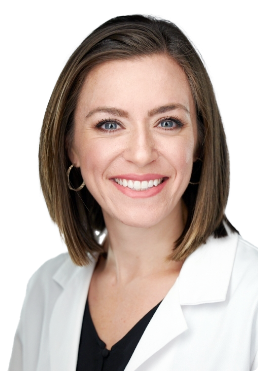

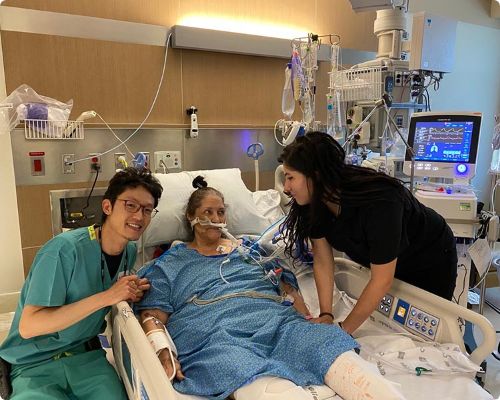 I stumbled upon Kali’s podcast midway through my anesthesia critical care fellowship in February 2021. At our institution, I got the impression that patients in the ICU either got better on their own or had a prolonged and complicated course to LTAC or death. In her podcast, Kali explained that LTAC was rarely the outcome for patients in the Awake and Walking ICU™ in Salt Lake City.