SUBSCRIBE TO THE PODCAST


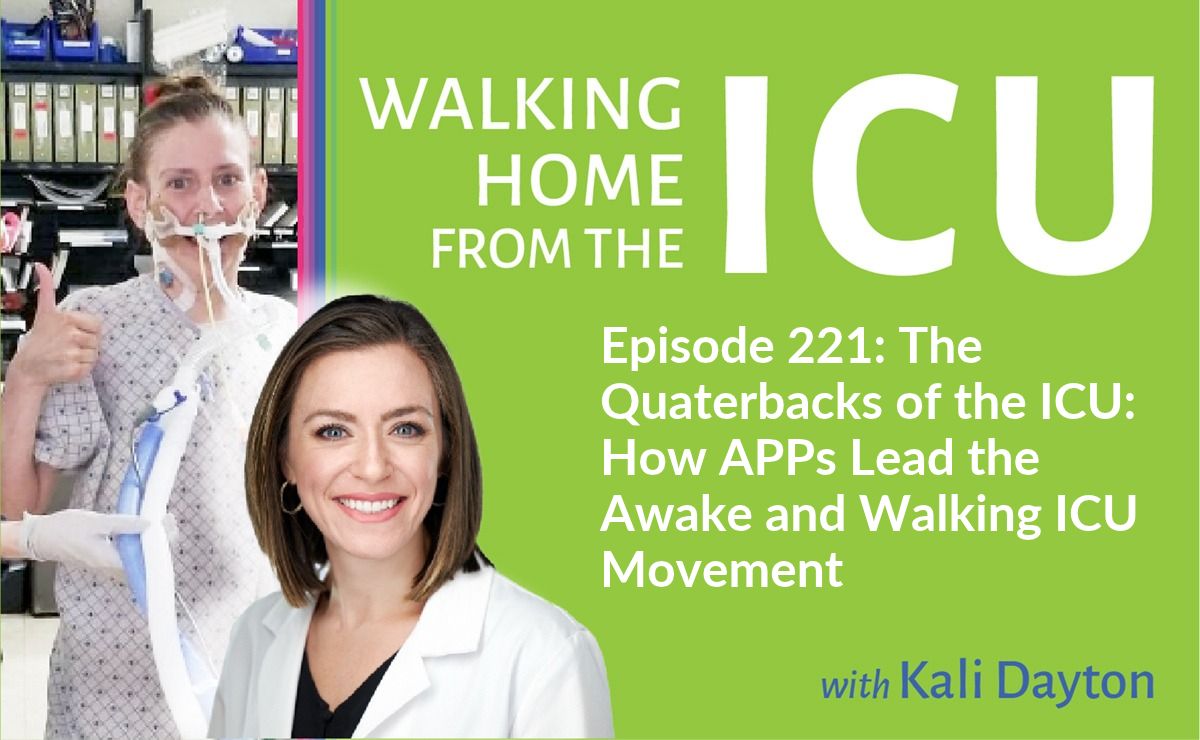
In honor of nurse practitioner week, Steven Bocchese, PdD, RN, AGACNP-BC, CCRN, joins us to explore the role APPs play in the ICU and how they should be utilized to get the ball into the end-zone of creating Awake and Walking ICUs.
Episode Transcription
[00:00:00] This is the Walking Home From the ICU podcast. I’m Kali Dayton, a nurse practitioner and ICU consultant. I help teams create awake and walking ICUs through evidence-based sedation and mobility practices. By hearing from survivors, clinicians, and researchers, we’ll explore how to give ICU patients the best chance to walk out of the ICU and go home to survive and thrive.[00:00:30]
Welcome to the ICU [00:01:00] revolution.
Happy Nurse Practitioner Week. I thought this would be a great opportunity to really hash out the role of NPs in critical care and especially in ICU liberation. Check out the article linked in the show notes for more of what Steve and I will be talking about in this episode
Audio Only – All Participants: Steve, it’s been a long time coming. I’m so excited to have you on the podcast. Can you introduce yourself to the audience? Sure. Kali, thank you so much for having me. I am Steve Bocchieri. [00:01:30] I am the Director of Nursing Research and Nurse Scientist at Virtua Health, which is a five-hospital academic center in southern New Jersey, about 15 minutes outside of Philadelphia.
I am a critical care, pulmonary critical care nurse practitioner by background was a surgical ICU nurse before that. And then have been really focused on ICU almost my entire career. And now I’m doing a lot of research that’s related to ICU [00:02:00] And you can put a plug in for your podcast Yes Good Company.
I’ll say it. He has a great podcast called In Good Company it’s a focus, it’s- it’s looking at those, those individuals in healthcare who are disruptors, innovators, and those that we put on pedestals and we say, “How do they get all of the work they do done in a day?”
And try to bring it back to, how are they relatable and really that we’re all in the same boat. We all have family. We all [00:02:30] work and life balance things. And trying to ground that, some of these people that do amazing work, and then also that they are just people just like everybody else.
So yeah, thank you. Thank you for doing that. You were my first guest and you were excellent. And people still talk about that first episode, so thank you. I wish I’d had that podcast years ago, ’cause I think being a revolutionist and going outside the box, probably in any facet of life, can be really scary and hard and daunting.
And so I think listeners of this podcast would relate to [00:03:00] your guests as terms of doing something pioneering in different venues and aspects because it’s it is hard. And yes, I was very personal on your podcast, which is not usually what I do here necessarily on this one. So yeah, go listen to Steve’s podcast.
But today, revolutionist to revolutionist and NP to NP, we were really hoping to dive into the APP role in the ICU, and certainly, I haven’t worked as an NP for [00:03:30] a few years as well. But my journey as a consultant helping create awake and walking ICUs, having worked in an awake and walking ICU as an RN and NP, has given me some strong feelings that we’ve you and I have shared.
And Steve and I co-published with other authors on an ICU liberation playbook for AACN’s advanced Critical Care Journal really trying to walk the readers through the role that [00:04:00] NPs or APPs should play in changing outcomes and elevating ICU liberation in the ICU.
So yeah, Steve, what has been your journey? What do you currently see in the community? It’s open mic. This is gonna be so cathartic. Let it, let her rip. Thank you. And honestly, this is perfect timing as, Happy National Nurse Practitioner Week to you a fellow nurse practitioner.
I identify as a nurse practitioner. I identify as a nurse. That is [00:04:30] always in there, that’s why I like the term nurse practitioner, ’cause it’s in there. But if you ask me what I am and what I do, I’m a nurse practitioner who does X and Y.
That is who I am and very proud of that and the work that our fellow nurse practitioners do. So from that paper The Liberation Playbook, that was published for AACN I was asked by you and then some of our co-authors to help fill in some of that APRN and APP aspect because I [00:05:00] totally believe that the nurse practitioner PA role is essential to critical care medicine in 2026, and has been for some time.
What it will look like in maybe 10 years, I don’t think we know quite yet. But it is essential to providing 24/7 consistent continuity of care of patients. And so why does that matter? So that matters because we have physicians who change weekly. That’s just part of their [00:05:30] rotation. We have nurses who work three 12s, so they rotate.
When I started as a nurse practitioner, I was on night shift working seven on, seven off, so I really got to know the unit those seven nights on. I was probably about 27 at the time, and so I was like … They were like, “Do you wanna work seven nights in a row?” And I was like, “I sure do.” But I can tell you I learned so much when I was doing it because I had to.
We were there and we had support from our physician colleagues, [00:06:00] they were on call and we had a hospice in the building and whatnot, but I really had to be at my best when I was there. And so what that gave me was the confidence and the awareness of the role I played in people’s lives in the ICU.
And so I always looked at the nurse practitioner role as the best of both worlds, but really that liaison. I am kind of the bridge that’s filling that gap. I- [00:06:30] Understand where the nurses are coming from in their workflow and their, issues that they raise and how they care for patients and the importance and the beauty that they provide in the care for patients.
But I also understand where the physician and provider role is and what, when some of those, competing priorities maybe don’t meet I felt like it was always my role and my job to make that kind of meet to better the care and make [00:07:00] it more consistent and cohesive, the care of that patient.
And so it’s funny, in that paper we use a metaphor with football. And so I’m right outside of Philadelphia. I’m a Philadelphia Eagle fan, unfortunately sometimes, but that’s part of it. But we talk about how the nurse is that wide receiver.
They are scoring touches. They’re on the field. They are at the patient’s bedside. They’re grinding it out and they’re making these wonderful plays. And the physician is more of that coach. They are designing some of the [00:07:30] tactics. They’re offering their consultive advice and whatnot and caring for the patients, of course.
But when it’s 24-hour coverage and whatnot, that quarterback who’s kind of the captain of the, the team there, they are really managing everything that’s going on, and they have those priorities of trying to meet demands of the patient, understanding what’s going on from the physician side and the nursing side.
And so it just plays such a huge role in that. And so when I look back and I’ve done this a lot, [00:08:00] especially as I have been listening to your podcast becoming a revolutionist and some of really getting involved in the ICU liberation and the awake and walking ICU and the tenets of that human-centered care through that I really look back on, wow I really did have an impact, whether that was good or bad.
Sedation practices I was part of the culture, I was the one that was putting the breathing tube in, but then I was also like, “Do you want propofol or do you want [00:08:30] fentanyl?” And that was just what we did. You’re al- you were also a product of the culture, right?
Yeah. I think most of us don’t- Do this voluntarily necessarily initially. It’s once you know better that it’s a choice, but yeah, that was your culture. Yeah, absolutely, and that was my culture as a nurse, then as a nurse practitioner. All of that. And one of the things that, and every time I think back on it I, you feel some guilt, but you kinda understand that was part of the culture.
And it’s kinda that moment of the matrix, like I’m unplugged [00:09:00] now. There’s the quote from Maya Angelou that Dr. Ely has, … that wrote in his book, Every Breath You Draw, Breath Of, I went from being ignorant of being ignorant to being aware of being aware. And so that is actually something and I’m not generally that corny, but I did put that in on a piece of wood, and it’s sitting at my desk, and this is something I think about quite often.
And so when I lecture to other nurse practitioners or PAs or nurses or [00:09:30] other revolutionists at, in my center I will say to them “I get it. We didn’t know better. However, now you do know better. So how do we be better and do better with what we know now for those patients?” Because now we can’t
The toothpaste is out of the tube. The Pandora box is open. You know better now, so how do we provide that care? And so you try to make it so it’s not judgemental because we don’t want people to feel this [00:10:00] resounding guilt. We did the best we could with the information that we had, but now we know better.
And so that’s really the product that we want to put out there. And following this analogy of the APPs being the quarterbacks of a team I remember as an NP in the Wake and Walk-In ICU, we just ran ourselves most of the time, and then the system implemented an APP group throughout the entire system, critical care APPs.
And so now we had a new manager and now we were in [00:10:30] the same group as APPs from all these other units who had a very different practice and culture and even role for APPs. I really think that we served kind of a CNS role as well, as far as like mentoring nurses, provide that bedside education, working on quality improvement, really getting into the fine details of patient care and our process of care as a team, as team leaders.
So now we’re grouped in with other people with other [00:11:00] experiences and roles, and management was trying to change our staffing to make us basically like a float pool, where we would float to these, 13 different ICUs and fill in different shifts almost like the nursing model again, right?
As a nurse, I loved to pick up a Monday day, Wednesday night, Saturday day, plan my vacations around it. It was so convenient. And honestly, I was having babies and life was getting crazy and I thought, “Yeah, this is not super fun to have this really restricted schedule and consecutive days of being [00:11:30] basically absent.
That’s not convenient for me.” And so I remember like being enticed by that model, and Polly Bailey, the founder of this Awake and Walk-In ICU, and Louise Bastian threw the biggest fit. And I was like, “Oh, here they are. They’re in their soapboxes. Here we go, right? Here comes another battle.” Now that I’ve done consulting, oh my gosh, I see it.
Because if you’re going through the quarterback analogy, how well could a quarterback play if they’re playing with a [00:12:00] different team every week It is not just that they catch the ball and throw the ball, it’s that they know their team members, they know the plays, they practice it, there’s a relationship and they’re running through it all the time.
And so I don’t think I appreciated continuity of care until I became an NP and I realized, holy cow, I have such a different perspective working three to seven straight versus when I first come on that first day, I’m not a great NP [00:12:30] that day ’cause I’m just putting out the fires and figuring out who people are and just trying to con- keep up with orders and procedures, right?
But by day seven, I have a global view, and I really know what’s going on. So I see that same model that was being implemented or attempted to implement in that ICU happening in some of these teams that I’ve trained now where it’s a different APP showing up different days, different weeks, they float throughout.
And so what are your thoughts on continuity care as far as schedule as [00:13:00] well as where they are practicing? Yeah I think that’s a great question and it’s a great point that you’re making. So part of that paper that we wrote about the Liberation Playbook and the analogy that we used in the football was that continuity of care.
And so if sports and whatnot, it’s very similar to how we practice, where as a nurse, as a physician, as a nurse practitioner, you’re always anticipating. And so when you’re a [00:13:30] quarterback, you’re anticipating, you know where the route is going, you know where the wide receiver is going.
But if you need to change up and flex a little bit from whatnot, you know your person, you know what they like. They, you know they like to catch with their right hand, not their left hand. And so that is really crucial, especially when you work with staff, that you know the nurses that you can rely on, you know the physicians that you can depend on if you need some assistance.
When you get floated other places, you can do the job. You can do there, you [00:14:00] can diagnose sepsis and you can put a line in and all of that sort of stuff. However, if you’re in your home unit and you build some continuity, you know so and so is gonna call you out if you don’t keep sterile technique, and that’s better patient care.
You know that you don’t have to go through the whole rigmarole of saying “No, we’re not going to put a sedation on. This is why.” So you don’t have to go through all of that because you know that this is the care that we provide here. [00:14:30] And there’s an ownership to that as well. I think, when we, when during COVID and then post-COVID really and some, some places are still have agency nurses.
And there’s nothing wrong with agency nurses that they we relied on them- Yeah … for so long. But there isn’t an ownersh- or there isn’t a a, a system ownership or a system dedication because they are, they’re coming in, they’re doing their job, and then they’re going home. And that makes sense [00:15:00] for what they are doing.
But it’s much different if you have to be living in that unit and really want to show up and you want to be, you want to make your pro workers proud, you want to do that. So I think that the plugging people into different stuff, I think that comes around every once in a while where they’re like, “Okay, we’re gonna, we’re gonna switch it up and we’re gonna, so everyone this hospital is a little bit more difficult, or this unit’s a little bit more difficult, so we’ll switch it out.” And then what you find out is that people l- feel comfortable in their community. [00:15:30] And so the, again that, that analogy, that metaphor I can never remember which one is which with the s- with the sports team, with the football team really goes because ICU care is very much team sport.
It has to be. There has to be a flattening of that hierarchy because we have to talk, be able to talk with each other as colleagues, not as someone superior, someone’s subordinate, all of that. Because we all have a job to do, but we all have to speak clearly, [00:16:00] transparently, know our roles, all of that.
And so that you can’t build that trust unless you spend time, work through difficult cases and whatnot together. And that can really have a negative impact on the overall care. You might be able to put out that fire, but the overall trajectory of a patient, I do think is affected by continuity of care A thousand percent.
And I experienced some of this when I, during COVID, and now I’m [00:16:30] working telemedicine in part. I’m doing, run of shifts in like walk-in COVID unit and then doing telemedicine. And so I was very much in the groove of how these patients should be cared for.
And from tele, I’m trying to help manage these patients throughout a, a region, and I’m Zooming in, and I don’t know these team members, right? I don’t know the nurse in the room who was already, like, hating that I’m watching them from the screen. I hate it, too. I know that it’s awkward. I hate it. But I’m also concerned about [00:17:00] certain things, especially related to delirium, sedation mobility, and ventilator management.
And I knew, I had an idea of what needed to be done, but I couldn’t coach them through it because they didn’t know me. I was just there temporarily. I’m looking over 50 patients at a time. I’m popping in being like, “Do an SAT, turn that sedation off, get them up, let me know. I’ll circle back in five hours,” right?
And i- it just doesn’t work that way. And if that was constantly the message that they got from APPs, it would never work. And so in our article we’re [00:17:30] using a case study from a, a patient that I just was involved with during consulting, playing the APP role, and it required a lot of bedside coaching, right?
This team was not comfortable with this patient, who was a bariatric patient on PEEP of 16 to 90%, turning off sedation was not their first thought. And yet, if I hadn’t been there, if there wasn’t an APP who spoke the nursing language, who could take the time, be that bridge, but also who had that bird’s-eye view, who could [00:18:00] anticipate what’s coming.
So yes, it was hours after intubation, but I anticipated delirium and ICU-acquired weakness coming and the bad repercussions. And as they had concerns, there needed to be someone there to validate those concerns and also educate and guide them and coach them through doing a new process. And I know I’m biased, but I really think APPs should absolutely be the ones to do that.
We keep waiting for physicians to play that role, and certainly I’ve interviewed physicians on the [00:18:30] podcast who take that upon themselves. I don’t think that’s part of their medical model. I think APPs a lot of times they’re just easier to communicate with, right? They speak that language.
They have those relationships. But I don’t know how they could possibly fulfill that leadership quarterback model when they’re going to a different unit every week or they’re picking up 12-hour shifts sporadically like a nurse, because you don’t know the patients either. You don’t know how they were [00:19:00] yesterday versus today or two days ago.
There’s so much information that we need to know that you are just trying to scramble and crank out your notes, copy and paste as fast as you can or whatever, right? I know we’re thinking through things, but, we’re comparing like crying yesterday to today, not what was their baseline level of mobility, what’s happened today, how much nutrition are they getting, who are their family members, how do we involve them more?
Things that eventually you want the bedside clinicians really to be able to navigate on their own. But if you’re creating a wake and walk in ICU, [00:19:30] you need a high-level provider with critical thinking, a global perspective, high level of medical management experience Who understands awake and walking ICUs very well and has these relationships and is part of the team.
Who else would play that part? Yeah, I think that, that’s spot on. I’m thinking about if I said to you, “How do you feel if you had to go in right now and talk, take care of a hyperactive delirious patient?” And you already can see [00:20:00] what your shift is gonna look like because you’re spending 12 hours at the bedside with that patient telling them to get back into bed,
Doing all that stuff. And so as a nurse practitioner, if I had to have that conversation with a nurse they knew that I had receipts. I had experience, that they knew that, and we built a relationship on that so that they knew, … And that just isn’t what happens with physicians, and that’s not a knock.
That’s just not- Yeah … that’s just, they don’t- The reality … they’re [00:20:30] not in there 12 hours a day. So that is, I think that does build credence. And, nurses, we’re a packed type of group. You gotta earn your keep a little bit to, have some any kind of Credibility
credibility. Yeah, absolutely. And so- I know that physicians that say, “Hey, turn sedation off,” and walk away, they’ve got the middle finger being- Yeah … flashed at them right behind their back. That is, that’s a tough spot to be in. And not that they can’t make an impact, but I find myself trying to coach [00:21:00] physicians to take that APP role, to stay at the bedside, and I don’t know that they’re always comfortable. These are- … these are, like, very hands-on humanistic skills that you learn being a nurse. And not that physicians can’t have human touch, but most of their education has been very focused on- procedures and writing out the plays and executing the plays rather than being on the team.
You know what I mean? Yeah, and I think it does come down to training, [00:21:30] too. What I will say what I think is very encouraging is And this is new nurses, this is new physicians, med students. Every generation goes through that thing of “Back in my day, we, walked uphill both ways,” and all of that.
But I do think that the physicians that are coming out now have really a great appreciation for the APP role. They are understanding that the human is at the center of all this, and I think that they are really focused on building some of those [00:22:00] skills. And that’s not to say that isn’t the same for those seasoned physicians.
I just don’t think the training was like that. And so they are trying to make up for it on the back end. But I think that some of them are coming out a little bit stronger with that, which is extremely encouraging. But, again, if you’re kinda making eyes across the way with the nurse “I understand what you’re going through,” that’s a big, that’s a big difference.
And then you have the NP provider kind of lens. So now you’re zooming [00:22:30] out. That’s what I felt like I always did. I just zoomed out. If there was any feeling of tunnel vision, I zoomed out and looked at the bigger picture and thought, That is, that’s how we’re trained, too, going through differentials and not missing those big don’t-miss differentials, like a PE or a dissection or something like that.
So that’s how you’re trained to not focus in on one thing so you have the greater picture. And so I think that is why they’re so essential, is that they can have that bigger picture, but then they can get granular [00:23:00] and go side by side with the nursing staff. So if you’re really trying to push something, like, “Hey, I don’t think that they’re desynchronous with the ventilator because they’re under-sedated.
This is why. I understand it’s gonna beep, and nobody likes that beep, and it’s gonna drive you nuts, but this is the reason why.” And I do think that, that does help. That does make a difference. And you’re building a stronger team, right? As a nurse, I would ask the NPs all the time these [00:23:30] higher-level questions.
And unless they were like, everything’s on fire,” they really would stop and educate and teach me, and that built a stronger relationship, but I think it makes everybody safer. So that’s kind of the CNS role as well, that I love the CNS role It’s rare that you have NPs and CNAs together, though I think it’s a great harmony.
But let’s be realistic, not, those are the unicorn hospitals that I’ve rarely seen. The other concern during these shifts that I was in the thick of [00:24:00] during that time was we want to have continuity care within our unit, right? I don’t wanna just float everywhere. But also, what’s gonna happen if we have other APPs coming who are not fulfilling this role?
They are there solely to do notes and procedures, and this is an expertise. I’ve come to really appreciate that. I thought if people just knew that it was possible, they’ll just go out and do it. I’ve come to appreciate that this comes with experience, right? So if they’re coming in blind, [00:24:30] and, we’ve got COVID, we’ve got turnover in nurses, we’ve got travel nurses now.
If we have these outsider NPs coming in, are we just gonna lose this culture? And so I see that when we’re establishing a culture and things are fragile, it should never depend on which physician, which NP, which nurse, which PT is on, right? But initially, it kinda does. So I struggle with when we’re reviewing cases with these teams, I’m like, “And where [00:25:00] was the APP?
How did this happen?” How do we go through five days of this? I can kinda see one nurse being tunnel-visioned on a bad shift, but where’s our safety net and our APP as, where’s the quarterback? So what what would be, I don’t know, ideal? How can a revolutionist APP advocate for continuity of care in their shifts be established in one ICU and being allowed to have this leadership role?
Yeah, that, that’s a great question. And I think it comes [00:25:30] back to culture, so flattening the hierarchy. So knowing that you’re working with colleagues, not superior subordinates because that’s a very sticky and very dangerous situation to get into And that, that comes down to being a high reliable organization where titles really should go out the window, and you have to work together.
And again, ICU is one of those environments and those ecosystems, and I think there’s some other ones too in healthcare where the ED I feel like is like that, the OR can be like that, where [00:26:00] it is truly a team sport, and you need all those pieces. And if you have all of the same piece you’re missing out on so much, so you need those that have a different lens and whatnot.
Back to your question, the advocating for the role and their place in ICU liberation is that, one, we have to get better at knowing what the evidence is and then what is our role in [00:26:30] that.
And so sometimes I’ve heard over and over APPs that will say something to defend let me check with my attending.” And so you have to really build that relationship. And, we work in states that we don’t have full practice authority, and especially in the inpatient side.
Even the ones that have full practice authority, that, that’s not the, the same in the inpatient acute care side of it. And so you have to show that you can hold your own and you know what you’re talking about so that your attending can [00:27:00] trust you, too. Again, it comes down to trust. Healthcare is all about trust.
And so I think you can build up some of that capital, some of that social capital with those that either you report to or those that you’re serving, you know, in, in the ICU. So I think you have to really know your stuff. The second part is I think you have to come to it in good faith. It can’t be a, “I’m telling you to do this, and we have to do it because that’s what happened when Kali Dayton came to our ICU.
She told us we had to do it, [00:27:30] and our metric for vent days is not as good as we need to be. Just please just do it.” That, that can’t be the case. That’s too superficial. It doesn’t have staying power. It won’t be sustainable. Once you leave, it’s out the window. I also think that we need to have coalitions of APPs.
We need nurse practitioners to be a- Working on this together. And so when you look at… it’s funny I did my [00:28:00] doctoral work on moral distress in ICU nurse practitioners, and one of the reasons why when I l- was looking through all the studies on moral distress and, like, how does it affect the nurse practitioner?
‘Cause I always felt like it was different because of where they are in the hierarchy. I did a qualitative study. That’s what it showed, that the the hierarchical system did play a role in their moral distress. But when you looked at studies, it would be sometimes we were grouped with the nursing staff, sometimes we were grouped with the physician staff.
There was an N of five. We never [00:28:30] really were highlighted as our own discipline and what we brought to the table. And like we’ve talked about tonight today, there, there’s so much that we bring that it should be noted, celebrated, and not just celebrated, but use it. We are there to work.
We want to work, and we want to do the best that we can without any of the noise. We really want to do the best we can. So I think that coalitions and nurse practitioner groups and stuff, that is where we can really start building, so tapping [00:29:00] into those revolutionists that are really bought into that.
I don’t practice in the ICU any longer. I still maintain my certification, my license. I do some adjunct work with nurse practitioners and some other stuff. But obviously as a nurse it speaks to me, but as a nurse practitioner, I’m like, this is really where we can shine
because we are present, we are there, we know the patients, we know the staff, and where we can really build a community of trust so that we can [00:29:30] really dig in, and build some roots with ICU Liberation and making this an awake and walking ICU. I 100% believe that. And I do think we will see that moving forward, and I think because it’s being highlighted by people like you.
So I think that is such a crucial aspect. And I think that nurse practitioners are really primed to lead that effort. I came out of NP school so excited to do the big sexy skills- Yeah … which are important, right? You’ve got someone [00:30:00] actively dying, you put a tube in, they’re oxygenated.
Those are very important. And I remember Polly being like, “Go ahead, Kali. That’s nice. Yeah let’s work on those things. But also, those may not even change outcomes.” And I was like what do you mean?” I’m just a new NP and that’s really what a lot of the grad school training was about, right?
And she’s “As NPs, we can change outcomes. We really determine whether or not they survive and especially what kind of lives they go on to live. It is an art, and it’s so much [00:30:30] more than any of our other colleagues have learned. This is our role.” And so I didn’t totally understand what she meant at that time, and I was like, “Oh, there’s Polly doing Polly.”
It’s funny how many times I rolled my eyes at Polly. Now I quote her all the time. Don’t tell her. But- Sure … now I get it, right? I see APPs doing good work and all these things, but almost being used as the physician’s assistants, the scribes, the the procedure people. But we have such an opportunity to change [00:31:00] outcomes.
But I think we have to rise up and not fall into the system that wants to treat us like nurses, where I think nurses even should have continuity care, by the way. But that’s gonna be a whole thing to overhaul. But it- but to accept being tossed around shift to shift at different locations we need to advocate for our teams by establishing ourselves as the quarterbacks and building up that trust and seeing ourselves in that way.
How do you become an expert in something you’ve never done? How do you know how to keep people awake and [00:31:30] mobile if you’ve never done it? You can be a total fan and advocate of ICU liberation ’cause it sounds nice and evidence is great, but when it comes down to it, do you really know and are you teachable?
And once are you willing to put yourself out there and fight for it, even though it’s pushing against the culture of your own ICU? I just can’t imagine anyone in a better position, but I think it takes a team of NPs or APPs that we as a team, we as we hand off the [00:32:00] baton from the night shift or to the next one that’s gonna do their run, I trust that person to carry on what I started.
But if it’s only this one APP is excited about this that I think sets them up for moral injury 一股 nonostante斯的 deline conferencing Marlin siren terça采vej BJ [00:32:30] Abo sere verde оби agon sientoୁ
[00:33:00] оби
way坚持 N puddleusch G A- it’s just really well said. I think that we have a a moral responsibility, a moral obligation to really own our practice, and as professionals, as people, to care for these patients and to kind of band together to do this. And again it’s a team sport, so it’s not that we are doing it [00:33:30] in a silo.
But, I think that the nurse practitioner role, and this is just me saying it, but I do think it’s the loneliest position. Only NPs, and I think physician associates can understand this as well, ’cause there’s so much overlap, is that you don’t quite fit in with either group, so I always felt that it was a very lonely position except for other NPs. And because there’s still a growing number, especially in the acute care setting, we are really growing. I think the last count was about 461,000 [00:34:00] from the AANP total in the country. But you would be hard-pressed to find an ICU that doesn’t have a nurse practitioner PA that is there at least at some point during the week.
If you’ve been listening to this podcast, you’re likely convinced that sedation and mobility practices in the ICU need to change. The ICU community is facing incredible difficulty with the trauma from the pandemic, staffing crisis, and burnout. We cannot afford to continue practices that [00:34:30] result in poor patient outcomes, more time in the ICU, higher healthcare costs, and greater workload for the ICU team.
Yet the prospect of changing decades of beliefs, practices, and culture across all disciplines of the ICU is a daunting task. How does this transformation start? It can begin with a consultation with me to discuss your team’s current practices, barriers, and to formulate a plan to help your ICU become an awake and walking ICU.
I help teams master the [00:35:00] ABCDEF bundle through education, consulting, simulation training, and bedside support. Let’s work together to move your team into the future of evidence-based ICU care. Click the link in the show notes of this episode to find out more.
Audio Only – All Participants: I think, really building the trust and [00:35:30] the coalition to band together and really describe and take on some of these things, I think is is crucial. You’re absolutely right. I came out too. I couldn’t wait to put in lines or intubate, and it was so much fun.
I can think about one of the, a chest tube that I put into a patient with tension pneumo, and it just resolved. But she had severe lung disease. She had ARDS, and she died a couple days later. It didn’t change outcome, but I was very [00:36:00] good at putting that chest tube in. And then I realized that, no, it’s actually about preventing the harm and diagnosing and understanding the trajectory anticipation of what could happen, and that’s really what ICU liberation and the awake and walking ICU is.
It’s you can see the future. And then in the paper, we talk about with the case study with the 38-year-old patient. It’s like you can see what could happen And so you now have the knowledge, [00:36:30] and now, again, the responsibility to be the stopgap there and say, “I’m gonna hold the line here.”
And I think that this is what we’re setting them up for because I have the educational background, the experience to say “This is what I am seeing the pathway for this gentleman, and it doesn’t have to be that way.” And the APP who’s there 24/7 is such a great person to lead that charge in collaboration, again, [00:37:00] with the coach, with the wide receivers, with the running back, like all of that as, as kind of that, quote-unquote, “quarterback.”
And I think we mentioned in the article as well, or maybe it was just something I always think about, is that I see- mastering a ABCDEF bundle from the APP role is part of protecting your colleagues as well. So in that specific case study, This was the patient with polysubstance abuse who was at high risk of delirium.
But I think everyone was afraid because we all know [00:37:30] that patient’s probably gonna come out swinging if they develop delirium. It was a patient of size, so it was gonna be a heavy haul for the team to boost, turn them. Everyone saw a trach and PEG down the road for him. It was gonna be demoralizing, depressing.
Everyone already had this dark cloud going into that room, being like, “Oh, freak, here it is. I know this patient. I’ve treated 20 of him last month.” And so I think there was an opportunity to be protective against the harm of your colleagues, elevating the morale of the unit by seeing good outcomes, celebrating their good win.
When he [00:38:00] walked out of there three days later, the team was, like, thumping their chests. They’re baddies, and absolutely they should celebrate. So there’s an opportunity to help make that happen and change the environment of the ICU through that, as well as improve patient patient safety and clinician safety.
And another Polly-ism that I appreciate more now that I’m older and wiser she had started these safety rounds, which sounds fluff, and most people would roll their eyes at them. But each shift, we would go around, and we had a little cart, and we [00:38:30] had this criteria, and we would identify what patients were at risk for and what level of risk that they had.
So if they’re at risk of hypoxia we’d give a yellow. If they were at high risk maybe they’re, like, maxed out on high flow we’d give a red. If, or even delayed intubation, pressure injuries, falls line two removals. So you’d get these little icons at the doorway, so everyone knew, “Okay, that patient has their high flow off.
That’s bad,” right? They’re they can’t just blow their nose, like some patients, right? Oh, their hands are going are [00:39:00] free. They’re not supposed to be, right? So everyone knew. So it seemed like a really boring, mundane thing. It’s like we got other fish to fry, Polly. We got all of these other things going on.
But now I see, having been through so many ICUs and seen how much safer that would make an environment. But it needed to be an APP, it needed to be an NP who’s, who can speak nurse and can see the big picture and those were the, our moments to teach. So everyone’s got preventative, proactive care on the mind, and it was just a quick 15-minute [00:39:30] through the ICU boom.
And now everyone’s got a plan to prevent harm rather than, “Oh, shoot, now we’ve got a pressure injury. How did that happen?” But that’s not sexy Right? It’s not like you just they were blue and now they’re not. It was something that you probably don’t see day to day, but APPs, we can appreciate it because we have continuity.
We see this harm happening and we see how it happens. So that’s our invitation for APPs out there is to rise up and to be leaders of the revolution. [00:40:00] Don’t just wait for your attendings to do it, and don’t just whine about the nurses and their sedation. Go to the bedside, coach them through it, turn it off with them, stay there.
Stay there after intubation. Don’t just order sedation. Go in two hours later if you gave a paralytic, turn sedation off with them and coach them through it. Be the quarterbacks And provide that why and that education like you mentioned. I think that is another piece that we have, we are good at.
We can provide that [00:40:30] why, and we should be doing that because, I don’t want to be dictated to either, so I get that feeling. And then also, one of the best qualities I always felt was, like, I could tell… I knew when someone was trying to do a workaround. ‘Cause you worked it, so you got the sense of, you’re like, “All right, I know what you’re doing.”
Don’t minimize that. That’s actually a great thing because now you know all the tricks, but I think that, like you mentioned and I was gonna ask you, how long did it take for you to do those, those quick safety, those safety rounds? Is it about 15, 20- Oh, initially, it took us [00:41:00] 30, 40 minutes.
It was so annoying. You got it down. And I was the only one in PE, so I was like, “Oh my gosh, I have so many notes to write. I’ve got transfers, admissions. I got,” and then it became 15 minutes, and everyone else initially we’re having to ask them questions, and everyone’s having to stop and think about it, but by the time they heard the cart running, they’re like, “I got it.”
They already knew what to report on. They had already been thinking about it. So it wasn’t just that we were meeting. It was that they were learning through that process, and they were becoming safer and more efficient, so it was just a check. But yeah, initially, it was annoying [00:41:30] and painful.
And that’s so much of what I do now. I’m like, “I’m gonna help you guys implement things that are annoying and painful,” but it’s going to become efficient. It’s gonna become part of the culture, and it’s going to transform outcomes. But also, there was an opportunity for accountability, right? We make plans during that time.
So we try to do it mid-shift so we could follow up by the end of our shift. And I see that being a blank spot in our role throughout some of these ICU teams as they’re just gonna write the orders, and they’re gonna focus on all these other [00:42:00] things, which there is so much going on, but also, does it get done or not?
What does the nurse need to get it done? Or how did it go? Like, how did that mobility session go? That gives me information. If you order a fluid bolus, you’re probably gonna follow up and see what happened. How responsive were they? You’re gonna do, POCUS or whatever. But do we do that with mobility?
So do we just order PT and OT and be like, “Yeah whatever they think or whatever happens”? No, instead, we should know they walked 200 feet yesterday. What did they do today? They barely sat at the edge of the bed. Did they do better today? What ventilator settings did [00:42:30] they need during that time?
That’s gonna help me know whether or not they’re ready to be extubated. I had PT and OT coming in and giving me their own separate reports on the entire unit every day during my shift. I don’t see that happening at all, so I feel like there’s a key piece of information. I included that in my notes I don’t see that happening.
I do remember as a nurse, Paul and Louise would come onto day shift at 6:45, and I was oftentimes working night shift, and they’d come to my bedside at 6:50. If I hadn’t mobilized my patient, they knew. They were checking on all the documentation from the [00:43:00] night before. They’d come to the bedside and so sweetly/stoically say, “Hey, looks like your patient’s alive, but mobility didn’t happen, huh?
What happened?” Yeah. If I now was like, “Hey, I was running a rapid infuser and the, we had two codes,” they’d be like, “Okay, get it.” Otherwise, there better be a good reason why you didn’t sit your patient up at least. And so there’s that level of accountability, and they instilled to me that it was like an antibiotic.
Also, if I didn’t get it done, not that they were super punitive, but they were just like an older Nurse Cratchit kind of generation, [00:43:30] where I didn’t wanna cross them. So I just knew- … it was easier to get it done, and I knew that someone cared, someone was watching it and that this was part of my responsibility.
It wasn’t optional. And we need APPs to instill that into the culture. You don’t just- Yeah … order an antibiotic, and if they wanna give it, it’s fine. If they don’t, it’s fine. You’re gonna follow up the next day and be like, “You didn’t give that Vancomycin. What are you thinking?” And then what happened even with that is now with sepsis, if you’re not hitting certain bundles and whatnot, you’re not getting reimbursed, and it’s [00:44:00] publicly shown of how, what your sepsis numbers are and what your surgical site infections are and stuff.
And so there’s not that with mobility, but there may come a time, especially with a lot of the age-friendly care with the four Ms there may come a time, and you don’t want CMS to make that you have to do it. We want to do it because it’s the right thing to do.
It’s funny when you said about if you were really busy and had… what I’ve experienced too is that word busy [00:44:30] ge- gets used a lot, and it’s very hard to differentiate what is truly busy. And when I oriented new to practice or had student nurse practitioner students or precepted new to practice I’m like, yeah, it’s you’re in the ICU.
There is literal life and death happening. But it’s not every second of every day. There’s a lot of times where you’re not putting in a line or doing an emergent chest tube, you’re just ordering a Dulcolax suppository. Do you know what I mean? You gotta- Yeah … keep it moving literally- Yeah
and figuratively. But [00:45:00] that is the grind. That’s the work. And so sometimes, like you said sometimes it’s not sexy, but that’s okay because that is the work. And what, when you do the work, when you put the work in, it will come back to you. It will show in your outcomes. When I was starting, I wanted to do all the procedures, but then I realized that diagnosing and preventing those procedures from having to be done was really the most important thing, and that totally changed how I practiced [00:45:30] after that, and I think we all go through that.
Yeah … we’re learning because it’s super cool, and it’s fun. It’s it’s just… It’s really, it’s… You got some swagger on the unit. It- it’s very exciting, but then you realize, really, this is the work, and it’s kinda great, to be honest, to be a good diagnostician and to, I- one night I diagnosed endogas- endophthalmitis, and I thought I was probably the best clinician in the world, and it wasn’t something…
I actually didn’t quite diagnose it. I felt the, had [00:46:00] the symptoms, and I said, “This sounds like a, a great case for ophthalmology.” But you start getting kinda jazzed about that stuff, and it’s the same thing with ICU liberation, I think and really trying to create a wake-and-walking ICU, is if you start seeing th- there’s not a lot of sedation on your unit, people are up and moving and stuff.
Yeah, you may not have these really cool hybrid and super interesting vent settings and all of this stuff- But your patients don’t want that either. They wanna be [00:46:30] extubated, they wanna walk and they wanna go home at baseline or better than when they came in. And that is really the job, that is what we should be doing.
And again, NPs, we know that. We know how to get them there. We are trained to get them there. And so now The Band-Aid’s off, all of that stuff, we need to get them there yeah, there’s certainly an initial high of learning how to intubate. But my question has become, but do [00:47:00] you know how to extubate?
Yeah. Do you know how to extubate as soon as possible with as little damage as possible? So in that maturation process, the new high becomes, “Whoa, we extubated them while they were in the chair. They walked out the door. They discharged home. They were 99 years old. We didn’t expect that.” That’s a true story- from one of the teams that I’ve previously trained. First one- … to walk was 99 years old. Could you get more bad A, right? Yeah. Now, whether that, they should have intubated is a question, but if you’re going to intubate, [00:47:30] then you do everything possible to get them extubated, and that should be the pride of everyone, but especially APPs.
If you’re gonna intubate, if you’re gonna take ownership of that, then take ownership of getting that tube out. And it’s not just ordering SATs, SBTs. It’s taking it to the end zone. Thank you so much, Steve, and thank you for the impact that you’ve made in your system. It’s been amazing to see an APP take a system-wide role and [00:48:00] again run this, the end zone, with at a system-wide level.
You’re a tribute to all revolutionists, and we’ll do some more follow-up episodes with your system and the progress that’s been made. It’s been a marathon, but it’s amazing to watch the impact of a revolutionist who lights the fire across the board.
Thank you for saying that. It’s very kind of you. I think that those that, that are working at Virtua are the ones that are really leading that. I may be lighting that fire, but they’re the ones that are, [00:48:30] again, are doing the work. And we’ve also been very lucky and very fortunate that Virtua says yes, that, that doesn’t always happen at health systems. But our mantra our whole thing is really being here for good. We are champions of humanity and being there for everybody always. And that is truly what ICU Liberation does.
It’s really being there for everybody always, and that is something that I’m very proud of at my institution. And all of, [00:49:00] not just the nurses, but the nurses, the APP’s, the physicians, the respiratory therapists, the dieticians, the physical therapists, the speech therapists, the occupational ther- It, again, is such a team sport, and people have just, Bought in.
And there’s always gonna be some of the late adopters, but we’ll get them there too. We will get them there too. But I’ve just been so impressed with the work that those at Virtual have done and very honored to have you join us in our ICUs. And [00:49:30] This podcast the work that you’re doing is just phenomenal.
And it’s impacting people in such ways that you and I will never even know. But it makes such a difference. And I’ve said this to you before, I said and I’ve said to others that, we can all do surviving sepsis campaign. We can all do the guidelines. We can all start antibiotics initially when you identify their sepsis, and we can do source control.
We can do all that stuff, but you can still kinda do that like a robot. But ICU liberation and truly making an [00:50:00] awake and walking ICU, you have to have that human at the center of the care, and you have to be very aware of that or it just doesn’t work. And so I always admire you and those that before both of us, you know, Dr.
Ely, Heidi Engel, Julian Barr, like, all these folks that have just been such leaders in the fields. They’re all coming to this in good faith, and I’m just So happy in my career [00:50:30] to be with you today and to be where we are at my institution. It’s fun to watch our generation kinda grab the baton and move forward- with it as well, right? We’re building off of what our previous pioneers have built. And yeah, huge shout-out to Virtua. Working with a lot of systems, I have a lot of respect for the system-wide support from the top down or however you wanna put it. I don’t even like that phrase, but, I don’t know how else to phrase it, right?
But throughout the system, there’s a [00:51:00] lot of support of this is going to be the standard of care. This is how we as a system are going to practice. This is the care that our patients are going to receive. And they’re really trying to provide the education, support, the resources to make it happen and feasible for the bedside clinicians.
We’re going to interview Amanda soon an assistant nurse manager who has poured her heart and soul into this but has really moved the needle there. But I guess this is an advertisement for Virtua, right? ICU revolutionists, if you’re looking for a system where you can [00:51:30] actually practice in a way can walk in ICU and thrive, I don’t mean to speak for them, but I’ll bet their doors are open, right?
They’re, Absolutely … if you wanna join an army that is moving forward with this and even leading the way, go to Virtua. It’d be worth relocating, just throwing it out there. So I want the best revolutionists to go and buoy up the, the revolutionists there and just run it to the end zone.
And we’re happy to talk with anybody. And from one quarterback to [00:52:00] another game recognizes game. So very happy to be with you today. Thank you. And I will put a link to the ICU Liberation Playbook in the show notes as well as Steve’s podcast. Thank you. Thank you.
To schedule a consultation for your ICU as well as find supportive resources such as the free ebook, case studies, episodes, citations, and transcripts, please check out the website.
Transcribed by https://otter.ai
References
Liberation Playbook: Pain, Sedation, Sleep, and Mobility Led by Advanced Practice Registered Nurses
In Good Company with Steven Bocchese, PdD, RN, AGACNP-BC, CCRN
SUBSCRIBE TO THE PODCAST