SUBSCRIBE TO THE PODCAST


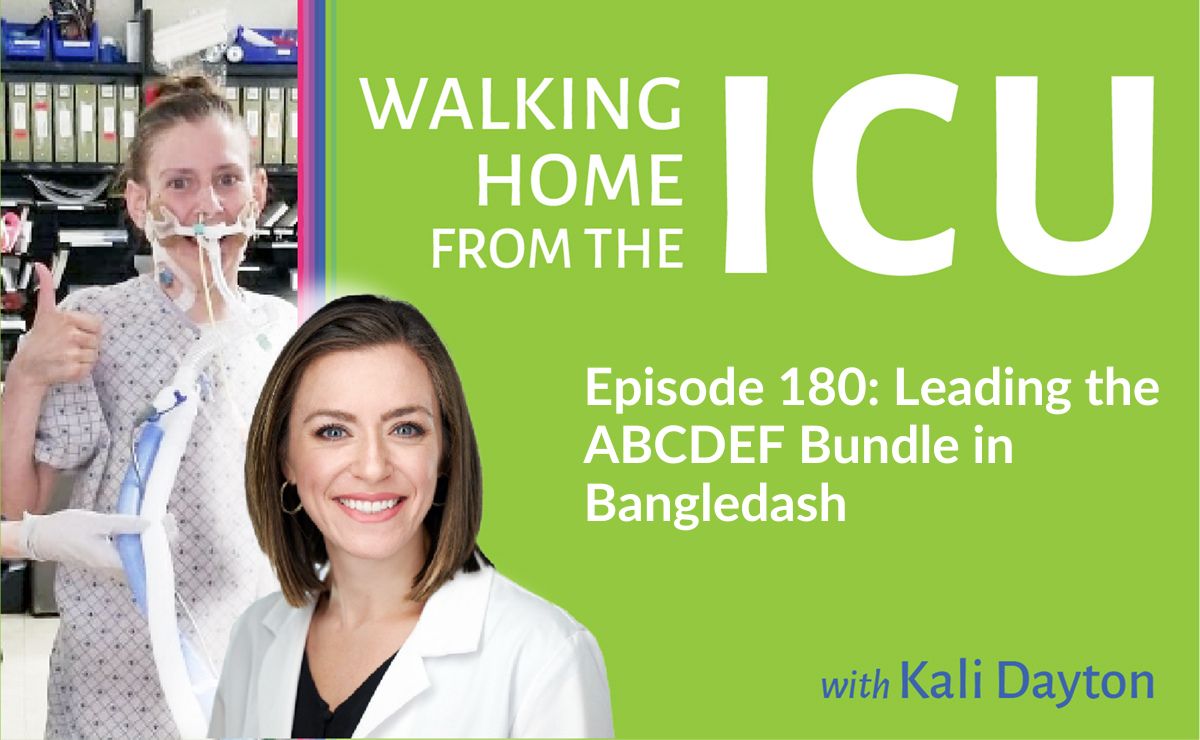
What happens when a visionary physician in a low-resource hospital in Bangledash leads his team to practice the ABCDEF bundle? How did this passionate team of ICU clinicians transform their care from automatic sedation and immobility to standardized mobility three times a day? How did they come to treat mobility as important and optional as an antibiotic? Dr. Mohammad Jhahidul Alam shares their story in this episode!
Episode Transcription
Kali Dayton 0:00
This is the walking home from the ICU Podcast. I’m Kali Dayton, a nurse practitioner and ICU consultant. I help teams create awake and walking ICUs through evidence based sedation and mobility practices by hearing from survivors, clinicians and researchers will explore how to give ICU patients the best chance to walk out of the ICU and go home to survive and thrive. Welcome to the ICU revolution. You since talking about the ABCDEF bundle on this podcast and online, since 2020 I have constantly received comments such as, quote, this is only happening in academic hospitals, or you’re just doing this for the clicks. This isn’t actually being done anywhere, or there must be one to one nursing ratios and tons of ancillary staff there, or hospitals can’t afford to provide the staffing and equipment to do this, or this is only possible in the nice first world hospitals. In episode, 55 providers from 22 different countries shared their successes with walking intubated patients. Most of those countries were not first world. There is almost a greater recognition of the desperate need to prevent delirium, and I see acquired weakness in these countries that do not have the staffing and resources to care for these patients for weeks or months longer than needed. These countries do not have lpacs and SNFs to send their patients off to when patients develop these ICU acquired complications, the ICU teams themselves are left to deal with it, rather than able to shift them off to another facility. It also almost seems like the most educated of clinicians and hospitals are some of the most challenging to educate when a team feels they have already achieved the highest level of excellence possible. They are less open to ideas and techniques that are new to them. I am so excited to have our guest for this episode share what can happen, even in a low resource country and unit, when a humble team fueled by passion and humanity comes together to learn and implement best practices, there is a lot that academic hospitals and first world countries can learn from this incredible team in Bangladesh. Dr jahida Alam, I’m so excited to have you on the podcast. Can you introduce yourself to our listeners? It’s
Dr jahida Alam 2:33
my pleasure. Kelly’s My name is Mohammed Jahad. I’m working as an associate consultant of Department of critical care and emergency in Apple, Imperial hospitals in Kiron, Bangladesh, second biggest city of the country. I have been working in my hospitals for the last three and a half years. So before that, I have done my residency program on anesthesiology in another referral hospitals, Kiran Medical College. Since then, I have been working in an ICU three and a half years Well.
Kali Dayton 3:03
I’m thrilled to be connecting on this initiative on awake and walking ICUs all the way in Bangladesh. Tell me about your current ICU. What kind of patients do you have, and let’s get into the staffing ratios and how your team functions.
Dr jahida Alam 3:19
My ICU is a mixed ICU. Though we have been 65 bedded ICU, all our different surgical, neurological, gynecological and like this, though our hospital has been functioning for the last two and a half years, it’s a kind of a new hospitals. We are now functioning on a 11 bedded ICU. In my ICU, 55 to 60 patient in a month. We are low resource countries, so we can give always the one is to one stops in for every patients. One bedded patient, one nurse, is not possible, actually not all the time, because if the patient is ventilated, then one is to one. If the patient is not ventilated, it’s more often one is to two, or one is to three. Oh,
Kali Dayton 3:58
I see. So it’s one nurse, the two vented patients, or when they’re not vented, it’s one to three. So that’s pretty similar to the US, if not maybe a little bit more load for the nurses than what we have in the US.
Dr jahida Alam 4:11
Look when in and around my eyes, you have daily five to six patients. So if I want to mobilize every patient, so not every patient in the same body configurations. Maybe someone is 40 kilos, someone is 90 kilos, someone is 110, kilos, and they are very six, even if not the patient is ventilated, they are very sick. So when, when we want to mobilize the patients, we together doctors and the nursing staffs and the respiratory therapist, all need to, all need to join, to mobilize the patients. Because if we want to mobilize the 110 kilo patients, so if you think that at least five or six patient need to be engaged with, with that time. So it’s the kinds of practice now in my ICU, initially, it was very difficult. It, but it’s for the last four and a half years, but at least you can say for the last eight or 10 months. It’s a become a practice or a habit. Initially, for mobilizing a patient. When I went to hospitals in early morning, I need to go there and tell them to mobilize the patients, leave the patient from the bed, and now it’s become a practice. Now, what I’m seeing that before I reaching the hospitals, before I’m going for the rounds to the ICU, the patient has been mobilized. The patient has been seated down in the chairs, or CPD has been given, has been given, the patient has been walking. So it’s a practice. It took time to make it a habit, but I’m glad that it’s a practice now that is so exciting.
Kali Dayton 5:41
And so you really were the instigator of these changes, correct? Yeah, yeah. Was this part of your training? Or how were you trained to practice Critical Care Medicine, and what opened your eyes to this approach?
Dr jahida Alam 5:55
No, it’s actually not. In my training, the triggering point was actually one, I think that the patient has the pneumonia, the patient was in ventilator, like the patient has a sepsis. We have done everything. The patient has been improved. The patient has went from the ventilator, the patient stock has been corrected, pneumonia has been resolved. So after five or six days, I am saying that the patient developed the backstory. So it was the first thing. It was the first thing which triggered me why, after doing everything, we have given everything, but the patient has later, I came to know that the patient developed the myopathy, or neuropathy ICU acquired weakness. So after going through those literatures and videos and many of things, I then I came to know the ABCDEF bundle. So I show in my ICU. I have a board in my SEO. So in my board, the bundle has been written, A, B, C, D, E, F. So I have a session of monthly two times in the first of Saturday and the last set out of the month. So in the session, we mainly discussed about the bandage components, how we can it’s more often with the nursing stuff, rather than the doctors. Because what I feel in the ICU, the majority of patients outcome is fully depends on the nursing steps, because they are the persons who were continuously in in from the in front of the patients or with the patients. So it’s more often doctors know how to implement this. It’s more of the nursing steps who needs to know what can be done, what need to be done during the start, it was quite tough, but it’s not so easy.
Kali Dayton 7:36
And were they scared? I mean, this is a very new thing for them. It was for you. You’re trying to lead something you’ve never done before.
Dr jahida Alam 7:43
So that’s why I need to put so many videos to them. So I need to tell them, even still today, I participated with them during the mobilizations. It’s not there. I’m the consultant. I’m the doctor. I can’t lift the patients. I can’t touch the patient. Actively participate with them to to pull the patients from the bed, even I sometimes I personally given the CPT to this patient. I personally do the lymph easy to the patients. So when they are seeing that I am their consultant. I am their boss. I am doing it. So they now do it passionately. At first, they were forced to do, but it’s not become their routine, and they’re more patient on them. Now I
Kali Dayton 8:25
love this. I’m just saying physicians take notes being a true leader. You brought in the why, you educated, you taught them why, and then you’re teaching them how by actively doing it with them. And this is a new skill set for you as well, but you physically being present and hands on the patient, helping them get up, brings in a lot of comfort for the nurses, for the rest of the staff, it forces them, it’s obligated. And the doctor’s saying, we’re doing it, the doctor’s doing it. They’re going to help. They’re going to do it. How do you feel like that changed their mindset and their fears about mobilizing patients,
Dr jahida Alam 9:01
the problem is the they face, at least what I train themselves before they part. They need during mobilization, of what they can like a patient in a bed for two days or three days, so suddenly, when we lift up the patient, there could be a postural drop, there could be a poster hypertension, there could be some desaturation, there could be some fluctuation in the hemodynamics. So at first I taught them, I give them what we can anticipate, what difficulties they face like we initially we face. The patient has a hypertension. The patient was in order during support, when they leave the patient, front of the patient, leave the patient, there is a postural drop. So I was in front of them in every patient. So I when I was there, I was managing the patients. I was telling them, No, don’t worry, it will settle down. Give some fluids. Don’t worry, give some oxygenation. But don’t worry, it will settle down. So they become habituated. Completion might be happen and what can be done. So I can share with an experience. We have mobilized the patients with 130 kilos. So the patient was in cardiomy with the patient was injection fraction of 27% so the patient had a pneumonia and had an failure also. So we mobilize the patient from bed, maybe 15 to 20 meters from the bed, so the patient hasn’t worked, and the patient seated down in the chair. So everything was fine. We have a monitor. We have a portable monitors. Everything was fine. The patient was talking with us, with the nursing step, and just within a within just within a second, the patient hadn’t in the chair. So immediately we jump down, and the nursing step was there. He started the CPR in the chair. So we everyone rushed down to the patient. So immediately shift the patient with a nearby bed. We started the CPS, and the patient actually reverted, and the patient has arrived. So one thing is that you can tell them what can be anticipated, and another thing is things happened and you manage. So when you manage the patient, then it become more easy to manage the patients. So there is, there is a lots of these small things happen. They manage. They resuscitated. So initially it was a fear. Now it’s become a practice that, okay, this can be happen. We’ll manage indeed, like this way, that’s
Kali Dayton 11:21
so interesting, because an experience like that, where someone arrests in this chair, that would be very easy for the rest of the team to say, see, it’s unsafe. Let’s never do this again. Let’s just keep them in bed, in a controlled, safe place. So how did this become okay? We now know what to anticipate. I mean, you couldn’t have anticipated that, right? He had no warning signs. That’s really tricky. So that is a worst case scenario. Yeah,
Dr jahida Alam 11:46
it was actually the worst case. And is the it was the worst experience after mobility in a patients. So it was the most work is other than this. There has some hypertension, some tachycardia, some deterioration. It which can be managed, but it was a double sorted experience. After that, nothing has to become afraid of. So later we manage the patients. So when we manage the patients, so everyone become more more confident, they know, okay, it can be happens, but we can manage also, like
Kali Dayton 12:17
you’ve already lived the worst case scenario, your team figured it out. Because it takes a lot for us within the team to know that everyone knows how to work together in those worst case scenarios.
Dr jahida Alam 12:29
That experience also taught at us that to mobilize the patient with ischemic cardio, maybe with dead, lowest infection fraction, so we need to be more careful. So we we thought that no okay, or if a patient has a low addiction, frictions and the patient has some cardiac issues, so we need to be more careful, or we need to be more cautious to mobilize the patient, because the what was the trigger? What I figured out that we moved the patient 10 to 15 meters from the from his bed, so that that 15 to 20 meter walk has done some exhaustion. Maybe, as he she has an low ejection fraction. Could be there was some arrhythmia. Actually, the patient had actually the VT when we immediately shifted the patient from the chair to bed, we put the monitors and see that it was gagged. So it has been managed. So these are the experience. There is literally little experience which actually explained to this. It led
Kali Dayton 13:22
to the root cause analysis, to look to understanding the physiology of why that happened, and leading to more critical thinking in the future. Because every patient is different. Every condition is different. Mobility is like a medication you have to give the right kind, at the right dose, the right timing. But that’s I love, that you as a leader, didn’t say this was an absolute failure. Let’s learn from this, celebrate the good and learn from the things that didn’t go right. So now, when you come on, your patients are oftentimes already up in a chair. They’ve already mobilized. But initially you had to go in early in the morning and go patient to patient, nurse to nurse, and say, Let’s do this. And you did it with them. Yeah, this is such prime leadership, which more physicians had that engagement with their teams and understanding initially, the teams need that kind of security support. They need more time to figure out all the logistics of mobilizing patients, but that’s when I trained teams. I tried to explain that’s not a long term plan. You’re not always going to need five people. You could get this down to two or three people, but you have to develop those skills first. It’s just like when you’re learning how to intubate, put in central lines. You need a mentor with you. It’s going to take more time as you develop that skill and you become more efficient, you can do it by yourself. You don’t need as much time. It’s just like any skill that we do in the ICU. But I think we don’t understand the intricacies of mobility, and we just get overwhelmed and give up and we’re afraid of it. But even if you’ve never done it, you took leadership, and you’re like. I’ve watched these videos. I know it’s possible. Together as a team, we can figure this out. We have to. There’s no one in Bangladesh that had ever done this.
Dr jahida Alam 15:07
I think what in Bangladesh, in what the what general people’s things, even, what the medical professionals also think that if a patient’s in an ICU for the five or six or seven days, they have a bed. So they will will definitely have a bed. So it’s the is the common thing in everyone’s minds. Even I can just share you, share you a case. We have a patience of around 110, kg. So that patient is a female patient. She had an sharing bacterial meningitis, and septic shock. She was intubated. She has an Aki and she has multiple COVID. Liver dysfunction was also there. So she is a very well known person in the society. So she has lots of relatives, even the medical profession may be four or five doctors of their family. So every day, they tend to ask during our counseling session that is, the patient hasn’t bad. So is the patient hasn’t bad? So is the patient hasn’t been after five or six days when the patient went from the ventilator, the patient has been seated down in the chair. So we allowed one of their family members, who was a doctor, so when she came to visit to her immediately. She checked his back or that, whether there is a bedroom. So when she didn’t see any bedroom, she was so astonished that that this patient has seven days in an ICU and she doesn’t have an backstory. So it’s quite remarkable. So these kinds of mindsets we have in our society, we in even in our within our in our doctors that if patient having five or six days in ICU, they are definitely having beds. But in our hospitals, in my MSU, the bachelor rate has been falling down drastically after the after this mobilizations, so early mobilizations and the everythings and the patient even has because just going through the your previous, previous points. Initially, when I was in the hospitals, I am doing it in the early morning. Mobilizations, probably the only the one time. Now it becomes that much regular date. It is as like is given an antivirus three times daily. We are giving the mobilization at least three times a daily, in the morning, in the evening and in the night. So it’s a become, initially, it was the first time of only one day in the morning. Now it’s become the daily practice, like in three times in divided dose. So it should be given in the three times, and everyone given is in the routine. Well, you
Kali Dayton 17:36
first reached out to me. I’m like, That’s what you said. Is on our ICU, we treat it like an antibiotic, which made my heart sore, because that’s the comparison I use when talking about my home ICU, that it was just as important and optional as an antibiotic, and that we too, did it at least three times a day. It was just like a conveyor belt. You’re gonna get morning mobility. Everyone’s gonna get up afternoon, night, and it was just unless there was a very valid reason not to. If you’ve been listening to this podcast, you’re likely convinced that sedation and mobility practices in the ICU need to change. The ICU community is facing incredible difficulty with the trauma from the pandemic staffing crisis and burnout. We cannot afford to continue practices that result in poor patient outcomes, more time in the ICU, higher health care costs and greater workload for the ICU team. Yet the prospect of changing decades of beliefs, practices and culture across all disciplines of the ICU is a daunting task. How does this transformation start? It can begin with a consultation with me to discuss your team’s current practices, barriers, and to formulate a plan to help your ICU become an awake and walking ICU. I help teams master the ABCDEF bundle through education, consulting, simulation, training and bedside support. Let’s work together to move your team into the future of evidence based ICU care. Click the link in the show notes of this episode to find out more. That kind of culture is hard to imagine, and people just assume that ICU had very different staffing ratios. That must be one to one. You must have so many physical and occupational therapists. You must have so many respiratory therapists. They run very lean, very normal ratio, sometimes a par. But it’s because it’s a culture, a skill set. The more you mobilize patients, and you probably have seen this, the stronger they stay, the easier they are to mobilize, the quicker they are to mobilize, the less risk there is all these things. So it’s it has to have an ongoing momentum, rather than waiting till day seven to now mobilize them only once a day, it’s always going to need a huge army to get them up. And I’m just My mind is blown by the rates of bed source here in the States. That’s the problem. But we also have fancy beds. We’ve got search protocols about turning we’ve got. A quick, high level nutrition, and yet still we have bed sores. And so people always think, well, mobility must only happen in academic hospitals, where they have so many resources, so much staff. And the point I try to make is, yes, obviously those things can help. But you have countries like Saudi Arabia Ireland, where they have one to one staffing ratios for the nurses and ICU patients, but they still don’t mobilize their patients. You’ve got to have the culture as well, but in some of these countries where you guys don’t have excess resources, you don’t have that latest beds that you’re and then new mattresses that you’re swapping out every five years, right? You don’t necessarily have all the nursing homes and ltacs, and you can’t afford to have these patients stained in your hospital. Weeks on end. We can’t afford it in ICU either, but yet, somehow we do that. But there’s an extra level of necessity to prevent these complications. And so the fact that without all the high tech things that are available that prevent bed sores, you have drastically dropped your hospital acquired pressure injury rate by early mobility. You don’t leave them in bed. They don’t develop that source. It’s amazing. I just
Dr jahida Alam 21:06
want to share another thing. I have a very good friends of my Italian friends. His name is Dr Louis. Last maybe two weeks back, he visited Bangladesh due to some research works. So when I tell them that I’m doing this, the early mobilization things, or they say I have seen him the videos. So he told that they just send me the videos I want to show my Italian colleagues in in Italy, because they don’t want to mobilize the patients. So here, he also acknowledged that they were doing very good things. Because even in Europe, even in my Italian hospitals, early mobilization is still a problem because no one wants to do it. No,
Kali Dayton 21:42
I think you guys are a modeling unit for the rest of the world. You know that your pressure injuries have drastically dropped, but are you tracking other metrics? Are you able to do thorough data tracking in your system? Yeah, as a
Dr jahida Alam 21:57
nation or as a team, we actually lacking within in these areas to sort out what are the ratios, what are the data? Because still, I am the only consultant during the morning periods. So we have a junior with me, so we are the two doctors with you can say four or five nursing steps for six or seven patients. So it was actually very difficult for me to make this data and to have any study or to keep it records. And also as a nation, when we grew up as a doctor, I look, I have done in an MD, and I’m doing the work so the research work as a country doesn’t grow. So we are not thought to make in case study, case series, or do research works in a routine basis. So as a nation, it’s not a become inhabitant for us. We are doing lots of things, but to keep it in records, or to keep it in data, I think these kinds of thing we need to develop. Do you have
Kali Dayton 22:57
electronic health records? Yeah, all your documentation is electronic for your nurses as well. Yeah, yeah, okay. And how you said that you were working on family engagement. That was your next milestone. What kind of barriers have you faced with family engagement? What’s it like in Bangladesh, culturally, economically that play into family’s ability to be really involved in ICU.
Dr jahida Alam 23:22
Look the general consensus among the peoples of Bangladesh or among the peoples of low income countries in that we are putting the patient unnecessary in an ICU. This is the first thing they they think that we are putting the patient in ICU, or maybe some financial issues for us, the patient and unnecessarily. This is the these, the first things, the what? What the joint people. Second things in there, as a nation, Bangladesh, country, acquired so many environmental disease are there, and we are not very much accustomed to the hand washing or proper housing. So generally, why? Not many ICUs in Bangladesh, you can say the 99% is of Bangladesh just allow visitors for the one time, maybe in the morning or in the evening. So it’s more of an IPC controlling measures. And another thing that the general awareness about the health and the ICU is so like so when a family member came to visit a patient in an ICU. So he is seeing that maybe we are tightening the patient hands because the patients is restraining. Maybe some putting their endogastric tube or endotracheal tubes, or the patients in in deep sedation, the patient is they, they think that the patient is no more, and they tends to take the photos. So they want us to take tasks, the patients and everything. So for these reasons, the family members only allowed for one time. So what by this time, as we just allowing for the one time? What happens is that the family and. There is a miscommunications between the families and the doctors. So when a patient suddenly deteriorated, maybe in late night, the family members are not there. They are in the home. So when we call them that this patient is deteriorated, so it’s become a shock to them, even we counsel them that the patient is who is bad, it’s critical. So when they come back, they tend to make a scene, or they tend to make in chaos within the hospitals. So I faced it for the last seven in my academic hospitals, also where I worked before. So I have been working in my su for the last three and a half years. Still, there is a not a single incidence regarding the patient deterioration in my hospital, there is no chaos, there is no scenarios. There is nothing because, as because I am very clear about the patient’s family and very open with the patient families. Because what I feel that, if you share the share everything with them, what is happening, what is the problem? Is what we are doing? What can be done? What are the other options? What are the options you can avail in the other hospital, which I don’t have, if we have a clear communications, then it’s sorted out. Most of the matters also what I founded that we initially in my academic hospital. Also, we tend to use high dose of fentanyl, high dose of profile immune muscular brokers. So when the patient become an agitated like the patient has been gone through for the first two or 242, or three days, and he is, or she is, improving, and when he wants to see the family members, look the patient wants to see the family members in the morning, 10am my visiting time is 5pm so if, if I’m not allowing the family members at eight periods or 10 hours periods, the patient become hesitated. So then I put to I need to put the additional dose of mirrors, the additional dose of fentanyl, additional mirrors of pro bowl. So when, instantly, I make her family, his or her family people in front of him, it’s, it’s, it’s 50% or 60% is settled down. The patient has been settled down. And when the patient and I feel I face that is more of an a problem, when the patient came came out from the ventilator. So the when the patient came out the ventilator, when we all, the situations, instantly they want to see their family members. So maybe I excavated a patient at 12am my visiting time is next morning, 12pm so it is the after 12 hours they tend to wait to see their family members. So instantly, if I patient, make visit his family member. Within that period, it is gradually decreasing down the sedation requirements. It decreases his anxiety and everything. So it’s the big things. Even within my hospitals, we have been like pediatric ICU. We have new nodal ICUs, we have some IPD. Also, everyone is strict about the visiting area. So that is two things. One is that they came from the outside, that they have been infection control. One thing another, one thing that the people stands to take the photos, tends to task the patients, tends to hug the patients. So that’s why. But in my family, yeah, I allow everyone what, at least two times, is regular. And one day, when the family also wants to see, or when the patient wants to see, I make a video call. I have a two separate tape, one in the patient’s side, one in the outside. So when we can’t allow the patients to see the see them in physically, we just make a video call to them. So it helps. It helps in so many ways. Yeah,
Kali Dayton 28:41
that’s so interesting. Culture plays a big part. Just thinking back to my experiences, different cultures have different responses to these very intense emotional situations. Like Americans are a little bit more reserved. We don’t show our feelings so openly, but in other people, they wear it on their sleeves, right? Their loved one is in a critical condition. They’re panicked. There’s also the question of medical literacy. When you don’t understand what’s going on, all of that is scarier. If the physicians aren’t as open and educational as you are, then there’s more mistrust. There’s just a lot there
Dr jahida Alam 29:19
is other issues. Also look if I, if I allow a patient who is in bed too, one family member came to see the patient in bed, two and one patient crashed in the Bedford. So we are doing the CPR. We are doing the everything. As you know, there is some sounds going from when the patient, one patient crashed. So the problem that we are facing that number two best patients, family member going outside and telling that your patient has been pressed, or your patient has been died. Did this happen? That happen? So that’s why, actually, if, though I am more open for two family members engagement, but it’s still the problem. Rather. In the mobilization, because early modulation is so much easier because it’s a closed door thing. I don’t need to engage the family members there, but in the bundles of F family engagement, there is still so much of constant, so much of struggles to make it a regular. Because these are the things is quite happening. Two number bat patients going outside and telling the phone number beds patient that this happened. This happened. This happened, and it makes a chaos at that time. Also,
Kali Dayton 30:27
I had a thought about that because I saw in your videos, and we’re going to post those online that you don’t have private rooms. You have an open area with basically shower curtains dividing these beds for privacy, but still, everything is audible. And I’ve worked in IC before that had shared rooms, so two patients in one room, and I’ve coded a patient one bed, and I’ve had another patient be very awake and walking the whole thing and or at least listening to it. So I but in the family wasn’t even present during that time. So and I can only imagine trying to control the chaos of a code while having family members and people poking their heads out, and so that there are a lot of dynamics to consider when it comes to family engagement and the role in the ICU and all these different cultural economic the layout of an ICU, all that plays into how we can utilize families, then you’re making a really Good point that the more families are there, the less sedation we use. Right? We treat anxiety with family engagement, rather than masking it with sedation. And obviously that’s better for everybody. It helps. I
Dr jahida Alam 31:32
can say it more confident, confidently that I attach more family members than any other hospitals in my city. Still, there is a clear communications it helps in so many times, and in 80 to 90% times it helps, but in 10% of time, it creates a problem. But things are changing. I think it will be more helpful in future. That
Kali Dayton 31:53
is fascinating. And I guess we didn’t even really dive deep into your sedation piece. How have your sedation practices changed?
Dr jahida Alam 32:00
In drastically in apart from the patients on ventilators, even the patients in ventilators, our our sedation protocol is to start with the Fanta and then needs the dose of dexment, or if need adding profile, we don’t actually use the media. Use, yeah. So initially it was more often center more than we are. Now more often Dex met, because dexmat has unconscious deletions and is easy to wake up the patients. So initially maybe our patient needs 70 microgram, 100 micro center in an hour. So first day is first one or two days. It takes more often sedations. But after two day on hours, the patients find the m&ms are improving. When we win the patients majority of time who don’t use another, who don’t continue the at that time more often, we tend to mobilize the patient, so engage the family. So yeah, yeah. It reduces the solutions,
Unknown Speaker 33:02
therefore you’re able to mobilize them while
Unknown Speaker 33:04
they’re integrated. Yeah.
Kali Dayton 33:06
What advice would you give to other ICUs that are wanting to make these same changes, especially in your general part of the world,
Dr jahida Alam 33:13
it’s more often you need to be passionate. First thing, you need to be more passionate about these goals, like early mobilizations or the family engagements. And I think the physician, at least, for the first hourly phase of this implementation, the physician needs to be actively involved in this, because you just can order the nurse to do this, and he will do this, because he’s a big thing. And another thing is that nursing ratios low resources. It should be here in everywhere, in Bangladesh, in USA, in Europe, everything here. I think it’s more open passion that everyone need. Because, look, early mobilization is not on course, or is not in training that you can train everyone. So it’s more often from your inner feeling that, no, I need to do this. I have to do this, then it will be I think it can
Unknown Speaker 34:05
be done.
Kali Dayton 34:06
The entire team sees it like an antibiotic and a life saving intervention. Everyone joins together to make it happen, and especially once it becomes a skill set and it becomes much easier,
Unknown Speaker 34:16
it’s more often the
Dr jahida Alam 34:18
involving and engaging your staff and make them, make them ready, and make them really believe that, and and give them that trust that if anything happens, I am here, so don’t worry, I can manage it, or I will take the responsibility to make that trust within the team. And it will take time, initially, but it will become in practice. As I told earlier, it was initially for one day, one time in the morning. Now it becomes since three times, like an antibiotics, wow. Well, congratulations,
Unknown Speaker 34:52
Doctor Jahai, dual alum,
Kali Dayton 34:54
I am I’m so excited for you and your team. I appreciate the Rev. Solution happening in your ICU, and I’m excited to have put you on the map of awake and walking ICUs. Thank you. You
Kali Dayton 35:26
to schedule a consultation for your ICU as well as find supportive resources such as the free ebook case studies, Episode citations and transcripts, please check out the website, www dot Dayton, ICU consulting.com you
Transcribed by https://otter.ai
SUBSCRIBE TO THE PODCAST