SUBSCRIBE TO THE PODCAST


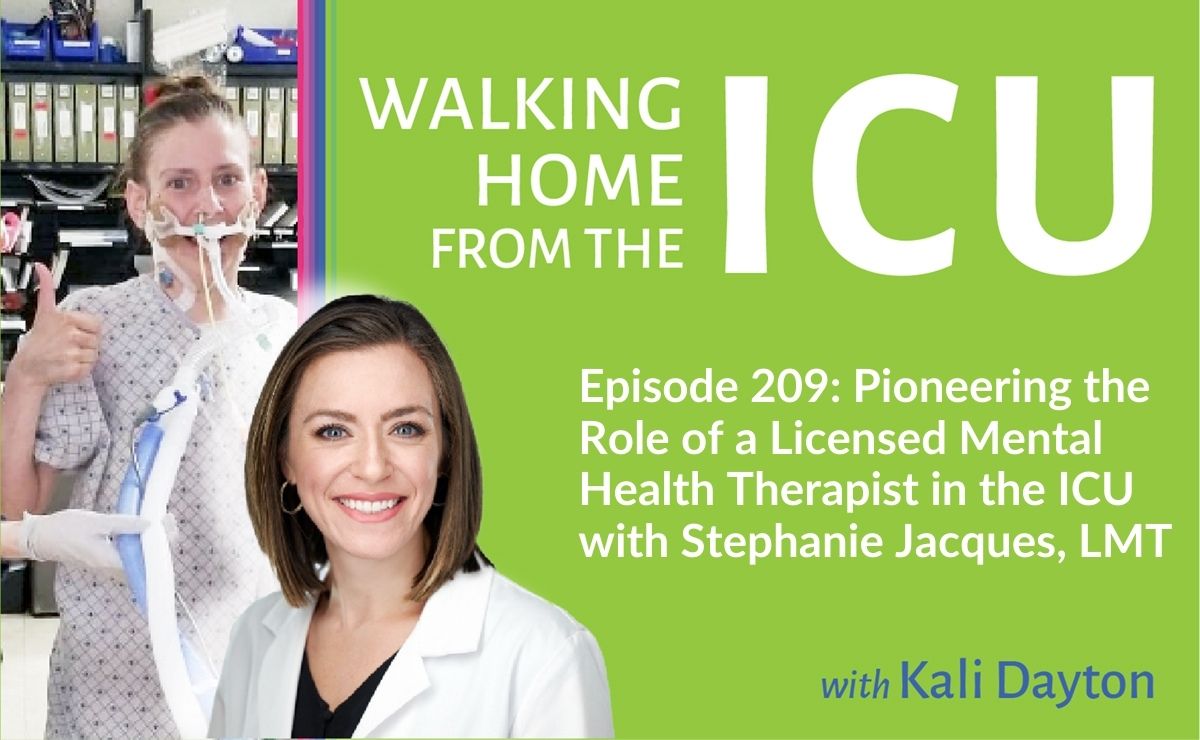
What if we had an expert continually present in the ICU dedicated to caring for the mental and spiritual health of families, patients, and staff in the ICU? How would this impact stress, grief, and trauma in the ICU? How would this kind of support impact patient and family experiences, outcomes, and staff morale and burnout?
Stephanie Jacques, LMT, joins us now to share her expertise, experience, and pioneer legacy.
Episode Transcription
[00:00:00] This is the walking home from the ICU Podcast. I’m Kelly Dayton, a nurse practitioner and ICU consultant. I help teams create awake and walking ICUs through evidence-based sedation and mobility practices. By hearing from survivors, clinicians, and researchers, we’ll explore how to give ICU patients the best chance.
To walk out of the ICU and go home to survive and thrive. Welcome to the ICU Revolution.
Happy New Year as you welcome in 2026. Hopefully you and your team continue to focus on the goal of saving lives. You are keeping patients as awake, communicative, autonomous, and mobile as possible. As [00:01:00] you strategize, getting buy-in and disseminating education, consider doing a one or two day awakened Walk in IU symposium.
Check out dayton icu consulting.com and or email me for more information For this episode, I am so excited to continue to explore outside the box into ideas, solutions, and pioneers who are trying to address the needs that have haunted us for years. Stephanie, thank you so much for coming on the podcast.
Can you introduce yourself to us? Yes. Thank you for having me. My name is Stephanie Jacques. I am a licensed mental health therapist and one of our local hospitals here. I work on our ICU floor working with patients in our families while they go through some of the most challenging and difficult times in their lives, and I know we’re listeners.
Totally understand why you would have a mental health therapist in the ICU yet, at least for me, [00:02:00] this concept or this position was new. What you’re doing or who you are is a dream, like it was something I had thought was needed. I wanted more psychologist, psychiatrist there and involved, but a lot of that is medication management, psychiatric conditions.
Tell us more about. How you came to be there in the ICU and specialize in what you’re doing as well as what exactly you’re doing in your position. Yeah, absolutely. This role came about our unit seeing a need for mental health support because of the capacity of their emotional stress existential crisis.
Families often have to make life altering decisions under immense stress while patients may experience trauma, fear, or disorientation. So this role is to bridge that gap and have like in a holistic care, and not only [00:03:00] advocate for, and, you know, integrated mental health support, but also to help bring some valuable information to the team.
One of the things that I do is when I speak to our patients and our families, I act as if an advocate, maybe I have a patient who has not been sleeping well or who is going through really high anxiety so I can bring this information back to the team and let them know, Hey, this person is in need of support.
What can we do besides medication? You know? And that’s something that our team really takes in very seriously. So it’s become a. Like a teamwork. I work with the providers, the nurses, our social work, even our chaplains as well to contribute to whatever is lacking. And of course not duplicating services as well.
We have social work, we have chaplains who come and visit the unit when they’re called. Mm-hmm. So what makes what you do different? What I [00:04:00] do different is I actually sit on the unit, so I’m there the whole time. Our chaplains are called. They have the religious and the spiritual aspect of it. I’ve come to find out it is good for the body and the soul, but not everybody is quite there yet.
And sometimes you need a little bit of different balance. And also a lot of times when people see the chaplains, by the way, the chaplains are absolutely amazing. I work with them. They’re the most kindest, sweetest people I’ve ever met in my life. And but sometimes when the chaplains come in. Everybody’s anxiety is high.
’cause they think, oh Lord, we’re going home to glory. When in fact, sometimes they’re just there to pray. So what I bring is I also provide some interventions as well, some grounding techniques, some ways to help them sleep better or just bringing in a different type of interventions for them. And are you.[00:05:00]
Formally consulted or do you stick your nose in and think, think I can help here. Can I go in and see this patient? Or how does that work? Or do both? Our providers will consult me if they meet with patients and families and see the need, but I also round with the team. So one of the things that I love about running with a team is I get to poke my head in.
If I see a family member just sitting there or a patient, I literally interject myself in, introduce myself, and let them know what I’m here for. And then from there, my goal is to build a rapport so that way they have support, they feel heard. I just do both. Like I’m, I tell them I’m nosy by a profession and I love it.
That’ll be all in their business. But. If I see the need, I definitely just put myself in there. And how is it usually received? I mean, the chaplain kind of scenario can make people feel like, oh no, they’re gonna read me. Right? Right. So when Stephanie walks in, how do families and patients [00:06:00] usually react? So the way I walk in, I usually tell them my name is Stephanie and I’m part of the critical care team, and I’m a licensed mental health therapist, and I’m here to support you through whatever you’re going through.
And I usually tell them. Validate for them that I know that this is a very traumatic moment for you and our patient, but I’m here for support most of the time. I give them a brochure that I created, which is called support in the ICU, and in this brochure I have some, some recommended books, some recommended support, online support groups.
I also have some scriptures. I have some hoping strategies as well in this little brochure that I give them. I give them my card and their reactions are usually, oh, okay, wow. Well, I need you. Or sometimes they say, I’m okay for right now, and I respectfully, however they need me in that position, that’s how I [00:07:00] am.
But typically, once I get that spiel, I usually just check in with them throughout the week, throughout the days. Sometimes it leads to end of life, sometimes it doesn’t. And there are times that I just come in and ask, how are they doing today? Did you eat today? Who is part of your support team? So I introduce myself and then back out, and then I put myself right back in.
And if I see that they have a lot of support, I always validate that for them. Then I’m always here for anything as well to answer the question. Yeah. So obviously I’ve worked with a nurse for many years in the ICU as an np. I’m just thinking about my own journey as a mother in a pediatric ICU. Sorry, I’m just thinking about how much I could have benefited from having someone like you.
The ICU was such a comfortable and normal environment for me. I knew what was going on. My daughter has mitochondrial disease. She was really, um, especially [00:08:00] weak and didn’t have a lot really strong cough when she was younger and she got a kid cold. I had a six week old baby at home that I was breastfeeding.
So I was pumping in the room. This was still happening at the end of COVID, and we were very isolated. I never left the room. The nurse would come in and out. S would come in and out, but I was doing a lot of like my own suctioning on my daughter and doing a lot of the carrots just ’cause why not? But um, I had kind of told myself, I know what’s going on.
This is just a normal thing. It’s routine. Like I was trying to go into nurse mode as well as. Be there for mom mode. I was like sleeping in the crib with her because she was having such anxiety and anyways, I just thought I was, it was fine. Like I was so prepared for that experience. She was on high flow.
She wasn’t intubated. I was like, this isn’t super, super critical. We didn’t have a diagnosis for her. We didn’t know exactly what was going on. She had a feeding tube for the first time. Not to make this about me, but the intensivist [00:09:00] mentioned I would love to have a palliative care consultation with you.
And it totally floored me, and I love palliative care, but it was very clear that my daughter had a lifelong disability, but I hadn’t really seen it as chronic illness, nor was I prepared to see it as life-threatening. And so here we are in the ICU, but I’m like, we’re just getting over the rhinovirus.
We’re gonna move on. We’re gonna get out, right? And here we’re having a palliative care consultation called. And an adult ICU. I’d seen it a lot for like end of life discussions or end stage conditions, even if they’re going to leave the ICU, things like that. But I was not there anyways. I sat down palliative care and I just sobbed for like the next hour and just talked about things that I couldn’t talk about with anybody else.
And it wasn’t even really about palliative care. I mean, that is part of palliative care, right? But just it was so therapeutic to talk about things like. How do I support my husband if we lose her? [00:10:00] How do I help my kids understand what life’s gonna be like with chronic illness or lifelong disability? How do I, all these things, which I know now with palliative care, but it was also, it was therapy.
They were listening, they were counseling, they were guiding, they were giving me a space to talk about things that I couldn’t, I didn’t feel like I could talk about it with my family at the time. Inner thoughts and concerns and worries in that moment that were just silently going through my head. In that IC room that I could finally say to someone that was an outside party.
I felt like when the clinicians came in, I was in clinician mode, I was in advocate mode. I was like trying to like just do the things. We’re just trying get through the ICU, but stepping into another room, talking to palliative care. It was like big picture stuff. It was, how do I really feel? How’s my family doing?
Like all these other things that aren’t, don’t. Feel appropriate or relevant in that room at that time. And so even now, obviously it’s making me emotional, right? But I don’t think I really [00:11:00] understood what goes on in a family member’s mind. Obviously I could recognize stress, trauma, distress, but those thoughts were not something that I necessarily would’ve asked a mom right in my position.
And yet. They knew that they created a totally different space to talk about something totally different than just medical concerns. Yeah, absolutely. And I love palliative care. You know, one of the things that I really appreciate was when I first started this role, I got to run with them for a couple of days.
I got to run with them. I got to run with the chaplains mental health consultants. I got to run with different teams, and those are some of the conversations that I love talking about, not only the patients, but also the families. These are the things that we talk about. We talk about the possibility that anticipatory grief, even if the person is surviving, but what does that look like?
We talk about what quality of life is not only for the patient, but for the whole family. And those [00:12:00] conversations are the ones that they, of course the providers are great, but it’s hard to have those conversations with them because like you said, like when you come in there, it’s like, okay, medical stuff, what’s happening?
Gimme the update. But I’m there to slow it down and just really ask, how are you doing today? What are your needs? What can we support you with? And then I found that a lot of people. Maybe it’s financial, of course, emotional stress. And I’m able to take that back to our social worker, be like, Hey, what can we do for this family?
They have four kids. The patient was the breadwinner. What can we do? And then from there, we’re able to come up with something as well. So if we don’t ask, we don’t know. And those are the questions that I asked as well. I even talk about has this. Person ever talked about end of life decisions, what would they want?
And being able for them to kind of process that within themself too. One of the things is, especially when it comes to withdrawal care, those are the ones that really pull [00:13:00] up my heart a lot, and those are the conversations that I have a lot with our families is what would that person want? So that way it takes the load off of them and for them having to make a decision and just honor it.
The patient’s decision. So those are the things that we talk about a lot. And I, as a nurse practitioner, even as a nurse, I would have those conversations with families. If your loved one could just sit next to you and look at themselves and, and anticipate what’s gonna happen after here, what would they want?
But as a nurse practitioner, I was the one going to write the orders, and I had never considered that. Maybe me asking those questions came with a lot of pressure, like if they just. Talked out loud and answered those questions and speculated and just worked through it verbally. Was I just gonna take the answer that I wanted and write an order?
Were they really safe and felt free to talk about this? I hope so. I hope they [00:14:00] trusted me enough, but I could see why maybe they wouldn’t. Whereas you didn’t have any power to change any plan of care, but to just talk. Yes, yes. Sometimes I sit, we sit and we talk and we laugh sometimes. And those are the moments that I always cherish, even when it comes to end of life situation.
Just an honor just to be in their presence. So one of the things I always tell them, especially our patients, thank you for allowing me your space, because for some of them, 10 minutes is all they can give and I’ll take it. So it’s, it’s definitely an honor. But we just talk and being able to process things that.
They don’t wanna say out loud because if they say it out loud, it looks so bad, or they look uncaring or, but being able to say these things and even our patients as well, for them being able to say, this is hard. I don’t, I, I, I don’t know what I’m gonna do. I don’t want this anymore. Being able to process that because maybe [00:15:00] they feel like this right now, but what about a little bit later?
You know? And I feel like maybe people in, in, in different positions when they hear that. I mean, like if a patient say like, I don’t wanna do this no more, they take it as okay. They just, they’re done. You know? But what if it’s just stay tired? You know? They can’t sleep their anxiety’s through the roof.
Everybody that comes into the room is telling them all this bad things that’s happening and you know, and my job is to come there and just provide a little hope and just allow that space. For them to really process what’s going on and to kind of dive a little bit deeper as well. That’s the only reason you are there like that is that’s it.
Because I mean, I know listeners, I see revolutionists, these are kind, compassionate, caring clinicians that try so hard to carve out space in their shift and during their care and between the procedures and all the things [00:16:00] too. Have these connections, have these conversations. Um, I just don’t think that I had really understood that might come with some conflict or barriers to the patients.
It’s also not reliable, you know, not every clinician is going to be prepared to have those conversations. I had very different life experiences. I had spent, you know, a year and a half as a missionary. Meeting with people, having very intimate personal conversations, getting to know people at a certain level.
That impacted how I practice as a nurse and a nurse practitioner. But we don’t have formal training as far as how to ask open-ended questions, how to create that safe space, and yet we’re kind of putting the burden on clinicians to do that, to humanize care without really teaching them how to, or making sure they have the actual time and opportunity to.
Sounds like having someone like you there designated just for [00:17:00] that. It brings in a greater reliability that families and patients will have that support no matter which physician, which nurses on Stephanie’s there. She’s there just for that, and they know that you come in. They know that they’re not gonna also get suctioned.
They’re not gonna also have all these painful procedures. They’re just going to have time to talk. Absolutely. And I, and I love our team that we have because if they notice a family member or a patient is having a really rough day, they’ll be like, Stephanie, can you check on so and so for me? They’re having a rough day today.
And I said, oh, yes, thank you for telling me. And then next thing you know, we are in there for an hour just talking about things that, you know, they wouldn’t share with other people, you know? And I think, you know, but you made a, a, you know, a good comment about time. You know, our providers, our nurses, you know, they’re really literally caring for our patients like 24 hours, especially in the [00:18:00] ICU.
So I feel like it’s not that they don’t want to have this sit down conversation, but they don’t have time, you know? And I see their compassion and their love and, and I tell people they, our nurses are the heart of the hospital, the heart of the unit. But they also have their own stuff that they’re dealing with.
So I tell them, okay, I got it. Don’t worry about it. I will come see them because I’m like, I can handle it. Um, which I am. I’m so grateful for them, you know, because if it wasn’t for them and their expertise in saying, Hey, this person is not themselves today, they usually help and laughing, you know, laughter.
And then they’ll be like, something is not quite right with them. They’re having a hard day. And next thing you know, I’m talking with patients and I’m finding out the upcoming procedure is worrisome for, you know what I mean, and how that affects their family. So I really would appreciate our nurses and our providers who, um, go out of their way to make sure that our patients and [00:19:00] families are being seen and heard as well.
I can’t imagine work, and I say this, I’m sure it hasn’t been studied, but I am very confident that having this role played in the ICU improves the moral injury and burnout of the nurses, even if you’re not necessarily providing the therapy for them all the time. I know personally the role that it plays on us when we feel like these other spiritual emotional needs are not met with our patients during this critical situation.
And all we can do, like physically we can do is just keep them alive. Like we’re running to do those things and to do these procedures. But we know, we can see emotionally and spiritually they’re dying as well, and we want to have those conversations, but we’re actually just trying to do the procedures that will physically keep them alive in the moment.
And then you walk away being like, there was so much more that they needed, but I couldn’t provide that. But I [00:20:00] wanted that for them. And then you feel like a sense of failure, disappointment. This is not why you signed up. It’s just to put them through all of this. This, what we sometimes feel like is torture.
You wish that you could have understood what they actually wanted and work through those things, but you just don’t have the time and the space to do it. So knowing that you’re in there, one, spending time with them. Yes. I just know, even as a nurse practitioner, when I wasn’t physically the one at the bedside doing all these things, when my colleagues would do things like take them to the shower, braid their hair, do all these things that would change their morale, make them feel better, humanize their care, it lifted my spirit like it made me feel better about the work that I was doing, even though I didn’t do that work.
But I’m like, okay, we collectively are doing a good job. We are addressing their needs. We are helping them and boost the morale. Conversely, when I’ve worked in other units where you just know that patients are not getting good care, that they’re [00:21:00] not really being cared for and attended to and like truly supported, but kind of neglected, it feels heavy.
And then when you’re the only one wanting to do that or able to do that, that’s even heavier. So half someone else sharing that burden of the mental aspect of critical illness. I, I just, what do you know about how that helps? The rest of the team and you can toot your own horn and or do we have anything in the literature?
What have you heard from your colleagues? Just so interested. If you’ve been listening to this podcast, you are likely convinced that sedation and mobility practices in the ICU need to change. The ICU community is facing incredible difficulty with the trauma from the Pandemic staffing crisis and burnout.
We cannot afford to continue practices that result in poor patient outcomes. More time in the ICU. Higher healthcare costs and greater workload for the ICU team. Yet the prospect of changing decades of beliefs, practices, and culture across [00:22:00] all disciplines of the ICU is a daunting task. How does this transformation start?
It can begin with a consultation with me to discuss your team’s current practices, barriers, and to formulate a plan to help your ICU become an awake and walking ICUI help teams master the A-B-C-D-E-F bundle through education consulting, simulation training, and a bedside support. Let’s work together to move your team into the future of evidence-based ICU care.
Click the link in the show notes of this episode to find out more.
You know what, I’ve, I’ve, I’ve heard I’m, I’m, it’s hard to talk about myself, but, um, anyway, I’ve heard things like, oh, thank you because I couldn’t do this. I’ve heard this allowed me to take something to eat real quick. I really appreciate you talking to them. Um, I also heard. I’ve heard you guys laughing.
I’ve never heard them laugh since I’ve been here. [00:23:00] So those are the things I’ve heard. But also I, even though I’m not there for the staff, I am there for the staff, you know, especially when we are doing like, maybe like withdrawal of care or, uh, they’re having a tough day. I feel obligated and I do to check on them, you know, because they’re part of this whole thing too.
I do what is called, uh, coffee and conversations once a month, and it’s for the team and it’s for our families as well, where I just post up coffee donuts. You can’t say no and we. Laugh talk. I come up with different things, stress balls and all these different things for our team as well, because I understand it’s hard for them too.
But even when tough situations happen, I always pull, you know, one of my colleagues to the side and say, how are you feeling? You okay? Did you eat? You know, or maybe I can get you something to drink. So it’s not just for the patients and their families, but also for the team. Where, you know, we are [00:24:00] building rapport and we’re working as a team.
You know, if this, if this patient or family’s having a hard day or whatever the situation is, we all can come together and kind of figure how, how can we help, but how can we help each other too? And that’s one thing I really love about our unit because we do look out for each other. And I know not a lot of places are like that, but I, I, for myself, I feel a sense of duty to be there for the staff as well, because they’re dealing with this.
As well, you know? And um, they’re just absolutely amazing people to work with when I think sometimes we expect our managers to do that, right. But they have a lot of administrative duties and again, they’re not trained and necessarily prepared to provide that kind of emotional support. This is, I think we need to recognize this is an expertise.
Yes. You are such a kind person. That’s me. Largely why you probably were drawn into becoming a mental health therapist, but [00:25:00] you’ve also received specific training. And so to expect that role to be played by many different people that do not have that training, may not have the personality, but they’re great at like making the, um, making the administrative decisions.
Yes, but not providing that kind of support for the clinicians. Seeing someone, I mean, you can probably sniff. You can probably feel someone’s hurt from like a mile away across the clinic. You know, it’s so funny you say that because, uh, sometimes when I’m rounding and I see either a family or a staff and, and they just have a look, and sometimes I’ll try to walk away, but it is like, Nope.
Gotta go back. And I’ll be like, are you okay today? And they’ll be like, no. And then here comes the water work. And I’m just like. Away. Let’s see what we, let’s see what we working with today. You know what I mean? And those are some of the things. So even though I’m not consulted for some, you know, patients and their families, but if I [00:26:00] see something, it, it is so hard for me to just walk away, you know, even if it’s like, can I get you something to drink?
Or do you know where the nearest food court is? You know, some of those things, but oh yeah, I can, I could definitely sniff it and I can’t let it go. And it’s amazing that you’re there for that. You know, I, I just, I know listeners are gonna be like, yeah, I, I know exactly what Stephanie’s talking about, but it’s so conflicting as a clinician to be like, I’ve gotta go give this lifesaving medication or this intervention, or stay on top of all these really important tasks.
But I know my, my colleague is struggling and when I am finished with my patients, I’m gonna see if I can go help them with theirs or whatever. But, um, it’s really hard for empaths to come onto the unit and be so limited in what they can do. I can only imagine. It’s gotta feel so much better to know that you are there, that even when you’re trying to hide your own struggle, Stephanie’s gotta smell you out and she’s gonna make sure you’re okay.
How did [00:27:00] Advent create this position? You know what, I, um, when I first started, they, they seen a need for the unit. It was high mortality, high stress, high burnouts, um, and they did like a, I believe a survey. And then from that survey, they realized that their emotional stress is pretty high, you know, and that they needed kind of a middle person in a sense.
So that’s how this position was created. And you know, right now it’s only on one ICU floor, so we’re hoping to kind of expand it to most of the ICUs that we had. So it’s, it’s been a year and a half in this role. Um, so the goal is to create, hopefully, in different units as well. Are you aware of this role existing in other ICUs?
No. I looked all before I actually, the week that I was training, I looked to see like what other people have done. Like what [00:28:00] is it, you know, what, what can I contribute that other people have nothing. Nothing. The only thing I found was in the UK they do have like psychologists that come into the hospital, but they’re more of like, um, like pretty much like a consult.
You know, you come out, you know, and they don’t really follow up unless it’s needed, you know? But, you know, with the population that I serve. It just can’t be one and done there. There’s no way it could be just come in and done. Because there’s so many factors that, you know, that play in there. You know, sometimes we have patients who are intimate, you know, so the families are the ones that we’re concentrating on, you know.
So for me it’s like this position, just being on the unit has helped out a lot because it helped me build rapport. It helps, uh, our. Our families know that they’re not alone, that they do have other people that are there. They’re not just to [00:29:00] tell them news that are not favorable, they’re just really there to check on them and talk to them as well.
So that’s how kind of, um, this role was, was come up with. So you are the pioneer. You’ve been carving out this role in the ICU, which is revolutionary, which we love. Wow. We love on this podcast, we love revolutionary visionary. People and initiatives, what have you had to learn? Like if, uh, if you were to be helping another mental health therapist or helping an ICU create this role, what kind of skills and knowledge would you lay as a foundation?
I would definitely, um, medical literacy, you know, um, we don’t, we’re not medical professionals, but it is good. To be able to know what some of those medical terminology are for our own self, because I can’t talk about anything medical with anybody. ’cause I’d be like, you know, more than I do, especially families.
I’d be like, you know, [00:30:00] exactly more they are able to like go down the list with everything. I’m just like, wow. But also for our knowledge to know that if someone is on ecmo, if someone is on on the Impella, what does that mean? You know, being able to have that knowledge for ourself. Lots of, uh, grief support and, and of course grief therapy.
You know, being able to understand some of those terminology and what that looks like. And also also trauma-informed care, you know, um, I think that’s another one that’s very important because this is a traumatic event moment, not only for our patients, but for the families that are looking and, and seeing how this is unfolding for their loved one.
You know, um, you know, many times our patients. Will not remember a lot of things, but our families will remember everything, every conversation, every procedure, every facial expression, you know. So being able to have that trauma-informed care and [00:31:00] also, uh, you know, being able to understand what self-care for the clinician looks like as well.
You know, if you have your own stuff that is going on, it’s, it’s important that you address that ’cause. This position will, it will, uh, it will challenge you. So it’s important to kind of understand what the self-care looks like and not just going out to do your nails, but you know, an every single day self-care.
You know, what do you do to kind of debrief and have boundaries as well? So those are the things that they would definitely need. I’m gonna put a plugin. We’re gonna do another episode with Stephanie on self care. How to keep your own mental health, how to fill your own cup so you can give in the ICU how to manage your own grief trauma.
Um, I don’t know if I’ve, even if I’m even ready for that episode, but we’re gonna, we’re gonna get into that stuff. ’cause I think that’s really important for a revolutionist to be [00:32:00] able to be whole and healthy in order to lead this. And so I can only imagine if you were there just focusing on just the emotional side, because I think as clinicians sometimes we.
Maybe go in and out, which we’ll talk about next episode. But in and out of being emotionally connected and business being emotionally connected and the procedures, like sometimes there’s a coping mechanism of just tuning out, but you never get to tune out, which is we’re gonna, yeah, we have, that’s why I wanna pick your brain and this is the next episode.
’cause that’s a whole conversation of how, how we can manage that. Yeah, it, I see such a different world. It’s not part of your formal training. You are bringing in expertise into a new specialty. And with that, I wanted to ask you also about, you’ve mentioned grounding techniques, managing anxiety, stress, those kind of things that you’re sitting with the family at the bedside.
Um, you might do these things with patients if they’re not intubated, which is this whole initiative we’re working on giving access to these. [00:33:00] Giving access to this kind of support even while they’re intubated. Um, what kind of tools can you share with us that other clinicians can adapt in their practice as well to help families and patients?
Absolutely. One of the things that I love is music. Being able to play that music in their room. It’s so important. Another thing that I tell our families to do, even when our patients are waking up or. I have pictures on the wall, you know, right where when they wake up in their eyes and the TV is there and right underneath it, they have these pictures and these important, you know, sentiments from their loved ones.
So that way they’re able to see familiar faces and familiar things. Uh, one of the things that we do, especially for sleep on our unit is if, if we notice someone is having a difficult time staying awake or they’re sleeping is not really the best. We put a sign on the door from this time to this time, [00:34:00] please do not disturb, because we understand there’s things that has to be done.
Of course, blood has to be taken, people have to do certain things. But if we can allow a certain amount of time, you know, where this patient can have some quality of sleep, that way it can decrease their delirium, you know, their lack of, you know, their confusion as well. So we try to implement that. For our families.
I always tell ’em to take a break because sometimes they’ll literally just sit in the room. I loved it, and nothing and nothing is happening. Nothing is going to happen. And I understand that’s part of them being present for their loved one. So I always encourage them to take a walk, you know, down to our, um, our, like we have a little garden.
You know, um, I always encourage them to take something to write with so that way they can write certain things as well for their own memory. Because you know, sometimes when you are so emotionally charged and you’re trying to [00:35:00] listen to what happening, you only concentrate on one thing only and you forget everything that was being said.
I always tell them to bring something to write, or I pro provide the little things to write with as well, so that way they can just write things down. Um, another thing I do for our patients is I give them like, um, it’s a, it’s a stress ball, but it’s not really a ball. I call it a pickle. It’s a, it’s, it’s a stress pickle, and I give it to them so that way that they know that they’re present and it’s like a rounding technique for them just to hold in their hand.
So when I walk into that room, I say, where’s your pickle? You know, and most of the time it’s right next to them. And that is just a reminder that they’re here, that they’re loved and that they’re doing the best that they can as well. And when we do have kids that come in, I keep some coloring books, some things for them too.
Or I’ll sit with them outside the room while they’re, you know, they’re talking. ’cause for kids that can be pretty [00:36:00] traumatic too. Um, one of the things I found from the, the UK place is that they have a picture. Of what the ICU room looks like. So for our children, but it’s like in a a coloring page. So before they come into the room, I sit down with them and I tell them, this is what the room looks like.
So when you go in there, you can actually identify, what is this one? What is that? So that way it becomes a game and we take out the fear and the anxiety, some of it apart from it as well. So some of those, uh, those are some things that I do. I love that we have a Starbucks right next to our place, so I’m always like, star bes, let’s go.
You know? And that’s our way to just walk and talk and just talk about anything. So those are the, some of the things that I, I’ve been trying to implement. I, I’m so surprised, like when you, just my own feelings and reactions, just listening to this, you talk about being stuck in a room for a long time in the stress, and I like.
[00:37:00] I really think that I haven’t necessarily unpacked a lot of the things that I probably still carry from my own daughter’s own hospitalizations. She was hospitalized five times within seven months, and I think I just tell myself like, it was stressful, but it’s in the past or whatever. But no one really sat me down and was like, this is gonna, she’s gonna survive this hospitalization.
Condition’s going to stabilize. You’re going to have a lot of joy, but this is gonna impact you for a long time. And I never got to leave the room ’cause it was COVID. And also my daughter wouldn’t even let me go to the bathroom without having a panic attack. So I, I just, there was like, and then everyone was so busy and I, again, I was like, I’m fine, I’m fine.
You’ve got other people, other families. I’m a nurse practitioner and they, I see like, I know had a, how to handle this, I’m fine, but I wasn’t. And I, again, like, you’re just helping me realize like I wasn’t Okay. But I didn’t realize at the time, but I have, yeah, I have like [00:38:00] from that hospitalization, like there are certain things that I’ll like, you know, suction canisters, you suctioned her so much and it’ll comes back.
And so if someone had like sat down and be like, you think you’re cool? You think you’re tough, you think you’re good? Right? But let, let’s like really dive into this. Maybe I could have recognized those things sooner and face them head on instead of just burying them. I had to be the strong one for my whole family.
You know, I’m the medical one. It’s like I carry it all. Um, and I still do sometimes. So like, this is not my own therapy session, but it’s just helping me have more empathy for families. Absolutely. Absolutely. Yeah. Sometimes you don’t, you really even see the problem until someone brings a solution. Yes. And you’re like, oh my gosh, I didn’t know that was a big problem.
It was just normal. Yeah, absolutely. That they’re stuck in these rooms for a long time and we tell ’em, yeah, go home and sleep or whatever, but. We don’t like walk and talk with him to go get coffee. Yeah. Yeah. [00:39:00] What a sacred role and calling you have like it, it’s amazing. It is. I’m, I, I feel so honored because, you know, I get to work with such a great team and, but also I get to be there and just free, you know, there’s so much flexibility is being able to recognize what is needed.
And then also figure out, okay, what, what can I do for this patient or for this family, you know? And where I’m not in the capacity, in the medical capacity, you know? And that, that to me is amazing because I don’t know anything medical. But to be able to be so free and figure out, okay, what is it this family needs today and what can I do today?
And to be able to have that time to process with them, it really makes a big difference. What stories can you share with us? I’m sure you have so many, it’s hard to even track. Ooh, hi. Lemme see. Hmm. I have so many, I’m trying to find something in here. Very recess. Recent, [00:40:00] so, okay. I, we have a patient who received the LVAD and um, they kind of, uh, went a little bit downhill.
They kind of deteriorated a little bit. And, um, they were like, Hey, can you speak with them today? They’re like, they don’t wanna do this no more. They wanna die. I was like, oh, okay. Well I know this patient really well. Um, so then I went into the room and I could tell that they, that anger is more like a, kind of like a defense mechanism, you know, where I know things.
Are going back. I don’t need you to tell me. You know what I mean? I, you know, it’s, it’s, it’s kind of like, okay, I get it. So I just came in there, I said, can I pull my state up? They’re like, mm, how long this gonna take? And I laughed. I said, not long. And then the first thing I asked ’em, I said, where from?
They’re like, oh, I’m from so-and-so. And I was like, what high school you went to? And then they told me their high school. I was like, oh my gosh, I went to [00:41:00] this high school and we were rivalries. Oh, wow. So we started talking about some of the rivalry stuff that we did, and because I was in ROTC for four years in high school, so we talked about that and we started to laugh, and then I told them that, um, Hey, I hear you having a hard day today.
How, how are you feeling? And then they just vomited, you know, that they felt, they had a, a, a situation where they had to be intubated and then extubated a couple of days. And during that extubation. They felt like they were going to die. You know, they felt like they couldn’t catch their breath. Their mom was in the room, and they did not wanna die in front of their mom.
You know? And we just processed all of that together. So, to me that was very heartwarming for me because, you know, people think, oh, they, you know, they’re just, they’re just having a hard day. They just wanna die. You know, when in, when in reality, it’s because that extubation was really hard for them. You [00:42:00] know, and then for them, they felt like, oh my gosh, my family is going to see me die.
You know? And that took up on different layers and layers and layers. So the whole time we processed that and we talked and I was like, are you still feeling like you wanna die? He is like, no, I never wanted to die. I just don’t like feeling. And I was like, okay, all right. I can work with that. You know? So we.
So every day after that we just checking in and just kind of see how their mood was and their mood has gone better, but they needed to process that, that time during the extubation. Something that they probably, no one probably say, how are you feeling? Are you okay? You know, because at at that moment they’re trying to safely get them to where they need to be.
Um, but for them, this was very traumatic for them. And, and, and that’s something that kind of haunted them. That they needed to talk about. And because of that, you know, um, that kind of caused that anger and [00:43:00] that very defense, you know, defense. But in reality it was, it was pain and hurt and like, oh my gosh.
You know, I can’t believe that. Yeah, that’s absolutely, and that’s something that I’ve noticed that survivors aren’t gonna talk about that until weeks, months, years later. I almost feel like the further out it gets sometimes, maybe the harder it is because yes, they’re supposed to just be grateful they survived.
It’s in the past, they should just be over it. No need to bring it up. No need to trigger the mom again by talking about that, like these things get swept under the rug. Also, when those things happen, that trauma, those emotional injuries happen, the rest of the team is not aware of it. If they don’t talk about it.
Right. And rarely do they talk about it ’cause they’re just trying to survive in that moment. Right. But then we continue to do things without knowing that we’re triggering them. Mm-hmm. Especially if they’ve had delirium. Yes. And so one survivor in a video said, I just wish someone had sat me down and [00:44:00] said, I know where your body was, but where were you?
Hmm. That would’ve helped him so much and he would’ve trusted that person to understand or be open to him talking about these crazy other realities he lived. But I don’t think survive, like patients really feel safety to do that. They don’t have space to do that. A family member, I was like, you’re busy.
You’ve got other stuff to do. I’m not gonna like talk about feelings like we’re life or death here. Yeah. But for you to be like, here’s what’s going on. And then I’m assuming you relay that to the team and so they can provide trauma-informed care. Yes, absolutely. Absolutely. So yeah, I was able to let the team know like, this is what.
It’s going on, you know, so no, they don’t wanna die. They all, for them, their perception is that they, they don’t almost die. And that’s fear. And it’s very interesting that you said something that, you know, ’cause sometimes when they say these things out loud, they don’t want people to think they’re crazy, you know?
Or if they have like hallucinations [00:45:00] or they get paranoid, you know, they, you know, they don’t want people to think they’re crazy. And one of the things I do is I normalize it for them. I said, it is absolutely normal. For people to wake up and feel all these different hallucinations, like, you know, they were like, oh my gosh, I felt like somebody was in my room and somebody was touching me, and, you know, and, and, and I can’t believe this was happening to me, but I don’t wanna talk about it because then they’re gonna stick.
I’m crazy, then they’re gonna put me in a cuckoo house. I was like, surprisingly, this is normal. I said, because you remember, your body has gone through so much trauma. You know, and your mind as well. So it is normal for you to feel at a place. And sometimes I, you know, describe some of these things for them and it’s like, yes, that’s how I felt like outside looking in.
And then from that, okay, I can bring that to the team. Like, this is what’s going on with them. How do we get them to clear up? You know what I mean? So those are the things [00:46:00] that we talk about as well, and that’s got to change. People like nurses or atory therapists are then able to approach the patient that they’re not just agitated, being belligerent and trying to get out of bed because they’re just annoying people, but they think that there’s a zombie in their room.
I mean, just having that kind of clarity. I would hope, I’m assuming Revolutionists know to ask those questions, dig deeper, try to see their perspective, but the rest of the team may not always know that. So to have you. Waving the red flags and like, Hey, there’s, there’s more going on that you can’t see that they told me that could save lives.
Absolutely. Absolutely. I just, and it’s like this is their perception. Their body is going through this, you know what I mean? For them. I had one patient who told me. My dog is underneath my bed. You know what I mean? I said, and I was like, well, just because you see it, I may not see it, but I’m not saying you’re [00:47:00] lying.
You know? But I can’t see it for myself. And it just kept on saying he’s under there, you know? But that was part of their delirium, you know? And that’s the information I had to bring back to the team because that was so important for them to know that like this is happening. Do you then provide education for the family of what Absolutely hospital syndrome is gonna play in their lives?
Yes. I have a little brochure that, that I provide as well, and kind of let them know things that they can do, like have conversations, talk about things that has happened, or maybe mo moments and events and pictures and you know, bring their phone, let them look at their phone, you know, let them scroll down or scroll for them.
You know, so those are things to kind of ground them and have more reality based. Amazing. Stephanie, what you have done in that ICUI feel like has to be replicated in more ICUs. [00:48:00] I, how could I see clinicians or administrators or whoever, how could, how can we, how can Revolutionists advocate for mental health therapists?
Be established in their ICUs. Ooh, that’s a good one. I think that they can start with providing that cycle education, the importance of mental health professionals in ICU and looking at some data, some numbers, some. You know, even when people lead to ICU, the anxiety and depression is still there. You know, being able to, because I know this world is data in numbers.
Yeah. I’m like, where, where are the financial benefits? You know? Exactly, exactly. Being able to see how this can help. ’cause one of our outcome measures, part of this role is does this role decrease burnout for our providers? So that is something that they can kind of like, you know, go in with, does this role help?
And it does help, you know, and being able to, you know, present that [00:49:00] as well because as our medical professionals, nurses and providers, they concentrate on the medical and keeping that person alive. We need to talk about the psychological piece and the effects that this has on them as well. And it’s like, how can we talk about the whole person when we forget about this piece?
The most important piece, the piece that’s really survival piece. So I think that that’s the kind of things that they can bring to them as well. That’s okay. That’s, I mean, it’s amazing. I had a patient that came in for suicidal ideation and attempted suicide and, um, as I talked to her and dissected more, she was an ICU survivor that didn’t know how to live with the trauma and the cognitive impairments, and she didn’t wanna be burdened to her family since she couldn’t care for herself anymore.
No one had talked to her about post two syndrome delirium. You could explain to her why she was not the same as before. And so I just can only imagine that this helps again, save lives, [00:50:00] improve quality of life, patient experience, patient satisfaction, all these things that we are tracking, measuring and being held financially liable for whatever resources you have, I’ll, let’s put ’em in the, the show notes and, um, revolutionists do your thing.
Advocate, share this episode with others. Um, we’ll make Stephanie the. The model pioneer. She’s ready to orient and mentor more people. Right? Absolutely. I’m volunteering you. Thank you. The pressure, I don’t want else to do it right. Like I, I totally that like pioneering your own role. It comes with challenges, so might as well just help other people do the same.
Right. So, well, thank you. I’m excited to, to see how mental health grows in critical care. Thank you. Thank you for having me. And, and Stephanie’s coming back to talk about more about US clinicians. Yes. Thank you[00:51:00]
To schedule a consultation for your ICU as well as find supportive resources such as the free ebook, case studies, episode, citations, and transcripts, please check out the website.
Transcribed by https://otter.ai
SUBSCRIBE TO THE PODCAST