SUBSCRIBE TO THE PODCAST


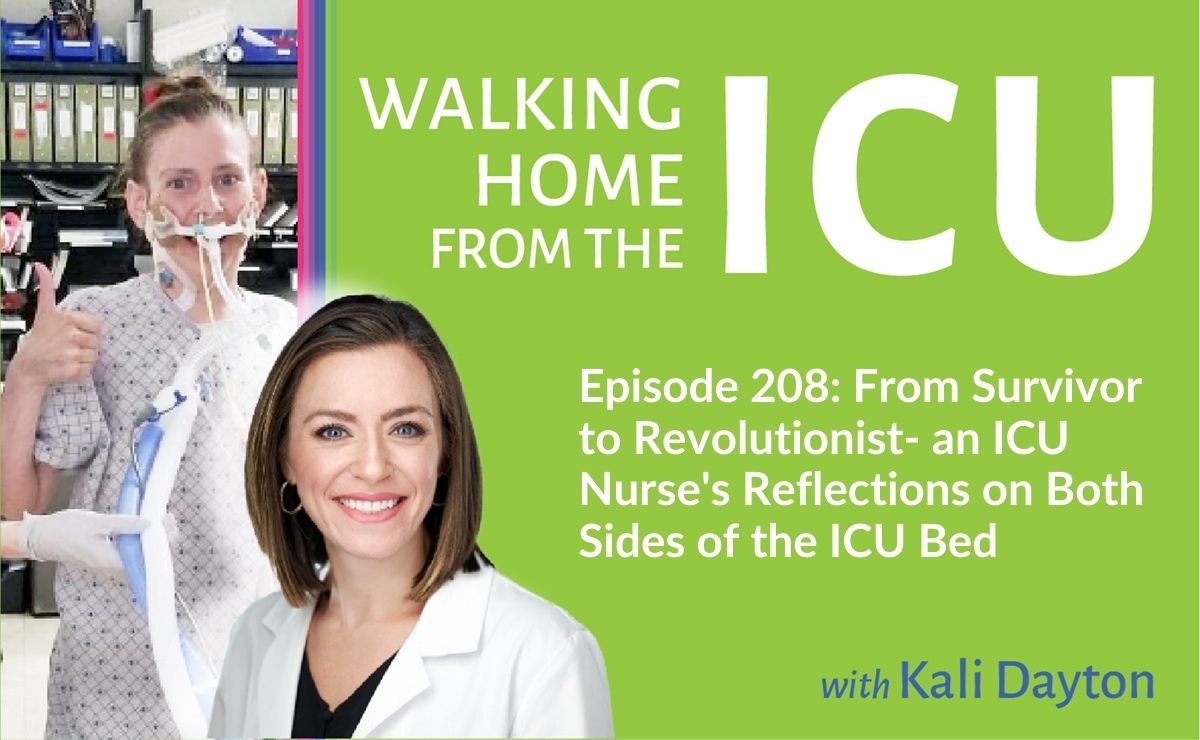
Erika Breivogel’s journey through the ICU as a patient forever changed her as a person as well as transformed the care she now gives as an ICU nurse. In this episode she inspires up with her reflections of ICU culture vs. patient reality and what moves her to keep fighting the ICU revolution.
Episode Transcription
[00:00:00] This is the walking home from the ICU Podcast. I’m Kelly Dayton, a nurse practitioner and ICU consultant. I help teams create awake and walking ICUs through evidence-based sedation and mobility practices. By hearing from survivors, clinicians, and researchers, we’ll explore how to give ICU patients the best chance to walk out of the ICU and go home to survive and thrive.
Welcome to the ICU Revolution.
It is time to circle back to the why of the ICU Revolution, which is the survivors. Their insights are the most compelling, especially when they also relate. The clinician side of the bed. I am elated to have a nurse and ICE two survivor here to tell us [00:01:00] about her journey as a patient in the ICU and how this has impacted her career as a nurse and ICU Revolutionist.
Erica, welcome to the podcast. Um, can you introduce yourself to us? Hi, my name is Erica and I am a critical care nurse. I’ve been an ICU nurse for 11 years. I work at an academic healthcare center in the Midwest. Excellent. And you’re also an ICU survivor? That is correct. I’m a little bit of both. Just such a valuable perspective to know both sides of the bed.
Yeah, absolutely. It’s definitely unique. Yes. I wouldn’t necessarily sign up for it, but I’m grateful that you’re willing to share that perspective with us today. Tell us about your ICU journey as a patient. Yeah, so it was when I was a brand new nurse, I was working at a smaller rural ICU down in southern Indiana.
And I started having really bad back pain and I was like the emergency response nurse that evening. I never worked night shift, but as [00:02:00] a new grad I was all about the money, right? So I signed up and the CVIU had a lot of cases that day and they needed about five or six Emerald arterial chiefs sold. The technology was way different, I to think was about 10 years ago.
So I pulled, like I said, five or six of those and you have to hold manual pressure for 30 minutes. And I was like, man, my back’s just really hurting because I’ve been doing this for so long and it’s the middle of the night, like not used to doing any of this. But then I got a call from the trauma ICU and they asked me if I would come up and do something and I started walking up the stairs and I just felt like something took over my body.
I instantly got lightheaded. I felt like I was gonna throw up everywhere and I like ran to the bathroom, started getting very sick, projectile vomiting everywhere. Super dizzy. I remember I was like laying on the ground of the bathroom near our work, which is really gross ’cause it’s not a hospital.
Terrible. I was, and I called my mom in the middle of the night, which like scare her half to death, right? Like I’m a brand new out of college and mom, something is [00:03:00] really wrong. Just you need to go to the hospital. I said, I’m at the ho anyways, like I had perfect attendance, right? Like I never miss a day of school, like your grade A student.
And I go up to the charge nurse and I was like, listen, I really am gonna have to leave. And he’s, yeah, you don’t look too good. And I was like, thank you. In the middle of the night, I get all my stuff and I walk out to the parking garage, walked up the stairs, which I don’t know what I was thinking, not clearly.
And I passed out near my car in the middle of the night, three o’clock in a parking garage. Thank goodness I did not get hit, had no like facial trauma. I must have landed just perfectly on my backpack. And what I could tell, it was like probably like less than an hour. Like, you have to realize this. I was not feeling well and all this was occurring.
I somehow woke up. I was very like dazed and confused and I was like, what’s going on? But what I did remember is my back was like killing me and I was like, there’s no way I’ve gotta, I’ve gotta go to the [00:04:00] er. So I go to the ER that I work in. I was really confused. I probably looked like, I know I just looked like something from a horror movie.
Like I’m all disheveled. And they’re like, what’s wrong? And I’m like, my back really hurts. And they put me on the monitor and like my heart rate’s 160, my blood pressure’s like 150. My temperature was 104 and I’m breathing in like the mid twenties and I get my labs, I’m like my LAC face like three to four, my white kid from the high 20.
And they’re like, yeah, we’re gonna get a ct. And I was like, fair. But you wanna know what the first thing that they did for me in the ER is they put into bilateral a C IVs. And I’m like, classic. Okay. It just will not use my arms for the next X amount of time. Sitting there like getting all this fluid wide into me and you hear the little sepsis alert and I’m like, this is just a nightmare.
But I get a scan and I had a little bitty baby, one millimeter obstructing kidney stone, but just like a little bit of background. I was [00:05:00] very healthy. I had no health history other than when I was in utero. My mom was getting like a routine ultrasound and down in southern Indiana, they told my mom I actually had hydro plastic kidney disease and I was gonna die because like you think I’m a nineties baby.
There was like no technology and they can’t dialyze a brand new infant. My mom being the mom, she is, she went up to the big city and I went to a children’s hospital where I was misdiagnosed and had Vesco utero, reflex disease and hy hydro necrosis. So very common now with no big deal. But I basically just had to take antibiotics and do all this imaging for two years of my life and then had surgery.
Basically my ureters are flipped upside down. So like all of my urine and bacteria was like flushing back up to my kidney causing hydro necrosis on a little bit of a kidney injury. I head to Sergio was fine, but my anatomy’s different. So my right ureter goes to the left kidney and the left goes to the right.
That’s why this little obstructive kidney [00:06:00] stone was a little bit of an issue because it had scar tissue built up is what a surgeon, whatever. I get my antibiotics, I get all these medicines and man they was, I was throwing up so much and it was cute. They decided to give me like Zofran Egrin and then they’re like, oh, I’ll give you Toradol, and I’m like, I don’t think it’s gonna work.
But then I like started getting morphine. Then I got Fentanyl and then I got Dilaudid and I’m like, I’m gonna, I’m crazy at this point. That’s a lot of medicines and I hadn’t been asleep. Right. I have all those medications, not sleeping and then all of this pain. Well, so I met the Sears criteria. So the ER doctor comes in, he’s, I hate to tell you this Erica, but you have to be admitted to the ICU that you work.
Amen. This is a joke like this. Hilarious. And I was like, it’s fine. Like I’ll take care of myself. Just make me to the PCU because this ICU is like a lot smaller. So there’s like an eight bed CV ICU eight bed [00:07:00] trauma and like a 30 bed medical. And I worked in the medical. Those other beds were specifically for those cases.
And so I’m like fantastic. It’s mine going back upstairs, right where I came from, right where I came from an hour before and it was so funny. When do you think that they transferred me up to the unit? It was that shift change, but plastic air move. But I remember they wheeled me up and they like brought me up the back way.
And I just remember seeing like all of my coworkers, like with these sad puppy dog eyes, like looking at me. They were gonna cry and then I was dying and I was like, guys, stop looking at me. I’m not dying here. Because it, it had to be dramatic, right? I had to have a non-rebreather, even though my SATs were a hundred percent.
At this point, I have five IV poles, I’m sure. But some of the interesting things like being a nurse and a patient is I love my nurses. I love my coworkers. Like they created my foundation that I started my career on, but they are rule followers. And so I get to the ICU and bless it, be the name, but my [00:08:00] nurse, she wanted to do a four eye skin assessment.
And I was like, Heather, we can’t do that. Oh yeah. This is such a different situation. Geez. You know the policy. And I’m like, I know I helped create the policy. Fine. I said, but nurse can refuse. Our patient can refuse, and I refuse. There’s a lot of sas. And then what is the first thing we do to these ICU patients?
A CHG bath? Especially back then. Yeah, back then, so I was very sticky from the CHG wearing my scrubs and then, then everybody and their mother came and visited me. I’m like, I don’t know who is taking care of anybody else in the hospital. I’m talking like the lady in the cafeteria. I used to get all my Diet Cokes was coming to, oh my God, don’t we love our cafeteria workers?
That is a special bond. I get it. It’s so sweety like, you want a Diet Coke? I’m like, no, I’m puking. Thank you. But it was so sweet. It was. But like I’m in a very vulnerable state. Like I [00:09:00] look awful. I feel awful. I still have this, I don’t know if anybody’s ever had a kidney stone, but not ideal. And then a little did I know I was septic.
I’m waiting to go to surgery, like an emergent surgery. And I don’t remember if it was like eight hours or so later, but my blood cultures already, they were calling it, they were caught coming back positive with gram-negative rods. And I’m. Of course I can’t just be a normal human being and get like something like MRSA, I have to get a super bug, like out of all things, a less routine super bug, right?
A less routine. I had to get club CI out of all things and yeah, I was in both of my blood culture bottles. It was in my urine and then at some point in my hospitalization I was able to get a respiratory culture and it was also positive. So that was the other thing. So I went to surgery. It was pretty uncomplicated.
There was a lot of hydronephrosis. I, it was pretty routine other than the fact she had to keep switching out scopes because my anatomy was different. I had to crawl and get like a ped scope is what I was reading at the [00:10:00] postoperative notes. But this is where things start to go south. I woke up and I was in a very unfamiliar location and I just, I wake up and I’m like, what’s going on?
And then it comes to me, my hands are tied down and then I start to realize my throat is really hurting. And I, my, I don’t know. My first instinct is to like just start to scream. I don’t know because I was like terrified. I was like also hurting, like my back was very sore. I look between my legs and I have a catheter.
I’m like looking at my arms and I’m very confused, like I know I’m a nurse. It was in a location that was like not familiar to me and I realized I was the PACU. In icu, we take our patients straight from or to ICUs. They never had seen the pacu. This lady comes over to me, which I’m assuming was my nurse, and she just looks at me.
She doesn’t say anything and she just says, I take some slow, deep breaths and I’m like panicking on the inside. Who are you? What is going on? My hands are tied and I’m in pain. [00:11:00] Did you know you were intubated? No. You just knew your throat hurt? I just knew my throat hurt and I’m like, I’m like looking around.
I’m like, yeah, like things I can see. Yeah, I guess that’s like a big, but I don’t, I didn’t really remember, like I was in like such a state from all the medications. Probably the sepsis that I couldn’t, didn’t know what was happening to me. And so then she walks away, doesn’t say anything, just tell me take slow, deep breaths.
And I’m like, okay. Women start getting agitated and I remember now I’m like really awake and I’m like, bang on the side rails. And I’m like looking around. I’m moving. I can hear like my monitor, my heart rate’s really high. And then the next thing I remember is I’m back in the ICU where I work in. So they must have extubated me, but I don’t, I don’t recall the tube coming out.
I don’t, no one told me to do anything. I just remember waking up from a nap back in the ICU that I worked in. So later that night I really started to feel bad. I started working really hard to breathe, breathe. And I remember my monitor that night kept [00:12:00] going off, and this is the inner ice U nurse. I’d look up and I would look over at my mom and I’d be like, that is not good.
And then I kept passing out and what was happening is my heart rate was extremely high, like one 60. And I was going in and vtac and my blood pressure was in seventies. And so then I felt, it’s almost like when you’re underneath the water in a swimming pool and you’re right at the edge of the water where you’re just looking up and you’re trying to breathe.
That’s how I started to feel like I was breathing. And then the next thing, like this stuff is like in and out, but I see the big orange intubation box coming towards me and I see the code cart coming to me and I hear overhead, like rapid response and whatever my room number was. And I remember like pads going on me.
I remember getting a central line, getting an art line. They’re lapping the BiPAP mask on me. I’m getting a chest x-ray. What had happened was I was in flash pulmonary edema and my blood pressure was tanking out ’cause I was in full blown subject shock. All of my labs have gotten worse. I don’t know [00:13:00] the specific numbers, but I just remember like every person in the whole unit was in my room and everyone is just like looking at me with these big puppy dog eyes and they’re super scary looking eyes and.
Then the next part that I remember is it was almost, I was like dissociated from my body. And I’m like looking over and I see all my coworkers, I see my mom like outside the room and I see everybody working on me. And that night I was really sick. I had to wear the BiPAP. I, they ended up, I didn’t have to be reintubated, thank goodness.
But I feel like if it was anybody else, we would’ve just intubated you, like no problem. But I was also in my early twenties, they were like letting pink ride. But I live on Levo. I got a very high dose of Lasix. And then the other thing is my temperature was like 105 and 106. That night they had to put me on a cooling blanket and that is miserable when you are awake.
They ripped all my gown off. I couldn’t have a sheet, I couldn’t have any socks. And I [00:14:00] just remember, I don’t know if it was like the sepsis, but like my body was just completely, it just hurt. Like just someone touching my hand. It just, everything hurt so bad. And then I was like. Shaking uncontrollably, my pain was out of control.
So then the next day, whatever things are, okay, I am still not feeling great. But I got out of the woods. But that night, one of my best friends, Jessica, she was like my work wife, I made that list of who could take care of me and who could. She was like top on the list, circle double five, five stars next to her name.
But that night I hadn’t gotten any sleep. They sent my family home. And so my family like never knew that this icy delirium was going on. But I remember one night I woke up from a dream. I either, it was more of a nightmare and I was panicked. I just woke up and I was so scared and I woke up and I see thousands of spiders just crawling around on the walls.
And I don’t, I’m not a bug person. Like I will kill the cockroach at work, but I do not like bugs. [00:15:00] And I remember I ripped my IVs out and ripping my monitors out. ’cause like I, at this point, I didn’t know where I was. I didn’t know that it was a patient. And Jessica comes running in and she’s Erica like, you’re at the hospital.
I said, I know Jessica. We need to leave. Like, I remember telling her like, I felt endangered and I felt something really bad was gonna happen to me. And then I see like thousands of spiders, right? That’s something from a horror movie. Like that’s not normal. Like, I don’t know where we’re at. It’s like dark because they’re trying to get me to sleep.
I’m in the back corner of the room and I’m hearing all these things. And I just remember I was like, I was fighting. I kept trying to get out of bed. And then the next thing, somebody else is coming into my room and they’re pushing meds in my iv, which I’m sure was a benzo, which that’s what we did back then.
Someone’s even still sometimes today, like some people are going crazy. I’m sure it was some Ativan. Um, but I remember I was terrified. I was crying. I like, I felt so, so helpless. [00:16:00] Like I didn’t know what was happening to my own body. I didn’t know where I was. But I’ll tell you what got me out of this, this phase.
Was Jessica took her hands and she put them on my face and she said, you’re okay, you’re safe. And I remember she like sat with me and she like held my hand and stroked my head and she kept just repeating her. She just kept saying, you’re safe. Like I am here with you. You have to trust me. You know you’re safe.
And so that’s what got me through. I’m telling you, I have never felt so, so endangered and so scared in my life. I had no recollection of what was happening. Like I could not put two and two together. This is an iv, this is a monitor. I’m in a hospital bed. Because I think what was really hard about my experience is do you ever dream about being in work?
Because I do that normally on a daily basis. It’s like I couldn’t differentiate reality from a dream. And so like in my head, I don’t know, like I was in a dream, like a [00:17:00] nightmare. Like nothing was real. Like she kept saying, you’re at A BMC. This is the date, this is the time. And I’m like. I don’t care. No, it’s not like it makes no sense to me.
It makes no sense. I don’t, and I think what helped me the most is like seeing that familiar face and then in the days to come, so I was in the ICU for about seven days just for like blood pressure reason. I just remember I was like very dissociated from my body and I like just didn’t have a lot of emotion and I just didn’t, I don’t wanna say I just didn’t care that much, maybe was how I felt.
Then I started to get better, but I had a lot of nightmares when I was in hospital. But that one night where I kept seeing the spiders and hallucinating, that was definitely probably the worst part. But I remember though, on day four, nobody had ever tried to get me out of bed and so I’m like 23 at the time for four days basically of being immobilized, stuck in a bed on narcotics, not eating, not drinking.
I had to be a [00:18:00] Q2 turn, like I had to be pulled up from the bed. I couldn’t even do that myself. And I remember the first time had a physical therapist come, I had to use the walker and I was a stand, like a two person stand assist to stand up. And I’m like, I am 23 years old. I am very faulty. And I’m like in the matter of four days, so days.
I just can’t imagine when I think of like mammal and pap that I take care of, like they’re on the vent 7, 8, 9, 10 days and they’re on myotoxic sedatives. You weren’t getting like propofol is a mitochondrial toxin. You weren’t getting propofol. But if Rams on that comes in frail is now immobilized also in septic shock and getting a myotoxic sedative continuously, no wonder their survival rates are so poor.
But that is astounding. You had just been doing the stairs at your hospital, you had just been like. Hurting patients. Boosting patients because this is 10 years ago, so you probably weren’t using a lot of equipment like you were doing. I just want nurses and all the clinicians to think about [00:19:00] what they physically do in a shift.
I got in a car accident once and I got double whiplash and I tried to go back to work and I was like, oh my gosh, my job was really physical. I so depend on my body. Absolutely. And to have that stripped from you so quickly is astounding so quickly. And me being me, I convinced everyone, like, don’t send me to a subacute rehab.
I got to the point by the end of, I think I was hospitalized like nine days and like by the end of that I could walk to the shower, but it was like I had to walk to the shower, sit on the shower chair. And so I convinced the hospital team to let me go home with my parents. And the problem with this at my parents’ house, my room is upstairs and I remember for the first several weeks I could not walk up the stairs like.
My mom, I was so reliant, like my mom had to make my meals if she did my laundry. I remember just like sitting on the couch, just honestly vegetating like, I felt like I just sat there, like there was nothing I could do. I felt so weak. I was like [00:20:00] not hungry. I still just felt like I had been like ran over by a semi and then I just, I don’t know, I just felt so dissociated from my body and like nothing that had happened was really like setting in at that time.
And then I was off work for a couple months and I remember going back to work and I had a lot of anxiety. Like first of all, like some of the most triggering things, it’s like I was taking patient, taking care of patients in two rooms down where I was the patient. Like that was terrifying. And then like certain things like would, I would have flashbacks that I didn’t know that this would happen.
Like I would hear like RRT and I remember just being like. Like I would almost start to have a mini like panic attack because that in my brain what I remember is like that intubation cart coming towards me. I see that red box, I see all those like CU and Goosebumps 20 faces looking at me with those like puppy dog eyes and then just feeling like helpless, like that.
There’s just so many things like [00:21:00] that I would see and be reminded of this job. And then there were things that I did right. I’ve been an ICU nurse for a couple years. I have hung a thousand piggybacks. Right? That’s like something you do as an ICU nurse. Muscle memory. Yeah, muscle memory. I remember checking my piggybacks like four or five and six times because I was so nervous that it was gonna make a mistake.
Like I had been cleared by all physicians. I had every consult in the book. I followed up like my strength, like I didn’t have any restrictions, but I just felt terrified, almost going back to work. And that was like a really hard thing for me to overcome because like. You as IIC nurse, like your patients are the vulnerable ones.
The nurse is not supposed to be the one in that state. But that was something that was extremely challenging for me to get over and to come back to work. So did you feel like you had cognitive impairments that were noticeable once you got back to work? Maybe the physician’s not doing a MOCA score in you, right?
No. And it’s almost like I just felt like I [00:22:00] was in a fog for most of it. I could come up with all the answers. Like I never, if I ever thought I was gonna put a patient’s life in danger, obviously I would stop working. Like I am that type of person. But I just felt like I had more, almost just more anxiety about just everything.
Like I didn’t trust myself anymore. And I’m not saying I was like the most fearless nurse, but as a new grad, what all of our confidence, they were a little self-confident and I felt I’d go to work before all this and give me the worst day, the worst patient in the world. Let’s do it. I’m ready to take on the day, but.
Then I’d come back and I, I would ask, Hey, can I start with the easy patients? Maybe like someone that’s really just an observation for ICU or something like, no balloon pumps, no CRT, no pressors, just something low key. And I was working like every other day and like normally I’d work like three twelves, so made a lot of modifications and like I would, on my breaks, I would have to sit in a quiet room and almost like meditate.
And like all of that stuff was just, [00:23:00] I was so out of my norm. And I ended up actually, after about a year of recovering from this, I ended up leaving that job because I felt like it was impacting, like the mental aspect of this. I would see all these people that had taken care of me. I had seen the room that I, in my opinion, almost died in a few times.
And then like when it came back to work, it was never the same. Like everyone was amazing, like super caring, like always looking out for me. But it was also just really weird like. Person I was eating lunch with had basically seen me naked, like boundaries had been crossed. Yeah. And like all the doctors, not that I had anything to hide in my medical records, but it was just like, wow, everybody knows my family.
Everyone has seen me at my most vulnerable state. And then that’s when I moved up here to the big academic healthcare center and I’ve been there the last eight years. So I use this experience just as a nurse to really teach people about [00:24:00] delirium. And there’s just a lot of things I feel like as an ICU nurse, we don’t tell patients, we just say, this is how it is gonna be and this is what you’re gonna do.
And people don’t understand. I’m talking like a central line where like you need a central line. You just tell the patient, oh, you’re gonna get a little numbing medicine and you’re gonna be fine. Actually not the most pleasant thing. And I’m gonna be honest, an art line that is literally on the top three things that was the most painful out of my entire hospital stay.
And what art line in like left and right, the I see. Art stick every four hours. Sure. It’s routine for us. Yeah. We forget how abnormal and even traumatic it is for our patients. Yeah. And we don’t, and that’s something I try to teach my new grads and my orientees is like, sure we’re putting in a fully catheter, but that’s actually very traumatic.
Or any other, the other tubes who put in every hole in the ICU, that stop is so traumatic. And I’ve been that nurse that like, when I’m taking off a tegaderm and like the patient’s, oh, it hurts. Like I’ve been like, [00:25:00] come on, does that really freaking hurt? Actually, I’m not gonna lie. It just, it does Like your skin is sensitive in this state of illness.
I don’t know how to explain it, but there are so many things, like I remember like just being pulled up in the bed that hurt me. And you always hear these patients again, I’ve been the guilty one being like, okay, literally just pulled you up. Like why are you screaming and yelling at me? Until you have been in that situation, you cannot be judgmental.
And I think that’s one of the biggest takeaways that I have learned from this is I was so vulnerable and nobody, I guess they took for granted that I was an ICU nurse, but no one ever told me what was going on, what we’re doing next. This is, we’re just doing it. That’s scary. That’s scary for my family.
Like my poor sister, oh my gosh, I traumatized her. ’cause she is like an elementary school teacher, not medical like lover to death. Like I remember my mom had to go home, right? To take a shower. Like I was there for a while. My mom is medical, she works in the microbiology [00:26:00] lab, so she knew some stuff. But I just remember like also just like looking over at my sister and just seeing that in her eyes, like it was not only traumatizing for me as a patient, it was traumatizing for my coworkers, my parents, my family.
So like this illness like just did not affect just me. It affected lots of people and I think that’s why like family engagement is so important with IC delirium versus just. Shooting the families out. Right. That’s the first thing you wanna do. Mm-hmm. We don’t want our patients’ families, we don’t want the patient to be awake and looking at pictures and looking at things on the phone.
We don’t want patients writing because, but I’m like, there are so many things that that would’ve comforted me. Like just ’cause there’s times my family couldn’t be present, but I’m like, and granted, I knew my nurse, but I’m like, when I was in that pacu, I was helpless. Like I knew nothing and had no comfort and I was just being told to do something like that.
We’ve got to change that culture. We have to do it like that is, [00:27:00] that’s something I will take to the grace. It is so easy to fall into routine. I just, I know I’m so guilty of it. There were times that I was working like four or five shifts a week, and I, no one should do that because you lose your compassion, your humanity, it’s, everything’s going so fast.
You lose your personal life. And so how do you make your work personal anymore when you’re just a robot? And I’m sure in that moment, assuming Erica was just here hours ago as a nurse, she knows this environment. If you’ve been listening to this podcast, you are likely convinced that sedation and mobility practices in the ICU need to change.
The ICU community is facing incredible difficulty with the trauma from the Pandemic staffing crisis and burnout. We cannot afford to continue practices that result in poor patient outcomes. More time in the ICU, higher healthcare costs and greater workload for the ICU team. Yet the prospect of changing [00:28:00] decades of beliefs, practices, and culture across all disciplines of the ICU is a daunting task.
How does this transformation start? It can begin with a consultation with me to discuss your team’s current practices, barriers, and to formulate a plan to help your ICU become an awake and walking ICUI help teams master the A-B-C-D-E-F bundle through education consulting, simulation training, and bedside support.
Let’s work together to move your team into the future of evidence-based ICU care. Click the link in the show notes of this episode to find out more
yet even when you know the environment. ’cause I, sure, I hope everyone’s asked themselves what would it be like for me if I was in this environment? I’ve certainly assumed I could understand what was going on and be more independent than other patients, but not necessarily because that’s a whole new perspective and I didn’t even think about that until.
I was playing the patient at the [00:29:00] conference, I just laying in a bed very stable. I was in the middle of a conference center. I knew these people, like I felt vulnerable. They were peering down at me. Yeah, it’s the peering down thing is until you don’t understand what that’s like. And then the other thing is privacy.
Oh my gosh. When I see people cleaning people up on my unit and people’s butts are wide open in the hallway, I get so angry because I remember being a patient and they’d be doing EKGs and they would take my gown down and the thing was wide open. That is a huge people. You forget that patients are human beings and like you said, we are all just so conditioned.
Go to work, give the meds, do the assessment. Like these are people’s families, like I was someone’s daughter, sister, niece. That is like something that I take and I want everyone to take from me. From that is, like you said, like you have to realize these people are so vulnerable and that’s so easy to forget.
And there’s a lot we can do to preserve their dignity. Even when we need access to all [00:30:00] these orifices in these personal spaces, we still need to remember that they are personal. And I think we assume, especially if someone’s been there for a few days, you’re used to it. You’re in this position, you are a patient.
We assume that patients expect to be treated like patients and not humans. It, it’s such an, it’s such a weird psychology and it’s been interesting for me to break down the different paces of my career and my mentality. And there were times again, when I was so burnt out that I, I realized that I was going in and being like going through the motions and being like, hi, I am your nurse.
Here’s what’s going on today. And rip off the blankets and start doing the things instead of being like, what matters to you? How are you doing today? Oh, absolutely. Absolutely. And that’s like a big joke, which on our, you know, like everyone calls me the stalk queen because I don’t just give people baths like.
I will take the extra 15 or 20 minutes and I will wash people’s hair every day. Like I will braid their hair, like I will trim apple’s beard. Like I’ll ask their family. Okay, do they part to the right, do [00:31:00] they part it to the left? Okay. Wow. Like these, he needs some lotion. Just like making someone feel more like a human.
It is like super important to me. And I always get joked about a non malist way. You never sit down. And I’m like, yeah, because like I’m a strong believer if you look good, you feel good. And there are studies that actually prove that. And like just making people feel like humans like, and then obviously like printing delirium, preventing delirium.
Like I’m crazy obviously ’cause have unique experience, but like get those people’s glasses, get their hearing aids, let them participate. And like you said, like what matters the most to these people? ’cause everybody jokes. Like Erica’s always in there talking to her patients, saying, okay, you’re at the hospital.
It’s. This date, this time. Now you have a breathing tube in your mouth. We’re gonna, you’re very sick with this and we’re gonna turn you, ’cause something I see every day that’s so disheartening is, again, we just get into the cycle of the motion. We just go into the room, the lights are off and we just pull a patient up.
I’m gonna stick this giant thing in your mouth. I’m [00:32:00] gonna clean your mouth and we’re gonna be done. I’m gonna try to get in there, get you less least amount of agitation and leave. And I like, I get that, like I love my patients being pretty in the bed, looking great and feeling good. But it’s scary.
Imagine like being like in a sedative state and just being woken up instantly pulled up in the bed, lights off. I don’t know who you are. I’m gonna stick this thing in your mouth. I’m always talking to my patients and I feel like that’s something that we forget as nurses. And like I said, I’ve been that person, like I’ve done that hundreds of times.
But I think it’s important to explain your hands are tied down. Like my, I see you. Unfortunately everyone has, it’s a policy. Everyone has to have their hands tied down and so. And so just telling the patients, like every time I go in there, I’m like, you know, I’m gonna have to clean your mouth so you don’t get a pneumonia from this breathing tube.
Now I want you to know your hands are tied down and that’s because it’s a safety thing, so you don’t pull that tube out and explaining if you do pull the tube out, you can have some focal cord damage. [00:33:00] Now, don’t get me wrong, like some of these patients are looking at me like they’re in la la land or they’re old and don’t understand, but would you rather be told that this is an okay thing or just being ripped around, moved around and and dehumanize.
The best way, the most potent way to dehumanize someone is to pick with the way their ability to communicate, be informed, make decisions, and move. Absolutely. Do we not go through that exact checklist when we sedate and when we sedate every single patient after intubation, we just put them through this conveyor belt and we’re like, your human rights will not be stripped until you survive If you survive.
And your life will never be the same. So deal with it. That’s never anyone’s intentional mentality, but that is the reality of what we do. Yeah, like I remember, nobody ever wants to let anyone ride on the vent. I get it. Like when people are delirious, like they usually are like scribbles, okay. But you have to tell the patient like, I know you’re really trying to write, but it’s just not legible.
But I’ll tell you, I took care of this guy and he was just so [00:34:00] agitated all the time and he is like wanting to write, kept giving him a sibling. He wanted to write. And I was like, I got record from the night shift nurse. I’m like, did you ask him what he wanted? And she’s, no. Okay, so what is the first thing literally I do, I get the clipboard and I get the dirty looks from everyone.
I love my coworkers. I don’t, I’m just saying, but it’s challenging the norm, right? It’s there’s an eye roll of, oh yeah, what’s a clip we’re gonna do? So I go in there, you wanna know he wrote, he wrote my dog. So what did I do? I called his sister on the phone and I said, listen up, whatever her name is. I said.
He is so worked out today because of his dog. I said, did the dog live with him? Are you keeping the dog? Are you feeding the dog? And she had, the sister had went over and got the dog and was taking care of it and like feeding. So I went and told the patient, I was like, Hey, like I just got off your phone, whatever her name was, I said, she has whatever the dog’s name was and she’s taking care of him.
And he just instantly starts crying. And I was just like so [00:35:00] heartbroken that he wanted, ’cause that’s his, that was his child. He wasn’t married, he didn’t have kids. He had this little elderly sister. And the rest of the shift I was able to cut a sedation down to a fourth of what it will. And like, there’s just so many stories that I have of that by doing all of these delirium prevention techniques that you talk about, that everybody talks about, that seems so not important in the bedside that they affect these patients or a lifetime.
And like I said, like my experience, I got lucky, right? Because some people that have delirium, they have to retire. I’ve seen so many, this is so sad, but like I’ve seen, I had took care of a 30-year-old lawyer that had a RDS from Influenza B that was on a rot, herone and ecmo. And he had to go on disability because he was so cognitively impaired.
And I’m like, you spend your whole life becoming a lawyer and now you just, you have to retire from or be on disability the rest of your life because he was a young, healthy guy that was [00:36:00] on the verse said Drip on the nimex strip for weeks on end. And like that kind of stuff is so heartbreaking because I got lucky is what I like to tell people.
And I was put into this circumstance so I could teach about it and tell my story. Because people don’t realize that we have to have a culture change. Like this is something that has to start small and we have to change this for these people’s lives because it matters. And. Every day. I said, I don’t care.
I will get the looks and I will be the crazy nurse on the unit I knew. Do your coworkers know that you are an ICU survivor? So that’s what drives you? A lot of people didn’t, until this past May. I actually spoke at NTI, the National Teaching Institution for Critical Care Nurses. For the first time. I did a podium presentation and it was like my personal experience, an ICU nurse recovering from IC delirium, and that kind of went a little virals, but I like to, with my coworkers and my work found out and they’re like, I had so many people come up to me like, well that makes a lot of sense now [00:37:00] because I’m like, let’s get these people up.
We were like, Erica, they’re on CRT and I’m like, so cool. We focus so much on renal function, lung function, liver function, like things that we can, can we measure and they don’t realize what else is at stake. Oh yeah. And like my, my back problems like I’m 33 years old is, can you imagine someone that actually has back problems?
I cannot lay flat in the bed. Think about your arms are propped up on two pillows. Your hips are to one side on the wedges. You asked to do that at home. See what that feels like. That is so uncomfortable. But you’ve ever someone that’s healthy. Let someone, I just wish someone would’ve helped me turn on my side and I really feel like that would’ve helped me have less like postoperative pain management medication because all the pressure was on the right side of my kidney.
And I’m like, if you would’ve just told me, turn all the way over to ease that pressure. It’s just like little things like that we forget to think about and who is the expert on which position is most [00:38:00] comfortable, the right? Like we forget to even ask, is this adequate? Does this help? What do you prefer?
Especially obviously if they’re intubated, it’s now they have. No say in anything that’s happening, but there, there were patients that I took care of that were just desperate to lay on their side, like, yeah, don’t we? Most of the side sleep? Yeah. Well, I’ve had, so like obviously if they’re not, if they’re delirious and trying to self extubate, but certain patients we would lay on their side, put a pillow between their legs.
They could sleep in a normal position. Even while intubated. Sometimes I would restrain their hands a little bit loosely to the side just so they like have a reminder if they woke up and moved, but they were in a normal position, can we not just try to normalize an abnormal environment? Oh, absolutely. I untie my patients when I go on there.
Once an hour, I will take literally the extra five minutes, let your patients scratch their face like they’re non, they’re not all gonna pull their tubes. And don’t get me wrong, you’re gonna have that young strong fighting man that’s withdrawing from all the [00:39:00] things like alcohol, cocaine. Yes, he will pull his tube or she whatever, but.
Just think about you’re sitting there and you have the worst scratch ever on your eye or like even eyelash and you’re just sitting there ’cause they want you awake on the ventilator. Can you imagine what that feels like? So I untie my people, I take the restraints off and let people stretch. Think about older people like arthritis, they need to move their joints.
What is like the biggest thing we tell people that have arthritis and chronic pain? Move mobility. Say you’ve got things like sepsis where you have so much systemic inflammation, it’s settling into the joints, causing or exacerbating those conditions. And then what do we do completely mobilize them so they cannot mobilize all of that inflammation and it leads to arthritis.
You have young people leaving post sepsis, they have terrible arthritis and it changes their lives and it’s because of leave laying there in a hypermetabolic and or hyper inflammatory state. Oh, absolutely. And like I said, the mobility thing, [00:40:00] like I just from my own personal experience. I have sat in with so many patients that are on like 3, 4, 5 sedation drips.
Like I kid you not propofol, burst, said Sedex and Dilaudid, maybe even ketamine. And I have spent extra time like in the rooms, like I prioritize my day to be able to do this delicate where I can. And I sit there with the patient and I talk them through what’s going on. And I always call like bringing a patient back to this planet.
Yeah, we’ll mobilize them. And in my opinion, I am the one if it wasn’t for me standing in there for literally like two and a half hours, which I realize that’s a long time and you don’t always get that time. But I will multitask in like sitting there, being patient, like explaining to them like don’t sit up like that.
Because like everyone, what do they do? These, they wanna sit up and grab their tube and if you explain, talk people down and be like, Hey, you remember you’re here in the ICU, you gotta lay down because you’re on your breathing trail right now. And okay, we have 45 minutes and then I say it again. We [00:41:00] have 35 counting down the time for.
And then showing them, look at the clock here. Okay. So when this clock is 2:00 PM then the tube can come out. And I just know that these patients will, if it wasn’t for me, they would be on the vent so many more days because it’s a scary thing to cut sedation on patients. Like when people are wild, it’s super scary, right?
Like they’re coming outta the bed, they’re in like eight point restraints, like you’re trying and you don’t know when they’re gonna come out. Yeah. It’s so hard ’cause you’re like, I’ve gotta check my other patient. I’m worried toward this goal, but I like if they’re RA negative four right now they’ve been on propofol for long.
It could be hours till they even open their eyes or it could be three minutes. How do you plan that out? That is so hard. Oh gosh. Yeah. And just every time someone goes crazy and I see people push verse said cringe a little bit because I just, from all the education that I know of, like how negatively affect versed.
It is for cognitive impairment, getting off the vent. The [00:42:00] half-life is super long. Don’t get me wrong. If you are actively seizing or an active alcohol withdrawal, no questions asked, here’s your birth, said or adamant, whatever. But like a cringe. When we give some of these, like even 50, 67 year olds, like they’re getting a verse said like once an hour or they’re on a verse, said drip.
And everyone’s like, why are you suggesting prosthetics when they were on a verse, said Drip at 10 yesterday. And I’m like, okay, but listen, low key, like people that are crazy on verse said, respond very well to prosthetics. I’m not saying everyone, you’re gonna have that one patient, but just to work on, but you just like just communicating with these people.
I’m telling you like, I could talk to you for hours and I have hundreds and hundreds of thousands of patients that I have seen this be successful for. It’s just you have to take a chance. So what if your patient kicks their legs out of the bed? Who cares? As long as they’re safe, right? They’re moving cares.
Like as long as your tube is safe, your central line is safe. Okay, put your leg back in the bed for the 300th time this hour. Great. [00:43:00] And I just think it’s so exhausting to be in your position where you get it, you are a revolutionist, you have li lifted, and now you can’t unsee the reality of what’s going on.
But you’re in an environment where your colleagues are well intended, but they are not trained. They don’t have this necessarily eye of empathy that you can only get when you live through it. Or I think obviously listeners of the podcast when they’ve listened to so many survivors, they have at least somewhat of a glimpse of that patient perspective and their their reality.
And that guides them. But if they’ve never seen anything besides their own perspective and they’ve been molded by this environment and are copied the things that they’ve seen modeled throughout their careers by their mentors, they don’t know anything else. And so it makes you look like the crazy one.
And so it’s unintentional gaslighting to say, oh, please, Erica, that won’t do anything. You’re the crazy one. You’re the cuckoo. You do your thing. But we’re not doing all that hard work. That’s why it’s becomes hard [00:44:00] work, because when revolutions have to come in and try to do the cleanup, when you have to spend two and a half hours as a norm for most of your intubated patients, to get them to do the right thing, that you’re ethically bound to do it.
I just thank you so much. I have so much respect because that was not my experience in an awake walk. And I see ’em. Yeah. Yeah. We would have some delirious patients sometimes, but not as, every single time. Most of my patients could write clearly legibly on a clipboard because we had ’em real awake right away, and we’re like, what do you need?
And I would, it was my MO to know how to communicate, and I knew that every colleague that came into the room was going to be communicating with my patient, identifying their needs, meeting their needs. It wasn’t just down to me and hoping to get them in time to prevent a tracheostomy, get them in time before they died from sedation to fill the weight of, I have to get them.
Out extubated or tomorrow or tonight, they’re gonna end up right where they were five hours ago, and I’m gonna have to do this again tomorrow, or no one will ever do this again. That is so much weight and responsibility and for you to see these interventions as for [00:45:00] what they are. For example, when you were delirious and spiders were crawl all around and you got Ativan or a push of whatever, what happened?
What did you experience when that was given? Like I said, I was in just a state of panic and fear and I just instantly went to sleep. But then when I woke up, I was still fearful. I was still scared. Like the spiders may have disappeared in that moment, but I remember waking up and I still felt that sense of panic and I was scared and hopeless.
I don’t know what that, I don’t know what that entailed. I guess it put me to sleep for whatever, but it didn’t help the situation. I just prolonged it. And some people, they go deeper into the delirium, hallucinations become more graphic, more vivid, they have less touch with reality, and it goes somewhere crazier and then they open their eyes.
Now it’s everything they experienced while sedated plays into everything, all the input that they’re receiving while quote awake. But then you’ve also experienced the power of someone grabbing your face, looking you in the eyes and connecting with you and talking [00:46:00] to you. That was the one thing that, that was literally the saving grace that brought me from being extremely crazy, aha.
Fearful to bringing me back to reality. And that’s what so often or not delirium, like we’re just disassociated. We were not there. And in that moment I felt humanized, like I felt like could trust Jessica. Just her calming presence. And just like I said, not looking at patients with those puppy dog scared eyes.
Like she just literally, I almost looked into my soul and I felt it like I actually felt she was protecting me. She was being an amazing friend, obviously, but she was also the most wonderful nurse for that. Did you recognize her as your friend? I didn’t recognize her nurse. She, she was just my friend. And, uh, wherever we were in my brain, I just knew like she was someone I respected and someone that I could trust.
If we really were like caught in the back of a alley, she would tell me to follow her and I’d follow her ’cause I would trust her. [00:47:00] It’s so interesting that other survivors, they have certain clinicians that had the same approach and they were so bonded to them and the sea of confusion, scariness totally isolated.
No one’s talking to them. And then one clinician comes in and they knew this is a safe person. Even though they were sedated and they weren’t necessarily even communicating, they knew this nurse talks to me, this nurse is gonna help me wake up more. Remember which episode someone said I knew which nurses were going to turn me off.
Oh my God. Wow. Like I had a patient once that they were on the vent and I take care of ’em a long time. Like I said, I’m the one, the crazy one talking to my patients all the time when they can’t talk back. But I remember, like I had been, I worked my brain and a round arms off for the week, whatever, and I go back and I spent a lot of time, like the patient almost died.
I spent a lot of effort to that patient and I went in there and I was like, hi, my name’s Erica. I took care of you. And they just started crying. I always, I remember your voice, I remember you saying your name is [00:48:00] Erica and you’re my nurse, but I didn’t know who you were. And just the fact like that had been like a week later.
They just come in when they’re doing so much better and they say, and they just start crying. Like they just hear my name, me saying I’m Erica, and they start crying. Like that in itself was like so humbling of an experience that what I’m doing every day, talking to these people, getting him up, that’s changing life.
I mean that, that’s why we become nurses for that compassion. So like you said, like that bringing humanization back to people, that is so important for our patients. And I know as nurses, especially when we enter the field, we’re like, I wanna get to the point where I can take care of the sickest patient.
Take care of the patients that are closest to death and run all the machines and all the pumps and pull them back. There’s so much product with good reason. What we do as nurses is amazing. If you zoom out and you’re like, wow, we are literally saving lives, right? But these interventions are just as [00:49:00] powerful and so for me it’s been amazing to watch nurses reconnect with their roots as they become awake and walking.
I see. Is when they realize this is so bad. A like I just episode, I had to think 185. It’s with the trauma ICU, and I think trauma nurses have their own personality. They’re their own species fantasy. That kind of, that pride and that identity translate to who can get the most smashed at patient, the most comfortable, the most communicative.
They’re like, yeah. We had a woman that she couldn’t even move her limbs except for one foot. We created a letter board that she could point to those letters and that we were like thumping their chest about that. And I’m like, yeah, we should be so proud about that. That should be like the kind of competitive spirit.
I remember one of my best friends, she was my roommate while I worked in the weekend walking ic. We both worked there and we would have makeover competitions like who could get their patient the most transformed. We had a lot of unhoused patients and so it was like who could get them off the streets and look in the most dapper possible even while [00:50:00] intubated?
That’s awesome. And that it was fun and it changed the environment. I’m watching that change these environments of these teams that I’ve trained where we laid this foundation of the science, the why, the harm, and then we start to pull in these other humanistic elements and first people are like, place like this isn’t gonna work or everyone’s gonna be thrashing or whatever, and I see how this works.
And then I love, I have a whole list and you guys wanna add to it. We’ve had these conversations on Instagram of hiking things, tips and tricks like beauty products or whatever. ’cause it’s really, it’s that Johnson’s baby wash, like it’s just. You don’t love using that. You don’t wanna use that on their hair.
It just so I know, like I’ve done it. A lot of nurses, they bring in their own shampoo and I hide it. I tell the units, I’m like, just get a huge Costco bottle of something that smells good and have med cups and let or do whatever, get these supplies. So the nurses feel like the unit values this. They’re not having to scavenge and fight to be, provide like humane care.
Get the beodorant that smells good, like do think that are gonna be [00:51:00] fun, have proper razors on the unit, have a hair basin so that you can use actual flowing water. Not just so I can go on and on about all the like hygiene stuff. But we should take so much pride in that as nurses, because I swear that preserves their will to live.
It helps them come out of delirium. It like prevents and treats acute brain failure. If we could do something to prevent acute renal failure, we do everything we can. Absolutely we can to prevent acute brain failure. But that’s what you do. And it’s hard to be an environment where the only one doing that.
Maybe not the only one, but the, maybe one of the only ones that see it in this light. It’s exhausting it. That’s what’s re lit my fire, especially being a COVID pandemic ICU nurse, like that was so challenging in its own. And it’s just all those little things that I have done. Like I unfortunately, I’m like one of the senior staff in my unit, so I’ve precepted pretty much everybody.
So it’s so funny, it humbles my heart when I like, hear people say, what would Erica do? Jenna, her [00:52:00] hair and get you up. Even though it’s 10 times more. The work, which it’s not really, but in their brains 10 times more the work it is. Okay, look, lean into that. ’cause I, I love it when it comes from someone that’s not me.
How does this work out? And I love, everyone’s heard past nurses that I’ve interviewed that have been part of the transition. Other units, I’m like, so how do you handle this huge workload? Is it that different? And they’re like, they, I wanna hear your take on it. You said it’s not that much more work. What do you mean?
I just don’t feel like any of this, like little stuff that I’m doing, like washing someone’s face like that is a big it. When I go into the room and people’s eyes are crusted shut, there’s secretions all on these nasty beards. I’m like two seconds. Like I’m, I am whatever, letting my meds dissolve in the cup.
So let me prioritize, let me clean your face. Okay. Their hair looks really messed up from the EEG leads that have been in their head for seven days. Let me actually wash their hair. Like literally takes five minutes or getting a patient up if I can get them up to the cardiac chair [00:53:00] and decrease their paint.
Like it literally takes no a cardiac chair, you’re literally laying someone flat and doing a bed transfer like that is not even hard if you don’t wanna get ’em up to the recliner. ’cause everyone thinks I’m crazy when I get my VIN patients up to the recliner, like at least get them to the cardiac chair, which like in my ring doesn’t even really count as it does.
That’s not, that’s positioning, but it’s positioning. But you have older beds that like they’re slouched in a chair position. Get them in improper position. It’s proper positioning. Quite early mobility yet, but I love it. It doesn’t, it doesn’t take, like I said, I come to work like, so what if I don’t get a play on my phone while I’m at work?
Or I’m not trying to be like that negative Nancy person, but I come to work or I’m facility to do the best for my patients and take care of them. Like, I’m not gonna like necessarily sit around in the circle and feed into the gossip and be on my phone. I’m not saying there’s anything wrong with that, but it’s just, in my point in my life, it’s more important for me to spend that time caring for someone else’s loved one than to be sitting doing nothing.
Yeah. I [00:54:00] think we are so into charting. We have to be, that’s what, that’s the environment and that’s the system that we’ve been thrown into that if, if that stuff is done, if you can document it, check it off the list, the care is done, instead of looking at the big picture and saying, what can I do in my shift to really preserve this patient’s dignity, humanity, identity function.
Nursing care, not just what meds can I give, which is nursing care, but what can I do to change the trajectory of their lives that may not show up in a mar, they might, that might not show up in the physician orders and go help your buddy out next door. If I see my friend next door is struggling, okay, I’ll go in her room and change her bed for her and get her patient up to the chair.
Literally did not take me 20 minutes tops to do all of that for her so she can focus on doing that for her other patients. Like I think that goes along with accelerated teamwork as well. Be the example if [00:55:00] someone sees me doing that for someone that’s literally not my patient, like I hope they, my unit does that like they help other patients.
So that’s another way I like spread. Spread a little bit of Erica around, like just secretly go in, like people will come back from lunch and he’d be like, oh my phenol tubings changed. And I was like, yeah, the bag was empty. No big deal. Like I don’t need someone to be like, thank you so much. To just be the culture that we do things for other people and we don’t need to be priest and thank for, I think that’s one of those things that I have taken for granted, assumed that there’s certain things, as I started to try to teach how I can walk and I see is I assume that certain things were instinctive basic, and that’s actually not that were, I think COVID really changed our dynamics.
We’ve had a lot of culture changes in society and all these things, right? But that was my experience. And like walking, I see that was part of why it was feasible is because everyone’s patients were my patients. My patients were everyone else’s patients. So we’re walking by and we’re like keeping an eye out for each other’s patients.
We are helping each other with all these tasks, and [00:56:00] that way I had a lot of help too. Also, the fact that we were all doing it the same way, made it easier and patients were easier to manage because it was easy to get someone to a chair because that’s what every clinician before me had been doing. So they preserved the ability to do that.
Pretty independently. For the most part. Everybody’s comfortable doing it. That’s the thing. If you all need this religiously, then it’s not gonna be this big deal. Oh, we gotta give this me patient up. We gotta have six people. If everyone’s proficient in doing it and you do it so often to every patient, every shift, then you’re gonna get more efficient at it and it’s gonna be easy.
Second, I know if my, my, my patient’s coding, my other patient is still gonna get a walk because either the charge nurse or even my other colleagues, not everyone’s in the room coding a patient. They’re watching the rest of the unit. That’s part of watching ’em to be like, okay, she’s not gonna be available for another like five or X amount of hours, but this patient doesn’t need to sit in bed the whole time.
So it’s part of the whole culture. It’s so cultural, but that’s the nursing culture. I think so many of us are fighting to bring back to say, the [00:57:00] workload, the burnout, the moral injury changes when we help each other. And really going back to our, why did we enter medicine? What is the best for patients? We have to break down.
Reality of what we do, that sedation immobility is not good for patients, that it’s not even necessary for most patients and that it’s actually causing a lot of harm. But I feel like we can best do that when we bring in the changes. I think especially during COVID, I was doing a lot of grand rounds and I was like, you’ve got six minutes to 60 minutes to tell you how bad the care you’re providing is and what should be.
Let’s go. But that was not enough time to then say, here’s how you do it a different way. Address all of these barriers so that you can make the changes. So I, I suspect it costs moral injury by saying the truth. I’m pretty upfront, but now when I can train teams and say, but we’re gonna change it, I think it’s so much better received.
And it comes with help and optimism, and that’s what you bring is like, I experienced delirium. [00:58:00] It was horrific, it was traumatic, but I now use it to protect future patients and actually brings me so much joy to have this perspective. What a beautiful way to deal with trauma. Keeps me going every day. I have my own medical trauma with my daughter.
I remember we were in a PACU and she got bed and her feeding tube, which was supposed to be a rou routine, right? Like just have her calm down before she got an iv. But she stopped breathing. It was partially central and obstructive just went blue in my arms or I laid her down on the stretcher, not realizing she wasn’t on any monitors, and she stopped breathing.
And I had a, there was A-C-R-N-A in the room and a nurse man and a nursing student, but they didn’t know anything. They didn’t know. They didn’t know my daughter. So the CRNA didn’t even recognize that she had stopped breathing. So anyways, I ended up calling a code blue bagging my own daughter. It was, and it was like hard to even find an ambu bag because it was a pre-op room.
Nothing bad supposed to happen in there. Anyways, it was very traumatic. [00:59:00] And I remember walking by that room during a different visit to the hospital with her, and I just back in. The patient is so routine. We do it all the time. And so I just didn’t think that it would’ve affected me. I knew it was scary in the moment, but also I was like, she survived.
We reversed. The verse said it was okay. She wasn’t even intubated. She’s fine. But when I passed by that room, it was like boom. Like it was like a panic attack just hit me and I was so blindsided. I’m like, but that’s routine. I wasn’t even the patient, but it was because it was my own daughter. Because it crossed into so personal, this routine, normal intervention.
That was a critical situation. But like it was routine to me, like in my mind, absolutely, but psychologically it changed me. So I just respect you so much for going back into the environment where your life changed and you use that to change the lives of others. Thank you. It’s, it’s beautiful, Erica, thank you so much.
Any last advice that you would give to the critical care community? Oh gosh. I would say [01:00:00] everything is better with laughter, so be happy. Make these patients humans again and take care of their family. That is something. Take the extra five minutes with these patients, make a difference in these lives because you’re not only affecting that patient, but you’re impacting so many other people without even notice, but just do with a smile and be kind.
Kindness goes a long way in this world and it’s so easy to be angry in this profession to be kind, be patient, and just keep doing what you’re doing because if we can survive the pandemic and if I can survive delirium and the ice UI worked in, I can survive hopefully any other thing.
Either like life is hard, might as well do it in a way that’s fulfilling and valuable and makes a difference. Working that I see is hard. Hard either way, but might as well do it in a way that’s going to bring something back to you and obviously bring life back to your patients. Absolutely. [01:01:00] Thank you so much, Erica.
Thank you.
To schedule a consultation for your ICU as well as find supportive resources such as the free ebook, case studies, episode, citations, and transcripts, please check out the website.
Transcribed by https://otter.ai
SUBSCRIBE TO THE PODCAST