SUBSCRIBE TO THE PODCAST


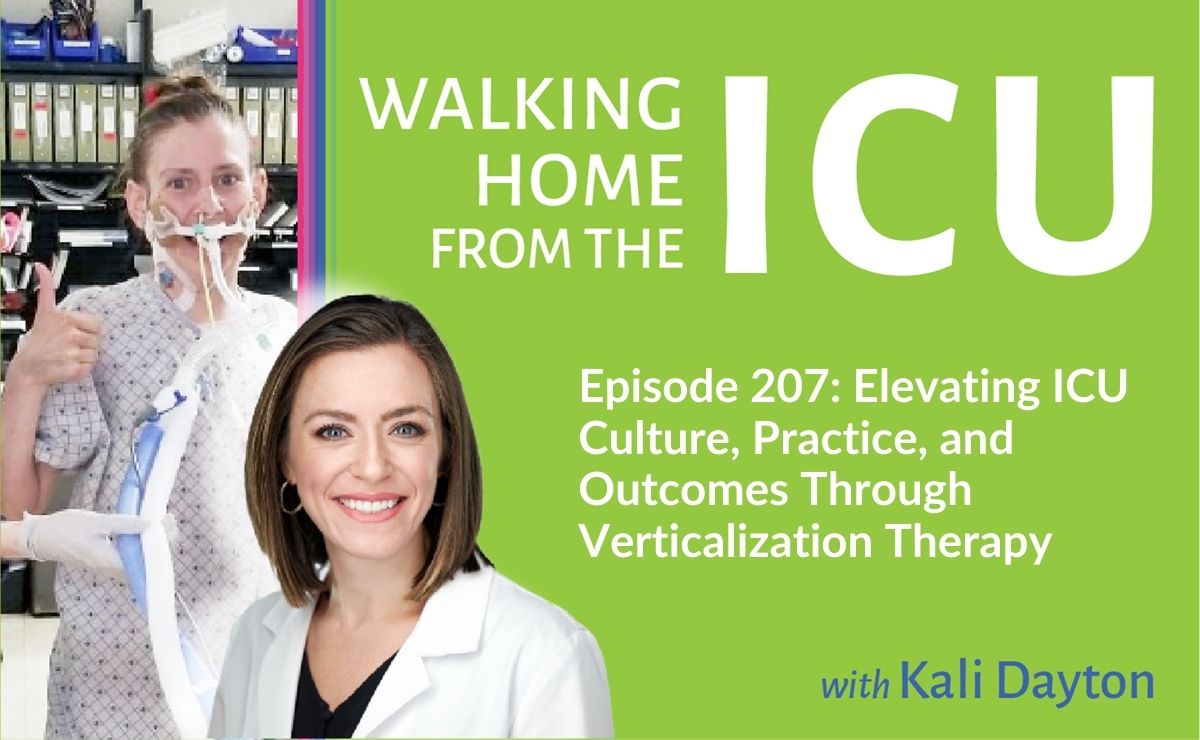
What does verticalization therapy look like at the bedside? What does it take to get the entire ICU team engaged in optimizing verticalization beds?
Jessica Cafferty, OTR/L and Jennifer Babb, PT, DPT join us to share case studies and insights into verticalization therapy in their ICUs!
Episode Transcription
[00:00:00] This is the walking home from the ICU podcast. I’m Kelly Dayton, a nurse practitioner and ICU consultant. I help teams create awake and walking ICUs through evidence-based sedation and mobility practices. By hearing from survivors, clinicians, and researchers, we’ll explore how to give ICU patients the best chance to walk out of the ICU and go home to survive and thrive.
Welcome to the ICU Revolution.
Okay. It has been such a busy time with so many updates. Check out my recent articles in nurse leader, critical care nurse, and an important letter to the editor this month, November of 25. In the critical care Medicine [00:01:00] journal in which we addressed a financial analysis of the team study, we’re also open to do one and preferably two day symposiums.
After doing over 60 conferences the past few years, I’ve come to appreciate how hungry the critical care community is for substantial knowledge training and tools to bring back to their teams to create awakened walking ICUs. I love going to conferences and having any chance I can to present on this topic, but I can only fit in a superficial summary of the problem and solution we’re working on here.
This brings us shock and intrigue to the audience, but we want to actually prepare the community’s toolbox with practical skills to bring back to their teams and start to really make big changes at the bedside. So if your system or organizational chapter is planning their conference or symposium for next year, lemme know I’ve got the content in terms of.
Didactic skill circuit training, [00:02:00] simulation training ready to go. I’m confident that after two days of awakened walk in ICU Bootcamp, your leadership and colleagues will be joining our IC revolution. I am so excited for this episode, guys. This is such amazing information that will transform your perspective and practice.
Please be sure to be getting educational credits for listening. I’ve partnered with Sapiens, which provides unlimited CE credits for all of our disciplines for a range of educational experiences like podcast episodes, webinars, leadership meetings, quality improvement projects, et cetera, that you’re probably already doing.
Check out the link in the show notes to get credit for all of your time and knowledge are much cheaper. Okay, now to the episode Jessica and Jennifer, I am so thrilled to have you guys on the podcast. Can you introduce yourselves to us? My name is Jesse. I’m an occupational therapist and I primarily work in our Neurocritical care unit.
I am Jennifer. I’m a physical therapist. I typically work in [00:03:00] C-B-I-C-U. I’ve been in critical care for 10 years now, and I’m still newer to everything. I’ve been outta school about four years, and I jumped into critical care pretty quickly. I saw the need for consistency there, and I just, I loved it. So new guys are assigned and dedicated to those ICUs.
I wanna put a plugin for that because that’s not always the case. But you are trained, experienced in critical care. You have a position in the ICUs, not just visiting the ICUs. You have relationships with your teams. So important, so beneficial. You have continuity of care. Mm-hmm. Absolutely. And so you are in the same facility that Dr.
Cockney is from. And Jesse, you work with Dr. Cockney in in that ICU. And he talked last episode about establishing that neuro ICU with a teamwork culture and humanization of patient [00:04:00] care and optimizing patient and family outcomes. What is it like for you to work in that kind of environment? So that’s what drew me into the ICU.
We actually used to float around for ot, and then this was part of the reason that we have established therapists in the ICU now because I saw what a difference, that continuity of care and that teamwork and that trust between different team members made. And so that was a big part of advocacy for me of being like, Hey, we need people here because I saw how incredible the outcomes were.
But having a leadership makes all the difference because you can trust all the people on your team. I especially knew in the ICU didn’t really know what I was doing. There’s a lot of scary lines, tubes, diagnoses, very tenuous patients and having. Strong physician leadership to be like, no, this is okay.
You have the go ahead. This is what to look for. This is how to tease out what series, what’s not, makes a huge difference with our patient outcomes. [00:05:00] And Jennifer, how is your ICU doing, what is it like for you to be established in A-C-V-I-C-U? So, well, I love the team that I work with. We have such a good rapport together that even when things above us, above our heads, you know, nursing director, leadership, there’s some off kilter type of things.
I know that the nurses at bedside and I work fantastically together. We are all cooperative with what does the patient need. So the nurse, the tech, the respiratory therapist will coordinate. Okay, so this patient’s still on nitric oxide. Are you weaning? Are you not? Okay, well let’s go at this time and we’ll just all go together.
And you, both of your ICUs use verticalization therapy, correct. It’s fantastic. Dr. Dak Akani talked a lot about how it’s used in the neuro ICU and in the big picture things, [00:06:00] and I wanted to pick your brains about what this actually looks like at the bedside. He talks about using verticalization therapy for hormone management, disorders of consciousness, agitation and delirium management, constipation management, all the things right?
And you have very different patient populations and yet really any of these complications, any of these conditions can happen to any patient in critical care. Each team has its own culture, its own ecosystem, its own barriers. So in patient population, obviously I wanted to pick these serial concepts, these academic principles, and talk through what this actually means.
At the bedside, even talking through case studies, because what I’ve seen, even with teams that have had access to verticalization beds, for example, they don’t optimize them. And I see even times in either the protocol and or the culture that some of the things that might prompt you guys to [00:07:00] use verticalization beds are actually listed as contraindications in other ICUs, such as if they’re RAs equal to or less than negative two, if they’re equal to or greater than plus two on the RAs score.
If they have, if they’re sedated, if they have endocrinal hypertension, if they have high ventilator settings, like all these things that I think they’re just so scared of this new tool. Talked to Dr. Cockney. It sounds like you guys actually understand what this is for, and from an OT perspective too, this is what I loved too, is you guys don’t really co-treat right in your ICUs.
We do, it depends if we have somebody on the total lift bed. We typically don’t co-treat those sessions because we try and optimize and do two separate sessions. But we will co-treat patients for when it’s indicated. Yeah, when it’s indicated. So it’s not a standardized thing. I think some cus they’re always going in together all the time and it’s extra tool.[00:08:00]
You don’t have to, and so Jesse, you as an ot, you get to do your OT specific magic and you get to treat those disorders of consciousness. So I see a gap. One time I was training the team and we were talking about nurses getting patients to the chair to prepare for therapy to come in. And an OT said, but then what do we do
if you’re listening to this on audio? You didn’t see them gasp. So there’s just a spectrum of what roles PTs and OTs play in the ICU when they come in, what they’re treating, how they treat it. So I wanted to break all of that down. Even just talking about, let’s talk about coma management and disorders of consciousness.
How do you guys treat that in each of your ICUs? Because this could happen in either. Mm-hmm. And how do you work together as PTs and OTs to do that? How do you work with your colleagues and how do you use these other tools? Is that a big ask? We will [00:09:00] try and break it down as best we can. So in neuro ICU, obviously we have a lot of patients who fall under the disorders of consciousness umbrella.
A lot of our patients who are DOC also have issues with ICP management and it’s a lot of our subarachnoid hemorrhages typically. And so that’s where verticalization really comes in handy because if somebody is ICP and other hemodynamics are very tenuous. If we gonna try semi a bed, if’s going to be a dumpster fire usually because they’re not going to tolerate it.
Blood pressure goes crazy. ICP goes crazy. So there’s a lot that we can do with these patients because of the total lift bed that we wouldn’t be able to do otherwise. And a lot of times, especially our patients who have very sensitive ICPs, we often can’t do anything with them until they’re upright. Like they can’t really tolerate linen changes are rolling, even any stimulation, even with head of bed, elevated ICP spikes.
And so a lot of [00:10:00] times it’s like, okay, let’s get this patient upright and then we can actually do our multimodal sensory stimulation work with these patients that we wouldn’t be able to do if they were just head of bed elevated or wiring to a chair because their hemodynamics cannot tolerate it. And so it’s a really good tool for us to be able to do our jobs and have the patient tolerate it at the same time.
And the fact that you’re seeing this patient in that acute stage may be pretty novel. And other neuro ICUs, OTs don’t even step through the door until. Sometimes their EVD is removed or their ICPs are totally managed. And so it sounds like if they have to be upright to have that controlled ICP, they’re fresh in, they’re so hot, and you are there helping manage that.
Honestly, really unique. We didn’t even start working with this type of patient population until about two years ago. It really was Dr. Cockney that kind of pushed that The research supports [00:11:00] us coming in early and we, I mean, we see very, very, very sick patients. I think a few years ago we would be like, oh my God, like you can’t see that patient.
And now it’s like, run of the mill. Oh, like this, like everything can be kind of crazy. There’s a thousand drips. There’s all this going on. We are in CRT, we’re on this. And it’s like, oh, we’re gonna verticalize them. Like, like everyone’s there. Everyone’s communicating and we’ve had really good outcomes. So.
You’re using verticalization to then do all this other therapy. Mm-hmm. Specific sensory stimulation kind of therapy. I mean, it’s so specialized. I couldn’t even list what you guys do, but it’s magic, right? You are reading their brain injury during an active injury and helping it heal while it’s still under pressure.
That’s amazing. And just having worked with so many ICUs, the common mentality is, oh, Jesse, ot, they can’t follow commands yet. You can’t come in, or They’re too [00:12:00] sleepy, they’re too sick. You can’t come in. Instead, you’re like, I’m the brain whisperer. Mm-hmm. Give that fake brain, brain. I’ve worked with a lot of these nurses for a few years now, and they now will say they’re not following commands, and they’re like, go in there and like try and make them follow commands.
Like basically like you said, the brain whisper. They’re like, okay, they’re not follow command. Like, see what you can get them to do. Or they’ll realize this has happened with a lot of our patients. They’re like, oh, they only follow commands when they’re upright. With that positional change, they’re like, that’s the only time.
And so a lot of times like our nurses and like neurosurgery and other providers will come, yeah, do their neuro exam while we’re in the room because they get the best exam outta the patient. And so that’s a cool way of it being therapeutic and also being able to assist other providers and members of the team with what they need as well.
I know Jennifer, you’re not in the neuro ICU, but what does this look like when patients are hypo have, when patients do have hypoactive [00:13:00] delirium or maybe they develop a stroke or they have altered levels of consciousness or like in your unit, and what is the role of the PT versus the ot? How is the therapies, how are the therapies different?
And sometimes even in the cardiac ICU, they have cardiac arrested and now they have an anoxic brain injury. And so I brought it to the attention of different critical care providers. I’m like, Hey, let’s give this a try. Family wants to do all of the things. Let’s do all of the things. And that includes verticalization, that includes disorders of consciousness.
So it’s opened up a whole lot of conversations with different providers and other healthcare professionals who had no idea that this even existed. And I think the difference, I actually tell a lot of people, I know that OT and PT here in this kind of critical setting, it does look very, very similar. But one thing that we’re [00:14:00] different and focusing on is we’re looking at different kind of systems in terms of some of the sensory systems.
So I might look a lot more. Vestibular proprioceptive, whereas Jesse is looking more at GU factory, that type of thing. And we’re working towards similar goals. You have to be able to do similar things to get to some of these same goals. If we are wanting to work on getting up to the toilet, that requires certain skills that both PT or and or OT would be able to work on.
And something I think that we might do a little differently here, I don’t know how does in other hospitals, but we have PT doing a lot of sensory stimulation and coma stim now. And that’s something that was started a couple years ago. It used to be, oh, only OT goes in and does call with stem, but then once again, get it.
We saw the research that supports all disciplines, [00:15:00] S-L-P-P-T, ot, and Jen was the first one. She had a patient with one of our other OTs who’s very well versed in sensory stimulation and. Jen was kinda like about all this, let’s do it. She was like, I’ll give it a try, and then they saw like astounding outcomes from this patient, and Jen was like, oh my God, this works.
Like we all need to be doing this because look at what we did, and we did verticalization. We did verticalization, a silk table, the janky tilt table from, I don’t even know when. It was terrifying, but it takes so much work. Like I, oh my God, I have so much love and respect for people that use tilt tables, because I honestly don’t know if I would’ve done that or been about that as a nurse to be like, okay, let’s do all this work to lift this patient to the chair, or to lift this patient to the table, or to slide them to the table.
In my iic, it would’ve been slid. We didn’t have a lot of lifts, and so it would’ve been, we still, I mean, I jumped in with mobility. It was still part of it, so I think, you know, I would’ve gone along with it, but. I just don’t know if I could sell that to teams that I trained to be like, use this tilt table.
Bring [00:16:00] it in, bring it out. Go hunt it down. You get to use it for like 10, 15 minutes, then put ’em back. Then bring the table out. I just think that’s such a hard sale. So that’s amazing what you guys were doing back then. Oh, and that’s actually what initiated me to be like, okay, we need the total lift bed back.
We need the verticalization bed back where we are. Not having to put this patient on and off the tilt table two or three times a day. Yeah, it’s too much. Well, and that’s more than most teams can do if they’re doing a tilt table, right? Like two or three times a day. That’s a lot of work. And the benefit of having just one transfer patient’s on the bed now, it doesn’t just come down to you guys to verticalize them.
Anyone on the team can, I had respiratory therapists that stand patients up while they’re doing their event check. They’re breathing treatments, they’re suctioning, all of the things. So it’s like, what, five, 10 minutes and then lay them back down. But that’s about what you guys maybe could have done with some of your patients using the to table.
Now we’re getting the frequency. And that’s what I love too about you guys breaking up your sessions, is there’s more [00:17:00] frequency. Mm-hmm. To decrease the dose duration and the frequency of it, which is not just important for the brain. You know, we talked about source of consciousness and neuro stem, but if you think about the bed being supine as an anti-gravity environment, it’s like we’re taking our frail, complicated patients and sending them to space for the next few days, two weeks.
So the more that they’re verticalized and bearing weight and getting doses of gravity mm-hmm. The more that we preserve so many of their organ systems. Right. Especially obviously their musculoskeletal system. How do you guys get or convince your colleagues to do this? That’s a big question that many people have is, oh, we, well, we can’t get our nurses to do it, which I have lots of thoughts about, but I wanna hear yours.
So it’s been, and there’s, I mean it’s, it has been a bit of an uphill battle. It’s been a journey, but I think. Very recently in Neurocritical Care at least, we started getting a lot of people on the beds. And I think at one point we had [00:18:00] four or five people on the beds at once. And I just reached out to the provider on service that week, the charge nurse and one of the nurse managers and was like, Hey, like I know we’ve kind of talked about this on and off before, but like we have a lot of patients on the beds right now.
Like can we please try and like really do it? Like they’re on them, let’s use them, let’s optimize them. And something else I did was educating family on what verticalization is supposed to look like. And I’ve told family, for your family member, this is, we should be staying between two or four times a day if that’s what happening.
Like ask, Hey, are we gonna do our stand tonight? Are we gonna do our stand today? We haven’t stood today, like giving family members that power as well. But the team in Neurocritical Care over the past like month has really kicked it into high gear and even like night shift is doing their stands. And so I’ve just tried to really.
Like reinforce and recognize like everyone is doing such a good job with this. Like [00:19:00] constantly giving them shout outs to their leadership and trying to really do positive reinforcement. ’cause it makes a huge difference. And now it’s becoming more part of just daily care instead of like, mm-hmm Oh, we have to stand this patient.
It’s just, oh, we did our stand at this time. ’cause that’s what we do. Business as usual. And what’s the contrast when everyone is doing some verticalization? There’s more duration, more frequency versus when maybe in the past when you guys convinced them to get a patient on the bed, finally got a order, finally got them on the bed, and then no one else is uses it.
How have you seen that impact outcomes and how does that impact your career fulfillment and your moral injury and all of those things? When we miss those opportunities, it’s so frustrating because we know the benefits Yeah. Of it and we’ve seen the benefits and then. Jen said when it’s there and the patient’s on the bed, it’s like, done.
You have three quarters of this done. Like we just gotta do that last part. And so that can be [00:20:00] very frustrating and it feels like we’re just like screaming till we’re in the face. And it can be very, very frustrating to kind of screaming to the void about it. But then when it does actually start to catch on and work and everyone’s doing their thing, then you’re like, it’s like a breath of area.
It’s been really cool. So that’s the way it work. And how do you guys, as a team, your own respective teams, navigate the timing in which this is implemented? Because I see, even when I’m on site with teams that are starting to use it, they’re not used to just putting patients on it or knowing which patients to use.
A lot of times it doesn’t happen until I think is very, very late and a lot of damage has been done. So how do you guys navigate, or when have you seen the timing be optimized or maybe missed? I think for like a lot of our subar acts with refractory ICPs, they tend to go on the bed pretty quickly because it is a medical intervention [00:21:00] and sometimes it’s, we’re either going to pen to barb them or we’re going to get them upright.
Let’s try and do everything besides medically induced coma them before. So those patients I think are a lot more optimized in terms of timing. Same with any of our like yore patients. I think those are pushed a lot more by physicians and nursing versus us. Yeah, so that’s kind of where we’re at with like neurocritical care and optimization of timing and stuff.
And I think that especially for like we’ve got a pulmonary critical care and we’ve got a micu, we’ve got A-C-V-I-C-U, we, they are a lot less likely to. Be ordered or at least come from somebody else other than us at the optimal time. Much, much less likely. I think a lot of that is because of physician’s support and when it is physician supported [00:22:00] and he’s like, okay.
Or she’s like, let’s skip this patient on the bed. We’re gonna verticalize three times a day, or whatever it is, and then they ask their nurses, okay, did you do this today or did you not do it today? I think that makes a huge difference, and that’s not necessarily present in the other critical peers.
Mm-hmm. Um, we’re trying to pull it into the other critical cares, but it’s a little bit of a different spin because we didn’t have to work so hard to convince their neurocritical care provider, and I have to, every time I want to put a patient on the total lipid, I have to go through my spiel of why it’s important that this patient.
Can and should be on the total lift bed. So it is a battle that I have chosen to fight. I always tell everybody that I have a love hate relationship with my verticalization beds because I love the benefit that I see [00:23:00] from these patients, from the using Gravity to be another medical intervention for them, but it’s been a long uphill battle.
Mm-hmm. To get them in use. I think you’ll have a lot of listeners being like, yes, I know I’m with you. Like I see, and I hear, and I feel that struggle. And yeah, physicians can oftentimes be a barrier because it’s not something that they’ve been trained on. Mm-hmm. They don’t necessarily have the same understanding of the physiological benefits of being upright.
They’ve been trained to accept patients being supine and yeah, they might be like, yeah, bed rest is bad. You can say that, but then it doesn’t necessarily mean that you’re panicked and you feel alarmed when you see a patient laying in bed. Because what’s normal is subconsciously accepted by us as benign, as standard.
And then also this being considered a rehab tool can culturally have the connotations of, [00:24:00] once we’re ready for rehab, then we’ll order pt, ot, and then they will tell us if we need the bed. Instead of, we are all in charge of preventing delirium and iio acquired weakness, and this is part of managing all these other organ systems even down to the constipation.
Mm-hmm. That everyone’s concern. Even our dieticians and our pharmacists are worried about constipation, and yet you guys are the only ones saying, Hey, here’s this tool, here’s this tool. And by then, if you’re not ordered to consult, you’re not invited to be part of that process. Now it’s, they’ve been intubated for eight days and now you’re like, well, great.
We have so much to work on, so much to clean up. And remember when I was trained, a neuro ICU and attending on that week said, oh yeah, these beds, they’re not really appropriate for our patients. We don’t have medical patients. And I, my eyes just got big, kinda like your face. I was like, do you have a minute?
He would take a walk. Yeah. And so we walked around the [00:25:00] unit and I pointed out patients and said, this patient, because look, they’re barely opening their eyes. Look, this patient’s like riding in bed, wiggling, throwing his legs over the side rails. He would benefit this patient, you know, was long to the chair.
I’d rather they’d be standing, this patient probably could extubate it today or tomorrow. If we got her standing like X, Y, and Z went through the unit and out of, I wanna say 21, 22 beds, I think I know pointed out at least 10 patients that could have benefited from that bed right away. By the end, he was like, huh.
Okay. But how would he have known? Why would he order something that he doesn’t understand? Why? Seen it in action, seen the benefits, and one of those patients, we got her extubated the next day when she stood, suddenly she was awake. Suddenly she was breathing better. Suddenly she seemed better. She all the things that we know.
But once he sought an action, he was like, oh, freak. We actually really need this on most of, if not all of our patients, but just uphill battle. And that’s why we [00:26:00] keep pushing this cart uphill, is because we know that the more physicians hear about it, the more nurses hear about it, the more that they see the benefits and the success stories from the patients that have been on the verticalization protocol, they are going to remember that they’re not gonna be clueless as to, oh, I didn’t even know that this existed.
And so the more that we talk about it, the more that we show it, hopefully it’ll come to their mind sooner. We even had a patient, this is another, I guess like off brand, off-label use of the bed. Recently he had some issues with like muscle spasms and cramps at baseline. And then he had a mid-brain stroke and he had just upped the ante for his leg cramps.
And he was always like, his blood pressure would always shoot to like two 40 over something. ’cause he was in so much pain. And like anytime you would touch his leg or turn him in bed or anything, his legs would [00:27:00] just, you could see the muscles just spasming. And the nurses were like, what can we do for his leg cramps?
Anytime we touch him, his blood pressure shoots up and like we can’t manage his blood pressure and what can we do to help with this? And I was like, honestly, I was like, he needs to be in a weight-bearing position. So I was like, get him on the bed, get him standing and see if that helps. And he was on the bed for two weeks and he didn’t have a single leg cramp during those two weeks while he was standing for six times a day.
And he always requested to stand. He was pretty cognitively attacked and he was like. I wanna stand longer. I wanna stand longer. And his pain, the lung cramps, everything went away. And that was a really cool use of the bed. That was not our typical use, but it ended up really working out for the patients.
So that was cool. Wow. And he would just would’ve been so miserable and that could have been so many complications if that pain wasn’t treated. Mm-hmm. If everyone was like, oh, he’s in too much pain, the standard get out of bed, which is, could have happened in a different ICU instead, you were like, actually he needs to stand.
Mm-hmm. [00:28:00] And if you guys were hesitant, there’s this other tool that can help you with that and increase the duration. Right. Even if he had been walking the halls, nurses, we, I mean, we just don’t have time to have someone standing and walking the halls six times a day. That’s just not feasible. So it doesn’t always replace those diabetic activities, but can augment them.
Um, I, one of my selling points for nurses is think about your patients that have hyperactive delirium, alcohol withdrawal, any kind of withdrawal psychosis. Sundowning and they’re just behavioral nightmare. So that rasa plus two, that’s to me, that’s a perfect indication. They’re not, I always say they’re not restrained, but they are secure and they’re standing bearing weight.
They’re exhausting themselves. They can go crazy, not a rasa plus four, right? But they can really exert themselves and the nurse can sit there and chart, right? Mm-hmm. Hydrate the pumps, do the things, and not have to come in and outta the room constantly saying, don’t throw your legs out. Don’t pull on [00:29:00] nap, blah, blah, blah.
And yeah, well, maybe they don’t have to be restrained if they don’t have certain devices. Like just let ’em, let ’em go for it. That’s my selling point to nurses to be like, you can wear them out and lay them back down, and that’s how you’re gonna get a quiet night. How do you see this? But other teams might say, okay, if they can’t follow commands or if they’re rasa plus one and plus two, they can’t stand.
That is a conation. It’s unquote unsafe. How do you see this being implemented in your teams? They actually had a patient somewhat recently who he. I actually don’t know if it’s psych or they don’t know. He just was off the walls and I mean his staff threat was like a level four, like hitting, kicking, punching all nine yards.
And he was actually considered to go in the bed for that reason. Our charge nurse was like, I know this sounds crazy, but like do you think he would be good to go on the bed? Because Lisa, we don’t know what else to do. He is restrained, but he’s like flying all over the bed. Like we think it actually might like calm him down and orient him if he’s up.
And she was like, and the straps like [00:30:00] will give that input, which might make it. And I was like, you’ve been listening to me, you mom love it. But he was actually considered to go on the bed for that reason ’cause they had the same thinking as what you’re just saying. And we ended up not doing that. But I thought that was a good perspective from nursing to want to initiate that for those reasons.
Well, I think about when those situations arise, you run to your toolbox. What are, what interventions do we have available? And in most units, the only thing in the toolbox is. Ativan, how dull. If they’re intubated, then it’s propofol. Even verse said, pushes or verse said drips. I mean, those are your only tools.
Of course, that’s what they’re going to grab. They’re not trying to harm patients. They’re trying to keep the patient safe and themselves safe. So we’ve gotta fill that toolbox up with other interventions that they can try. It’s not that the sedation isn’t in that toolbox, but with that knowledge, that nurse has that critical thinking.
They’re gonna reach for these other interventions first, knowing why they’re important, having experience with them, knowing and hoping [00:31:00] that they’re successful. And then the sedations there if that ends up being necessary. But without that knowledge. And if you guys are the only ones that has, that have that knowledge mm-hmm.
Then they’re not gonna call necessarily call you in because a patient’s behavioral nightmare. Yeah. That’s not currently how you guys are used. I think it should be, and I think a lot of times our patients who are like really off the wall, so in neuro we. Try not to sedate as much because we’re trying to get consistent neuro exams, which is a huge per of working on that unit for therapy because that is not a huge barrier that I face.
And our patients who are a little bit more off the walls, a lot of the times the sedation doesn’t touch them. You give them pushes of verse and you give them push of Ativan doesn’t make a difference. And so I think it also, ’cause I think with him, the charge nurse’s point, she’s like, well, nothing else is working.
So like why not try this? What we’re doing right now isn’t going well, so we might as well try something new and see if it works. Because loading him up with meds is clearly not the solution. And how [00:32:00] about in your other ICUs and environments when the patient has hyper productivity agitation and an environment where they’re like going to think about that right away?
Have you seen that in action? Or how do you think they’re, it’s recede if you’re like, it’s okay, let’s just get ’em standing. Is that something that they’ll think is crazy? Yes, that that is crazy for sure because. They definitely are. The patients are typically more sedated. They’ve got, and I say, okay, so what happens if we decrease sedation?
That’s the kind of com. That’s the question that I’ll ask. You know, okay, what happens if we decrease sedation? And then they’ll gimme all these reasons. I said, but if we get them upright, do you think that will still happen? Happen? So those are the conversations that I have, the questions that I ask. But I do get funny looks like, are you gonna be here when we do this?
I, yes, I’ll, yes, I’ll help. No, that’s a great approach to navigate in these conversations. ’cause again, they don’t know the why, then it’s really hard for you to invent them to [00:33:00] do these things. And that’s obviously why I’m so passionate about standardized education so that you don’t have to exhaust yourself and waste time having those conversations at the bedside.
They’ll be pulling you and being like, Jennifer, I’ve got this patient on the bed. They’re standing, they’re ready for you. Come do your thing. And how much more therapy can you then provide? If you’re not spending, what I hear is about 30% of your shift trying to even get in the door and get the patient de sedated, get the nurses to let you in, which is crazy to work with patients.
So by using these tools, everyone engaged, breaking up your PT and OT sessions, now we can have more consistency. And then even having night shift engaged. For me, that was normal in my awake, walking ICU as a night nurse. I, it just, it was like an antibiotic, it was part of the protocol. If you didn’t mobilize your patient at night, NPS would’ve come in and ask you what happened.
Like, I see they’re still alive. Why weren’t they mobilized last night? What’s the excuse, what’s the reason? And sometimes if the whole unit was crashing and [00:34:00] burning, that’s fine. Opportunity missed, but it’s valid. But otherwise, no. I was mobilizing my patients. And so that’s where I love to see verticalization becoming a tool that night nurses can use.
I’m like, there is no excuse anymore. You would take need one person you’re already having to chart. You already have to do these things. I like to incorporate it into the bed, bath and the night routines. It wasn’t to me, even without verticalization beds, it didn’t feel like a whole extra thing. It was like part of the night routine.
So I’m gonna come in with my antibiotic and my linens and all my bath stuff, and we’re just gonna do it all at once while they’re sitting inside of the bed. Take ’em around for a walk while maybe the CNA changes the bedsheets, that’s easier than in the bed. So, Jesse, how have you gotten, maybe it hasn’t been you, how has the, how has the nursing side been convinced or compelled to do verticalization as a standard on night shift?
Honestly, I’m not sure about night shift besides just our providers. I think encouraging it, and [00:35:00] also I think also just them seeing the patients progress. Mm-hmm. From day to day to day. Yeah. And the next time they come into their shift, the patient is doing just a little bit more. Mm-hmm. Why is that? Oh, they’re more comfortable when they’re upright and I think.
So I think you asked us something earlier about like how we like schedule the times and stuff and the, we actually help create the protocol in process for this. And we have it scheduled out for if the patient’s like four times a day standing, then we have it spaced out a certain amount of hours between each stand and same time, same thing with three times a day.
So we put times in there that’ll pop up on the nurse’s, like brain be like, Hey, it’s time to stand. So that way it’s not all clustered together, it’s spread out and it’s more reasonable. Like I think night shift, their stand is scheduled for like four or 5:00 AM and that’s usually, you know, they’re giving the meds and also that’s like, right, not at the very end of their shift, but it’s also not two or three in the morning.
So it makes a little bit more sense. [00:36:00] So we spaced it out in that way so it makes sense for everyone and for the patient. And this pops up in Epic because this is integrated into the Epic. Yes. Reminders, prompts, documentation. And so a provider can come on and you guys can come on and you can see when they were verticalized, how long they were verticalized for what angle they were at.
Give so much information and then the previous nurse or the next nurse can look back at what was in the last shift. There’s continuity of communication. The nurses feel really unsure when it’s new as far as how much can they tolerate, how do I know it’s too much or whatever. And you guys, us PTs and OTs are advanced practice providers.
You have your doctor degree in advanced license, you can prescribe this therapy. You’re not just the administrators, right? Administers. You’re not the only ones administering. Mm-hmm. Therapy. Yeah. But you’re providing an expert assessment, prescribing it, and helping oversee it. [00:37:00] Now, that’s not always how you guys are perceived.
Mm-hmm. It’s really nice to have your other providers, the physicians reinforcing that. Yes. Is a physician order. Yeah. Yeah. I think for the most part that they do. Most of our fighters that were like, we either convinced them that the patient needs to be on this bed or they’re like, yes, let’s get the patient on the bed.
They’re like, okay, so what do I put in this order? Is it how many degrees, how many times? And for what duration? And then I’ll say, well, let me go in and see ’em first, then I’ll let you know what that elevation needs to be. And do you have certain nurses that are really obsessed with this, total bomb experts at this and that maybe advance it on their own and are more comfortable navigating this as well?
Yeah. And I’ve also seen a big shift in like, we have a couple nurses who are really good at it, really love the bed, really know how to use it, and some of our PCTs also. [00:38:00] And so I’ve also seen them really help each other out. Like if. There was a new nurse last week who was like, Hey, my patient’s on the bed, but I honestly have no idea what this is or how to use it.
And one of the other nurses, she’s like, oh, like I’ll come in there and it’s time to stand and I’ll show you how to do it. She was like, it’s really not bad, I’ll show you to blah blah. And it’s like they’ve really helped each other learn the bed. And I’ve even seen the text jump and they’re like, oh, you have to hit this button first.
Let me show you how to drive it. Like they really helped each other with that cross training, which has been huge. Yeah. Also off life that, but it made me happy when I hear like the question about the bed and I turn to answer and somebody’s already answering it, I’m like, oh my God, it’s happening. So that’s been really good for like just nurse to nurse education and even with our PCTs and that’s been really cool to see.
And you’re at that point where there’s peer modeling? Mm-hmm. Yes. When it’s a new concept, you don’t walk into the unit and see everyone’s standing. And so when it feels like it’s new, experimental high risk, I see a lot of hesitation to be the first initiate that, [00:39:00] whereas in the neuro ICU that you have.
Everyone’s doing it, so it’s like peer pressure to do the same. Um, I felt peer pressure when I entered new. I felt peer pressure when I entered normal ICUs and they were sating their patients. I was uncomfortable with that, but everyone else was doing it, so I was like, okay, I’ll do it. Same thing there. If everyone’s keeping their patients awake, everyone’s standing their patients, when someone steps into that environment, they’re like, okay, this is new to me, but I’m here to fit.
We gotta fit in. Right. If you’ve been listening to this podcast, you are likely convinced that sedation and mobility practices in the ICU need to change. The ICU community is facing incredible difficulty with the trauma from the Pandemic Staffing crisis and burnout. We cannot afford to continue practices that result in poor patient outcomes.
More time in the ICU. Higher healthcare costs and greater workload for the ICU team. Yet the prospect of changing decades of beliefs, [00:40:00] practices, and culture across all disciplines of the ICU is a daunting task. How does this transformation start? It can begin with the consultation with me to discuss your team’s current practices, barriers, and to formulate a plan to help your ICU become an awake and walking ICUI help teams master the A-B-C-D-E-F bundle through education consulting, simulation training, and bedside support.
Let’s work together to move your team into the future of evidence-based ICU care. Click the link in the show notes of this episode to find out more,
and that’s maybe what is not quite standardized in the other ICUs. And then you have, again, physician orders. What does nursing leadership do in the neuro ICU versus maybe other environments that helps? Reinforce that leadership and accountability for the nurses. I know that our, like the unit manager for [00:41:00] Neurocritical Care is really pushing mobility in general, and that’s been something that she’s like really gone after recently especially, and I think that’s helped a lot.
That’s been one of her main points. And so whether they be on the bed or if it’s just getting the patient to the chair and it’s like she’s been very pro mobility. She’s like, we have the tools, we have the resources. There’s no excuse to have our patient’s in the beds. And if they are in the toll of that, there’s no excuse for us not to stand them.
And so she’s really advocated for mobility as a whole and I think that’s helped a lot of just making that part of the culture of the unit instead of it being, like I said, something you have to do. It’s just harden the care that the patient receives during the day. Jennifer, how do you see the impact of nurse leadership and how well this thrives?
Nurse leadership on the cardiac units has been instrumental for me because if it hadn’t been for them not having the support of the nurse leadership, then it wouldn’t have gone [00:42:00] anywhere in the cardiac ICU for sure. And so having their support was huge. I think there’s a less emphasis on the total list bed because we’ve got that entire cardiothoracic surgery population.
And so those patients, the surgeons, they expect their patients up out of bed 5:00 AM like they are up out of the bed. And so for the most part, mobility is not necessarily an issue for the overall cardiac ICU. But then when you come to these specific patient populations where they are just so unbelievably sick, that’s where we see that, okay, we are sedating them.
We are keeping them flat in bed for 12 days. Where can we fix this? And so I do have the support of the nursing leadership, but it has typically just been my voice or a few nurses’ voices who I’m now convinced I pulled over to the [00:43:00] verticalization side to be like, Hey, I think we need to put this patient on the lip bed.
And it’s awesome to have more revolutionists in your corner to build up your little army. It’s also a really big challenge when you’re in the minority. You’re a few, so you might have a great success that day or, oh, we got ’em on the bed, but then it’s not used. And I am assuming they’re suspecting that in the neuro IU, getting these patients on the bed early and using it frequently allows the rest of the team to see the benefits and the outcomes when we wait until now they’re facing a tracheostomy or now they’re have such profound hypoactive delirium.
Or finally we take sedation off and now they’re just a puddle in the bed. It’s gonna take a lot of work and time to start to see the impact. It’s not like someone’s verticalized and now they wake up more. Now they start to engage more. And now, and yes, they’ve had a stroke, but they’re now out of [00:44:00] bed bearing weight.
That’s pretty profound pretty quickly. But if we, they an A RDS patient and A-C-V-I-C-U 10 days, and now we get ’em on a verticalization bed, they may have orthostatic hypertension. So the nurses might see, oh, blood pressure dropped. Oh, it’s unstable. It’s an unsafe intervention. Whereas if that same patient had been on the verticalization bed nine days earlier, but they have seen their oxygenation improved, their blood pressure would’ve tolerated it better.
They would’ve stood bare born weight. They could have been extubated by then. And the team could see, wow, we kept their diaphragm intact. We prevented, we could have done all these things. But now when we’re only using it as a rehab tool, it’s a hard sell. It’s like, well, okay, what are we doing this for?
Right. And I think that’s where. Our patients. I remember there’s this guy who, his ICPs would just hover around like 17 to 19 with zero stimulation. You walk in the room, they shoot up and I remember, ’cause they chart the ICPs on the door in neuro, they just, that’s where they write all the numbers down. I was just looking at his trends [00:45:00] from the past few hours and I was like, let me just stand this guy and see if he likes that better.
And as soon as we got up, I think like 40, 45 degrees is his sweet spot because I’ll play around different angles and see like where are we the happiest for especially patients with refractory ICPs and ICP was six and it just stayed there. And even with stimulation six or seven, the highest it got was like eight I think.
And the nurse was like, are you serious? She is that real right now? And I was like, yeah. And she was like, oh my God. She’s like, we haven’t had it like in single digits in four days. And I was like, he likes to be upright. We haven him on the set. This is why we need to use it. And. That day, everyone was like, oh, like this is crazy.
And I was like, yeah. And so I think that helps, whatever, like nurses see it from that standpoint. It’s like, oh, we don’t have to sedate them as much. We don’t have to do this and this. Like, we don’t have to worry about how we’re chasing the ICP because we’re not having to chase it. If we’re upright, [00:46:00] they’re just, they’re contemp there.
Or we, they’re able to come down off of vent settings and now all of a sudden we’re verticalizing and now we’re able to come down on vent settings. Oh, we can flip them to CP Pap. We can do spontaneous breathing trials now. ’cause look at the volumes they’re pulling. There’s all these things and people see that and they’re like, okay, we see those puzzle pieces starts to fit in.
That’s, that just speaks so much to how much we love numbers. We love looking at lab values, monitors, bent monitor, vent screen, those numbers that have immediate feedback, that really obviously guides our care in so many ways. I’ve always that if. Delirium popped up in the screen with a number. We have the ICU cam, ICU seven is the delirium severity screen tool.
If that were to pop up in the screen, and when you sit someone up at the side of the bed and you see the severity of delirium start to go down mm-hmm. That would speak to the nurse brain so powerfully. Wow. I did this intervention and I immediately saw that I had control and beneficial impact. They would do that.
And so I [00:47:00] think that’s what’s happening there in your culture is that in ICP, it’s a number on the screen. It’s immediate gratification that, wow, we, we have to treat this one problem. That’s why they’re here and now we’re going down. But they’re so, the benefits of verticalization are so vast. It’s like you don’t necessarily see the impact to the bowels right away.
Mm-hmm. I wish we could have a number showing up for the diaphragm thickness or function or strength or whatever and see that we’re have this baseline number and how we preserve it over time, or how we’re rebuilding it with verticalization. You know, there’s so many things, but absolutely until our settings, oxygenation, ICP, those numbers.
That helps, but that’s not always the case. It’s going to be most impactful though when we do it early and frequently. Mm-hmm. And we can see the contrast rather than, it’s always a cleanup tool. And I think for nurses, they’re gonna be like, okay, yeah, so what? Because they’re not gonna watch them for the next seven days.
They have them that one day for their shift. They might be back in two or three days, but with a different patient, [00:48:00] so, mm-hmm. The more they can see that instant impact, the better they’re gonna want to do this. And something else that nurses have spoken on a lot is skin integrity and verticalization really helping with that.
Just those positional changes and the offloading. A lot of our nurses are like, oh my gosh, whenever we have patients on this bed, like their skin always looks so much better. We aren’t having the same issue like. We had a patient with a very, very severe case of Dilla bere. I’m not sure if Dr. Cockney spoke about this patient, but I mean he couldn’t even blink.
He couldn’t, he didn’t even have eye movement and we got him on the bed early and he was with us for two months and by the end he could shrug his shoulders and wiggle his right toes a little bit. That’s all the movement we had. And he went to Shepherd Center and he was able to, hey, sit up in the wheelchair for two hours the first [00:49:00] day.
And shepherd’s like, we have never had a patient with like this severe of a case of Gare and be able to tolerate. She’s like, we normally spend, they told the wife, they spend the first two weeks just basically doing like orthostatics on them because they can’t tolerate anything and nurses don’t know that.
Nurses don’t see orthostatic hypertension coming down the road. Yeah. It took me a long time to realize that we pause most of that. Did that. And so he could now jump into actual rehab. And Shepherd also said there like his skin is perfect or he didn’t have a single like Blanchable red, like no marks on him.
And we’d never seen a patient who is completely paralyzed come to us with like completely intact skin. And so that’s something that I’ve reported back to the neuro tape and they still talk about to this day. And they’re still proud of that. They’re like, we sat in there and like his skin was perfect.
And that’s another huge thing that you don’t think about. It makes a really big difference. And yeah, that was a really cool thing to, to be. I’ve [00:50:00] heard concerns that there are different technologies across the different beds and the quality of the material or the mattress might vary, but if they’re having pressure injuries with these beds, I’m like, I want to know more about how soon you’re using them, how frequently you’re using them.
Even things of like. Are you keeping the mattress inflated? I saw that early on in implementation. It was just, that’s a small detail, but makes a huge impact. And they didn’t realize that the mattress wasn’t inflated, so it wasn’t, it was a user error. That’s so dangerous. So they can get bad wraps. But how we used it, what do you mean?
I mean, because you have to plug the bed back in or the mattress stays deflated and we would go to so many rooms and we’re like master playing on the frame and we’re like, yeah. So that was so yeah, you new we were gonna have those hiccups. Right. It’s always that talk about proning. We had, we lost lines, [00:51:00] two dislodgements things that you don’t want to happen.
Uh, and they did happen at the beginning, and then it became much easier, quicker. You needed less people. It was safer. Same thing with this and any kind of mobility that we do, any kind of sedation management, any of these changes, right? So it’s taking those moments, doing a root cause analysis and learning from them.
But I see that if something happens, the entire team’s like, okay, well it’s the bed, it’s bad. Instead of saying, well, maybe we only use it during the day and not at night night. Maybe we should have done it earlier. You know, like, how are we using it? Not just if it’s in the room or not, if it’s under the patient, that’s, like you said, Jesse had three-fourths of the battle, but it doesn’t get us across the finish line.
I love these case studies. What else? What other stories have you seen, good or bad? So we had a patient, God, this like three years ago now. He was kind of like our Hallmark, like he was the first patient we really tried. [00:52:00] Yeah, this whole verticalization thing with, we just gotten the beds back and yeah, he, I mean, massive stroke hemicraniectomy.
He was incredibly sick, necrotizing pneumonia of both lungs, and we were getting to a point. He was DOC. We were getting to a point where we’re like, it’s been like two and a half months. Do we discharge him? What do we do here? We were running out of ideas and I was like, Jen, I was like, what do you think?
We put him on the bed. She was like, okay, like we, our hail area. It was our hail area. She was like, sure. And so nothing else to do. Yeah, exactly. We were like, okay, we’re gonna do this. It’s either this or discharge or he’s done. Yeah. Where he’s gonna die. He’s done. He was getting to that point where I was like, he is getting sicker, and I’m like, current pneumothorax is, yeah.
It was terrible. And so I was like, all right, Janet, let’s try this for two weeks, and if two weeks we don’t see any improvements, like we’ll take him off caseload. We’ll call in a [00:53:00] day. And so put him on the bed or verticalizing him and he was on. Very, very high event settings. When we put ’em on the bed, we use a PRV in Neurocritical care, pretty much strictly.
It was on very, very high pressure settings. And I’m looking at the case study right here. Within four weeks, we went from incredibly high A PRV settings to 21% FI O2 50 liters per minute on a tra collar wearing a passenger valve. And that was like necrotizing pneumonia like that, that could have, like, he could have needed support and pressure for the rest of his life, like he could have if, if he survived exactly four weeks since I’m putting him on the bed till wearing a passer valve.
And I said, that was our Hail Mary and it worked. And so that was like one of the coolest things. And we saw his neurological status improve his activity tolerance, obviously his respiratory status. [00:54:00] Got him sitting up on the edge of the bed. Yeah. Started sitting in edge of bed after that. And he was DOC.
He was a low level DOC and we were sitting edge of bed, like modest cyst, like he was assisting with like postural corrections. And we never would’ve dreamed that we would’ve ever set this patient edge of bed ever because he was just so sick and so low level for so long. And so that was like really our first experience with the bed.
And we were like, oh my God, like this. I’m magic. We have this crazy. Yeah. And even to have the strength to use a pai mirror valve. Mm-hmm. In that short amount of time, considering all those things, he would not have had the diaphragm function, the respiratory muscles. He used a passing mirror valve that would’ve been actually quite traumatized to even try, you know, he wouldn’t have been able to pull lung volumes.
I mean, he still would’ve been on ventilator support if he did survive. And yet he’s on a trach collar passing, like those are two high levels of respiratory function. And he was voicing, he was able to tell us his name and he ended up being decannulated shortly after that. And he was like. On [00:55:00] a modified diet, but he was eating at the, he went to, and so that was like a really insane like, oh my God, what?
So I think that was like our first victory and one of our biggest victories is like we just saw this rapid shift in, like I said, every single system. He maintained his hemodynamic stability. Mm-hmm. The very first time we sat edge of bed. And how long had he been down? I think it was like 110 days, 102 days, something like that.
And the no ortho hypertension. After 110 days in bed, you sat him up and he was solid. I don’t think nurses or physicians, I don’t think they’re gonna appreciate that. Yeah. Like it was, yeah. He wasn’t tachycardic, wasn’t aic, no blood pressure. Like he was just like, it was nothing to Okay. Right. We haven’t got his patient.
Yeah. 102 days or something like that. And he was just like, he was fine because we have his body to do that. And obviously that’s an amazing [00:56:00] story for anybody at any point. I think part of the magic was that it was the first time, so your perspective and your expectation and the way you were used to treating patients, you were used to setting them up and being like, okay, catch ’em.
’cause they’re gonna drop, they’re gonna get cyclical. You’re so used to that. You’re used to someone like that dying. Your perspective was I acclimated to a certain level of care outcomes. You anticipated and assumed complications and this huge rehab mess inside with our pressor support. Yes, yes. You just knew it was gonna be like weeks and you’re gonna, if he gets to LTAC there, he’s probably gonna die now tech, he’s still gonna be in the ventilator.
All these things. Right? So to see that huge contrast from what you were used to now, if you were to pick that patient up and bring it to now in 2025 in your unit, Jesse, it’d be like, yeah, that bed’s bad. A, but they’re not maybe gonna have their jaws on the ground like you did then. I’ve noticed with teams that I’ve trained over time, it’s almost like it loses [00:57:00] its magic a little bit.
So I love, I always invite people to go back as this becomes more normal, to go back to that perspective and that magic those first few times because that magic is still happening. We just become desensitized to it. But that power of gravity therapy early pre prehab, it’s still happening. We just need to continue to see it and celebrate it.
We had another patient recently, and this is cool ’cause I had a level two Berg student and we started working with this patient at the beginning of my student’s rotation and she was a massive ach, has five, 5% chance of living younger patient refractory ICP. Like she was so sick and they were like, she’s not doing well, she’s not doing well.
And we got her on the bed pretty early. And then as she stabilize a little bit more, we’re more consistently verticalizing and doing multimodal sensory stimulation. And we were in a comatose [00:58:00] state, completely unresponsive to anything from two or so weeks, not on any sedation. And then she slowly started waking up and waking up and waking up and doing more and more.
And then by the time she left us to go to rehab, she was standing, she was on a diet, she had passed her fees. She was talking, she was laughing. Her daughter was like, this is her personality. Like she is with us. Like she’s good. And like she was so funny. And so like you could just go in there and just like banter with her.
And we just really watched this woman come back to life and my student was like, that’s the coolest thing you’ve ever seen. I felt a connection to her. Like from the first day we saw her, I was so disheartened, ’cause I was like, we’re not doing anything. And then she just became a human again and she’s like, that was wild.
Like I didn’t know we had the power to like. Do that or like be part of that. So that was really cool. This kind of prompts me to reflect on a painful aspect of care in the ICU. [00:59:00] I just think about that kind of patient. We saw this a lot, maybe during c when people had hypoactive delirium. How those conversations oftentimes go a week into her being completely unresponsive to stimuli.
I can’t imagine a normal ICU one intervening, right? They’re not ization therapy as a norm on that kind of patient. And two, the discussions with the family would’ve been towards discontinuing life sustaining measures. And so I don’t imagine she would’ve once survived in a normal ICU too walked out of their walking, laughing, talking.
So it, it’s a little bit uncomfortable to consider how many people. Didn’t survive because of hospital acquired complications. They didn’t know how to treat those complications. Prevent them first of all and they called it pretty promptly. Yeah, I know we’ve talked about having [01:00:00] like the cockney and us and like maybe a couple other folks sit down and talk with you and I think we have a very good patient story that really aligns with that because there was conversations of you should withdraw and then it ended up his outcomes were beyond what I would’ve ever thought.
But I think that would be a really good story for the Cogni and other members of our team to share. ’cause it very much it that narrative there. Let’s, yeah, let’s do that next episode. Circle back and have them other team members tell the stories. We can talk about these big picture things when you talk about these ICPs going down, I can think about study a bunch of case studies from Maryland with ICP management and verticalization decreased ICP on average by 12 points and medical management by 50%.
Which is astounding, right? It’s very impressive. But it’s different when now you’re talking to a patient that’s facing a cardiotomy. Mm-hmm. And we prevent that, or we’re getting them awake and engaging weeks [01:01:00] sooner, or we’re saving their lives outright. We’re avoiding sedation, we’re avoiding further injuring and injured brain because now we’re replacing them.
Instead of starting or increasing sedatives. When it’s actual patients that we’re talking about, then those numbers make sense. Then it means something. And when you actually see it at the bedside, you can’t unsee it. But you guys sharing your journeys, your stories, and help our listeners see it and bring this to the rest of their teams.
So if you are a revolutionist begging, pushing verticalization therapy in your ICUs and all the things, right? Mobility in general, seeing patients as human in general, avoiding sedation, all those things. You can feel like you’re crazy sometimes. I was just at the A PTA conference and I had people, these physical therapists raise their hand if they questioned their own judgment, their own instinct, and felt like they were crazy in these other environments.
And almost everyone raised their hands. And I was a little bit shocked because a lot of these therapists come from [01:02:00] what I consider fairly progressive units and not full awake, awaken walking yet, but this is the cream of the crop at that kind of conference, and they feel that way. They’re doctorate prepared therapists that are experts in their domain, and yet they’re gaslit in their workplace.
You think that because it’s not done there, it can’t be done, shouldn’t be done. They’re the crazy ones, but you guys aren’t crazy. You’re actually doing it. It’s all very possible, feasible, and this someday will be the future and the standard of critical care. But it also falls on us now in 2025 to be the ones doing the hard work, ringing the bells, fighting, advocating, educating, reinforcing all the stuff that the bedside.
But once it gets there, like just has described. That’s when we really get the full benefit and that’s when outcomes totally transform. Anything else that you guys would leave with the critical care community? I think keep pushing. Don’t give up. Yes. You might wanna don’t give up. Jen always says we have to be the squeaky wheel.
And there’s times where I’m like, this is, [01:03:00] I’m done throwing in the town too. Frustrated. But yeah, there, there has been progress and we have seen the culture start to shift. So keep fighting the good fight. What? You know what I’m gonna this, it’s so nice to be just over a microphone. Talk to people that you don’t even see them.
You don’t know their names. Say the things. So physicians and the critical care community, what do you tell them? Listen to your therapist. This work. This work. It works. Look at the research. Trust your therapist. Mm-hmm. Make it a team approach. It’s less scary when you have. Nursing, rt, pharmacy, pt, RT, and you working together towards this common goal because you’re all part of the same team and what’s best for the patient.
So rely on each other. If you don’t know much about it, rely on the people who do and like it can make a huge difference. Definitely. Yeah. And they’re smart people. They can go educate themselves. It is part of medical management. It is part of their scope, their stewardship, not just down to you guys. What about nurses?
What do you tell nurses? I tell ’em the same thing. It worked. [01:04:00] It worked. Yeah. And then same thing. We are all working towards the same goal. Whenever we want somebody on the bed, it’s not because we wanna make the nurses’ life more difficult or make them add to their workload, it’s ’cause we want them to have to give less meds, have less secondary complications.
Improve the restaurant. Like we wanna make things better for them and the patient, and that’s why we’re doing this. It’s not to, yeah, make your day harder. Especially whenever we’re introducing the bed and whenever it’s kind of a new concept in a certain unit. I said, I know that this feels like a lot of work, but it is a hundred percent worth it.
It’s a lot of work for me too. But the patient will have so many more benefits. Yeah. Other than just laying flat and getting all of these extra complications, which I will describe to the nurses, we can prevent those. Mm-hmm. And we can be well on our way to improving this patient’s mental [01:05:00] health or their respiratory status or whatever it is that I’m trying to talk to the nurses about way sooner than we would ever do if they were in a basic critical care bed.
Yeah. And everyone has to play their parts. We desperately learn the nurses to own this. As well and take pride in it. It’s really fun to watch nurses that were hesitant then up their chests about it. They’re like, I, I order the bed by myself. I don’t need some therapist telling me to order the bed. I use my own brain like I fix my patients, and they should be proud of that.
They, it’s within their scope, and I think it should be nursing led, and maybe I’m biased, but they’re the front lines. They’re with the patients all the time. They’re assessing patients promptly upon admission. They should be the ones identifying who’s appropriate for the bed, because the sooner we do it, the more benefit patients can receive.
What about rts? I think just exposure. Asking rts also to just keep track of what the trends they’re seeing are, [01:06:00] you know? Mm-hmm. What settings were they on when we got in the bed? What volumes are they pulling and seeing if they notice any differences or trends. Are we seeing more spontaneous breathing?
Yeah, that’s a big one. Events whenever we’re more upright. And I will actually comment to respiratory therapist. Mm-hmm. This is what we did and I saw this many spontaneous breaths whenever I was looking at the vent for this certain amount of time or he was on this support and now 30 minutes later he is on whatever the support is.
So I would ask, I usually do have conversations with my RTS coordinating care with verticalization. Are we gonna try capping? Let’s try capping after we verticalize. And what do you about RTS using verticalization in their own treatments on their own? I think they do often, like I know neuro will like give breathing treatments when they’re there.
Or sometimes they’ll trial, oh, we wanna see how they do on CCP pap. Let me go ahead and do it. Now they’re stating, see if they tolerated or let’s see, like if we need to [01:07:00] do it before, during, after what they do when they’re like actually like awake and like working. So coordinating care with them is definitely a big part.
But do you think it’s been an RT scope too? Stand patients themselves, I think with, I think they would probably, I think with nursing, maybe accompanying them because I don’t know, I can’t speak for every place, but I know, I don’t think rt, our rts would feel comfortable like putting the straps on and moving the other equipment in the room as much.
Obviously, if they have, it depends on the patient, right? Yeah, it does. But I think if they feel comfortable, I think they can definitely go to the nurse and initiate that as well. Mm-hmm. More the better. Thank you so much for everything that you shared and for the impact that you’re making in your patients there locally, but also sharing this with the community at large.
You guys are leading the future of critical care and I’m so excited. Thank you so much. Thank you. You[01:08:00]
To schedule a consultation for your ICU as well as find supportive resources such as the free ebook, case studies, episode, citations, and transcripts, please check out the website.
Transcribed by https://otter.ai
SUBSCRIBE TO THE PODCAST