SUBSCRIBE TO THE PODCAST


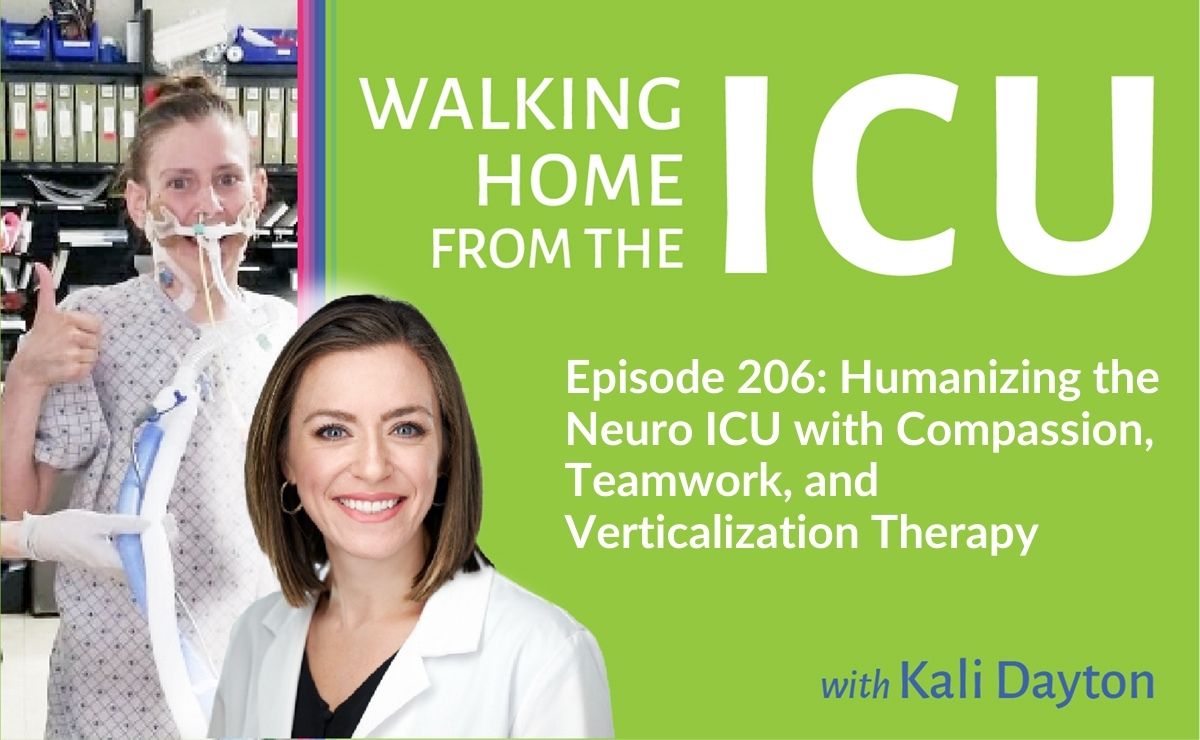
With the complex mobility needs of patients in the neuro ICU, how did Dr. Tarek Dakakni standardize patient standing for 8 hrs a day? As acting medical director, how did Dr. Dakakni bring all disciplines together to customize care and optimize outcomes for each patient as a person?
Dr. Dakakni joins us now to share how the ABCDEF bundle looks in his Neuro ICU.
Episode Transcription
[00:00:00] This is the walking home from the ICU Podcast. I’m Kelly Dayton, a nurse practitioner and ICU consultant. I help teams create awake and walking ICUs through evidence-based sedation and mobility practices. By hearing from survivors, clinicians, and researchers, we’ll explore how to give ICU patients the best chance to walk out of the ICU and go home to survive and thrive.
Welcome to the ICU Revolution.
Having worked briefly in a neuro ICUI quickly came to appreciate the unique challenges teens face in providing care to this vulnerable population. This was not my M-S-I-C-U in which patients are usually awake, riding on the clipboard and walking. [00:01:00] Their neurological insoles usually changed all of that.
Yet this doesn’t mean that the A-B-C-D-E-F bundle doesn’t apply to them. It especially doesn’t mean that we can’t drastically humanize their care. I am so excited to have a neurointensivist. Doctor Cockney, share with us what humanizing the ICU really means in a neuro ICU. Dr. Cockney, thank you so much for coming to the podcast.
Can you introduce yourself to us? Hey Kelly. My name is Cockney. Before I introduce myself, I would like to thank you for giving me this platform to talk about my passion, which is taking care of patient from A to Z, not just in the neuro ICU. I’m one of the neurointensivists at Northeast Georgia, and I’m stroke physician as well.
So we take care of the patient when they come to neuro ICU and patient with acute injury like traumatic brain injury, large strokes that need the ICU need. But at the same time, I identify as an intensivist. So if a patient comes cardiac arrest, traumatic brain. At the same time, if they have any Es, they have any [00:02:00] sepsis or anything like this, we take care of those patients.
And you have a really unique unit, the way that you guys function. What you’ve created is really the dream of all IIC Revolutionists to be able to work in that kind of environment. And I wanted to really dissect how that environment came to be, how you guys practice. So what tools you use. So tell me more about how you established this neuro ICU that you oversee now.
So I have the honor and the luxury of starting something from scratch. I’ve been in many ICUs before. I have a health, a leadership role in the ICU and neuro icu, for instance at Alway Medical Center, other ICUs. But I always walk into an ICU that’s already established and the nursing staff and patient and the neurosurgeon and other services, they have expectation from the neuro ICU or the neuroscience in Gainesville at Northeast Georgia.
It a little bit different. Because our neuroscience program wasn’t developed yet. So five years ago, less than five years ago, I was recruited [00:03:00] to help with building a comprehensive stroke center, a neuroscience center, because the closest center to Gainesville that they can do, the thing that we can do is in Emory, or like 20 miles, 30 miles a planet.
You know that traffic is not very user friendly. So if the patient comes with that new thrombectomy or with traumatic brain injury and they need a higher level of neurological treatment, unfortunately they have to travel that hour plus and timeless brain and the burden that brings to the family as well, because we take care of like wide variety of patient and their family.
So some patient family are very simple. They don’t wanna drive planet, especially when they have that acute phase of their loved one had a stroke or traumatic rate of injury or something like this. So the need was there and that was the pleasure of me building that team from scratch. Trying to recruit very like-minded nursing staff, PTOT, creating protocol with pharmacy, with other colleague, with the neurosurgeon, with the [00:04:00] neurovascular team.
So I feel like I have the advantage to be involved in every simple things, and I wanted to do it right. I love feedback. I always got feedback from the nursing staff. What would work for them, what would make thing for them make sense for them, especially that many of them are involved in the community and from the community.
So the social aspect that, that you brought to the table was very appreciative. So we worked together in, in four or five months after I started, we applied for the DOD Comprehensive Stroke Center. We become a comprehensive stroke center, and then we opened that, that flood gate. We couldn’t say no to anybody.
I have some of my colleague contacting me about a patient that was in Illinois. We transfer some patients from Illinois to Ticus or her BIS encephalitis because we offer those services like continuous DE. Status epileptic aggressive management, including the fourth and fifth line management with immunotherapy and steroids and plastic racism stuff.
But the most important thing was the neurosurgical aspect [00:05:00] of the neuro ic because if the patient comes with aneurysmal, OID hemorrhage, acute stroke, that meet intervention time is brain, you need to interfere on that patient and their process right away. And that’s what we do now. That’s amazing. And I love that you involved all the disciplines so closely and bringing in the social aspect of their coming from their own communities and serving their own communities.
They understand their needs of their population, so invaluable. That’s just what helps you have this vision of the team being so interconnected, so united. I think sometimes from surgical standpoint, that’s not oftentimes a neurosurgeon’s focus. So what helps you have that vision? I’m interested in taking care of the patient.
As I said, from A to Z, it hurt me before, when we are very busy in the neuro ICU, we bring that patient with ECT and subarachnoid nerve sometime 24 hours, sometime 24 days, and then we take care [00:06:00] of them. Their ICP, they’re very complex. They have the pneumonia and their, and their sepsis and stuff, and then like we do a little bit of like early mobility or a lot of initiatives to take care of the patient.
Once we move them to step down, then they stay in step down. They have infection. There’s not, in many institution, unfortunately, there’s not that investment or that expertise that they know what the patient needs. We hear that from the family all the time that please don’t send us out that ICU because last time that happened and we felt that the care wasn’t the same in terms of like how it was like, of course not like the same because this is ICU, but I am interested in the full spectrum of taking care of the patient to push them to rehab.
To restore their functional status. I feel like we work so hard on the patient to bring down their ICPs and finish their status ticus and then they end up in nursing home. Unfortunately, some patient cannot save them all. Some patient, they have bad outcome. They end up in nursing home. But I feel like we did not optimize what we can do for the patient in the spectrum [00:07:00] of the acute subacute phase.
From that perspective, I wanted people to have ownership of the program. It’s not my program. I want it to be everyone’s program, the pt, the pharmacist, the ot, the nursing staff, and that’s why we had that humanizing hashtag humanizing the neuro ICU care. ’cause we connect with people and they come back to visit.
I have the charge nurse sometime when we running in the neuro IC and we send somebody that we’re not a hundred percent sure that we need to send them just because we’re very busy. We need to bring the next patient. We check on them multiple times and like we connect with them despite the fact that we are not the primary taking care of those patients anymore.
Oh wow. I had many patients, family, they come to me even if they are not under my care, tell them me Shepherd or another acute rehab center, they say that they cannot take my husband or my loved one because they are 1, 2, 3, or their oxygen level or their, I pick up the phone, I took the hospitals or the other physician that’s taking care of them and I say, I think we can do one to three if you put them on this or that.
And I will myself help the [00:08:00] rehab and tell them that we’re working on that too. Offer them a spot because it’s matter life from that for them because you either restore your functional status and I feel like all the work that we did in the ICU might just not be considered. If you’re gonna go to nursing home in, in many cases we were successful to bring that patient to a rehab where they can come back and walk and not give us hugs and hold hands up.
So I am sure a lot of revolutionists are banging their steering wheels being like, right, right. Exactly. Like this is the frustration. I know, right? Finally, like an intensivist that really gets it. It’s so easy to fall into that very narrow vision and mindset in the ICU where we’re focusing on one problem and we’re causing all these others.
And with a neural population, obviously they come in with brain injury, they already have physical impairments oftentimes. But then it just befuddles me that we add in delirium and I required weakness on top of it. So I explain to people, you’re taking the [00:09:00] patients with hemiparesis and you’re basically turning them in into quadriplegics when you leave them in bed supine for the next few days to weeks, and now it’s really, really difficult to rehabilitate them.
And I think the mentality is, oh, well, they had a stroke. Oh, well this primary thing caused all of these other problems. But you understood that. We can make or break their physical, cognitive, and psychological outcomes by how we manage them. Yes, they have all these primary injuries coming in. How we manage them determines what happens in a few days, weeks, and months.
And to establish a unit already focused on the big picture, like I, it sounds like you talk about rounds where they’re going to end up and you’re directing your care towards what’s gonna happen in a few weeks. Rather than just getting through our shift today, focusing on the ICP only. You’re looking at this big picture and you established that culture was just so nice.
I appreciate how hard it’s to change that culture and that mindset. Not [00:10:00] impossible, but you started that way. And so what other, you brought in the right people, you established that right away, but what other tools did you bring in? Oops, sorry. What other tools did you bring in to facilitate that kind of culture and process of care?
Before I start talking about, I can talk for days about sedation and pain management and delirium because nothing bothers me more than if I walk to a patient room and they are on five propofol cannot off first little bit of ketamine. I’m like, that drives me crazy. Can we get further for propofol first?
Like what is the propofol or an stone? So I think first of all, ownership, I really wanted all, everybody who’s involved in that care team to have a say and feel that they are balanced and feel that that input, because it’s freely, it’s not just lip service. PTO, OT are very important to me because again, I’m an non intensivist.
My main goal is to limit the primary injury, [00:11:00] prevent a secondary injury, restore the functional status. How would I do that if the patient is sedated for 20 days without any physical therapy or occupational therapy or involvement from the nursing staff? So first of all, I want everybody to say, this is my team, this is my unit, this is my.
Number two, humanizing the neuro IC or ICU care. Unfortunately, we’re busy, right? So bed 24 is not doing very well. Who’s bed? 24? He’s, he’s that septic patient. Who’s that septic patient. He’s no longer, he came with I, he has a name, he has a family, he has a story. So during ground I tried to emphasize on the human aspect of that patient and that the family, they love it.
Apart from the fact that involving them in rounds and involving them in taking care, of course we bringing them the data and we try to guide them to make the right decision. But involving them in that decision involve the patient. Unfortunately, in neuro, I see some of our patient are com told, but involving the family in the decision making is very important [00:12:00] and telling the family during en route, many times I say, okay, Mr.
Soandso, his wife. Can you tell us a little bit about him? Like what did he like to do for fun? What was his personality like? And you’ll be surprised when they talk about the patient personality prior to the hospitalization. You can match that because even the medication that we’re offering that patient, of course we need to know if the patient drink a lot or they do any recreational drugs for withdrawal and this and that, but just the fact that the patient was very honored, the patient was very stubborn.
They didn’t sleep at night. They slept during the day or he would hate it. He lays on his back all day or his back was hurting. Small stuff. Or they enjoy dogs. They enjoy the news they like. That’s very important to us because we feel like we’re talking about a human being. One you, once you present that to the staff, then it’s not number 21, but 21 who septic.
It’s this patient who had you connect with them. You feel like you’re treating a human being that at any level you can relate to as if you’re [00:13:00] treating your truly loved one or family member. Safety is very important. As I said, being there present. We created this culture in our neuro ICU that we try to be there 24 7.
It’s a little bit different than other ICUs because our patient, they can crash like this. Time is brain. We’re trying to prevent a secondary injury which VA a spasm, more seizures like more injury, expansion of the intracranial hemorrhage, other strokes. So those can happen right, right away. You need to train your nursing staff and you need to empower them and you need to them to stay.
You need to be present if they have any questions. Like with the shortage in nursing overall, we see more and more younger nurses that they don’t have a lot of experience with neuro ICU and ICU in general. You want them to feel safe to come to you, not intimidated. They are my first line to know that there’s something going on that’s not right for the patient.
So just to have that low pressure, to connect with those nursing staff to come to you and tell you, I don’t think, I don’t know [00:14:00] what’s going on, but something is not right. And that immediately said, let’s go and evaluate the patient together. I respect your opinion. I hear your opinion. Please come to me anytime, 4:00 AM 4:00 PM ’cause by the end of the day, Kelly, you and I, we have a choice right?
I can decide tomorrow. I don’t want to code to work. I wanna be whatever influencer or I want to do whatever, but our patient when they come or when I present my neuro IU, that the state of the art neuro IU come to me with your brain injury and this and that. This is a commitment that I need to keep those patient.
We are responsible and it’s not just the director or the attending on call or the neurosurgeon. All of us are responsible just to give that culture to the nursing staff, the physical therapist, the physician, the resident. You’ll be amazed when the ED resident or internal medicine resident, they rotate through neuro icu how much they like culture.
And when they call me, when they are doing another rotation, a patient, the way they present the patient and the way they did one good three before they called our ICU consult. It’s amazing to [00:15:00] me. So safety and the last thing I would say protocols, just to make sure that everybody speaks the same language.
We try to get everybody’s standing input like what we did with the standing bed or verticalization that we’re gonna talk about. Initially when we did it, we were so excited. We did not know if they needed protocol and stuff. We learned from our mistakes. I do that with my nursing staff always after procedures, especially initially when we open the unit with invasive procedure, emergent intubation, central lines or bronchoscopies or anything that’s very emergent.
We debrief after the procedure. We say, what did we do right? What did we do wrong? What can we do to improve? And I ask everybody that was involved, not just the nursing staff. Sometimes technicians are bringing us the medication sometimes. So debrief and do better in the future and create those protocols so everybody are on the same page.
Of course, your patients are very unique in terms of the management of their patient, but as long as you have that big protocol, so we speak the same language, I think that will [00:16:00] do it. And it’s amazing to consider how having protocols, having these relationships, having everyone have a voice, it all plays into psychological safety.
Which translates into patient safety. I was thinking about, I had so many instances as a young nurse, I was very new to ICU, very scared to pick up a phone and call the intensivist. And I didn’t trust my own judgment. I had reason not to. Right. And I was like, I don’t know if it’s a big deal. I don’t know.
And it’s the middle of the night. I don’t wanna bother them. And it really delayed things. I remember having a patient that had breast reconstruction and she had flaps and she was brushed outta the OR and her blood pressure was low. And I kept calling the surgeon and I remember it was one of my first times really pushing, saying, I know something’s wrong, but I was also so nervous to do it.
And the surgeon was hostile over the phone saying, just give 250 mils, give another 500. And I’m like, I don’t think that’s the problem. I don’t think that’s the problem. And they were very abrasive over the phone [00:17:00] and just undermined my concerns. And I, I can’t remember, the blood pressure was like seventies, over sixties, fifties, and it was all night that I was calling this surgeon and I just.
My first time ever following my instinct to call AM Labs came back and they had like dropped the, her had dropped like 13 points and the surgeon was like, we’ll order some blood just in case we’ll keep an eye on it. Tickets, tennis, US actually tickets, tennis, US, well hour. Yeah, so like they sold, they played it off like he did not want to acknowledge that I was right.
And then within three minutes the OR was on the phone saying, we’re coming to grab her right now. So there was so much ego there. There was so much and it was so unsafe for the patient. If he had actually listened and said, you know what, you’re right. I should have offered up the idea to, to check A CB, C, but just was so new, it would’ve been an opportunity to say, why do you think the blood pressure’s low?
Yeah, absolutely. Let’s just check an H and H. Let’s see what’s going on. Instead. He just dismissed me and it was unsafe for the patient and I hear that happening [00:18:00] over and over again instead of following up and reinforcing. Thank you so much for calling. You were right. Keep doing that. That mentorship opportunity was missed.
That’s where we can create so much more safety, better workplace environment, better job fulfillment, more patient safety by doing exactly what you’re describing of coming together, understanding how we work together, making it safe for everyone to voice their concerns. Having bedside support right there.
People, experts that mentor and teach your nurses so that they become experts and they become safe practitioners. That’s exactly what should happen. And when I train teams, when we do rounding protocols, part of it is to first start off with something personal about the patient and something personal that also reflects their function.
So one time there was this patient that we were rounding on and they said something about like, this is a 76-year-old male with a history of epilepsy who’s here for status to kiss. And I said, hold on, pause. Who is this person? [00:19:00] And so talking with the family, just like you described, the presentation turned into this is a 76-year-old that.
Gardens, loves to build sheds and was chopping wood when he had a seizure and now it changed to, oh my gosh, this is a very, he is a human. Yes, this is a human and this is a robust man. And like our care needs to focus on getting him back to that status. And yes, he’s having seizures, but how do we preserve his muscle mass?
How do we protect his brain? And it turned into, let’s get him on a verticalization bed. But that perspective would’ve been lost if we hadn’t involved the family to give us those details. And if we hadn’t been looking for them, now we know who we’re treating and everything else we’ll discuss during rounds, circles back to who this person is and who we’re treating and what we’re fighting to send them back to easily.
A 76-year-old man could have been seen as a frail, geriatric, whatever, and we would’ve missed who that person is in the bed and the life that they lived before. So [00:20:00] I love that’s the stand that you set. And I think in a neuro icu it’s so easy to do that because they come with impairments and we just assume the life that they’re headed out to live when we have a lot of control over what life they go back to live.
But we miss that opportunity. And you set that standard of we treat people, not patients, and not just saying the bed name. I’m guilty of that. You know when you have a unit full of people, it’s like you’re just jumping to it, but you don’t accept that. You expect them to call them by name. And that’s so small, but it changes everyone’s perspective.
When you walk into a room and a patient’s pictures are up on the wall. I know that it’s changed my perspective. I think I didn’t realize how much I dehumanize patients until I saw those pictures and I’m like, wow, that’s not how I saw this patient before. And I thought, wow, I don’t really know who I’m treating.
So there’s so much more opportunity. But you as a medical director, as a physician, that’s not in your training. That’s not [00:21:00] how I think physicians are usually trained to practice unless you’ve had similar mentors and yet that is a standard, and so I think it gives permission to the other disciplines to be humane to bring in these elements.
I think sometimes we see all this stuff as fluff, like optional things that aren’t important or things that we can circle back to once CP is managed, which to some degree, right, if you’re in an immediate crisis, yeah, it’s not the time to be like, let’s look through your family pictures, but very promptly after an ICU admission.
We can start to do that and to say, as a medical director, that is just as important as everything else we do, or all of this doesn’t matter if we’re not focusing on this as well. That’s powerful. That sets a tone in the ICU where a lot of times nurses feel like we have to follow this medical model, just do these tasks.
We have to have this hard shell. As ICU practitioners, we have to protect ourselves emotionally. If we see them as human, it’ll hurt us more. Instead, you’re like, no, this is why we’re here. That’s [00:22:00] powerful. You mentioned something very crucial, and I can relate is of course you go to healthcare because you wanna help you, right?
If somebody comes with a stroke or with sepsis and you see their loved one or crying and they’re very stressed, of course you wanted to help them, but that’s not the only reason why we humanize patient care. What you mentioned is very crucial in the expectation that you would change your medical management.
I am not treating that status of fixation as an EEG. I’m not looking at the EEG and treating the EEG and Adam on medication. I’m treating Mr. So-and-so who is a gardener, who is a loved one, because I wanna restore his functional status. I’m really interested in making that person better to lead the ICU, not making the EEG quiet so I can have a quiet night, or I can see, you know what?
EEG showed that it’s very suppressed, but there’s no seizure. I’m like, okay, so what did do we have to do? Do we have to keep the patient on propofol and versus, and this can we we, some of the things, because I’m not treating the A [00:23:00] EGI am treating the patient. Same thing with the ventilators, same thing with the verticalization, with everything.
So when you apply that to your medical management, it changes the way you approach medicine. And it’s very important to remember with delirium and with agitation. A quiet patient who’s completely with RA of negative four is not agitation. Have we? That is dangerous. 1, 2, 3. Before we, because we know from studies after studies that the more sedation, the more you know stuff you get them, that will increase their PTSD, that will increase their lympho state and they have that pneumonia and then everything you’ve done for their ICP or SAS epilepticus, you might lose it if they have pneumonia that you can get them on the ventilator and they are hypoxic.
So I a hundred percent agree with your assessment. No, that’s so nice to hear from an intensivist. ’cause sometimes I try to narrow ICU and. It was just a very different culture than what you’ve described. I know the nurses really felt these this way and they wanted this, many of them wanted to create this kind of [00:24:00] environment.
It was a little bit different to convince the intensivists, to be honest. It was, they scoffed at some of this, or I was helping them implement verticalization beds. And the neurointensivist attending that week said, oh yeah, we don’t have medical patients so that our patients aren’t really appropriate for these beds.
And I thought, wow. Where? Huh? They like, this is not part of their perspective. I thought that they would jump on and be like, perfect, this is exactly what our patients need. But they didn’t have that big picture perspective. And so they were like, this is new. It’s not really relevant. Also, this ego of, we already do this so well, we trained at X, Y, and Z academic hospital, and so we already know how to do this.
Who are you to tell us? So I invited him to go on a walk with me and we walked around the unit and I said. This patient would benefit from a verticalization bed because of X, Y, and Z. This patient this, so I think in, I think it’s 22 bed ICU, I think I picked out like 12 patients. That could be 22, 21. I right.
I’m like everybody conservative. I’m [00:25:00] like totally overwhelm him and be like everybody, but preferably in my dream, neuro ICU, everybody would have a verticalization bed. But I’m like conservatively these patients, and I could say, this patient could get extubated if we got them standing on this bed, they’re gonna wake up, they’re gonna engage their diaphragm, they’re gonna do pulmonary toileting, and you could see the wheels turning.
And it was like, huh. But it just was not in their culture from their very academic training 20 years ago to think of things this way. But it was almost like, okay then now we can achieve our objectives here. Now we can actually accomplish what we admit them into the ICU to do. So tell me more about verticalization therapy in your ICU.
How did you know about it? Why did you care about it as an intensivist? I’m just so curious how you set the standard. Yeah, absolutely. First, it’s 2025. What we practiced 20 years ago doesn’t apply, especially in the neuro IC. Again, I think in the neuro ICU, we are at the disadvantage that a [00:26:00] lot of our patient, that they have impaired level of consciousness.
I use verticalization. I’m very interested in colon stimulation. Unfortunately, in the neuro ICU, we don’t only see patient, they are eighties and nineties. Everybody’s important. But we see 19, we see 20. We see a patient that they were planning for their wedding next week. They did not finish their college.
So again, we are responsible to, when we say kitchen thing, to throw anything that we can think that’s not harmful and try it. Verticalization was one of those things, for instance. A lot of people, they argue to death about the use of SSRI with motor recovery after stroke or like anine for aphasia because we don’t have enough studies for stroke, but we have it for traumatic brain injury.
I’m like, yo, you know that they are depressed. Their risk of depression is very high. That means that I am depressed for them because they are in the ICU Lane in bed for three weeks. They are a young patient. They have the aphasia. We look at the SSRI, we involve our nursing staff. We involve our pharmacists to pick up the safest [00:27:00] SSI.
We started with a low dose. We monitor the labs. We mon this is a perfect environment to monitor everything. But what’s wrong about starting 10 milligram of like Prozac or for the patient and see worst case scenario, it’ll help their mood and engagement in rehab. And it would not hurt. Like any medication can have side effects.
They’ll get neural. But I feel like we, we missed the point of starting some of the medications just for the sake of academic conversation sometimes. Verticalization For me, it was part of what I do for coma stimulation because of our uniqueness of our patients. Since I trained over a decade ago at Duke, I was so interested in coma stimulation for the same reason that we started this episode.
By talking about the spectrum of the patient. Yes, we treated the status, yes, treated the ICP, but the patient, you see a score of three, so what to do next. So I often start early by giving them like some medication like provi, Ritalin. I’m very liberal when it comes to trying those medications. Yeah, that’s very controlled.
And [00:28:00] that’s when I started using the vertically. I read a lot about it and we tried to rent like two beds and we used them for two patients. And it was amazing because A, we proved to the unit because of course I got pushback from the nursing staff and from my colleague and from administration because they don’t know.
They fear that this could be harmful. Right. I’ll call something from one of my daughters. She’s applying for leadership in her elementary school. She’s 10. And one of the quotes that she put about her speech about being a leader tell people to vote for her is from Roosevelt. It’s the only thing that we have to fear is fear itself.
So I feel like the unknown is what we hear. So when we started with those verticalization, I was at the bedside and let’s do it at this degree. Let’s increase a little bit. Let’s do it 30 minutes, let’s do it 60 minutes and debrief. What did you learn from us? How could we do it better? And then we realized quickly that we need protocol because we did not have a protocol because I’ll do it on my week that we just do it at night.
The other nurse would not be [00:29:00] comfortable. However, safety was very important for the nursing staff to feel that their pt, ot, the physician, the pharmacist were. So if anything happens, it’s not on you. We are there, we got it. Let’s give them another five minutes because the heart rate went to one 20. Oh, the heart rate now is 60.
You see, next time when she does it on her own or he does it on his own, then the nursing staff, they’ll be like, it’s one 20. Let me wait for a couple of minutes. Are you even paying, talking to the patient? All this kinda stuff. So we get the buy-in and now they ask for it. We have a protocol. We do it four, four hours, twice a day, every shift and maybe a little bit longer.
That for early mobility, for common stimulation for routine patients. And now we use it for all our patients. We’ve proven administration that it’s cost effective. ’cause the patient that I talked about with Gilbar Syndrome, he stayed in the ICU for a long period of time, almost two months, and he was discharged from rehab with intact skin.
He did not have any skin breakdown with Gilbar syndrome. He wasn’t moving anything. He was quad aple because helping the nursing staff, [00:30:00] he take care of the patient’s skin without bearing on their back and stuff. They will do it more often. They’re happy to do it. About the family. They look the patient in the eye and they communicate with the patient.
So that’s number one. Number two, we use it a lot for medical management as well. I cannot tell you how many times I intubated somebody with a little bit of verticalization ’cause with intubation, that’s why I tell my EO resident position is everything and your first attempt is everything. So try to position your patients.
They have ICP crisis, you think they are herniated. Last thing I wanna lay flat and wait for the medication to take in so I can manipulate safely with the verticalization to try to inate them in a safe way where I can look at their core and I can do it safely. We treat ICP with verticalization. We have many patients that they have refractory ICPs, again kitchen thing.
And then when we verticalization, then the flow, even the pressure, intrathoracic pressure moving to their vessels and all skin stuff had helped with ICP. I have a patient that he has [00:31:00] all refractory constipation, like he had ous and he was very, very constipated. We tried everything. The last thing we tried neostigmine and with all the medication that we tried, it verticalization has helped his lung and finally after the four days and the family were like, that’s a vertical able, yeah.
He was able to go Those simple stuff like talking about bladder training, right? Especially for male physicians. I have done t ultra bladder after ultrasound before and after ization from somebody that were like, is it time to reinsert that folding? Is it time? I’m like, you know what? Let’s have a trial, get them on verticalization for a couple hours.
Let’s do the bladder and before and after and the patient went and we avoided the full. So from a medical management standpoint, you can talk about a lot of things, not just early mobility. I just couldn’t have said it better myself. I mean, I, I can’t unsee it. I was hesitant about verticalization therapy or like the beds, I don’t wanna say six, seven years ago when I first was exposed to them because I [00:32:00] think some early mobility tools have actually become a hindrance and I didn’t have personal experience with it.
I awake and walk in ICU ’cause most patients were awake and mobile. But I look back to certain patients that we got from outside facilities or they did develop hypoactive delirium. They did have ISO cord weakness. We would put them at the side of the bed. We would do a lot of work. And it wasn’t, it was still beneficial, but I could only imagine how much more we could have done if they could have been actually bearing weight in their lower extremities.
We could have done it longer, more frequently with less people. There’s so much that could have been provided for them if we had this tool. And now I think back to, I worked in a neuro ICO and I think, oh my gosh, those patients, I just can’t unsee it. We put patient in different units and then we introduce the verticalization bed for the trauma unit, the medical IC unit through that protocol and safety.
And then the entire hospital uses them now, not as extensive as in the neuro ICU, because again, we [00:33:00] use them for chronic stimulation as well. But we’ve seen some patient with traumatic brain injury. It’s very safe. And that’s the key point to tell people like I have an neuro intensivist doing this for a while.
I would tell you that the chance of losing your EVD by sending the patient to have that 10 CT scan for the day or CT angiogram, because we do that unfortunately for our patient. ’cause they need it. It’s way higher than virtualization. I cannot tell you when was the last time because of verticalization.
Now we are used to that again, the safety. You are there for the nurse for the first couple of time that they are. We read the menu. We did not do that initially because we were just trying to figure it out altogether. But now we do it with our eyes closed. Of course our eyes are open. But what I’m saying that we’re very comfortable with that.
But we try to do it for all our patient unless there is any side effects. And if you share the protocol that I developed with the audience, then I would love to hear some feedback about it. Very simple. However, it’s all safety. It’s telling the nurse when to stop, when to report, when to call. Like what is the degree, how long do you have to do it?[00:34:00]
’cause we all have to speak the same language. Then we do it twice. Once a shift, like four hours a shift. That’s for early mobility, colon stimulation. If the patient has any problem that you need to treat with verticalization, then it’s a different order set. We don’t keep them at this degree and this and that and I think that will make everybody happy, including the patient and their family ’cause they are engaged.
I had a lot of patients when they go to rehab, they call me for rehab and I was like, what’s the name that, and then we were talking to that rehab doctor and they were like, oh that sounds amazing. We would like to order our hospital as well. Couple weeks ago, one of our physical therapists, occupational health, nervous, they called me what a patient stepped down.
’cause they see mainly patient in our IU, but they see, especially on the weekend and stuff because unfortunately you know the resources and stuff and they say Miss so and so, she’s cardiac arrest. She stayed in the ICU for this number of days and now she’s not doing much. And we think that she is a very perfect candidate for the standing bed and colon stimulation.
Step down, can you [00:35:00] transfer her to her ICU so she can get the standing better? And I’m like, I don’t think I can pull that off. You know, let around, unfortunately. But they’re not wrong. She needs, that’s also higher level of care because again, I think it’s safe. You can use it anywhere, but you need that, that one-on-one, one and two involvement and the step down the ratio is a little bit higher.
The the door, the wound design is a little bit different. Like you don’t have your eyes always on your patient and this and that. I think the standing bed is very safe, but I think we’re not there yet. And from a resource standpoint, I think it’s a little bit more costly to have both kind of bed. Yeah. And the step down units.
But in the ICU, when you do it early and aggressively like you guys do, the financial benefits are obviously absolutely justify it. And this is really fun for me to hear how you guys use it, because I find hospitals that have the beds are like, yeah, we have them, but. PTs beg and beg and beg to have it rented, and only sometimes it actually get rented.
And then [00:36:00] PTs or OTs are the only ones to use it. The nurses are afraid of it, they don’t like it, blah, blah, blah. And so to have that standard of the nurses alone are doing four hours during their shift of verticalization, that is the standard, unless there’s a contraindication, is so powerful. And I think about these patients with altered consciousness, but especially or, and even think about these patients with hemiparesis and especially altered consciousness, when else are they getting verticalized?
I know with our hemiparesis patients, yeah, they might stand, pivot to a chair with pt and that’s what, once a day, now they’re standing bearing weight, getting a strong dose of gravity for eight hours a day total and sometimes even more so powerful for their multi-organ system. And how does that impact their behavior?
So obviously they have altered consciousness, they’re more comatose, they become more awake. More engaged, more roused. But how does your team use it for patients that have hyperactivity [00:37:00] or even agitation? One of our patient, I remember, he has a history of substance abuse. He was so anxious, his anxiety was through the roof.
And unfortunately when you’re unsafe for you and for the nursing staff, ’cause if you’re in anxiety and with roll and we add more and more medication. So I just wanna draw everybody’s attention to delirium and how to manage delirium please. Sedation is not treating for delirium. And remember the two top of delirium I hated when the patient is very quiet and everybody was like, oh, he’s so sweet.
He, I’m like, he’s 25. He should not be that sweet said by three highball, active delirium is as bad for your outcome as hyperactive. Keep that in mind with rounds. Please check the delirium, like whatever scale you’re using. But that patient in particular, like he had a lot of anxiety when we lay him flat and when we come and talk to him and he can, you imagine like you laying in bed and then you have the nursing staff and everybody’s sweet, everybody’s trying to help him, but this is not the environment that he’s used to and he’s freaking out.
He cannot speak. He has a tube in [00:38:00] his mouth. So once we started like verticalizing with this patient, he would require less and less sedation and dedication. Of course, we tried, we tried Seroquel and antipsychotic. We treated him from a role perspective. But as far as a drip goes, like when we started doing four hours and all that goes six hours and then he will see his family talking about humanization of the patient.
And that’s what one of the patient gave me feedback. He was like, I hated it when you laid me flat and everybody, like when I was laying flat and everybody was, but when I saw my why, when I saw, when you shook my hand, when I saw you, when I saw Jesse from physical therapy, when I saw our pharmacist, I, even if I did not communicate because you know like it’s his injury was debuted.
At least I would. I felt like I was human. My son is five years old. When I talked to him the other day, he was like, I hated when you talked out to me like whatcha talking about? I talk down to you and when I come down and face to face, he really responds and he look at my face and my, this is how human interact and this is how we [00:39:00] connect.
So I feel like from a humanization, that gives them less than anxiety and you give them less medication and guess what? That’s better for the outcome overall and that’s better for wakefulness and reassurance. I have a slide that used on presentations of the feeling of a hospital and that’s the perspective they have for days to weeks.
It’s insane. That has to drive you crazy to just look at ceiling tiles or fluorescent lights constantly. And that obviously impacts the brain. So many considerations that setting the standard protocol of we have to do this and it’s documented, right? This show up on the mar, that’s where I would love to see things headed is.
It shows up in the bar, you have to document it being done just like a medication. Those doses of gravity have to be mandated. So when you look at our protocols, and again, we got the feedback from nursing staff, from everybody, including our family, it’s all about safety, speaking the same language. And then, and you stop that treatment, it, the heart rate goes by This, you equal [00:40:00] the physician at the heart rate goes by this.
And initially we received a lot of calls. We did everything together. Our culture in the neuro ICU U that we are there, we don’t leave that bedside because our patient, they can decline at any given point. But now we’ve been doing this for a while. So they, you know, they can give the patient a little bit of time, a little bit of anxiety medication, a little bit of pain medication.
They, before they start sending patient, they look at all the tubes, all the lies to make sure that it’s safe. They’ve done it long enough. Sometime they grab the chart nurse, they grab the physician to do it, and they document. And again, according to the protocol, you do this for two hours, four hours.
Everybody say everybody’s speaking the same language. Then you stop if you see one of those signs, and then you document that. So when I come in the morning, I say, why we did not do verticalization yesterday for this reason. Let’s do it together. Oh, the heart ring’s better now. Maybe they missed their beta blocker.
Maybe they were a little bit more anxious. So we troubleshoot based on that feedback and that constant communication between us and the nursing staff. If you’ve been listening to this podcast, you are likely [00:41:00] convinced that sedation and mobility practices in the ICU need to change. The ICU community is facing incredible difficulty with the trauma from the Pandemic staffing crisis and burnout.
We cannot afford to continue practices that result in poor patient outcomes. More time in the ICU, higher healthcare costs and greater workload for the ICU team. Yet the prospect of changing decades of beliefs, practices, and culture across all disciplines of the ICU is a daunting task. How does this transformation start?
It can begin with a consultation with me to discuss your team’s current practices, barriers, and to formulate a plan to help your ICU become an AWAKE and walking ICUI help teams master the A-B-C-D-E-F bundle through education consulting, simulation training, and bedside support. Let’s work together to move your team into the future of evidence-based ICU care.
Click the link in the show notes of this episode to find out more. [00:42:00] Oh, I love having physicians involved ’cause it brings in another layer of accountability authority. I hate to admit it, but if the physician says we have to do it, it’s more likely to get done. But also the troubleshooting and adjusting the medical management to facilitate it and also giving that sense of security.
Last episode before this one, we talked to the team that this was very new. They were doing this during COVID. There’s a lot of apprehension. You’re talking about being able to critically think through, tolerate some fluctuation and hemodynamics, things like that. Your team knows. What’s serious, what’s not.
But in this other team, when it was new and the nurses were just doing it alone and they were scared and they didn’t have the support and foundation that you guys seem to have, they would really promptly discontinue these treatments. And now they recognize maybe they were too conservative and their parameters, maybe they weren’t tolerant enough of this physiological change to an adjustment in position.
The fluid shift, the things that happen when you’re standing, we just happen to catch [00:43:00] because we’re watching the vital signs so quickly, but it’s not necessarily adverse. And so having physicians there to say, Hey, it’s okay, let’s give it a minute, or, Nope, this is Sandra, let’s take ’em back down. That is so helpful.
And now just like we always want to happen, the bedside clinicians build up the expertise. They have the tools to critically think they can manage this on their own. They’re not calling you for every little increase in heart rate, right? So now we’ve built up safety and autonomy, and this can be standardized because your bedside clinicians are so experienced.
And again, you are teaching a culture. So once you have a culture where it’s the expectation to have the standing bed for everybody for a couple hours, unless it’s not safe. When you have new nurse, you are onboarding a new nurse for that period. Or even when they are first stay on their own or they’re coming from a different unit.
And then the charge nurse said, did you do the order with verticalization? They say, no. What is that? They put him, oh, the heart rate was 16. Now it’s 80 or like [00:44:00] 90. Then it’s okay if you don’t feel safe to abort that procedure, but then you can communicate with the physician or the charge nurse. And sometimes with family, I love that the family are so involved.
We explain to them. ’cause they can communicate with that nurse and they say, you know what? Yesterday Dr. De Kmi was here and the heart rate was one 20, and then they gave them five minutes and then they settle. Can we do that? Or they can be engaged in that conversation. Then that nurse, when I say, you know what, let’s do it again.
Let’s give them a minute. Then the next time they’re gonna do it, it’s. It’s the expectation that, yeah, the heart is gonna go up a little bit as long as it is within big goals. That’s written very, very clearly in the protocol. Then let’s wait a little bit. So that will be the expectation. Of course, we don’t do it for every patient every day.
Sometimes it depends about your resources, it depends about how busy you are. If you’re doing a lot of procedure and your patient’s crashing and everybody’s involved in that patient care, sometimes there’s a little bit of delay. But in general, the expectation that it’s a safe because we prove that it’s safe.
And I would love to [00:45:00] collect the data and publish that data, especially about EBD and safety before, because I totally believe even if the I CCPs are normal with EBD standing, the patient in the upright position can help them with circulation and prevent them from having B be shock. That was not a hard evidence, but based on my experience taking care of many patient from different pathologies, subar, hemorrhage, intercranial, he viral conversion, I feel like the upright position helped them with that B, BD continuing to be functional and maybe prevent them from having.
VP shown in the future. So I would love to publish about safety that we’ve done it and this is the numbers, but at the same time the humanization aspect, having that patient and talking to them and having everybody involved and taking care of that human being that’s facing it changes how you see the patient as well.
And when they start to interact more and or calm down, you just, you start to see who they really are. I have, however, had Norten worry about the impact of ization on Cebul fusion. So we don’t do it all. First of all in the very super [00:46:00] acute setting. We try not to do it. And again, we do it if the patient has neurological examination to watch the neurological examination.
If the patient are profusion dependent, of course we’re not gonna do it. And sometimes we know if the patient is profusion dependent by, if they have any change in their neurological examination, when they are a little bit volume down, when they are not flat. And then how is that gonna impact your study world profusion if you have good autoregulation.
Of course in the brain you don’t have that. In general, if you have good carotid, if you have good, and many of our patients where they come to our IU, they already have CT angiogram and angiogram and another angiogram. I would say to that, first of all, try it. I mean, we are there. We’re seeing the patient.
If you have decrease in your perfusion, then you’re gonna see some change in mental status, some change in vitals, some change if you have an EBD in your CPP or all this kind of stuff. But prior course it, it’s super acute setting. We don’t do it, but in my opinion, I don’t think there’s any correlation between decreased perfusion or not.
Because by the end of [00:47:00] the day that patient’s gonna go to rehab’s, gonna set out, is gonna do a lot of things. I feel on the other side, when you have the weight bearing that save your muscles with ectasis, that’s very important with hypoxia to brain perfusion because you want the patient not to be hypoxic, even if the number are fine, but you want them to expand their lungs, decrease the pressure, transthoracic pressure go into the brain, abdominal pressure going to the brain, the the venous return as well.
Decrease it. And I think all of that helps with cerebral profusion and oxygenation overall. Yeah, the big picture physiology is so important, but I think we failed to really discern or critically think through that when we’re just used to this certain picture in our mind. If someone with an E-V-D-I-C-H and they’re gonna be supine, comatose bed, so it’s, I think it’s a hard shift to suddenly see them in a totally different way, being treated in a totally different way.
But when you bring the physiology behind it, it to, it makes sense. But that is what we need to be bringing to the bedside and teaching our clinicians to [00:48:00] say, Hey, this makes sense because of X, Y, and Z. And that’s what I found with that neurointensivist that day, was explaining the physiology and the why behind it.
Then he was like, okay, let’s do it. And then we got to actually do it. And he saw immediately the benefits. This one patient was barely opening her eyes and, but they couldn’t, they weren’t even trying to figure out why her SPTs were failing. It was just, okay, we’ll try again tomorrow. And I said, hold stop.
You are not treating the why. The SPTs are failing. We’ve gotta get her stimulated more awake. Look at her body habit as laying there in bed. She’s technically at 30 degrees, but she slides down, she’s at 20 degrees, we’ve gotta get her standing bed doing the same thing tomorrow as the the definition of insanity.
And they had already been doing it for days that way until I showed up. And I was the one being asking, what sense does this make? And so we do so many things just out of culture habit, just the routine of going through these boxes, checking these boxes during rounds without using our brains, our [00:49:00] questioning it.
And I feel like verticalization gives us another tool that allows us to address those problems. And then we see the benefits and then we see the problems more. It’s like when you have a solution you can use, you can see the problems better, but also the solution doesn’t make any sense or have any value if we don’t know the problem.
And so I find that with the verticalization bed, people are like, why do we need this? You don’t even see the problem. That’s a problem. Yeah. Maybe the body habits is the problem and you need to send them. That’s how humanizing or you have to treat that particular patient. Yes, you protocol says 1, 2, 3, but this is a patient.
We might adjust the protocol safely a little bit more because we are interested in that particular, I’m not sitting behind computer and just having orders. That’s why I don’t like tele telemedicine too much. I know that telemedicine is very important in a lot of different perspective, but I’m like, I wanna see, I wanna try to analyze the problem and I wanna try solution and see if course or not move the next step.
There’s so much cues in the room, things that happen and, ’cause I support people remotely, but I’m also [00:50:00] like, I don’t know. I’m not there so I know I’m missing a lot of things. Here are my thoughts, but get surgical perfusion. I immediately stopped and I imagine a patient with dramatic brain injury and e disease.
I was like, we stand them, what we see first, it’s not, it’s gonna happen. Decreasing sleep profusion. Right? Isolation. Vitals and neurological examination and pupils and this and that or other rin. Also, I’m very interested in neuro rin. I love like quantitative EEG looking at EEG, looking at ICP and looking at the trend and unfortunately again we look at numbers in isolation.
We look, but even in neuro ICU, many things are, they come in a syndrome way, like the malignant cerebral edema that needs the patient to go to the or. They’re not one minute gray and then the next minute that happens with change in the pupillary and stuff. But let me look throughout the day, oh they have a little bit of fever, they have leukocytosis, their NI stroke scale went up, there’s ct.
So there’s a lot of things leading to that. And again, for somebody who’s trying to [00:51:00] prevent that secondary injury, not try to wait too late and treat it. That’s the essence, that’s the core of the neuro ICU. And that’s what I love, the neuro ICU ’cause it’s a perfect environment to prevent that stroke. With subarachnoid hemorrhage.
I love subarachnoid hemorrhage because if you treat their aneurysm, they wake up, they’re moving everything, that’s fine. And boom, they have vasos rine that could bleed through poly ischemic. We wanted to prevent this. And what is better than a neuro ICU environment where you have your I nursing staff doing neuro examination Q1 hour, two hour, four hours.
I have the labs from the morning, I have the trend every minute of their viral signs and boom, they have a stroke. So I have everything bleeding to that syndrome of the late cervical skin. So I learned from that a lot for my next patient. I look at the TCD trend, I look at the headache trend. I look at the NIH trend, not just one thing.
And I would advise people with verticalization or any concern about verticalization to give it a chance and just to look at the whole patient and the trend, not just one thing. In theory might be a [00:52:00] plausible, but in real life you have to look at a lot of different things before you make that decision.
And this is. Reminded me of the challenges with sleep hygiene in the neuro ICU. So do you guys have a sleep protocol? Is there a certain threshold in which you stop your Q2 Q1 neuro checks? How do you guys navigate that? So part our daily round is to ask about the our neuro checks, because sometimes we put patient on neuro checks you an hour forever.
I’m like, are you really doing neurot checks for an hour? And she’s letting you doing that? So we’ve tried to be mindful of the fact because again, resources you have to be, in order for you to have the nurse be empowered to be your first line and your safety net. For me as a physician to come to me and tell me there’s subtle changes and stuff, it’s, I have to reciprocate it.
It’s two ways, right? So if there’s no need to do, like why we do n tex Q1 hours initially in the acute phase, we expect hematoma expansion. We expect the peak of cerebral edema, the late [00:53:00] cerebral ischia. That makes sense. And unfortunately it’s not a pleasant experience for everybody, mainly for the patient.
But then the very next day, when I look at the labs, when I look at the Y count, when I look at the fever, when I look at the ES stay, when I look at the oxygenation and volume status, my gut feeling as a physician, it’s not a big science, but it’s an experience that those patients are towards the end of their acute phase.
So let’s do a Q2 hours for a couple of hours, and then please come and communicate with me if it’s solid and the NOR exam is this. Let’s do it Q4 hours, let’s do an NI stroke scale Q shift. And I’m a big fan of letting patients sleep. If anybody doesn’t have a central problem like nut stroke or ular tumors, which treat a lot of patients with myasthenia and lumbar syndrome and different peripheral syndromes, those patients would try to be less extreme in terms of doing the neuro exam because we know that their process is not central.
They lost their motor function. It is not gonna change anytime overnight. An anxiety [00:54:00] is over the roof for those patients. So we try to do sleep hygiene by not interrupted neurological examination, doing labs during the early morning and not in the middle of the night. If there’s no need for a chest x-ray.
We change all of that, like daily chest x-ray at like midnight and labs and all this kinda stuff. We give even some that the patients are awake and they’re bothered. We give them ear bloods, light eye masks, the whole, yeah, absolutely. So, but it’s hard for a patient in the acute setting and initially and if they have a central process that you find to prevent from expansion.
But having that culture right, I had some nursing staff working on the quiet protocol where we keep everything quiet two hours during the day from two to four and during the night as well. Apart from the fact that some patient, we don’t allow labs and this and that, but everybody in the unit. But sometimes I, unfortunately we are outside the room and we try to joke and sometimes patients quoting and this and that.
We try to be mindful if there’s nothing [00:55:00] acute going on, just let’s keep it quiet for our patient as well. Oh, I love that. Even having some quiet time during the day, and I felt like a lot, there was a lot, a lot of hesitancy from the neuro side, almost like a fear of liability to face those neuro checks out more.
Even for patients that are just waiting to go to rehab, there’s just nothing acute about their process anymore. But there was just this fear of letting go of that control or the liability of something happened and we’re not checking even though they’re stable. So do you have a protocol as far as, I mean you, you described this intuition as a physician.
You’re giving nurses that permission. You’re writing that order, but are there set parameters that you might be able to share along with your verticalization protocol that can provide a guidance? ’cause I’ve had lots of people ask for it and I’ve looked for it and I don’t see anything. Unfortunately we don’t have, like, we have a protocols about how frequent would I do n checks in the acute setting.
So if I admit somebody with strokes of ular hemorrhage, [00:56:00] Q1, Q2, Q4, that’s the standard. We always choose Q1 initially, but I always, during rounds, I mean we run twice a day and that’s very important. Not twice a shift. So we did the initial round, which is the multidisciplinary approach, and I asked for few people’s opinion.
If the patient, if we in induce, you’ll be laughing because some patient, we induce colon, right? Like if they have a refractory ICPs or status and their G Cs is three, then I’m not doing neuro checks because that def defeat purpose, not just because they have OSE and their EEG is flat. Just because I don’t wanna stimulate them.
So even if the protocols still say Q1 hour, the nurse, they don’t do it, we communicate about it, we change it. But apart from that, we get the feedback from the nursing staff, from everybody about is it time to do it Q4 hours? We think it’s safe. Then if they say that, then we have a closing rounds. If my shift is seven to seven, we do closing round, round four or five just to follow up on orders and to make sure we’re in constant communication.
But that forced us to [00:57:00] follow up on things on the list. And do you recognize, did we talk to the patient’s family? Did we sign this consent? Do we have time with screen for tomorrow? Do you’ll be amazed about closing around? How important and any communication with the family as well. We say that, is it okay to continue to do Q4?
Is it okay to let Mr. So-and-so sleep throughout the night? Do you have the safety of this room or this room is not safe enough for you not to enter the room for seven hours during the night? Because some rooms in the ICU, like you see the patient, right? Some rooms are in the corner. Yes. Assignment. So you have to individualize your thinking and your care.
You have to think about even the room, if they have, if you have an EUG, that you can look at the camera from outside. All of that are things will push you towards doing. The last thing I always ask my resident, myself, my pharmacist, my nursing staff, the why behind blown stuff. We don’t do just neuro checks for the fun of it, right?
There’s nothing fun about doing neurotics. So if you have a change in your neurological [00:58:00] examination at this point, first you see a lot changes. Like we know hematoma expansion for ICH, the first 12 hours, the first six hours, seven days into that with controlled blood pressure. You know, if there’s an aneurysm that’s fixed, if there’s an A BM that’s fixed.
If it’s hypertensive that I treated, they ask that they’re gonna have hematoma, ma. Matter of fact, many of those patients, they are moved out of the ic. So if you don’t think that they have high risk of having changed a neurological status by the expansion, by this, by that, and then it doesn’t matter if you do it you want or Q4 because you’ve been doing it.
Q went for three days and it hasn’t changed. And if it’s changed, there’s nothing to do If it’s slight change. Then don’t do it. That’s what I asked. I asked the why behind it, because I don’t want them just to do it. Just to do it and document it. Similar to an NIHR scale, why do we call our physicians? Why we freak out and send the patient for a CT scan of the brain if there are like two point drug scale, not one point or three point not, you [00:59:00] know, like what I’m saying and what are, when we talk about it, what are those four, four women sensory?
Was this and wasn’t this, so should I do an intervention? Should I send this patient for CT scan? Or do you think that sensory is more objective or subjective or like operating dependent or not? So there’s always, and again it might sound like it’s exhausting, but when you have that culture, it’s not that extensive.
They think about it before they present it. And that culture of provider being available, the follow up, the accountability, the feedback, they report back on things. That is a huge gap that I’ve seen in a lot of ICUs. That is what my role was as the npe was to be right there on the unit, always available.
We talk about things in rounds and I could pop my head in and check up on things, get the report back. I was talking to pt, ot, they’d come and give a report in the entire unit. That’s there’s, that is so important. But I find that some units, it’s not the culture of the physicians or the intensivists are [01:00:00] between many ICUs or many facilities, or they’re only remote or they’re hospitalists and they don’t have apps.
Like there’s such a gap and I love that you’ve captured the purpose of that follow up. So obviously the multidisciplinary rounds, but then the check-ins throughout the day and a formal feedback loop of we’re gonna go around the unit and check in on these things and I know what I’m checking up on with each patient.
How about at night? Is there like a lightning round process? Do night to this check-in as well? We have an intensivist that they do rounds for the nursing staff because round our education as well. When time we have the emergency room physician, we have residency program for emergency room family medicine, internal medicine surgery.
So some of those residents they rotate, especially in the emergency room, internal medicine, ’cause some of them emergency room, like you are the first line dealing with any acute neurological injury. So you need to know what happened before, what happened after, how your intubation or decision to intubate or to give that Keppra will impact that patient when they come to neuro [01:01:00] ICU.
And why when you call me and you say the patient has lial hemorrhage, but their stuff pressure is 300, why I’m not having that? I’m nice. But sometimes like, oh, are you serious? Do you wanna give them something before you call me? But now they change that. So education is very important. We do rounds. Many of our nursing staff are young nursing staff, so we love to show them CT and they are our first line of taking care of the patient.
They protect us and that’s why. I don’t get it when somebody’s upset that the nurse told them about change. Like the story that you mentioned. ’cause I feel as a physician I wanna know early ’cause I could have come to bedside order CC early and give that patient blood versus going to the OR or like doing massive transfusion or freaking out and you calling me for reason.
Right? Like not telling me at 4:00 AM just to check on me like you call me because you have a need that I’m responsible to me. Even if it’s a silly thing like I am here, I’m working, I will just usually, even if something is not very serious when they call me twice about something at night because you wanna sit down, you wanna write [01:02:00] good notes, you have some downtime.
I try to respond. But yes, we are around during the, the night. Some nights, some days are busier than others. I understand a lot of places, resources are very limited from a physician, from a nurse practitioner, from providers. But we try to have a culture that those are the expectation. I can tell you weekends are different than week days because the resources are different.
At least this is the culture. This is what we do in a typical day. But we have some days better than, and I think it, it trickles down to the rest of the unit culture. So I think it impacts how the charge nurses interact with their new nurses, with the rest of the team, how the orienting nurses respond to their new nurses.
It just how the nurses respond to the PTs and OTs is greatly impacted by how the physicians treat and esteem the PTs and OTs. So I think physicians can be huge culture leaders. The more absent and cold that they are, the more likely the whole team is going to feel. Defensive, [01:03:00] abandoned, scared, nervous, and less open to new ideas and concepts and practices.
So this has been so insightful about the physician’s role in creating this kind of team and what it takes to be there and how these tools come together to create. This process of care. Again, I always say it’s not about not giving sedation. It’s what we do instead. It’s how we use the sedation and how and when we mobilize patients and all the amazing tools that are out there now in 2025 to open up totally new interventions and transform their outcomes.
I can only imagine you guys don’t have a real baseline because you started your ICU in this way, but it, I look forward to opportunities to bring this process of care to more neuro ICUs and actually have a baseline to compare. If you’re standing in someone eight hours a day in a neuro ICU, that has to change what happens in a few days, weeks to months and years later.
It’s amazing what you guys have accomplished. [01:04:00] Unfortunately, we have a lot of our patient in ICU in general, if they have peripheral neuropathy or they have loss of their muscle mass because they don’t have any weight layering or anything like this. I would love to have just a pilot study where I can study couple patient after verticalization and do an ENG before or two, a different group patient that they, we, we did not do verticalization.
And just to compare that because there’s no way that you stay in the ICU for a week laying on your back and you don’t have a component of peripheral neuropathy, acute illness myopathy, or peripheral neuropathy. That’s gonna impact your, especially as a neuro ICU patient, because you have that injury and on top of that, you’re not moving your muscles like granted, if you come with sepsis two or three days, then you can recover faster.
Or if we don’t hit you with all the paralytics and the this, the ward. But for the neuro patient, their lymph stays longer. They only have, they already have an injury that’s impacting their like motor function, this and that. On top of that, not mobilizing them early and not giving them that chance, I would imagine [01:05:00] that really impacting their ability to go to rehab and their outcome overall.
If there somebody is listening to this podcast somewhere and interested in doing that study, I would love to partner and do it. I’ve got a whole list of my dream research. We’ll add that to the list. I think that we probably should get a bunch of revolutions together and say, here’s what we want to research, and I know that there are revolutionists that are researchers, so throw out all the ideas I would to that online.
Well, to that. I’m like, well, let’s study vestibular function too. If we’re doing this with patients, let’s say there’s just so many things that we can study that we need to study. You say that time is brain. I agree, but I would add also it’s muscle mass. It’s nerve function, it’s quality of life, it’s career.
It’s so many things. I have another slide with an hourglass with the sand flipping down through the hourglass, and that sand is labeled as quality of life, relationships, survival, physical function, independence, family relationships. [01:06:00] It’s just so many things hanging in the balance, not just. What we can see on a CT scan or what shows up in the monitors, there’s so much more.
Your neurological injury, if you don’t restore that functional status, doesn’t impact the individual impacts this individual, his loved one who’s gonna take care of him. Yes, you’re gonna go to rehab for a week or two weeks. If you’re not functional, it’s your wife and your kids and your husband. And that’s very impactful because that’s not one person disease.
Everything’s important again, but your COPD or your sepsis, even if you are stable from that perspective, you are able to be left alone where your loved one can go to work and earn for the C or you can take a shower with little bit of ox oxygen, but we don’t, when we don’t restore or do our best to restore that functional status, then that impacts the entire family.
And you are dependent on another person or more than one person to take care of you, and that’s very, very huge. I hope a lot of people, they look at it from that perspective, especially when we are argue about the SSRI and this and [01:07:00] that. Depression is very important in all our ICUs, especially in the neuro ICU, and I would love for people to pay more attention to that and start treating that early on.
Now, granted is a high risk of having depression with a stroke. They do that with a follow up in the stroke clinic. But if the patient stays in the ICU for four weeks and then they go to a nursing home and then you make an appointment with access to a neurology clinic is very, very long wait time. By the time you see them, if they’re depressed for a month or for month, not just one month, then you don’t know is it their aphasia, why they are losing weight?
Is it because of hospitalization? Is it that the dysphasia? Is it? So it becomes very at that point, and I feel like it’s not treatable. So please, before you send your patient to the next level, try to check all those boxes. Look at delirium, look at pain management. Put them on some anal GICs, not just Profo versus.
Look at depression. If you think they should be depressed, probably they are depressed. Then throw some depression [01:08:00] medication. Granted, no medication without side effects, but we can look at all the options and decide which one is the best and we can always take it off later, but it takes weeks to become therapeutic, so let’s just get ahead of it before the world comes.
Truly comes crumbling down when they’re trying to get back to life, and reality really hits. Obviously the crisis is hard, but if you have a bad day and you want to go to the gym and you don’t feel like it, are you gonna go to the gym? Can you imagine if the patient is depressed and I won’t from them to do three and four hours of rehabilitation after having a stroke, which is hard war.
Even if you go lifting, this is harder because you cannot move your arm. So look at it from that perspective and try to help that patient to have that motivation to participate in rehab. I love it. I have learned so much from you, and this is an invaluable episode. I know that so many people are going to be.
Feeling so inspired, so enlightened, validated. I know that there are a lot of neuro nurses and therapists that will be sharing [01:09:00] this with their providers and their nurses. This is the future of neuro critical care and all critical care. These are all things that we should be considering. I think neuro, it feels like they’re the exception, and I love the way you flipped it to say, actually these are top priorities to get verticalized, to get standing, to be awake, to be engaged, to be stimulated.
We talked about a humanization of critical care or neuro ICU specifically, but I want you to look at it from perspective. That we’re taking care of an individual that’s very unique. Yes, we have a protocols and we have stroke protocol and census protocol and all this kind stuff. Look at this person as a person and try to tailor your treatment towards them.
I’ll give you an example. Sometimes early trade is, uh, humanization care because we say seven days for stroke and 12 days for trauma and this, and. Sometimes I talk to the family, I see the patient, I see their trajectory. They just wanna leave the ICU. I say, you know what? Let’s do early trade. ’cause that will make them one step closer to go [01:10:00] into rehab and this and that.
The fact that you communicate with your patient, you say Good morning. Even if they have have comatose, and I think the verticalization would force us to look at them, engage your family members, engage them in the decision making, and engage them in the treatment. They will be the true active person to push for the next treatment while you’re being very honest in terms of the expectation.
So you have that relationship with them. If things, they don’t go very well, they trust you. If you think that they are making the wrong decision or you want to push them to make a different decision based on your experience, that’s beneficial for the patient, they will do it. Take care of your nurse, take care of your physical therapy.
How would you take care of the patient and say, I am very passionate about neurocritical care and I love my patient and their family. Why you’re not very kind to your colleague when you call it for a consult. Your nursing staff, your physical therapist. So I think we have to take ownership, we have to take care of each other so we can take care of that patient.
So thank you so much for everything that you’ve shared. The resources, the verticalization [01:11:00] protocol, your contact information will be on the show notes as well as on my website with the transcript open access. Thank you so much for sharing that and for making this huge impact in the critical care community.
It’s my pleasure and I am very honored to be able to share my skills, my experience, and my passion. I’m very passionate about Neurocritical care neurological patients, and it’s my honor to come on your podcast anytime to discuss more about those issues and we’ll be picking the brains of some of your colleagues.
Next episode, to get more of the RN PTO, OT and Survivor family perspective. We’ll go through some case studies with you guys and keep learning more. Thank you so much. Thank you.[01:12:00]
To schedule a consultation for your ICU as well as find supportive resources such as the free ebook, case studies, episode, citations, and transcripts, please check out the website.
Transcribed by https://otter.ai
SUBSCRIBE TO THE PODCAST