SUBSCRIBE TO THE PODCAST


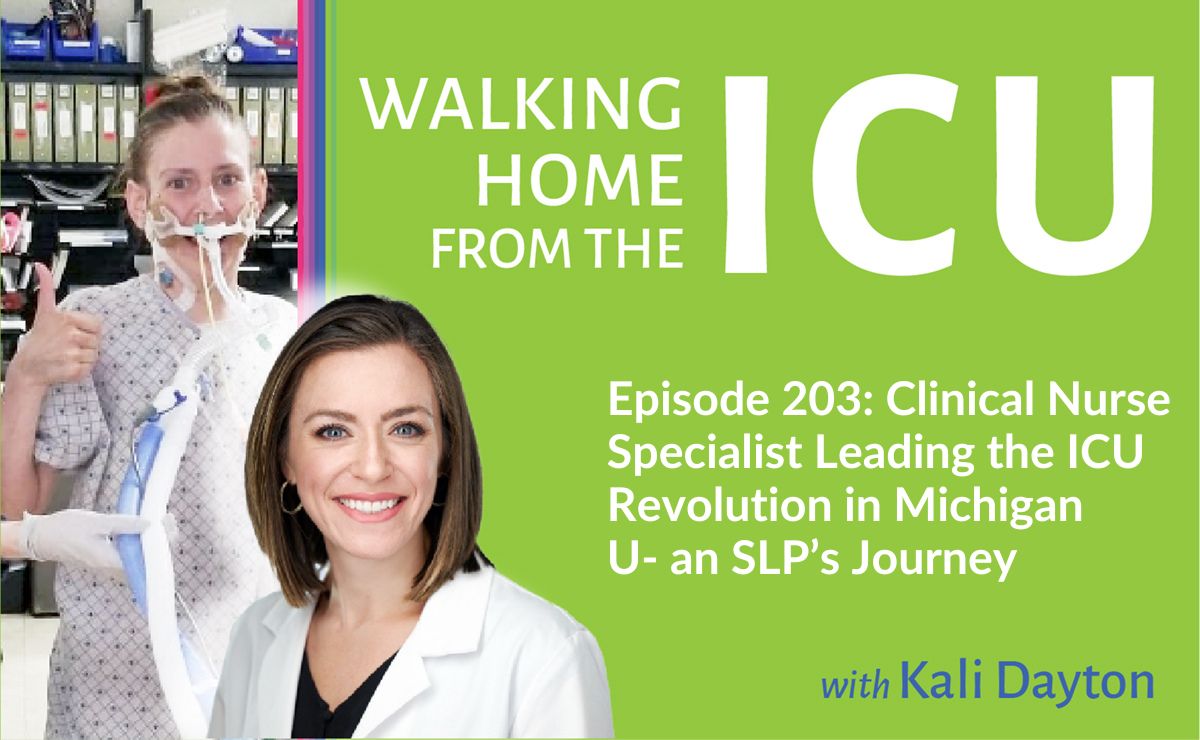
What is the role of a Clinical Nurse Specialist (CNS) in the ICU? How did Lynette LaBine, MSN, RN, CNS, CCRN leverage her CNS role to win buy-in and guide her team to become an Awake and Walking ICU?
Lynette shares with us how consulting and training services opened the doors for her to fully lead the revolution in her ICU.
Episode Transcription
Kali: [00:00:00] This is the walking home from the ICU Podcast. I’m Kelly Dayton, a nurse practitioner and ICU consultant. I help teams create awake and walking ICUs through evidence-based sedation and mobility practices. By hearing from survivors, clinicians, and researchers, we’ll explore how to give ICU patients the best chance.
To walk out of the ICU and go home to survive and thrive. Welcome to the ICU Revolution.
I can’t believe that this is episode 203. We have been talking about awake and walking ice use for years now. But you know what they say, talk is cheap as [00:01:00] revolutionists. I know you listen to this podcast with the intent on actually doing the work. That’s why I’m so excited for you to hear the journey of this up and coming awakened walking ICU in Michigan.
That has gone beyond just talking. They put in the upfront investment for rewards and returns that will continue for years and generations to come. They are literally walking the talk, doing the work, and seeing the fruits of lives and quality of life being saved in their patients. They are basking in the improved workplace environment, career fulfillment, and decrease in healthcare costs and workload.
Make sure you get your continuing education credit for this episode with Sapiens. Check out the link in the show notes. Now let’s hear it from their lead. Revolutionist, CNS Lynette Labin. Lynette, thank you so much for coming on the podcast. Will you introduce yourself to us? Um, sure. My name’s Lynette Labin and I am the critical care clinical nurse specialist at a local hospital in Grand Rapids, Michigan.
I am [00:02:00] so excited to have you on Marker, Arnold and I. Had the honor of training your team back in January of 2025. And so here we are seven, almost eight months later to talk about this journey that you had. I mean, we came on site in January, but we really started the process and the discussions back in October.
October, yep. Yeah, webinars and everything. So it’s been a journey, but I wanted to start with talking about the role of. Clinical nurse specialist or a CNS. Mm-hmm. This was a fairly new position to me. I really didn’t know about CNSs until a few years ago and had not had the great opportunity to work with the CNS.
Mm-hmm. Um, as far as training a team, and I think we need to talk about what CSS do on the units, and then we can dive into the role that you played in this transformation on your team. I think as a CNS, we definitely take [00:03:00] evidence-based practice and apply to the bedside, making it real to the nurses. We are great at bringing all the stakeholders in to make sure that everyone understands the why behind evidence-based practice and getting their input from the very beginning.
Um, because certainly most things in critical care nursing have to do with a multidisciplinary team, and everyone has their role in supporting. Yeah. So just bringing them on early. I think it’s a really good skill that the clinical nurse specialist has, and it’s amazing to consider the impact that A CNS can make.
I think it’s a safeguard against the mentality and the culture of this is how we’ve always done it. Yes. I could feel that, ’cause I’ve since talked to many CNSs. They’ve reached out saying, Hey, we need to get our team on board. And so you guys are the ones that are scouring the [00:04:00] research, gonna all the conferences.
Mm-hmm. Really looking at what is best practice, what is evidence-based, what is the latest and greatest. And then providing that expert support at the bedside to actually make it happen. Yep. And I think too, most clinical nurse specialists are very respected by the provider teams that they work with. So working alongside with them as well as the bedside nurse, and sometimes bridging that conversation, role modeling, mentoring nurses at the bedside, how to have those conversations.
Is also like really important. I mean, you’re an advanced practice nurse. You have how many years of clinical experience? You’re so funny about age. I think this is a bragging right. I actually have 40 years at the bedside and 30 some of those as a clinical nurse specialist. Amazing. And the moment I met you, I was like, yeah, [00:05:00] this team’s gonna get it done.
Yeah. Lynette’s not gonna have it any other way. Right. And I, you know, I think too, being able to work alongside the nurses and support ’em and like be, as most nurses would say in the trenches with them, really helps them to see that it’s just not. Taking literature and saying, okay, do this. It’s like being in it together and showing them and um, showing patients too, like what a benefit it can be.
We started really what I think is really gently with our staff. Even before we started webinars, we started just making sure that the basics, we’d gotten back to basics after COVID, such as getting patients up to eat their meals. That is so important on so many levels, but really just starting there then it, when it came to the more coordinated efforts, it wasn’t such a [00:06:00] big leap.
Yeah. You guys started in a really good spot, even just culturally, I could tell that your clinicians were open to learning. Yes. Your team had healthy dynamics. They liked each other. They knew each other. Mm-hmm. Um, they were used to working collaboratively and it was just really good science of. Field ready to harvest.
And I just watched the way you worked within this ICUI could tell you had a long history, these relationships, people respected you. And I realized that a lot of times I was trying to make other people or positions into a CNS in teams that I trained. Mm-hmm. And people have been able to fill that role temporarily.
Mm-hmm. As far as this. Mm-hmm. Very hands-on bedside support. They’re just looking at these practices, but it’s really hard for a nurse manager, assistant nurse manager to do that. Full time when they’re in charge of so many other managerial responsibilities. So, mm-hmm. Shout out for CNSs, I think. Yeah. I’m assuming we have a lot of evidence [00:07:00] about the return on investment for cns.
Yes. And that’s what the other piece of being a CNS, it’s just not implementing. And then here you go. It’s implementing. And then following the data in showing senior leadership, showing the nurses at the bedside, what a difference this practice has made. So just for an example, for our unit, we decreased our restraint use.
We definitely decreased our bent days. We decreased the amount of sedation that we use. Those are the low hanging fruit that we were able to see like fairly quickly. And then of course we were able to decrease our delirium, which is good. Pulling data can be tricky because it’s all based on documentation.
So really then diving into those assessments that we do, like RAs and Cam ICU, [00:08:00] and making sure that the nurse at the bedside are accurately documenting the assessments. So even though we’d done a lot of work when we implemented RAs and Kim ICU ages ago, having newer nurses, like most places, just making sure that they’re doing the assessments correctly and speaking that common language to the providers when help is needed or patients become delirious.
Absolutely. And this is. Such a great position for this pivotal time in critical care in which you have so many new clinicians. Mm-hmm. Trying to recover post COVID kind, trying to go back to our roots as well as move forward to the few different and better practices. Yeah. And we know that poor care is expensive care.
Yes. It just makes sense to have mm-hmm. Expert nurses available. You have your master’s degree, so many years of experience, leadership skills. To just oversee these practices and ensure quality within that [00:09:00] unit. And even though you had the vision of what the a b, C bundle should be, mm-hmm. What kind challenges did you face and did your team face in really getting patients?
Fully awake, communicative, autonomous, and mobile right away. I think the biggest challenge was nurses believing that patients can be on a ventilator without sedation successfully. So previously we’d done an SAT, just like probably many hospitals do. You shut the drip off for 10 minutes, they wiggle their toe or nod or whatever, and then they go right back on maybe at half the dose, but right back on because.
The general thought process was that all patients on ventilators need to be on sedation so they can tolerate it Well that makes sense. ’cause we use words like sedation, vacation process. Yeah. Interruption holidays. So it all implies something temporary. So yeah, I don’t fault anyone for doing it [00:10:00] that way.
I did it that way. Even after working in a week walk. Can I see you? Mm-hmm. Mm-hmm. Well, I think then post intubation now setting that patient up. Talking to them as their sedatives wear off. Certainly supporting ’em if they had a paralytic for intubation, support ’em through that period, but then really shutting the sedation off.
And what I’ve really honed into the nurses is establishing communication. Especially on those patients where it wasn’t a planned intubation, like they have no idea. Now they’re waking up and like, what’s going on here? So establishing communication, we just say over and over and over is our first goal. We need to know what the concerns of the patient are because them being able to answer our questions really doesn’t get at their needs or their questions.
And it can be simple things like really simple things like who is watching my cat? [00:11:00] Or I’m super hot, can you fan me? Or like, I want a cool cloth on my head. I can’t tell you how many times people wanted that, but stuff like that, even I need to get outta bed like, or my back hurts, or, you know, something you wouldn’t have even thought of.
So that’s been really good and nurses have said it’s been so nice to be able to interact with patients again. Especially, I know we keep saying post COVID, but really post COVID being able to interact with people again and you feel like you’re really making a difference and showing their families what they can do.
It just makes me bust with pride. You know, your team was so great, everyone just had. This is enthusiasm. Every team has its own culture and own climate. Mm-hmm. But it was just refreshing to be in such a great environment and yet these are were new concepts for them. Yep. I think we assume that nurses know how to do this, that the team just won’t do it.
I always quote the medical director that says, our nurses won’t do that, [00:12:00] and it drives me crazy. And I think sometimes we expect this to be something really crazy. Complex or profound. Right. Obviously in the webinars we talk about the why, the hear from survivors. Mm-hmm. And we went around to each of your team members and asked what stuck out to them in the webinars.
That was repeatedly what they talked about was, I didn’t know survivors. Still carry this with them. I didn’t actually experience, and I took it over my pride because I feel like I put a lot of really good research statistics, powerful, compelling information in there. Yeah. But in the end, it reaffirms that it’s the survivors that really open our mind.
Yep, yep. And they took that with so much humility. They’re like, okay, do you know that? So I’m ready. Look, what are we gonna do about this? Yeah. And practicing those skills of nonverbal communication and in these scenarios, I just think it took a lot of faith for them to be like, okay, this makes sense, but it’s new to me.
Yeah. I dunno how this is gonna look. I dunno how it’s gonna go, but I’m willing to try it. And we had people certainly that where this is never [00:13:00] gonna work, you know, yada yada. But then really showing them at the bedside that it really does work. And those are probably our strongest advocates now. Yeah.
Saying, look at this. Patient’s totally awake. They can interact with their families. We did have one patient who really was dying and instead of having him sedated, they actually could spend time with their family in those last moments before they were taken off of the ventilator and could interact with them.
And you know, they told stories of. His wife and they never would’ve had that, he never would’ve had that experience before. So that was powerful too. You know, a couple of naysayers for sure. And just seeing how strong patients are when the sedation comes off right after intubation. Yeah, I, it was, it’s always fun to watch the surprise on people’s faces while we’re there.
Yeah. Yeah. And we’re like, Hey, we’ve talked about this plenty. We’re going to do it now. Yeah. On patience. And, [00:14:00] um, you know, I think without the didactic previously, they’re not going to understand why we’re doing it. There’s gonna be a lot more hesitation, but even knowing the why, it’s just a new experience.
Right. Um, and so I was thinking back to, you know, those few days that we spent on the unit back in January, there was another patient with, at, with, um, there, there’s another patient at the end of their life as well, and team took sedation off and she was able to be part of those conversations, but they brought in her dog.
Yes. And that was so meaningful. I just, yeah, it just gives me chills. I mean, how different that scenario would’ve been just the week prior. Right? For the family? Absolutely. For the patient, for the dog, yeah. Yeah. Right. There was a COVID patient, newly intubated, and we’re like, yep. Perfect. Wake him up, get him up, and he just popped out of bed and he was older, an older gentleman as far as I remember.
And, um mm-hmm. They had what, one or two people in the room with him? Yeah. And he was getting himself to the bathrooms hanging out in the chair. Yeah. Just watching how [00:15:00] surprised, but also routine, it quickly became for the people taking care of him. Yep. Like, oh, I, I guess it was okay. Mm-hmm. There was a patient that was having seizures.
And he was a 76-year-old. He’d just been chopping wood. He had an adjustment. Oh, yes. Yes. And we even, um, made plans to get him on a verticalization bed. Yep. It was, it was cool to treat patients that had an indication for sedation. They were not gonna be awake and walking, but we were able to bring in another tool and have your team see we can start to preserve muscle mass.
Even while they’re deeply sedated, having seizures and, and by then it was, it was fun to see the light bulbs go off as far as remember the Y standing rounds and talking about, he was just chopping wood. Yes. And everyone’s like, oh, okay. We saw this 76-year-old man, not as an older patient. We saw it as a robust man and that’s what we’re gonna return him to.
Yep. There was another woman that was newly intubated. I don’t remember exactly why, but I think she’s. [00:16:00] Pneumonia or something like that, but she was very anxious and for me in that position, trying to guide these practices with a team that is very new to it. Mm-hmm. I’m always looking with my fingers crossed and like be as simple as possible, tolerate it to show them that you can, and instead of just throwing a fit and being like.
She’s too anxious. I can’t deal with this. I don’t wanna talk to her. Your team was so patient and the nurse was really bought in, but at the same time, she’s like, she really is struggling here. Mm-hmm. And instead of sedating her, they got up to the chair. Yeah. And that did it. She was able to breathe better.
I mean, she just, for her body habitus, it was just hard for her to breathe in the bed. Mm-hmm. On top of the pulmonary congestion that she had. So yeah, we got her up and that was it. Yeah, and I know we talk a lot about patients on ventilators, but really this has. Crossed over into like high flow patients and patients in on BiPAP, which I believe has prevented, you know, a few of the patients from being [00:17:00] intubated because they can, like you say, they can breathe better and.
We can do pulmonary toilet better when they get up. So kind of our mantra is anyone, and we didn’t really set like a, if you’re on this much oxygen or this much peep, you can’t get outta bed. Which was a little frustrating to the nurses, like, what are exclusions? But we didn’t start with exclusions. We started with everybody and we’ll just case by case, figure out if they can or they can’t.
So eventually we got to a couple exclusions, but really I think that was key into starting the whole process is let’s not limit ourselves from the beginning. ’cause we just don’t know. And the timing is such an important part of the feasibility for the team. Mm-hmm. We’re looking at staffing equipment needed.
Yeah. I mean it’s just too much if we’re trying to rehabilitate an entire ICU. Mm-hmm. And so seeing your perspective [00:18:00] on this, I mean, you were immediately like, absolutely post intubation doing this, and that was so nice. ’cause I think for leaders of this, it’s also hard to lead something that you’ve never done before.
The traditional mentality is, let’s ease into the bundle. Let’s start with awakening trials. Trying to mobilize them once they’re more stable and once they’re extubated. And that is, you’ve probably experienced that throughout your 40 years. Oh yeah. Absolutely. And so I could just tell you we’re done with it.
You’re like, tried it, struggled with it. We’re doing something different. This makes sense. And I know that my team will be able to figure this out. Mm-hmm. And I’m here for them. Mm-hmm. Yep. So I walked away being like, Lynette is gonna make sure this happens. And your team was bought in right. Oh, absolutely.
What did it make, having your team understand the why and be trained on the how? How did that change how you were able to lead this after that? Well, I think one of the biggest impacts was. Having the team, the [00:19:00] whole multidisciplinary team trained together, so bringing the ahas to the therapy team to the, not only PTOT, but respiratory and then even in the simulations for everyone to be together.
They really felt like they were all in it together. It wasn’t just gonna be nursing driving. I wasn’t just gonna be the pharmacist or whatever. It was everybody together. And then when we started just working on that communication between the teams. As we all know, like therapy has their schedule and RT has their schedule, and patients have their schedule.
So really being intentional about that conversation of when we can move and we initially had a mobility nurse, we called, but very quickly, staffing didn’t allow for that. So we had to work one-on-one with just the [00:20:00] nurses at the bedside and PCAs and stuff like that. It was really neat to see your team talk to each other.
You could tell it was a little bit cathartic for some of the clinicians that maybe they were revolutionists for many years and they’re finally. Let’s actually talk about this, and it was received well. I remember a pharmacist cared very deeply about this. Had been Oh, absolutely. Watching this for a long time and could finally explain from a sedation pharmacy side, here’s what’s going on in our unit, here’s the impact that makes.
And it’s different because pharmacists are there for days straight, and it’s frustrating for them when they’re working with. Colleagues that are well intended, but they’re there for just that one shift. Yep. Those are two totally different perspectives. Mm-hmm. And so it was really helpful to have them share their perspectives with each other.
I liked that we did the late afternoon simulation training so that if night shift one, two, they could come to that one. But it was also mixed in with day shifts. So night nurses could talk to the day PTs. Yes. Day OTs could talk to the night nurses about [00:21:00] just how they can. Support each other. Mm-hmm. How, what they do on their shift impacts.
Yeah. Their ability to do the best care for the patient during the day and night. Nurses, I mean, just great insight like yeah, you turn sedation after the day, you might work with them, but once sedation really metabolizes out on my shift, I don’t have 18 OT with me to help Right. Manage these patients.
Right. And so it was just great to watch everyone kind of work those things out. And I could tell even though they didn’t have all the perfect solutions right away, they at least knew that they weren’t alone in working on this. Yeah. And I really think that each role really saw the value of all the roles and really could appreciate the strengths of each role.
For instance, the therapy sometimes. If a nurse was hesitant, I would be always let therapy see ’em because they are amazing and it’s a new perspective for the patient. To have someone else talk to them about mobilizing and [00:22:00] strength and stuff that we don’t necessarily talk to about. And even rt, like if a patient is not acclimating to the tube, well, having RT come in there and talk with them and work with them on the best position.
Like using them to benefit the patient. Everyone saw the value in each other’s role and I, I could see the relief on the nurses’ faces. ’cause historically the bundle has been down to the nurses. Yep. They’re there to do the SATs and if they don’t go well, R can’t do SPTs and they have can’t do mobility, but then they’re left alone with it.
You know, it’s just Right. I always use the analogy of a grenade, you know, starting sedations right off the top of a grenade and then passing it down. Shift to shift. To shift. Yeah. And it’s gonna explode on somebody. Mm-hmm. So that’s, I think a lot of the hesitation is I come into this is, are we just gonna have a whole unit of confused and pulse the thrashing patients that are really hard to move ’cause they’re floppy and they’re weak and we can’t move those patients.
Yeah. [00:23:00] Once you establish communication with the patient, you actually find things out. That are causing them agitation or causing their vital signs to be changed. I remember recently we had a post-arrest patient, young, 44-year-old. We cut the sedation after she came up to us from the emergency department and she was actually still having chest pain, so then we could get her to the cath lab.
So that’s like life-changing for her. She could have been sedated and it could have been gone on for days. Absolutely prime example of how communication saves lives. Yeah. If you think of any other care setting in the patient, they’ve able to report important symptoms that play into our assessments and our treatments.
But now when people come into the ICU and they’re especially critical, vulnerable and potentially at end of life, now is the time to muzzle them. It’s crazy to think that we’ve accepted that for so long, but your team really. SW onto [00:24:00] that and ran with it. I really liked as well, the intubation cards that we made.
Oh yeah, yeah. Let’s talk about that. This was the first thing that I’ve seen do it. I think it was really kind of your idea. You’re like, what can we do for family education as far as this prime time of post intubation? Huge light bulb moment for me. Why didn’t I think of that forever ago? Tell us what you made.
So what we did was we just made like a family patient education card on just like a one-sided on like why patients are put on ventilators and what’s gonna happen once they are put on the ventilator. So they’ll have restraints just like explaining each piece of equipment that we had and really the trajectory of what was gonna happen.
We’re gonna take the sedation off. We’re gonna try and get restraints off as much as we can. We’ll establish communication and just the ways that we can communicate with the patient. We also put that [00:25:00] on there. You can bring their computer in, which several families did. Um, patients having their phones and I remember this one gentleman like that was his issue.
He needed his phone ’cause he had to tell his employer that he was in the hospital. We also had a patient who was on parole who had to get ahold of his parole officer, so he burden off of him. He was super agitated, like really a plus three. Rasa plus three on the ventilator, cut the sedation, establish communication, and that was his issue.
I need to tell my parole officer that I’m here. Oh my gosh. Yeah. It was huge. We always make the point that sedation wouldn’t, wouldn’t have treated any of those things. No. We would’ve just given him more because it would’ve just escalated. ’cause their need wasn’t being met at all and it was simple. And I like on those cards, we also disclose they’re going to cough, gag.
There might be an alarm. Yeah. This is [00:26:00] anticipated. Your job is to stay calm, help them communicate, help them understand what’s going on, which is just brilliant. So I’m assuming you guys give them this card as they walk into the waiting room, or if they’re coming in for the first time. Maybe if they came up from the ed, that’s what they have in their hands right away.
So they have a minute to process. Before it’s time for them to fulfill their role. Yeah, I mean, we struggle with the emergency department remembering to give them the card, but then once they’re up here, up to our ICU, then we can explain it more. So you know some things you initially start and you’re like, oh, this is going well, and then you realize, well, we’re talking to families anyway.
Do we really need, like we’re saying all of these things. If you’ve been listening to this podcast, you are likely convinced that sedation and mobility practices in the ICU need to change. The ICU community is facing incredible difficulty with the trauma from the pandemic staffing crisis [00:27:00] and burnout. We cannot.
Forward to continue practices that result in poor patient outcomes, more time in the ICU, higher healthcare costs and greater workload for the ICU team. Yet the prospect of changing decades of beliefs, practices, and culture across all disciplines of the ICU is a daunting task. How does this transformation start?
It can begin with a consultation with me to discuss your team’s current practices, barriers, and to formulate a plan to help your ICU become an awake and walking ICUI help teams master the A-B-C-D-E-F bundle through education consulting, simulation training, and a bedside support. Let’s work together to move your team into the future of evidence-based ICU care.
Click the link in the show notes of this episode to find out more.
So I would say the practice of using the card is waxes and wanes. Yeah. Depending on the [00:28:00] timing, the family maybe. Exactly. But that’s great. I just thought how nice is set that standard. I mean, right away after. Yeah. Left. I mean, we introduced that during simulation training to say you’re going to be waking your patients something, you’re gonna be involving families in this way.
So. I wonder if it was kind of an education for the staff as well and And yeah. Helped reinforce this high reliability environment of, yeah. Standard. Yeah. Yeah. And maybe now they don’t need that you anymore because it’s part of their routine. Am I correct? Right. Yeah, definitely. How are your providers feeling about all of this?
I would have to say the providers. Initially, with the exception of maybe one or two, we’re pretty skeptical at the beginning, but as they saw how nurses therapy, respiratory therapy especially, could manage these patients without sedation, they just got more and more and more on board. And one thing we [00:29:00] added to our rounds is how does the patient communicate?
So, and when we have residents, I say, so listen during rounds, how the patient communicates because I want you to use that same method and not just talking at the patient, but allowing them to talk with you or communicate with you. So that’s been valuable. Yeah, absolutely. I mean, residents, that can be a challenge ’cause they’re coming from other facilities.
They’re still pretty. Yes, young in all of it. So they’re gonna carry with them whatever they’ve first been exposed to. So to set that standard. Mm-hmm. And to make communication of value while they’re still learning all these high level procedures and right roles. That’s so powerful. I am also remembering not all of the patients that were there, we were able to catch right away, right?
Mm-hmm. So I think the first intubated patient that was mobilized. While we were, there was someone that had been sedated for I think six to eight days. Yeah, yeah. She was young, but she was very confused, very [00:30:00] deconditioned. Mm-hmm. And after one of the first, or if not the four simulation training, the nurses went in and got her up.
They didn’t wait for rehab then. Oh, no, that’s because she was getting anxious. She was starting to get towards agitated and they were like, okay, we’re not gonna start sedation. Let’s, I guess let’s do that thing. And I, I just was so proud for doing on a more complex patient who mm-hmm. Not an easy mobility hall.
No. And he was a sling appropriately. They got her to the edge of bed. They tried to stand her, she was not even able to stand. Mm-hmm. But they, using the sling, they were able to do that. Safely at least try. But they absolutely wore her out and she was Oh, absolutely. Out after that. Yep. Yep. And they continued to do that.
And so even through the four days that we were there, we got to see her progress mm-hmm. As well. And I think she ended up extubated Yeah. At the end of it. Um, which she was failing her breathing trials primarily because she was so weak slash sedated slash hilarious. [00:31:00] And so they got to see, even nursing was just able to use those tools to treat her.
They didn’t. They could see that they didn’t need to have rehab there. Now granted, I think there were like four nurses at least in that room. Yeah. And I was like, Ooh, they’re not gonna love that. That’s not a no no. But I had to say, this is not going to be the standard. No. Anytime you do something that for the first time it’s going to take longer, it’s going to take more people.
Yeah. It’s gonna be a lot scarier. And you’re gonna catch these patients much sooner, so it won’t be so challenging. But even for the more complex patients, you’re gonna, someone like that could have benefited from a verticalization bed. Yeah. Or maybe she never will. Would’ve ended up in that situation with where you guys are at now in your practices.
Mm-hmm. Mm-hmm. But it was just amazing to see the nurses take the first initiative. And not wait for rehab. ’cause mobility is in their scope of practice. Exactly. And yeah, I kept reminding people that I know like at the beginning, this is gonna take longer, but it will get better. [00:32:00] So just trust that it will get better and it certainly has.
Oh for sure. Sometimes it’s just a PCA and a nurse getting a patient up. We always check with respiratory therapy and are you okay if we just get ’em up like they’ve been up to other times. They really wanna be there the first time, which is totally acceptable. And they should be. ’cause they wanna know how they can move.
But yeah. And sometimes they need to adjust the ventilator. Maybe more support. Yeah. Maybe they can quickly wean it down once they’re up. So, no, that’s great. So you’ve been able to witness this change in morale, comfort level, competency within your team. Yep. Margaret went back and interviewed. You’re members of your team.
Yeah. You got to film a patient, you know, with all the, because the patient was able to consent to have the recording done. And so we’ll put a link to that video in the show notes of this episode. Maybe we’ll start sharing clips of it, um, on social media. ’cause it’s so nice to hear from your [00:33:00] colleagues mm-hmm.
Talking about how their, just, their experiences with it. And it was fun for me to hear how comfortable they are with it and how they find so much value in having patients. Awake able to communicate more easily. Mm-hmm. Something that we talked about a lot was how hard it is to communicate after two, three plus days of sedation.
Yeah. And so I’m always like, trust me on it. You’re, they’re going to be able to write legibly with a clipboard. Yes. For the most part. And you’re going to love it. And it sounds like they do. And I, I’m so, so proud. Any other stories? I know at this point, seven, eight months in things start to get so normal and I told your team not to lose the magic of it.
Yeah. What’s become so routine. Yeah. Other stories? I think one of the most powerful stories that really impacted the staff is we’d gotten a transfer from Florida. Not, I’m not saying anything bad about Florida, but we’d gotten a transfer and the gentleman had been on Propofol for almost a [00:34:00] month at about 16 hikes.
So he got here and actually the family was just moving him to our hospital because they were from here and they were anticipating just withdrawal of care. But when he got here, we shut the sedation off like right away and got him on a vertical bed and within three days. He was opening his eyes and he was showing more interaction with the family.
So of course that changed the whole trajectory of his stay. And he actually was able to, he did end up getting a trach, but he was able to come off the ventilator and go to Caltech, but he was way stronger than when he came. Like he could barely lift his arms when he came to us. But we got him up. Like we, he was on vertical bed for about five days and then we were able to get him up and he was able to stand with a walker before [00:35:00] he left.
Wow. To go to Altec. But he definitely need a lot of rehab. But I think that just showed the staff that, you know, we’re doing a really good job and really impactful for patients to change like the trajectory of actually their life. Whether, you know, he has complications or whatever is yet, yet to be seen.
But he made a lot of progress when he was on our unit. We also had another patient, we had that bariatric patient when you were here really heavy. No one thought he could like hold his own wage or anything. So the training with like bariatrics. Was also very valuable that they can carry their own weight.
It’s like a misnomer that they’re weak, which they’re not. Anyway, he ended up going to LTAC and he actually came back to the unit and thanked us for cutting his sedation off so that he could interact with [00:36:00] his wife, and we were able to like even get what his likes and dislikes were and sports teams. He wanted to follow It, like made a huge difference.
In his ICU stay and that’s what he said. I always use a bariatric case in, in simulation training because they’re such a vulnerable population and they pose many challenges. Mm-hmm. Uh, when we continue routine care, like old standard of care, right? Yeah. It becomes a challenge, but we make easier for everybody and it’s so much more successful with this approach.
He came into your unit while your team was doing webinars? Yeah. So they were open to kind of experimenting and so it was about like day 10 or 11 that they really got him to the edge of the bed. Yeah. Which I think is amazing considering his size. Yeah. And all. And the delirium. I thought that was like such a.
Huge accomplishment. Mm-hmm. And so we used him as an example in simulation training. Yeah. And they were able to redirect the care to have him awake promptly, [00:37:00] mobile promptly. And then we could say, you probably remember him, it was day 10, but if you come up on day 10, if you have, if you can swing the staffing and you can do that hard work.
Yeah. And take those risks on day 10. I know you can do it on day one, day two. Yeah. Yeah. So that was, yeah, a great case study and how perfect that he came back. Mm-hmm. To talk about it. Got feel good for your staff. Oh yeah. It was amazing. And even that transfer patient working on a week and walk ICU u certainly we got transfers from all over the region.
Right. Community hospitals, sometimes different parts of the country. And it was really challenging. And I don’t know. I mean, actually I do know that early on in my career, I didn’t know why they were challenging. Right? I couldn’t, I didn’t understand the risk of sedation and immobility or really how much sedation can cause delirium.
I just knew that they were a handful. Yeah. They were really, he and impulsive. And it took a lot more people, it was a lot more work to mobilize them. [00:38:00] I just didn’t know the why, and once I learned the why, then when I saw these transfers, I was really annoyed. You know? I was just frustrated. Yeah, yeah. Like it’s hard to witness that harm, but it’s also very fulfilling to realize how much good we are doing.
Mm-hmm. By quickly rehabilitating them. I don’t wanna always say, bring all those patients here, but if you’re gonna bring them here, bring them early. Yeah. So we don’t have to do it, the cleanup, but it also just shows our patients hardly ever get to that point because our care is so different. Yeah. It’s not because this patient is different, it’s because the patient came from a different process of care.
So yeah. Do you feel like your team could see the contrast and they could celebrate. Yes. How has become for them? Absolutely. Absolutely. Because he came with like pressure injuries and like super weak and they could just see just what we were able to do in such a short time that it truly made a [00:39:00] difference.
And that just highlighted for him that we haven’t had a patient like that. In such a long time where it’s just this prolonged sedation for whatever reason, and previous to this initiative and this training. Mm-hmm. We didn’t have verticalization beds. No. What would you have done with a patient like that?
We would’ve just lifted him to the chair. He would have been bearing. No, not at all. That and staff see that too, that having a verticalization bed makes a huge difference in like subset of patients for sure. Neuro. And are they starting to independently identify those patients that are appropriate? Oh yeah.
Oh yeah. Sometimes therapy will say, let’s give it a try, and sometimes nursing will say, I already ordered the bed. But yeah, it’s from both sides, nursing and therapy. Which might make some therapist weep because I’ve seen commonly that [00:40:00] teams that do have the verticalization beds but don’t have the full culture and knowledge throughout the team, the beds get ordered.
Late therapy is the only discipline to you use the bed, so they get like 20 minutes a day, which is an adequate So yeah, having your nurses already ordered the bed. Yeah. They already know can identify, oh yeah, this patient needs that bed. We’re on it. And then are the nurses using the bed? Are they standing patients up?
Oh, absolutely. Absolutely. So we quickly realized that we had to establish a process for when patients on a vertical bed. So we use our whiteboard and we just say like what? They were able to get to 60 degrees. 10 minutes and then we’ll just put three boxes three times a day or, and then just change the percentage and the time as we can with the patient and just progress them.
So really having that communication shift to shift, it doesn’t have to be just day shift. [00:41:00] So much easier for night shift. On some patients that are on that bed because they can just call RT and then the two of them can just have them stand up for a little while. Yeah. And I love that RT is so involved and down the road.
Absolutely. They may not need to have RT there every time. Right? Yep. But it’s a great time to do suctioning and pulmonary toileting and breathing treatments. Mm-hmm. And that’s prime time. Yep. And just seeing how patients. Who previously are in a bed not looking at you, you stand them up and you’re like, look at me.
And they actually can do that. Like maybe not on the first time, but as you keep doing the therapy, eventually you can just see. How much more neurologically intact they become, the lights come on. Absolutely. I, I wish I’d really valued that as a new nurse. Yeah. I know that Louis Bestian and Pauly Bailey, bless their hearts would Yeah.
Certain patients. I didn’t understand. I mean, if they’re like rasa negative [00:42:00] four and we’re doing all the work for them, sitting them at the edge of the bed and holding their head up for them. Yeah, I felt annoyed. Yeah. I was like, what’s the point of this besides wasting our time? You know? And I wish one that we had verticalization beds.
That was, yeah, it was a wild west back then, but also that I’d understand the impact of what we were doing. I wish we had understood the impact of what we were doing and realizing, yeah. They were starting to open their eyes because we had them upright. Yeah. That they were starting to make eye contact with obey commands.
But how nice to be able to have one or two people and put in that into routine care. So how are the nurses finding the time to stand patients up? That’s always to hang up is we don’t have time. If they’re strapped in and standing up and someone has to be there, we can’t do that because we don’t have the staffing for that.
How does that work for your nurses? I think initially that was the sentiment, but then as they saw, like 10 minutes is not a big deal and really highlighting you can do other things in the room. You don’t [00:43:00] have to just stand there and stare at the patient like you can do your neural assessment during that time.
You can be right next to the patient. You can chart stuff, you can talk with them and answer their questions or have the families talk with them. So I think they were able, yeah, just to combine other things and realized it really wasn’t that much time. I feel like some of the foundational skills of nursing is multitasking.
Mm-hmm. But in a way that’s so much more productive. It’s not that big of a deal. It’s a chart next to a patient while they stand and it’s more fulfilling. Yes, it is a little bit awkward. Sit in a room with a patient that’s like just staring at the ceiling. Maybe you feel like you’re supposed to be talking to them, right?
You are doing something productive. I’m gonna go do something productive. We’re working on right goals together. So I would imagine that would improve comfort in just lingering in a room. And even nurses have been more and more like putting patients into the chair position as they do their first assessment.[00:44:00]
Maybe they can’t get ’em up at that time, but at least putting ’em in that position and then doing their assessment, looking at having the patient look at them, you know, giving them the best chance to get the best neuro exem, just given that standard of. You’re gonna be awake and alive today? Yep. I don’t remember how consistent your team was about lights on during the day.
Lights off at night. Yep. Do you feel like that’s changed as well? I think we were pretty good at that, but definitely more intentional. I would have to say. We also worked on, probably other places have this as well. Patients that like to refuse. So we changed our script instead of asking, do you wanna get out of bed?
Just setting the plan at the beginning of the sheriff. So today our big plan is we’re gonna get you out of bed for all your meals if they can eat or if not, our plan [00:45:00] today is to get you out of bed. We can work with timing, really negotiating with the patient. Some would say, oh, I didn’t sleep at all. I don’t wanna get out of bed.
I just wanna sleep today. And we’re like explaining delirium. And actually, if we get you out of bed, you can take a nap and then we’ll get you outta bed again. And then hopefully you can sleep during the night. And just giving a better script of the why it’s important to get outta bed. I feel like a lot, it’s because.
Your clinicians understand the why better themselves? Yes, absolutely. Absolutely. Like hard to teach something you don’t know. ’cause I’d been teaching delirium and telling ’em all the statistics and all of that stuff, but until they actually saw it change, they weren’t believers like they had the theory.
In fact, some would say, we’ve heard all this before. I said, yeah, we didn’t do anything. So I think that’s the value in bringing [00:46:00] outside people in, especially for like, for myself, having been here for so long and people hearing me say the same thing over and over and over again. Having just that support of this isn’t just me, this is other people, other hospitals, other, you know, units are doing this.
And having that. And in our area too, a lot of nurses grow up here. It’s the only hospital they’ve ever worked at, which is totally fine. We can grow our nurses and they can take care of the people in the community, but really hearing that other places do this as well, and this is best practice and we need to move along.
It’s hard to be a prophet in your own land. Yeah. And there’s some things that are hard to say to your colleagues, so. Common things are overstating patients, and I don’t think it’s intentional, but like doing the rest inaccurately. Mm-hmm. Uh, it’s hard to say to people that you’re with all the time to say [00:47:00] you’re doing it inaccurately.
Yeah. But I can say with all honesty, this is a very common thing. Yeah. We’re not picking on one discipline, demonizing anyone. This is something that no, we’ve all either inherited, fallen into, there’s so many things. So I hope that people get less defensive with that approach, but I’m just an outside party being like, yeah.
Here are the common problems. You may see this, you may have done it, identify it, change it, let’s move on. And I think that’s a little bit easier for someone that doesn’t necessarily have a history with them. I don’t have to see them the next day. They can hate me. I’m fine with that. Right. Yeah. Yeah. And for people to say, I mean, there were one or two nurses that were like, we already do this.
Or some of the providers like, we do this already. Yeah. I’m like, okay, alright, well let’s see if we can do it a little bit better. For me, I can be like, I don’t know, maybe you do do it. Yep, yep. But we’re gonna, we’re gonna make it easier to do it. You may personally do it. Whereas if you were to say that, I mean, you’d probably personally say, no, you don’t.
I watch you practice. Right. But it’s, we need to have psychological [00:48:00] safety and sometimes that does require a person in a different position to come in. Mm-hmm. And say those hard things. Yeah. Yeah. And I feel like your team received it well and clearly acted on it, which is the ultimate objective. I’ve realized over the years that when I do a brief ground rounds with teams, uh, we bring in this insight of like, Hey, you’re harming people.
And here’s what is possible, but without providing all the tools and the support to actually, yeah. Yeah. It can feel distressing, like you can call it moral injury with doing that. Mm-hmm. It can also make it feel like this is impossible, this is just theoretical. This can’t actually happen at the bedside.
They don’t have any actual practical tools to get there. Mm-hmm. The journey that we went on with your team is the perfect example of, I was very clear. Yeah. I think you and I had the same style of where we’re very upfront. This is actually dangerous. Mm-hmm. This is harmful. Mm-hmm. But to be able to stay in a way of, but we’re doing something about it.
Yeah. We’re bringing hope, we’re bringing changes. You’re going to enjoy this, this is a good thing, but we’re gonna talk about some of these ugly things, [00:49:00] very frankly, so that we can fix it instead of you’re hurting people. Figure it out. Why. Yeah. Yeah. Yeah. I, I’ve learned this to be much more consistent on allowing for a full process.
Mm-hmm. I think realistically. Mm-hmm. Just one presentation. A few things is just not enough for most teams or probably all teams. Yeah, we don’t just watch a, a YouTube video on central line placements and go out and do it. We have. Yes. You learn anatomy, you learn the risks, you learn what to do. If something bad happens, you learn why you’re doing it.
You learn how to do it. You practice on hands on. Mm-hmm. Kind of in a sim setting. Right? Yeah. Then you do it with mentorship. You have a, like a phase out process before you’ve receive your full autonomy. Yep. You and I talked about also about you can’t hold people accountable for what they don’t know.
Right? Right. So how do you expect nurses and everyone to practice at this level if they’ve never been trained? To do that. Right, right. So after the training, what’s that look like [00:50:00] in your position as a CNS now? Bring in that. Accountability piece. Well, first of all, praising ’em for what they do do and then just having conversations on.
Okay, so, so tell me why the sedation needs to be on. What are the behaviors of the patient? Is there something underlying that we’re not treating so that we can make the patient more communicative and really honing in on if they can answer your yes no questions, that’s awesome, but we’re not getting their questions.
So let’s work on that and continuing to pull and highlight the nurses that are doing it really well. We highlight those nurses in staff meetings. We have them speak so that it can be like peer to peer. We also continue to do simulations with the new nurses that were training to ICU. So we take those same concepts and we have providers and we [00:51:00] try and get the whole team as much as possible to give them the full experience.
And then of course as they work with preceptors, they get to see those behaviors modeled. So, and that peer modeling is so important. Yeah. And I’ll have to say that even the physicians that were a little hesitant. I’ve seen the value and that thought, they’re not gonna be able to do this. We don’t have enough staff for this kind of stuff.
They saw. They really do see how much less work it actually is seen as believing. Yes. And that’s what it takes some successes, talking through those situations where people say, see what happened. I can’t say we had more self extubations, but we did have self extubations. So I then would go back to the provider and say, actually, we had these self extubations before we even did this.
Like alcohol drug withdrawals, they self [00:52:00] extubated. Before we did awaken walking and really, really talking through the patients that did self extubate. They were actually ready to be extubated. In fact, one patient I remember vividly, was scheduled for a trach. And he’s, he hadn’t been restrained. He’d been in the chair and he said he lifted his arms and the tube fell out.
Well, he had never ended up getting a drink, so he was ready and every single patient never had to be reintubated. Oh, wow. So they were ready. It’s like we were late. And what was the team’s response to those self extubations? Because I’ve heard of very punitive environments where the team isn’t working towards this, that it’s maybe a revolutionist pushing towards.
I’m gonna keep this patient awake and the rest of the team’s like, no, you should sedate them. And if something happens, they get in trouble. So, yeah. What was the response to that nurse who maybe felt mortified like it was a failure? How did you support them through understanding that it was okay that it [00:53:00] wasn’t such a failure?
Well, the first patient who self extubated, of course it was. Well, this whole new thing, Lynette’s new thing is not working. I just talked to the bedside nurse and I’m like, it’s not your fault, because the patient was actually restrained. They were taking that tube out, whether they were awake or not. I mean, and there was no reason to keep ’em like totally sedated.
There was no reason they were on high settings. They were just waiting for the patient to be neurologically or have increased LOC or mentation or whatever. I said we couldn’t do that, keeping them on sedation. And actually one nurse said, I asked them to extubate the patient and they said, we don’t do that at night.
’cause unfortunately we trained and then we got a bunch of locum positions. So I’m like, but you got it done. Yeah. Yeah. What’s gonna happen regardless. So you know, you reach out to the providers, this patient’s gonna pull their tube unless we do [00:54:00] and And they do. And now the rates haven’t increased. No, we haven’t had catastrophe.
No. Everyone still takes airway management very seriously. We’re not lackadaisical about it. And yet you’re having improved overall outcomes, which is the objective. I’m so proud of your team. Great job. Go Michigan. I think you’re such a tribute to the CNS role, so shout out to the CNSs out there.
Absolutely. Um, you’re a model revolutionist and it’s so amazing to see your entire team become revolutionists. Mm-hmm. This is a great success story and I think this is replicable and other units as well. Oh, absolutely, absolutely. No coming back and I’m, yeah. I’m happy to talk to any other CNSs cross country.
You need to start presenting at CNS conferences, A NTI. I just think there’s so much to learn from your journey, and I appreciate you being willing to share this and for everything that you’ve done. It’s amazing to thank the lives that you’ve [00:55:00] saved through this. Leadership in this initiative that you’ve led, so thank you.
Great. You’re welcome
To schedule a consultation for your ICU as well as, find supportive resources such as the free ebook, case studies, episode, citations, and transcripts, please check out the rest of my website.
Transcribed by https://otter.ai
SUBSCRIBE TO THE PODCAST