SUBSCRIBE TO THE PODCAST


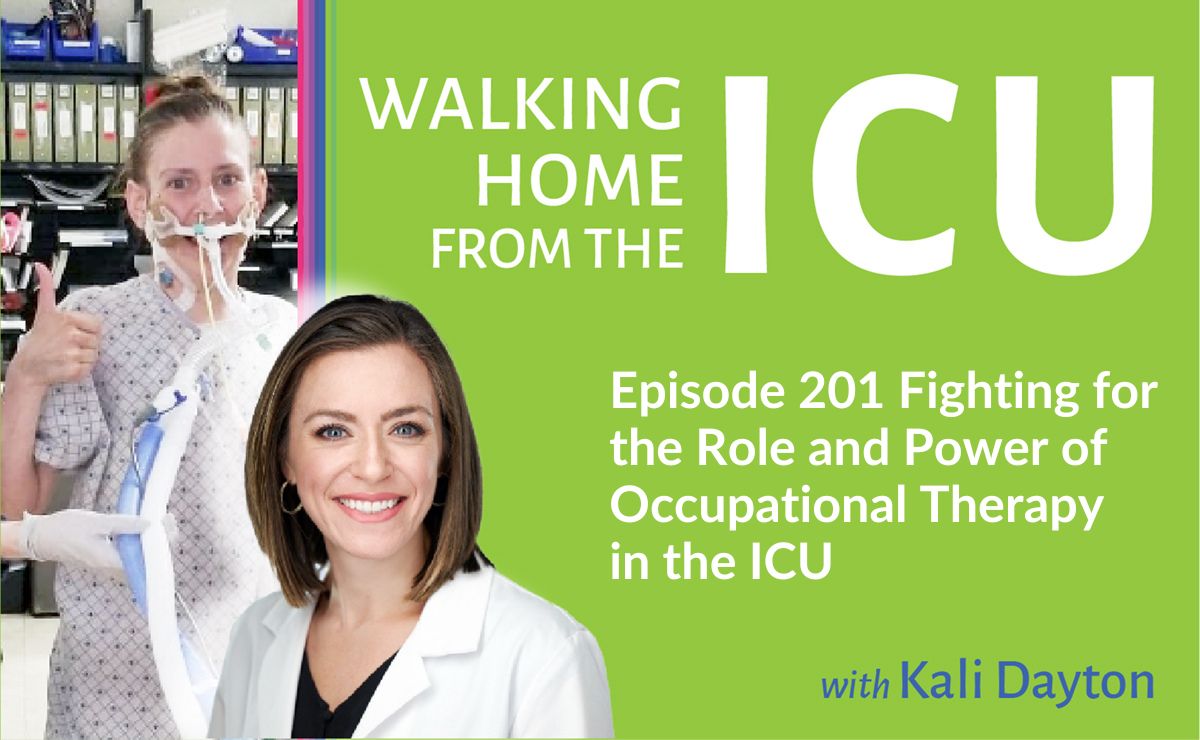
Amanda shares her journey, starting from her field placement at Vanderbilt, which shaped her career path, to her current focus on early mobility and cognitive care in the ICU. She discusses the innovative approaches she has championed, including mobilizing patients early, even building protocols for cognitive assessments.
Amanda also emphasizes the importance of interdisciplinary collaboration in the ICU and highlights the critical role OTs play in patient care.
The episode touches on her experiences advocating for better OT training and competency in ICUs and her work in post-ICU support groups.
Through detailed examples and heartfelt patient stories, Amanda illustrates the significant impact occupational therapists can have on patient recovery and outcomes.
Episode Transcription
Kali Dayton: [00:00:00] This is the walking home from the ICU Podcast. I’m Kelly Dayton, a nurse practitioner and ICU consultant. I help teams create awake and walking ICUs through evidence-based sedation and mobility practices. By hearing from survivors, clinicians, and researchers, we’ll explore how to give ICU patients the best chance.
To walk out of the ICU and go home to survive and thrive. Welcome to the ICU Revolution.
I am so excited to introduce an amazing revolutionist, Amanda Luper to the gang. She has been in the fight for many years and is bringing incredible insight and expertise to us in this episode. To get your CE credits for listening to this podcast episode, [00:01:00] any of these podcast episodes, any episode on any medical podcast, or any learning that you do, check out Sapien in the link in the show notes to get your credit.
Amanda, welcome to the podcast. I’m so excited to talk with you. Can you introduce yourself to us? My name’s Amanda Luper, and I’ve been an occupational therapist for almost 13 years. I practice in Central Indiana. My entire career has been in the acute care ICU. And one of my favorite stories I love to tell and how I even became an ICU therapist is back in the days of OT school, you had to pick a lottery number of where you’re doing your field work placement, and I wanted to be in a hospital and I decided to go to Vanderbilt in 2013.
And I had no idea what was happening in the world of critical care at Vanderbilt in 2013. And I remember Elena, she’s a physical therapist who’s actually mentioned in Dr. Eli’s book, and she asked me to do my presentation, early mobility in the ICU. I was terrified when I showed up to John’s [00:02:00] or to Vanderbilt and had no idea what I was getting myself into, and they completely shaped.
Who I am as a therapist. I took that and I made sure I found a critical care job or somewhere that had ICU, and that’s how I landed my first job at a 300 bed hospital just north of Indianapolis that actually didn’t have early mobility, but they set the groundwork and I’m still in contact with Elena today and she’s been a great mentor and it’s crazy full circle when you look back on the evidence that came out of Vanderbilt at that time when I was there.
It’s just been a really fun, it was a very amazing start to my ICU journey, but they really are what shaped me and how I ended up in critical care in the first place. So similar starts, right? So my ICU had influenced what Vanderbilt was then working on. Yeah. And then I went to other ICUs and I was not in that same environment anymore.
So, especially so early on in your career, what was it like to leave your, whatever your residency, [00:03:00] fellowship, your final phase of your education with this perspective of your role in the ICU to then go to an ICU in which. That had not been established. So what’s interesting is when I started, there was an acute rehab unit attached to the hospital.
So I started on acute rehab, which I think was a great foundation in looking at rehabilitation in general. And what’s interesting is they had an LTAC that decided to rent out space in the hospital. They contracted the therapist. They asked for volunteers to go up there and everyone looked around and I’m the new grad going, oh, trachs and vents.
I’ll go, because that’s what I had fallen in love with. So I ended up going to an LTAC and I would go to the hospital every day, but go up to the unit. I was getting patients that had been sitting there for two weeks on sedation that all of a sudden now were on an ltac, and now it was our job to rehab them.
My brain went from. What are we doing at the hospital side? Because I know we, they could, we could be doing a lot more. So I caused a lot of ripples on the ltac. A lot of [00:04:00] ripples. Yeah. And what’s fascinating is about nine and a half months after I started that job, I got the brochure and I was looking for the Johns Hopkins rehabilitation course.
And I was like, you know what? I’ll see if they’ll pay for me to go. I got an email on my way to vacation saying, we will pay for you to go the Johns Hopkins course. You pay for your travel. So I will never forget flying out to Baltimore. I was not a very well traveled person at the time. I went out to Baltimore on my own and I sat in this auditorium by myself and at the time.
There were teams of people from hospitals going, I was this lone OT that knew there was something more to be done and had no idea where to start. And I hung on to one thing at that, two things at the conference. Dr. Dale Needham said, if you wanna change, it’ll take five years. So I wrote down five years and I was like, okay, this is gonna take a while.
And two, I loved when they used iPads. This is a long time ago, and I took that back. And I was determined to change the narrative that [00:05:00] patients didn’t need to be sedated for two weeks and then end up trached on an ltac. And then it was my job to rehab them. And I did that, which was super exciting. But I was a little fish in a big pond at that conference and I was very intimidated.
But I still have that memory and it really jump started everything I’ve done for the last. 13 years. And you have OTs right now being like, yes. Thank you. Like I, I call PTs and OTs and SLPs. Cleanup crew. Mm-hmm. That we create this mess and this damage and then punt them off to rehab. It’s once we’re done treating the critical illness, now you guys get to fix the things that happened under our care, and I remember 2021 presenting for the first time in person at a trauma conference in Colorado.
I’d flown out there and I was like, we’re still in COVID. And yes, I have this podcast, but it’s different preaching these hard truths through a microphone versus presenting to like a hundred, 150 people in person of these wonderful clinicians that are doing their best during a [00:06:00] pandemic, a really hard time.
And to have to say, we are hurting people. And I just wanted to crawl under a desk and suck my thumb. I just was so mortified. I just felt like so small and I just was racing myself to be booed off the stage. Anyways, I briefly mentioned OTs as part of that team, that really important team that makes this happen.
And the OTs, there were like five of them, I think maybe six, came up to me in tears afterwards and said, thank you so much for mentioning us. No one ever recognizes us as part of the team, and I just, I was mortified. I was still really learning about these big motifs happening throughout the community and all this history, and I just thought, really, OTs are not part of the ICU team in so many units.
And then I came to realize in many of the ICUs that I trained, since they don’t even understand really what their role is because they haven’t been allowed to practice there or early on, they just accept that they’re the cleanup crew that they won’t. Prevent the harm, they will treat it. So what is the role of the OT in the ICU and how did you carve that [00:07:00] out in your workplace?
I think OTs role is so multifaceted and I think what’s been hard, what, what’s been a hard narrative to break through is. Walking vents, early mobility, walking vents. And it’s funny because as we were even breaking barriers at the hospital I was at, there was this huge push for walking vents. Walking vents.
And I’m like, hold on a minute. How do you get them walking? They have to be awake. There has to be cognition like we’re missing. We wanna jump. Everyone wanted to jump to this walking vent, and I’ll never forget, part of the reason I was able to go to the ICU is I met with a clinical nurse specialist, met with the nurse manager.
We formed an IU liberation team. So really I was the first rehabilitation specialist at that hospital championing for therapy. So I was championing for ot, pt, speech, the whole group. And so my OT voice was loud enough because I was at the forefront. But there was a physician who was pt, ot, pt, ot. But the one time the patient’s wide [00:08:00] awake in a chair and he wanted to walk and I said, where’s my OT order?
He goes, she can read. And I’m like, do you even know what I can do? And I think what was interesting after that was he saw me working with even non vented, low level stroke patients, and he didn’t know what OT was. And so I had to do a lot of education with nursing, with physicians, with respiratory therapists to say, I can do more than walk someone to the bathroom.
I can do more than help someone brush their teeth. And so one of the barriers we had was sedation. So I championed OTs, therapeutic use of self, and my practice framework is perfect. Or when that patient’s coming off sedation or you’re trying to do an SAT. Now obviously in awake, ICU is the best ICU, but when you’re trying to change a culture, you have to meet people where they’re at.
So I actually did boots on the ground work and I rounded with the [00:09:00] team and we actually went in and watched nursing workflow. So a nurse who had two vent patients, I stepped back and just watched what did they do? And I was taking this feedback of, okay, now as an ot, what would I do and how would I change that?
So one of the things that I have championed OTs from early on is we can provide environmental modifications. We can close the door the way we approach patients. We’re not in a hurry that we have two vent patients. This is my patient. We ask about hearing aid. Our checklists are different and the nursing checklist isn’t wrong.
We just have different lenses and we have different checklists. So one of the things that I became very crafty with was I was helping nursing workflow by being in there while they were doing their SATs so they could go to something else. But I had time with a patient and then they were oxidation for 30, 40 minutes.
And then I could get ’em up and moving and they’re like, how did this happen? I took their sequentials off, I put their head of bed up. I made them more [00:10:00] comfortable. I put their glasses on, and by the time nurses would come around, the patient’s waving at them. So they also started to trust me because I wasn’t going guns blazing of this patient has to walk around the unit once or twice.
Let’s do what I know how to do best and get ’em awake, get ’em oriented, ask about their social history. ’cause patients that are awake can answer the questions of, do you like the TV that’s on? Or do you like the scary law and order that’s probably playing, giving you nightmares? And I got chances to talk to family.
And so it was a really good introduction. I definitely, I think, changed the narrative of what early therapy looked like in the ICU. And I think nursing really appreciated that because for a long time it was. You’re not doing enough. We’re not doing all this mobility. But there was so much more and we found that if you do this well, everything else will follow suit.
Yes, absolutely. And I went to visit a team once and they didn’t know who I was. I was tagging along with someone else who they knew it was Margaret Arnold from early mobility.com. [00:11:00] She is the face of early mobility.com. They know that she was there for mobility and I said, I’m Kaylee Dayton and I. Nurse practitioner and I help bring this piece of sedation and delirium management to facilitate mobility.
And the medical director looked at me and said, why are we talking about sedation if you’re here from mobility? And I was like, you can’t do anything else. This is what we see in our early mobility studies is that. We sedate them until they’re so weak and now we can only do low level. And then we see that the barriers to mobility are sedation and agitation, but we don’t know how to work with that agitation.
We don’t know how to tease out what’s causing the agitation. A lot of the agitation is from the delirium. That’s what’s so cool watching OTs work is that in that setting in which sedation rates are still high, the lium rates are still high, we’re still like having to work with those barriers. OTs really shine where they’re like, I’m gonna prevent a tracheostomy of this patient because I’m going to get them to a place where they don’t need sedation anymore.
It is so powerful, and what I also see is a lot of co-treating where OTs are almost like treated like a [00:12:00] PTA. You know that they always have to go and do these gross motor activities together and I see you like physically responding and that’s one of my objectives is to say. Whoa. Like then where’s where?
When does OT come in? When does OT get to do the OT stuff? We need separate interventions and so I feel like a lot of times OT is missed because we’re co-treating. What are your thoughts? 1000%. I’m a huge fan of co-treating, but I also had a really amazing PTs and I’ve worked with amazing PTs, but we had a very good understanding of.
She would leave me for a while and I would do my OT stuff and then we would come back together. I think what’s really fa, I was just on a call, which was also just crazy for me to think with Chris pme and this whole conversation of competency came up because you know that she has the very large, wonderful PT competency that came out.
And one of the things that has come up in my career is competencies and. OT education is different than PT [00:13:00] education. I now work in academia and so I’m def, and there’s a lot of reasons I did that well. One was to help change narrative for OTs coming out to practice because the education is a lot different.
I say that because not every therapist that or every OT that comes out of school is wanting to go into the medical model and go into acute care. Where we’re missing the boat is institutions not understanding that there’s another component of education that needs to happen. Once therapists come out.
PTs and OTs are both graduated as generalists. So when I came out of school, my, the reason I felt comfortable is I had 12 weeks at Vanderbilt and an I trauma one ICU with trachs, intubation, learning all of this. But that’s not where everyone comes from. And so I’m actually mentoring an OT in Florida right now and.
She has asked multiple times. I don’t feel comfortable going to the C-V-I-C-U. I’d like someone to mentor me. She has gotten nothing. And so I think when we look at co-treating, it’s safety in numbers [00:14:00] and if I can go with somebody because I’m worried or I’m not a hundred percent sure what to do and I don’t know my role and I don’t know policies, and I’m worried to move vented patient like.
Safety in numbers, and so I do think we’d see less co-treat and co evaluations if we had a better system for preparing therapists to go down there and feel more competent and confident in their skills. I had to push. This is for anyone listening that might be going, oh, I want this, but I can’t get it. I was told that ICU is not rocket science and that people coming out school, anyone could do it.
And the only reason I was able to get an ICU competency is because I went to the medical director and said, I need you to tell the manager that we need a competency or she won’t listen to me. I had a ton of barriers from the therapy side when I was doing my ICU work and helping with the culture. But even then, it was a very hard culture for someone to think they needed to be deemed competent to work with these critically ill [00:15:00] patients, which then fast, fast forward a little bit, then COVID hit and guess where the all the eyes were on the people who were doing the competencies, because now you have drugs and peeps and vented patients that everyone’s, I don’t know what to do.
We tried to say there’s a competency, so I truly feel that there needs to also be a shift in education. And really more on organizations that if this is truly, you want great ICU therapists, as you all do, there should be a way to deem competence and confidence to be able to go into these rooms. And coming from the nursing side, I was never expected to just jump into the ICU because an RN in license and just treat these patients and be safe.
There was a whole orientation, it was months of classes, courses, tests, then it was. Shadowing people that it was a mentorship and it was like someone to check in a buddy system. It was really to make sure that I was safe to practice and I wasn’t. Initially I was so I can’t imagine being like, you have your license and you work in acute [00:16:00] care, so just jump in and go treat that patient with a RDS.
That is so scary. But that is the mentality I see from a lot of rehab directors. They don’t understand the skills and what’s at stake in the ICU and how high level it is and how nuanced it is. They don’t understand what they’re up against. So this whole rotating everyone through the entire hospital. I see you physically reacting.
It drives me insane and I think it is unfair, unsafe, and insane. And I did an episode about just the. The opposition that revolutionists faced. And one of them was an OT that had spared a patient a trach by advocating, leading the whole team to do the right thing and got this patient extubated. And she got demoted, I dunno if that’s the word, but she got basically kicked outta the ICU.
The rehab director felt threatened, I think, said, you are acting like you know everything you’re, everything you’re practicing outside of your scope and. Didn’t send her back to the ICU and it’s been months and she’s having to look for different work. But what a waste of skills. So why don’t [00:17:00] these leaders understand the impact of just not training people, preparing them, and then just throwing anyone into this environment?
Oh, so one of the things that I think we face is acute care in general is going through a really hard time. We’re expected to get, and this is take Ice u out of this. We’re expected to get patients out faster. We’re looking at length of stay. We’re looking at productivity to make sure, okay, are you a therapist productive?
How many units are you getting out? And the barrier I face, which I still PRN at both the hospitals I’ve worked at, so I’m still at practicing ICU. Still have a pulse on the ICUI worked in, that is different now, but they’re still getting the same thing. The ICUs get prioritized because they’re not being discharged and they’re not.
So I think from rehab directors, they’re getting push of, get that eval done, get that pre-cert done. They need to go to nursing home now. What I argued and what we were able to do as a team and collect data and was that by the work interdisciplinary we were doing, we actually saved the [00:18:00] hospital $150,000 and this was just in a short amount of time because in therapy we also collected data.
At one point, 40% of patients that were leaving and transferring out of ICU were walking before they transferred out. 55% were going home. They also showed that, ’cause we also were finding that our patients weren’t being discharged to rehab. And that’s weird. They were too good to the acute rehab. So the acute rehab admissions also looked at numbers.
And so we were able to pull this data to show that yes, they are important because in the long run we’re saving how many days. And luckily because we had a very strong team and I had physicians and nursing and a part of a larger system, they were, had their eyes on the bundle. We were able to get dedicated.
T and OTs, but it took probably from when I came back in 2014, like [00:19:00] from the ltac, and then it was on the ICU. It wasn’t until 2017 where we actually had a presence full-time. So three years it took a fighting and taking orders and working and showing our worth. Johns Hopkins also used to have a really cool calculator where you could put in FTEs and spit it out.
I actually gave that before and was like, here’s how much I cost. Here’s how much a PT costs. But overall, so I think it’s, I think the problem that we’re seeing is why would I invest in mentoring and all of that when we’re not even getting to patients? We’re not staffing, we’re not getting enough therapists to cover the rest of the hospital.
Why should we prioritize ICU patients? And I heard that for years. I still hear it. I also would pull out literature and show. At one point when I was looking at a job shift, I was actually looking at a possible job plan. So if anyone wants a business plan for critical care navigator that actually showed the resources after someone leaves the hospital and actually [00:20:00] all the readmission rates.
I worked with a business and our business analytics and he actually pulled. I patients who had discharged from ICU that were readmitted for anxiety, we could pull up all the diagnoses and actually pulled how much all that was costing the hospital by readmissions. Ed admits the first year resource utilization, and so that also helped them understand that this is a bigger issue, and so if we can address things.
Right when they get here, you’re gonna save the hospital system X amount of money. Now none of my patients are ever dollar signs. In my mind. In my mind, yeah. But I have had to speak dollar signs when I’ve sat at meetings and had to advocate. But yeah, I have a whole business plan that outlines resources and there’s navigators for patients after cancer.
There’s navigators y aren’t there people to help navigate our patients from the time the families, by the time they get there, through them leaving. That’s a whole other tangent, but. I was able to pull some of that to also [00:21:00] continue, but every year I was continually having to say like on my performance reviews, oh, what are you doing?
Here’s why we’re still down, here’s what we’re doing. Like it has been a constant advocacy for my profession down there, and it’s still what I’m doing. So you just always have to try to prove your worth. Oh, I haven’t had to prove it to though my patients. Yep, absolutely. They know how amazing OT is, and I think that’s really in the end, what matters.
No, I’ve heard from survivors repeatedly that the therapist that came in and worked with them, that’s when they finally felt like they had a chance to survive. That’s when they actually had hope. That’s when they got to really fight for their own lives and that it changed their course. There is a study Johnson 2019 from a CV ICU where they increased.
The dedicated PT and OT staff in that ICU from two clinicians to four and decreased length of stay by 3.6 days in the ICU and like 2.2 days in the hospital, even after the ICU. So that’s almost six [00:22:00] days less in the hospital just by increasing by two clinicians. That is so negligible like that. Just think about the huge cost, like this is a big C-V-I-C-U.
This is a very expensive hospital. These are expensive patients in A-C-V-I-C-U that is so much money compared to the salaries. I, I think you guys are underpaid, but it just doesn’t make sense to not have that, their sepsis checklist when you go to the ed. It’s amazing to me how we prevent so many other harm and yet we know we’re doing harm.
We know and. I’m waiting for the time when there’s gonna start being repercussions for creating harm. We’re all waiting. I was really waiting for it. If hospital acquired weakness was treated like hospital, acquired pressure injuries, correct. We wouldn’t be having this conversation, I swear. And then we could really just get down to work.
But we have so much evidence, there’s just more evidence coming out. A more recent study showed that when a hospitalized adults lose a level of mobility, their length of state increases by [00:23:00] 48%. We know that we have to mobilize patients within 72 hours after admission to make any impact on post ICU, post ICU syndrome.
We really do need to treat it like the sepsis bundle. I’m so glad you brought that up. ’cause that’s the way I see it too. I remember when it was. The bundle was first rolled out for sepsis, and you get this like lime green page on your front door of your patient’s room, and it started in the ED, and they marked the time in which cultures were drawn, antibiotics were drawn, how much fluid was given.
You had this checklist, but what if we had that approach for. Here’s what time they were intubated. Here’s when they were first mobilized, and here’s when we first took sedation off. And it’s very time sensitive. I think that is how we need to treat this. But, and if we did that as a standard throughout the entire hospital.
Like warning came up saying, Hey, it’s been 12 hours since I’ve gotten out of bed. What’s going on? Especially in the acute care floors, then you guys could work on so many other things. Then we’d finally have the cost benefits and it just would be a no-brainer. But to have this narrow view of you guys are there just to get [00:24:00] patients to their care facilities instead of preventing them from having to go to care facilities.
It doesn’t make sense. What kind of stories can you tell us about how you’ve. Changed patient outcomes as an ot. We love stories. Oh my gosh. I love stories too. I think there one that has been most notable in the last two years was, so I’m glad you brought up rotating therapists. The last house I worked at, we would rotate monthly.
So what would happen was those longer stays would rotate through multiple therapists. So for context, the first hospital I worked at for 10 years, I helped shift their ICU was a 300 bed hospital. Trauma two, trauma three, but we got a ton of head injuries. So neuro ICU was my thing. The next hospital, I worked there for two years full-time and I work on their burn unit is a safety net hospital.
So definitely different demo demographics, level one trauma hospitals. So again, you’ve got [00:25:00] all these multi traumas. Fellows. Fellows. It was a teach, it’s a teaching hospital. But one was most notable was there was a gentleman and he landed on my schedule and I noticed he’d been there for almost a month.
He came in with GA beret, ended up coding, needed a trach, I’m giving like the abridged version. And it was a Miller Fisher syndrome, so it affected his ability to open his eyes. So you have a gentleman who’s now trached, so can’t talk, and his eyes are closed. And I’m reading through notes and again. The thing is, and it’s not a, I’m not judging therapy, it’s hard to take ownership of something when it’s not something you have the full time.
One of the things about me is when and when you’re in an ICU and you’re the only sole person is you have to problem solve, they’re gonna be on your caseload. And the good, the bad, and the ugly, like you just knock it out. When people rotate through, it’s easy to say the next person will handle it. The next person will handle it.
He [00:26:00] started to fish a little bit about what is going on. He would just go in, the doctors would go in and talk to him, and he would just give thumbs up, thumbs down. He’s on sedation, but his eyes are closed. He can’t open his eyes. I was like, okay, everyone’s scared to move him. He’s coated, but he is fine now.
He’s not any drips. What are we doing? So without the pt, me and the rehab tech, I’m like, I’m getting him on a til. Table, the verticalization. This is safe. I can see what his blood pressure does. I can see. So I get up. He stood for 25 minutes. All his vital signs are fine. The other reason, so for any OTs listening, I love a good vertical verticalization because for upper body, that scapula can get away.
So I get so much more movement. You can weight bear with tables. It’s so dynamic and I don’t have to hold someone up on the side of the bed. He’s lifting his shoulder up. I’m like, this man has way more potential. He has been laying in bed. He’s depressed. How long he been down for? Oh, over a month. Gosh, over a month.
So then I asked the nurse, I said, [00:27:00] he needs to go outside, but we’re taking him outside. The man hasn’t been outside, so let’s talk to a cardiac chair. Wheel him outside. It’s a whole, like, I have rt, I’ve got a nurse. They’re looking at me like I’m crazy. I just inherited him two days ago. He didn’t, I don’t, I think he was asleep the whole time.
Like he wouldn’t give a thumbs up. And I don’t know, his eyes are close, but he went from like thumbs up, thumbs down to just. I think he was finally relaxed. He was outside. It was great. Next day I sit him up. His sitting balance is only minimal as this. What, and I’m seeing him every day at this point.
Nursing is floored. They’re like, who are you? And I’m like, I have been told I’m a unicorn in some instances and a magician. Magic. Yeah. By the time he was, they were gonna get him send to an L Tech. By the time, the last time I saw him again, it was Meina Rehab Tech. I stood him three times. He was at an SBT.
And I stood him by myself. He could have gotten off the vent. Wow. He could have gotten off the vent. And the hard part for me was we made so many assumptions. So many assumptions. He couldn’t write [00:28:00] because he couldn’t see. Yeah. And so his dexterity, and so they’re asking him questions. He didn’t have family.
There were so many assumptions about this gentleman where if we just would have done, we would’ve just done what we know what to do. He has just stuck with me because the whole early mobility of being nervous and we failed him, and it’s usually the ones that I feel like we’re not doing the best we can for someone that usually sticks with me because it’s how do we change that system?
Once somebody is hemodynamically stable, they should be mobilizing. What? I’m surprised that he wasn’t severely orthot. When you first got him up, which is amazing. He must have been really young. That’s such a, I feel like a month down. No, he was older. No, he was a young guy and he was not very healthy at all.
No. His blood pressures were great and rock solid and I think what was interesting is once nurse and I am really into the interprofessional, because once nursing saw what he could do, they kept asking, when are you seeing him? When can [00:29:00] I help you? Yes. What can we do? What can we do? They saw somebody in a bed, and I will go back to Wes Ailey’s book because this man became a patient on a bed.
He wasn’t a human anymore. Yep. And the resident came by one time I was working and said, how is he doing this? And I’m like, he’s a human. Get magic. I don’t know. We’re like. He needed to be upright. He needed activity. He’s been laying in a bed. We haven’t, you haven’t tried any of this. You assumed he couldn’t do things.
So with that, what are your feelings about these verticalization beds that we have now? So, I’ve not tried the beds, but I’m all for anytime someone can weight bear, I, if I had my, I had my way, every room would have them. I love them for spinal cord. I love them for TBIs. I love them for disorders of consciousness.
I’ve always struggled with the consensus mobility report where it says RAs and it’s out of bed mobility and I think it’s negative three [00:30:00] or lower. Don’t do it. And I’m like, I’m just gonna scoot you over here and strap you in and get you up. I know. How are you? If they’re like barely. Hypoactive delirious.
Right? That’s what’s gonna get them going. And I remember early in my nursing career, and this is, we can walk in ICU, we didn’t have, we didn’t use help tables, we didn’t have virtualization beds. This was 2012. It was the Wild West and the NP would have us sit patients up that I look back and I’m like, yeah, that was, they were probably a negative four.
And it took three or four of us, and they don’t even hold their heads up and we’re holding their heads up for them. Yep. And I’m sweating under PPE and I’m like muttering and cursing these NPS names that are my breath. And I’m like, what a waste of time. I’m doing all the work. They’re not doing anything.
What is this? I wish someone had explained to me why we were doing that. I don’t think I realized the significance of that, but I thought, remember. Tons of pulmonary toileting. Yep. And they would start to open their eyes on their own, start to wiggle their fingers, start to do things. The lights start to come on.
And so when I read these studies about verticalization and disorders of consciousness, I’m like, I have seen it. When you see it, you can’t help but absolutely [00:31:00] believe it. It can’t take away that tool. Buy those SSEs. And then as OTs, you talk about where’s OTs place vision? I have told and doctors think I’m crazy and I, you probably have learned I am a little crazy, but if I can get somebody with a brain injury to open their eyes, I can do therapy with you.
I can do it even with their eyes closed. But then there’s, there is there where in there, how can I do scanning? How can I occlude you? Especially in disorders of consciousness or in low level. TBIs. I love it because for ot, that is sensory stimulation. That is, we are doing visual scanning. That is ot. You can bill for that.
And I think what, you don’t need a PT for that either. Slide ’em over, lift ’em over, stand ’em up. I look at standing tolerance. I look at their vital signs. It is a therapeutic thing that I’m doing and I, one of the best tools during COVID was a verticalization because these patients. A safe way to get them upright.
There’s this gentleman I still keep in [00:32:00] contact with. He was one of my very first COVID patients. It was a til table and that was the only way I could get him to weight bear without me breaking my back. And you can monitor people so much closer and safer that way. But no, I have not worked with the beds yet, but I am all for, if you’re willing to bring in this huge extra piece of equipment from the other side of the floor or wherever.
Get someone to transfer them onto there for what, 10, 20 minutes of standing and you get that much impact during that short period. That’s why I love these beds ’cause it’s so much more convenient and then the entire team can do it. So the nurses have seen you do that. They see that you didn’t die, you didn’t de saturate or get sink Apol.
And you can say if they’re on that bed now, you can do that. You wanna sit down in the chart, strap ’em in, stand ’em up, rts, when you go to do your vent check, stand ’em up. You can order that and everyone follows through, ideally. But I just don’t think there’s a lot of fear around verticalization because we’re so fixated on having them supine.
I have gotten agitated patients in it [00:33:00] too, which I gotta be careful, but one gentleman was trying to rip the straps off and I was like, ah. But. He did get lively, which the doctors needed to see. No, I love it. But nine times outta 10, don’t they calm down more? Yeah. We’re not natural beings to lay down for 24 hours, like at a time all the time.
That’s just not, but yeah, I definitely don’t think OTs utilize that like they should. And I think empowering ot. That you don’t need a, that is mobility. I still think that’s out of bed. Mobility, I think it’s weight bearing, but you don’t need a PT to be there to do that. We are just as capable. And again, it’s a tool that enables all the rest of the therapy that you Yes.
Can and should do. Yeah. Amazing. Okay, so more stories. What else has this. One of my other favorites. I have some good COVID ones, but I actually have good COVID ones. That’s not what a lot of people say, but I will say one of the ones that I, that has always stuck with me are the agitated brain [00:34:00] injuries, and I am a certified brain injury specialist.
Neuro just has my heart, and those are the patients where I feel we are quickly to sedate and. In report, if they were eng, they got agitated last night. So we’re not gonna try again until we have this whole team here. And there was one gentleman in particular who’s an anoxic brain injury overdose. Big boy and young, big, strong Uhhuh, and everyone looked at me and I go, I look at the PT and I go, we gotta go in.
And this is the perfect co valuation. If you’ve been listening to this podcast, you are likely convinced that sedation and mobility practices in the ICU need to change. The ICU community is facing incredible difficulty with the trauma from the pandemic staffing crisis and burnout. We cannot afford to continue practices.
That result in poor patient outcomes, more time in the ICU, higher healthcare costs and greater workload for the ICU team. Yet the prospect of changing decades of beliefs, practices, and [00:35:00] culture across all disciplines of the ICU is a daunting task. How does this transformation start? It can begin with a consultation with me to discuss your team’s current practices, barriers, and to formulate a plan to help your ICU become an AWAKE and walking ICUI help teams master the A-B-C-D-E-F bundle through education consulting, simulation training, and a bedside support.
Let’s work together to move your team into the future of evidence-based ICU care. Click the link in the show notes of this episode to find out more.
I go, we gotta go in. He if, if we don’t try to do something with him, because everyone was so scared and this was back, this, I was a young therapist, like I did not have years of experience under my belt. And I’m in there making a name for myself. Go, we gotta a try. Nursing looked at me cross-eyed. I will say the beauty that I had.
And it was interesting, the ICUI worked at had five attendings and they would all split the patients. So one [00:36:00] attending had one patient, one attending. So you just never knew who you’re gonna get. So in this particular case, I had a really good relationship with the attending and I said, I’m gonna go in there and nursing turn off sedation and we’re gonna get him off sedation and we’re gonna move him around.
And he just looked at me like. You’re crazy. I go, it’ll all be fine. It’ll all be fine. It all, it was crazy. He was wild. I think prepping and having clear delineation of who, whose role is what, and having nursing very clearly me telling nursing, here’s my plan. There is a safety component, but here’s why we’re doing this and here’s how we’re all gonna work together.
We cannot all shout at him together. If he goes to reach for something, don’t scream at him. Let me take the lead. And Summer, and I, she’s a physical therapist I worked with, we were so in sync that she knew, especially with patients with a brain injury, I was always in front. Clear [00:37:00] communication. She was always in back providing if there was mobility needs and we always told nursing, just hang out here.
If we need you, we’ll let you know, but just let us run this session. He ended up getting extubated, physician thought we were crazy it, we had to show that he could be semi like he was awake. Mad but awake. And that really asking the physician why are we keeping him intubated? Are we worried about agitation?
He is gonna be agitated on the vent, he’s gonna be agitated out, like off the vent. What is safer for him at this point? And so they ended up extubating him and he with insurance and everything. He ended up going home with his mom. Probably not the best situation. We worked with him like two days ’cause we were getting orders from admission.
Interestingly enough. I’m gonna go on a little bit of a tangent. So I worked for a larger system and this was a smaller hospital in the system. So I was a part of a very, there was two of us from the hospital I worked at that said an A through F team and PT was gonna be pre-checked on every patient.
That and the ICU admission order set and I said wide like OT order, the hospital, the [00:38:00] large. Level one trauma said they couldn’t do that, they couldn’t handle the volume, and I said we can. So we compromise was. PT may order OT one in the ICU. Is this what I wanted? No. Did I train the PTs very well and have a whole list of criteria that when a patient entered the ICU, we got orders, so I was getting orders on patients from the day, like day they were admitted, or maybe the day after, depending on we were there, but I had strict criteria if they were independent before and intubated.
I got an order. Anyone that came in with alter mental status, I got ordered. Anyone there? The criteria for OT orders in the ICU was all but like one thing, active comfort care order. I was getting in there though, like the same day or in chart reviewing so that I could make the determination when OT was going in.
And so for some of these patients, he was agitated and not hypoactive because he wasn’t sedated for two weeks. Yes. And you weren’t trying to now move that large habitus. [00:39:00] Correct with tools or with yourselves, like would you add to all the complications? And we took him out like he was walking after this.
And so as much as it’s nerve wracking, and I’ve talked to newer therapists that again, don’t have the mentorship or the competency to go, I know this is the right thing, but what do I do? That was a team approach and I had a team around me that said. I’m with you. The nurse was in there in case we had to, if I would’ve gotten knocked out or hit or something, medication or safety, like we were all there.
But clear communication. And I think these are the patients that as soon as they’re agitated, we all go. We can’t. We’re done. I also had another young TBI that wasn’t intubated yet, but the physician wanted Intubator to be able to control her. Correct. And I. I love your Instagram because you talk about people getting in trouble.
I went to the family and I was in her room for over an hour giving them therapeutic things to do. I phoned a friend from the local rehab he worked at. He used to work at the rehab hospital and said, okay, what are some [00:40:00] good meds? Because we didn’t have pm, like we didn’t have a pm and r. We didn’t have psych there.
What are some things? I went to the family and said, whatever you do, let’s avoid intubation. The intensivist not only pulled me into a conference room, but also showed up to a meeting I was in that same day and talked about how no other discipline should be talking to the family. She was never intubated.
Um. Neurology came by and gave them other things to work on for helping with managing agitation in that moment appropriate to head injuries. Her mom, she ended up going to acute rehab, but I followed her from ICU all the way through, and the mom could not have thanked me because there was no way she would’ve been at the level she, she was getting in the shower.
She was, there is confusion, but there’s no way we would’ve had her sedated for weeks on end. We would’ve added in a secondary brain injury on top of. Primary injury. So it, it just doesn’t make sense, but it’s what we habitually do. Yep. And it was hard in the, and it’s still hard, so that physician still won’t even look at me when I go to the [00:41:00] hospital to work.
And honestly, I’m like, at this point, I dunno what to tell you, but that patient is out there. Surviving and thriving and we show up to work to do no harm. And we gave an oath of that and I will keep being a mouthy OT and stepping in. But I do also, if there are OTs that are working in neuro ICUs, you should be in their day one family education on rancho levels, positioning just.
Looking at, sometimes it’s not even mobility because of blood pressure. There’s so many other things we can do to prevent what’s going to come and provide education. Families are powerful. There’s a reason they’re a part of the bundle. Equipping the families to also be an advocate. It’s very powerful.
Have you seen my family podcast? That’s something that therapists oftentimes really, ’cause then obviously it saves time, but also I can say things that maybe are uncomfortable to say. I don’t feel like I don’t make enemies of the families, but I explain the culture and the environment and the [00:42:00] history and try to create more of a trusting relationship, but empowering the families to be involved and prevent these complications.
It’s a hard line to walk, but I feel like I do a fairly good job of it, but it’s safer coming from it. This random person on Spotify, then from your colleague, it’s called Walking You through the ICU. I could put the link in the show notes. That’d be awesome. Yeah, I definitely, I would love to. We made handouts and you add all the resources and would give ’em up to the families and I sued delirium.org.
Yep. Yep. We added all to diaries, and I will say the other thing, and it’s not in the ICU, but one of the best things I ever did in my career was I started an ICU support group. In Nove talking about families in November of 21. So right in the heart of the pandemic, we kept saying all these things. And for OTs, when we talk about the difference in education, we have a larger mental health background than PTs.
And so looking at. Post ICU syndrome is [00:43:00] something that should be in every vocabulary of OTs, whether you’re on acute rehab, whether you are in acute care, whether you’re an outpatient that affects your patient. And so one of the things I did is we put on a calendar and we had a support group, and luckily I had patients that had come back and thanked me.
And so if you ever need anything, we’ll help you. They ended up coming back and being like the first staple patients. We’ve actually had a wife of a family member, they were contemplating a trach. It was around Christmas. She showed up and the patient who had a trach like it grew at one point, which you should never have 20 people in a support group.
We had 20 people there. Wow. I connected people with voc rehab and got them connected into all kinds of services that were even lost after acute rehab. And the biggest thing is. They changed my life. Sorry, this is, I cry all the time on here, so it’s, you can’t talk to one of ’em and not wanna go and do better.
It’s funny because I’ve watched them come out of ICU and [00:44:00] hearing how they were before and. They’re not the same people. They’re not at all. And the one gentleman in particular, he, he actually ended up with a brachial plexus injury. We still have no idea. It was probably from a neuromuscular blocking agent.
And, but he wasn’t prone, it fell through the cracks. And I just luckily happened to, he was driving a support group and I said, you need to go. And I made some connections, ended up getting in him in to the clinic, and he now can lift his left arm. And he still will say, without an OT advocating for me. He went to outpatient and they have no idea what was going on.
They put a TENS unit on his hand who he couldn’t feel anything without the concept. There’s still just work to be done in our society of what happens. We talk about chemo brain, we talk, there’s all these resources. Bypass brain. Yes. There’s so many things that I don’t understand why we’re not farther ahead for the patients once they leave too.
I don’t care how great your care is in ICU, you leave. I [00:45:00] have provided, we had a lady who was awake the whole time and she came and said, that was the worst experience of my life. And she came back and she goes, we just need to do something about it. And so I just don’t know. I don’t know what else needs to be done or how much harm needs to be done, but I think for OTs, there’s so much more, I’m gonna keep saying it, than walking and walking.
There’s so much psychosocial. There’s that mental health component and. There’s also things if you are listening to this and you’re not in the ICU, but you’re getting these patients an outpatient, there’s still things you can do to identify and get them the resources they need, and we’re just not quite there.
And I will keep screaming it from the rooftops until we get more. But those patients, I was in ICU for over. Nine years before I started the support group and I thought I knew every, I thought I’d heard it all. And you get a group of people that are sitting there going, my 16-year-old was trying to figure out if I was gonna live and I don’t.
I can’t believe I’m here. And just the trauma it puts people through. It really humbles you and really makes you wanna be a voice. [00:46:00] And go on podcasts and share, share your knowledge because they really, truly are my heart, my family, and why. Do what I do. It helps you face that opposition unabashedly knowing that this is your why.
And I always say for our how we manage patients in the ICU, unless we know our why, we can’t find our how. And I think as a revolutionist, knowing how hard it is to advocate for these changes and all the barriers, if we don’t know our why, we don’t hear the survivor’s voices. How are we gonna manage their care?
How are we gonna prepare them for a future that we have no idea? Has in store for them. Um, when I train teams, I do sense of webinars and didactic with them and I share so much research and statistics that are very compelling and shocking. But when I ask them once I’m on site what impress ’em the most, what they remember, what’s impacted them, it’s 95% of the time it’s the survivors.
They out shadow anything I can share and building that bridge. And I feel like just OTs just so naturally get it. I think PTs do as well with [00:47:00] OTs, with all the. The brain injury, the long-term cognitive impairments for me as a nurse, when I heard cognitive impairments, I don’t think I really understood what that even meant.
I had to hear survivors explain not being able to drive and not being able to care for themselves and cook and do these basic things. But OTs are like, oh yes, that is my thing. And one of the things that I also tried to work on, and one of my best friends, she’s a speech therapist, we combated this together, was we came up with a protocol at the hospital.
It’s not the, I wish I could have more data around it and then COVID hit, but. We were, so the thing that I’ve always struggled with is long-term cognitive impairment. People argue that they’re alert oriented in the hospital, but they were just delirious for two weeks and now you’re sending ’em home with meds.
We’re not even looking at cognition when we’re sending people home. So we actually made a pro. Yes, we made a protocol, and the moca is very sensitive, like the R bands. So if we look at post ICU clinics and the R bands, one of the things that we implemented, we had, it was called our post ICU syndrome Standard work.
And [00:48:00] so any patient that had been intubated greater than 48 hours. Who screamed negative for delirium. Was getting a moca, and from there we were figuring out what resources that also was strengthening our patients’ need to go to rehab because if they have cognitive acute rehab, if they have cognitive impairment, they get all three disciplines.
Insurance is more likely to accept them. So we were finding that our patients, we were doing great early mobility, but also we’re having, A lot of ’em are 17, 18, which is moderate, mild to moderate deficits. We’re going home and we’re expecting them to do their meds and all of that. So we were hooking them into resources, doing more family education, but also some of our minimal assist patients who could still walk, were going to acute rehabs.
And by the time they were leaving with that intensive therapy, they hopefully, the goal was I saw some of their scores, they were back to almost normal. So then they weren’t going home and all the things we’ve heard on ICU ju room.org of we’re getting their checkbook and so they still do [00:49:00] that standard work.
ICU patients are still getting a cognitive assessment and what cracked me up the best was the first time we did this. This part’s not funny. It freaked everyone out because what do you do with scores? Social work was mortified. They’re like, this patient has severe deficits. What do I do? And I’m like, we have family involved.
They don’t have family. I don’t. Okay. We in decision making. A nurse looked at me one time and I came outta the room. He goes, what’d he score? And I told him, he takes the MRI form and ripped it. And he goes, I guess he shouldn’t assign this. Yes, it was a culture shock because they were allowing patients who were, could tell them they were at the hospital and that it was December, and to make life altering decisions.
Some of these patients weren’t paying bills because they were in the ho, like they couldn’t figure out what was going on and were going home probably nothing on, and so it changed the whole culture of cognition. So much so that during hospitalist orientation we were educating them about hip fractures and delirium [00:50:00] on the other floors, and hospital-wide cognition now at the hospital is something that’s routinely ordered between OT and speech.
They know what the scores mean and it really originated down in ICU because. We know it causes long-term. We know delirium. So whether they’re delirious for a day or two or 10, we needed to be looking at this before we sent and we had really good results. Instead of the podcast, I didn’t even know what a MOCA score was.
I was so curious. When I learned about it, I was like, oh. And so I started working with my speech therapist. I’m like, can you go do a MOCA score on them? I’m just curious. And they actually, most of ’em turned out really well. One of my case studies is an A RDS patient that was there for three weeks and he had 27 outta 30 probably what I would score right now.
But, uh, but also these people were like. If they’re nonverbal, they’re cam negative. But I wanna have like end of life discussions. I wanna have big discussions. I don’t, I now, I don’t trust it right now. I understand. So it just changes everything. I think that’s a great opportunity for OTs to be teaching about these hospital induced brain injuries.
I wish delirium [00:51:00] had. I think it, I wish it was socialized to be acute brain failure. Yep. Because then we would have urgency or an acute brain injury. ’cause then we would actually understand more of the big picture just by those semantics. Delirium just sounds like transient confusion. Yep. Sure. Rather than a life threatening and life altering condition.
So OTs hope this empowers you to get out there and magnify and optimize your role. I hope the other disciplines hear this and support OTs in becoming more competent. Having the opportunity to work with patients early, do all the other OT things besides just mobility. As everyone participates in mobility now, you don’t need to have two people there, two doctorate prepared clinicians to sit some up upside the bed.
We can open up those doors for OTs to do all the very high level specialized things that they are prepared to do, and. Help them adapt that into the ICU. Amanda, thank you so much for joining us. Thank you so much.[00:52:00]
To schedule a consultation for your ICU as well as, find supportive resources such as the free ebook, case studies, episode, citations, and transcripts, please check out the rest of my website.
Transcribed by https://otter.ai
SUBSCRIBE TO THE PODCAST