SUBSCRIBE TO THE PODCAST


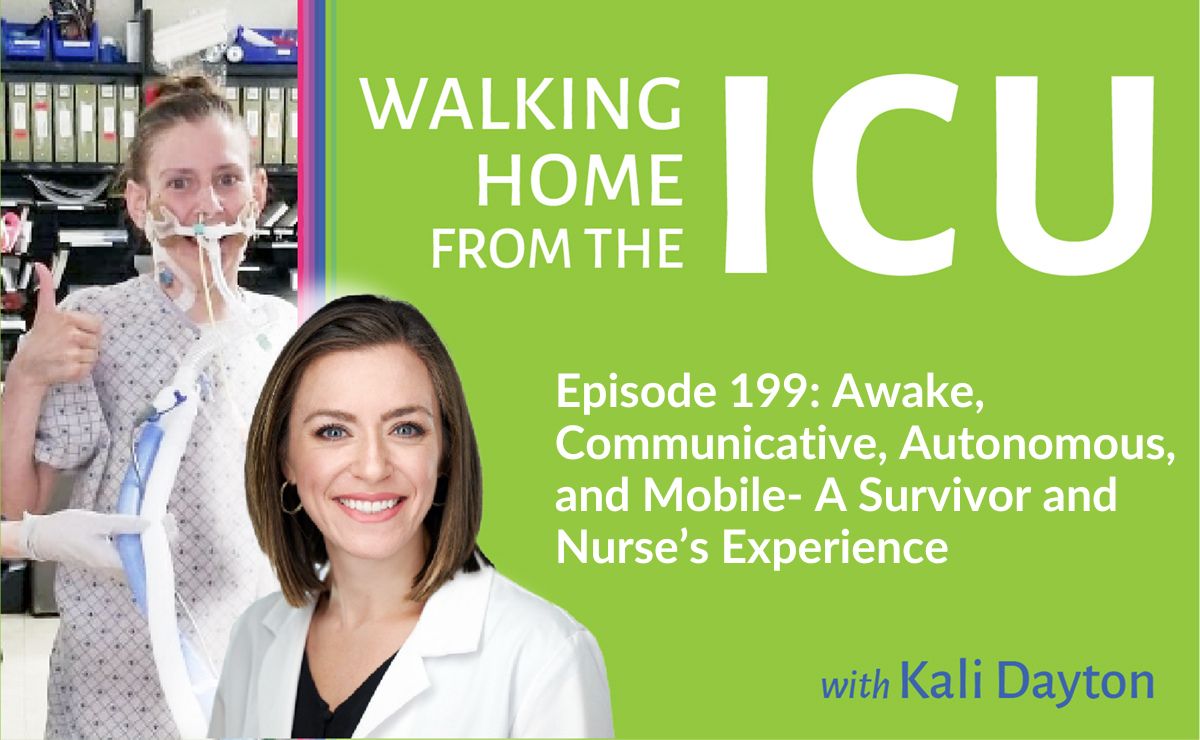
When Molly suffered a severe stroke requiring mechanical ventilation and an EVD, what did Kaira do to prevent further neurological injury? What role did Molly’s ability to communicate while intubated play in her survival? Molly and Kaira both join us to share their perspectives from both sides of the ICU bed.
Episode Transcription
Kali Dayton: [00:00:00] This is the walking home from the ICU Podcast. I’m Kelly Dayton, a nurse practitioner and ICU consultant. I help teams create awake and walking ICUs through evidence-based sedation and mobility practices. By hearing from survivors, clinicians, and researchers, we’ll explore how to give ICU patients the best chance.
To walk out of the ICU and go home to survive and thrive. Welcome to the ICU Revolution.
Okay? I am so excited to share a huge update with you all. For years. I have wanted this podcast content to count as continuing education credits for all disciplines. S-L-P-P-T-O-T-M-D-R-N-R-T. Everybody, so many [00:01:00] of you already have another graduate degree in all things delirium, mobility, and awakened walk in ICUs.
You have spent countless hours and years researching and digesting this content. It is time, the cash in and all the learning you’ve been doing on your own time. The day has finally come. I am teaming up with Sapien to finally give you all the credit for the countless hours of listening, as well as other efforts you’ve put into this revolution.
SAPIEN is accredited to evaluate learning experiences and turn those reflections into CE credit for any medical board, even many international. That accept A-M-A-C-N-E and A NCC credits. This means other activities such as our monthly revolutionist meetings, simulation, training, webinars, whether live or on my YouTube channel, your own leadership meetings, preparing for your presentations, et cetera.
Sapien helps you reflect on your learning during those activities and gives you your continuing education credit without any limit. Of how many learning [00:02:00] experiences you can submit and credits you can earn confirm specific requirements with relevant credentialing and licensing bodies of your country and check out the link in the show notes to start earning credits.
This episode is exactly the kind of learning that may not come with dozens of citations in the past five years, though I’m sure I can find some, but it should and can account for continuing education as it has the power to transform your practice and save lives. I am so excited to have a survivor and her nurse talk about their journey through being awake and mobile in the ICU during critical illness.
Kyra and Molly, thank you so much for coming on the podcast. Can you introduce yourself to us? Yeah. My name’s Kyra. I’m a registered nurse in Neurocritical Care and Surgical trauma ICU. Um, my name is Molly. I am a first grade teacher at, actually, Cairo was my nurse. This is the first time that we’re having a survivor and a nurse do the [00:03:00] podcast episode together.
And you guys are in the same room right now, like hanging out. I see artwork on the wall. Where are you? We’re just in a cute coffee shop in Lakewood, Colorado. Okay. I love it. So you guys are friends, you were actually hanging out at the ICO? Yeah. I remember when I was Molly’s nurse, I think I was her nurse eight out of the 12 days that she was in the ICU and.
Her family and me and Molly all became so close and I just became very involved and my heart was very invested. And afterwards they had all written me letters saying, thank you so much, please text us if you feel comfortable. You mean so much to our family. And I was so touched, and obviously I felt the same, like I was very invested in so many different ways professionally, but also emotionally.
I really care about. My patience and afterwards it was the holidays and I had just reached out like, hey, thinking about you guys, [00:04:00] Molly, how’s it going? And one thing led to another and we actually hang out now. It was so neat and I took this so normal, but prior you were, you do work in a budding away from walking.
I see you. Episode 178. We talked with Andrea Silva, assistant manager at the time, what it was like to transform this culture. I saw you early on and there was a lot of deep sedation and mobility, A lot of the classic fears, hesitation, and easiness of having patients be on lighter sedation, let alone being awake and mobile, especially while intubated a lot of challenges and talked about what it.
Watch this evolution. And really, she drove it, right? She drove everyone insane driving it forward. But now you guys are in such a good spot where patients are awake right away. And [00:05:00] so this is exciting to be able to hear from your perspective, Kyra, yes. Hear from your perspective, Kyra, what that evolution was like, and then what it was like to care for Molly with that approach to care.
And then we get to hear from Molly about what that was actually like because it’s gonna really debunk some myth. Cairo, were you in the ICU during that change in culture? What was that like? And you can be honest, what was your first impression of this process of care and what got you to buy in? Yeah, so I think that initially we weren’t so terrible with sedation.
I think we put it on to keep people comfortable. That was the thought. But I also think that. When Andrea came in and she really started this culture shift of awake and walking ICU, we could be ambulating our patients. We could be getting them up to the chair. I think that so many nurses felt a little bit overwhelmed at first because we felt like we’re doing our absolute [00:06:00] best already.
We’re already providing Q1 our best care for our patients. We’re already cleaning them up and running the labs. Watching patients crash and trying to do everything and we have to get them up and we have to get them doing this and going to the bathroom. Like, how is this possible? And so I think there was certain circumstances where we were really tested and pushed to do this, and I think sometimes it felt inappropriate.
Sometimes it felt, oh wow, like that was really cool and our patients benefited from it. And our families really enjoyed the process and it was. Rewarding at times. But I also think that there was this kind of balance of is this possible? Is this appropriate for this patient? Is this person who is so critical?
Is this gonna fit for them? And so I think it did take a couple of those patients that weren’t appropriate, some of them that were to show us what, like [00:07:00] a good balance of starting this was. And I think. Andrea really did come in and the providers had to be on board and the nurses had to be on board for this culture shift to really work.
And I think we did get a lot better. I think we did learn new limits of, okay, this person has been on a trach for two weeks now. Let’s get them up. Let’s get them moving. Let’s get them trying to stand up. PT OT became so much more involved, and I think that was a really cool part of it too, because. Once we started getting more help, it was easier to facilitate and now it just feels like a way of life, a way of how we do things in our ICU.
But it did take some pushback and some struggle and some upset nurses, but we got through it and I think we’re better for it. Yeah, I appreciate that honesty so much because it’s not like a light switch where you’re like, oh, the patient’s bad, [00:08:00] mobility’s good, and now this is what we do for everybody.
It’s a lot more complicated than that and it’s uncomfortable and it’s not perfect initially. And you know that your team really started with kind of the rehabilitation approach first and switching to this pre rehabilitation approach where patients are awake promptly as soon as possible and mobilizing as soon as possible.
Did you feel a shift in workload when you guys started? Being able to get these patients up sooner. Yeah, I did. I think that you need a lot more staff available to do things safely. Like you need to make sure that if you turn off the sedation, making sure that you can appropriately intervene or if you wanna get them up to the chair, something like that.
You need like multiple staff to be there. But I also think that we found a way to turn off sedation. Quickly extubate them quickly that it became easier as time went on. And I think at first we did need a lot more [00:09:00] support, that transformation in expertise, approach, timing, age for then Molly to enter the scene.
Molly, how old are you? Um, I’m 24 now. I was 23 when I had the stroke. That’s exceptionally young to have a stroke. Tell me more about that. It was just a random Sunday and I was playing in a soccer game. I played soccer my whole life and played in a soccer game. Went out for food afterwards, and then later on that night, around 6:00 PM I started to feel funny and I remember it just escalating and then went to make the bed at my parents’ house, and I went like this with the sheets.
I flacked them up and as soon as they came down, I started to see four of everything, and it was just spinning. And I collapsed and my boyfriend was there. My parents were, we were dog sitting, so they were on their way back from a trip and I told him like, I need help immediately. And we thought it was just a really bad migraine.
So I had horrible neck pain, really bad vision, really bad headache. [00:10:00] And so all night I powered through, went to urgent care. The next morning, about eight 30, they gave me a headache cocktail and then sent me home. And then I went back about an hour and a half later and was just like, this is not helping.
And they said, all right, go to the emergency room. And then after like multiple hours in the emergency room trying to figure it out, they did a CT scan of my brain and they saw that I had a vertebral artery dissection, which led to a cerebellar stroke. So it was just, it was crazy and I, it was, no one expected it.
Yeah, no, that’s not your first differential with a 23-year-old with a severe headache. That’s, that is terrifying. So then you were admitted to the ICU and what happened after that? So I, they gave me a shot of morphine because I was in so much pain that sun, that this was Monday night and I don’t have really any memories for a while after that.
So I was, they did the CT scan and then as soon as there was a [00:11:00] bed in neuro ICUI was admitted, taken up there. And then I guess that Tuesday I was. Trying to get up and go to the bathroom and interact with people, which I don’t remember any of it. And that was when I developed hydrocephalus. So throughout that day, I was just like becoming unresponsive.
And Kyra was my nurse at that point. Yeah, I remember. She. Came in, she was in so much pain that she was like curled up on the bed and I had to do my neuro exams and she just wasn’t participating. She like, it took a lot, shaker and Molly, put your hands up, Molly, open up your eyes. And I knew something was wrong because here is a perfectly healthy, strong 23-year-old able to move all of her limbs, able to answer me properly, and then as the day went on.
Her eyes started to be fixed to the side. Her coordination was getting worse. She wasn’t responding. [00:12:00] And I remember telling the providers, and I think just the, I don’t know what protocol it was, but I think there were like, at this point, we’re not gonna do anything until she needs to be intubated. So it was really uncomfortable for me as a nurse, seeing someone going from what’s.
A healthy 23-year-old to not able to move one side of her body eyes are fixed, not responding. It took a lot more, she felt more lethargic as the shift went on, and that’s how it all began. She ends up intubated. Yeah. Yep. Yeah, I remember that night. New set of doctors came in, new set of nurses came in. It was the night shift, and I was like, I’m uncomfortable.
I really think that she should get surgery. It ended up leading to that and they put in an EVD drain and she was intubated, so I left. She was [00:13:00] in her actual normal clothes. She wasn’t even in a gown. She was like moving all around, able to get herself to the commode. And then I come back the next morning and she is intubated, sedated, and has an EBD drain, and her head is swollen.
Yeah. And what were her ICPs? I think they, I think they stayed relatively under control, like around 20 and under with the EVD, but I’m pretty sure before that they were under out of control. Yeah. So then what step with now she’s intubated, she’s beated primarily because of the endocrinal hypertension, but that’s well managed with the EBD.
What was the next step then? What led you to get going?
Get her going to surgery or like at what point or after that, at what point did she become awake and responsive again? When did sedation come off? [00:14:00] Yeah. I think we had tried to keep sedation off initially. I think we would start to see patterns of her having pain or things like that were. We had to do stuff and we gave her some pain medication to help get her through that, but really she was just resting.
And we started to see pretty early on from Molly, her ability to communicate and. It was so crazy. ’cause a lot of the times it’s a guessing game, being a nurse and having a patient who’s sated and they’re frustrated and they’re shaking in their restraints and they’re wanting something or they’re uncomfortable and we reposition them, or we give them a bath or we give them fentanyl.
We’re like, what possibly could the issue here, how can we troubleshoot? And I think it’s this new culture of the ICU. Let’s not just throw verse at them. Let’s. Figure out, are they in pain? Do [00:15:00] they need to be repositioned? Do they have to be changed? And Molly is specifically was special because her mom is the principal of a deaf school.
So she grew up knowing some sign language and she was able to communicate. Through signing what she needed and pretty complex things. And so it became like the easiest job as a nurse. She’d be like water and they would sponge my mouth or just things like there was lies that Kyra has connections with people.
She’s talking to my mom and I’m listening to these conversations and there’s connections, but my mom couldn’t figure out who that person was. And so I was like, and I signed exactly what Kyra was saying, how we knew her. That whole relationship. So I was able to tell people what I needed in those times through sign language, which was when you’re intubated and you can’t really drink water and your mouth is dry.
Like just being able to say, I think, I don’t [00:16:00] remember this, but one doctor was surprised because I was able to tell that doctor exactly that I wanted my mouth sponged instead of scraped. And like just being able to communicate those things. Being with it enough. Yes. Yeah. To just limit that discomfort.
And this is. With a new stroke. Yeah, you have endocrinal hypertension, you have a new A EVD, you’re intubated, and this is within 12 hours after being intubated, having that drain placed. Now you’re with it. And obviously there are so many different kinds of strokes, brains packed into so many different ways, but it’s very common for patients with stroke to have aphasia or just lots of neurological impairments that impede communication.
It’s really hard to tell when you’re not even trying to let patients communicate until three, five days after it’s happened, and now they have delirium. Mm-hmm. So then, you know, what’s the stroke? What’s the delirium, new stroke, and all this pressure in [00:17:00] your brain because you were awake right away. And it sounds like Kyra, you guys did the right thing.
It sounds like you had sedation off right away, and you were treating pain and you were letting her present herself. Yeah. Allowing her to have that capacity. Yeah. And I think allowing her to guide her care. Like are you having pain? Yes. Do you want a Fentanyl push? No. Do you want Tylenol? Yes. Do you want, oh, I have to pee.
You have a Foley in? Maybe we can adjust the Foley. Like all of these different things that I wouldn’t be able to communicate as in depth, and I would just be guessing for my other patient. And I think, I like to think that I’m pretty in tune with what my. Patients need, but sometimes you just don’t know.
And it’s really hard to know when they have a tube down their throat and just hours before that she was neurologically altered. Yeah. You address the cause of that by draining the fluid in her brain that was causing those changes, now you’re protecting her [00:18:00] brain from further damage through avoidance sedation, treating her pain, giving her right to communicate that.
Molly, this probably sounds so basic. You’re like, of course I was human. Of course I could communicate. I know it’s not language, duh, but for ICU clinicians, this is really profound to have someone having an acute stroke right after being unresponsive due to that stroke, and hours later, while intubated, communicating and articulating those needs and things like swabbing your mouth instead of scraping it.
An ISO clinician who runs vasopressors, puts in central lines. Does these like. Crazy high level interventions. Swabbing the mouth seems like fluff, like it’s not a big deal. But to you, what did that mean to you? That was the best thing ever. That was my biggest thing was I love drinking water and when you are intubated you can’t drink water.
That’s just not gonna happen. And like it was just the best thing to, because I would just go water, sign it. [00:19:00] Obviously I couldn’t. And so Cairo was able to understand that I needed water and then show me what that looked like, and then I was able to communicate with her to make sure it was as much as I needed.
But still, I wasn’t like, I remember trying to drink it, like being the sponge is in my mouth and like crying a game changer because it was uncomfortable being intubated, but that, just knowing that they could sponge my mouth was. Yeah, and I think a lot of the times too, as. ICU Neurocritical care nurses like we, and I don’t think intentionally, but I just don’t think we are aware of how much our patient can hear and know and feel.
And they might be laying there and paying or. Thinking all of these thoughts and wanting to be a part of the conversation, but they don’t know how, and it was really impressive because a lot of the exams that I do on my patients in neuro are very basic. Give me a thumbs up. Okay? They’re there. They understand that, and that’s the basis of, [00:20:00] okay, that was my neuro exam, and I was able to see that Molly could understand and feel and see and be involved so much more than I knew.
One of the examples that I had is. She was worried because she had been, maybe Molly, you can speak to this, but she had been surprising her mom because her brother was coming into town and she was signing to her boyfriend who was also in the room like, Hey, is someone gonna pick up my brother signing this?
And I was like, the fact that she had the wherewithal to know what day it was that no one had accounted for this, her boyfriend didn’t. No one knew he was coming. No one knew he was coming. So she had a range. It was a surprise. Two months. These travel, two months prior. Yeah. And it worked out. And like even I was supposed to nanny that coming weekend and I was able to tell my mom without even really knowing that I did this, you need to let his family know that I won’t be able to watch him.
And like just those things, like I was able to. [00:21:00] Know what was going on where I was, but still get the rest that I needed. Like I would pop in and be like, okay, that’s important. And then I would go back to sleep and rest. So it was interesting. Yeah. And I think being able to tell the doctors like, how is she doing?
And I’m like, she is having complex thoughts. Like she is really aware and with it, and we had to keep her intubated because of her, how severe her brain. Damage was, they didn’t know if they were gonna have, do more surgery at any point. Yeah. So they’re like, we gotta leave it in and just see. Yeah. So it was really, it changed earlier.
And were you restrained? Do you have your hands tied down? Yeah, but I have memories of figuring out how to unhook them. And, because the biggest reason that I was restrained was it started when I was intubated, like fresh outta surgery. I was trying to yank it out. And then it turned into, I had the drain in my head and so they didn’t want me to pull that out, but I figured out how to loosen it so that if I had a scratch on [00:22:00] my face, I could just slip my arm out and scratch it and then slip my arm back in the rest.
I would’ve saw that. Okay. But I wasn’t, it was when I wasn’t like trying to yank the things out anymore. Once you knew what those things were and you knew where you were able to protect them, I’m just trying to imagine signing while restrained. The signing came after restraint. Okay, so this No, you, no, you were still, oh, maybe I was signing down here.
We did them loose enough to where she couldn’t reach, but she to lift up her arm a little bit and do this, weren’t able to titrate restraints because I think sometimes we treat patients that are just awake as if they’re levitating off the bed and trying to pull everything out, and that was not your case.
But for clinicians in a normal environment, someone that is trying to lift their hands and use them. With an EVD and an endotracheal tube, the gut reaction is absolute panic for a nurse to be like, you are not pulling out those lifesaving devices. And in episode [00:23:00] 103, I had clips from survivors talking about what it was like to not be able to communicate or to try to communicate.
And they were trying to sign like what they wanted to write in a pen and paper, but their hands got tied tighter and everything went black. And that was very traumatizing. So, hi. Are you able to identify, oh, she can sign. She’s trying to communicate. You didn’t panic at movement and even let her have some range of motion and maybe like eventually you could be unrestrained or there are different ICUs of different thresholds and it is really scary when you don’t know exactly where that patient’s at.
You do have to wait until you know that they’re not gonna mess with that stuff. But you didn’t respond to her trying to sign with said push. Yeah, and I think a big part of that too was. Her mom was so in tune with her the entire time she was doing little movements by the bottom of her bed when her hands were restrained and she was like, oh.
She said no. Oh, she was saying water. And so then once we started to know and trust that she is like there and she’s aware of [00:24:00] her restrictions, we were able to loosen these things up. But I think our policy, I don’t know if it’s changed, but is we have to have you restrained if you’re intubated and have an EVD, but.
I wanted to be loosen them because I know that she wasn’t gonna reach all the way and give her some freedom. If you’ve been listening to this podcast, you are likely convinced that sedation and mobility practices in the ICU need to change. The ICU community is facing incredible difficulty with the trauma from the Pandemic Staffing crisis and burnout.
We cannot afford to continue practices that result in poor patient outcomes. More time in the ICU. Higher healthcare costs and greater workload for the ICU team. Yet the prospect of changing decades of beliefs, practices, and culture across all disciplines of the ICU is a daunting task. How does this transformation start?
It can begin with a consultation with me to discuss your team’s current practices, barriers, and to formulate a [00:25:00] plan to help your ICU become an AWAKE and walking ICUI help teams master the A-B-C-D-E-F bundle through education consulting, simulation training, and bedside support. Let’s work together to move your team into the future of evidence-based ICU care.
Click the link in the show notes of this episode to find out more.
Yeah, no, absolutely. I’ve even had patients ask to be restrained at night because they’re afraid that they’re gonna forget. They would do it l loosely so that if they go to scratch their nose or whatever, it’s a reminder of, oh yeah, I’ve got something to in my mouth. I can’t totally just have for your reign.
It’s just a reminder. Molly, were you so uncomfortable with the endotracheal tube? Mm-hmm. I remember like. My mom more sign language. I was, we were communicating and she like came in and she’s like, the doctors are gonna take it out on Thursday. And I was like flipping off the doctors. I was like, I need the help.[00:26:00]
I need something new. I’m ready. But it wasn’t a constant irritation. It was like occasionally if I needed my mouth swabbed or just needed little things. I was in a point for quite a while where I would just barely open my eyes and just look and see who was in the room. And then wake up a little bit to hear the conversations and add what I could.
And when I was awake, that’s when I was aware of it. But like my body was just sleeping. It knew it needed sleep. And when I was in those relaxed states, like it didn’t bother me. And I don’t even actually remember getting it taken out. Like it was not a very, like a hugely traumatic experience. I, my brain drain caused me more difficulty than the tube did.
But no, I wasn’t really, especially once we figured out the bunong in my mouth, at that point I was like, okay, I can do this. And it is interesting to hear. ’cause something that Molly and I have talked about is a lot of her time, even though she’s having these really complex thoughts, [00:27:00] she was saying, I don’t remember any of that.
Like my body felt like it was under sedation by itself. Like I was just in a daze the entire time. Even though I was like, really? We had a whole conversation now. And a lot of memories like have come back after talking to people. But like I remember my grandparents live in Grand Junction. They drove down when I was still intubated, fresh outta surgery, just struggling.
And I remember them being there. I remember like greeting them and having little conversations with them. But then also I wasn’t like, it was just interesting because my brain was shutting me down enough to come to when I needed to. But to get the sleep that I really did need so I would, could come back and forth and yeah, it was just, it was really interesting to see what your brain can do on its own.
And you were having an active brain injury and the normal response for the clinicians would’ve been to give you medication that deprives you of sleep. And as toxic to the brain [00:28:00] is not wild. So even struck alone that was sedating you enough, you were an alter enough. To not be Levi off the bed, but we would’ve felt like we were protecting you from discomfort or anxiety or whatever.
With sedation, really the anxiety was from being thirsty, which is so valid. Yeah. I will barrel roll out of a car if I’m thirsty, so, so I can only imagine. But then you were able to have that treated, you were worried about your nanny assignment, your brother coming in, all those things that, that’s where my brain would be at as well.
If I had any capacity, I would need to know that my kids are taken care of. I’d have very specific. Things that need to be taken care of before I can be like, okay, now I can be sick and rest and if I can’t address those things, I will probably freak out. The patient would never answer those things for me.
No. If you were still unaware what was going on, even while sedated, I’d be like, is someone gonna pick up my brother? Someone tell the kids like, I’m just not gonna show up. I can’t be. It sounds like you’re very responsible, very advert, and it’ll [00:29:00] drive you insane, but the day she would never treat those things.
KRA would never know what those things were. Yeah, no, yes or no question would’ve covered any of that to the, even to the best of Guessers, even to your own mom or boyfriend, Kyra, you became so invested, not just because you were working with her for so many shifts, but because you got to know her as a person.
Even if Altered State, this is not her prime. She’s not out playing soccer at this point, but what did it mean to you and to like just your career fulfillment to be able to. Have these intimate experiences and connections with your patient. It’s, I tell Molly, ’cause I think Molly’s always, oh, you saved me.
You mean so much to me, but I’m also equally back. No, you meant so much to me. It’s really special. I think a lot of the times this job is very demanding. It’s very emotionally, physically draining and I think sometimes. [00:30:00] Some of my patients pass or they go on and I don’t see the end result. I don’t see them when they’re awake and communicating for the most part, and they go down to a step down floor and they’re able to create those relationships after the fact.
And I think sometimes I feel like, oh gosh, I’m working so hard. I’m so invested. I really try. I want my patients to do well. I want them to get better. You don’t know if they do and you’re like, is all this hard work for nothing? And I think Molly’s a really special case because she’s so young. She really handled every step of the process so well and she was able to be like, thank you for doing this for me.
Thank you for being involved in this process. And it was so rewarding to see the hard work that I do pay off and. It’s the reason why I’m in nursing. It’s the reason why I set out to be a nurse, and it made me feel so fulfilled and I think I don’t always get that [00:31:00] same fulfillment or, yeah, happy ending.
And big concern from nurses is the extra workload. Things like swabbing Molly’s mouth or taking the time to try to figure out what that sign means, things like that. Is that just such. Extra work? Or how does that, how do you manage that? If I have the capacity, that’s like my favorite part. I, I remember when Molly got extubated and she had, her hair was so steep.
It was so bizarre because we weren’t able to touch that part where the drink is. And I remember getting her up and I was like, we’re gonna sit in this recliner chair and we’re gonna head to the bathroom and we’re gonna put on some music. You’re gonna wash your face and you’re gonna brush your teeth, and we’re gonna go back to the chair and I know you’re tired, but I’m gonna put this shower cap around this other part of your hair and [00:32:00] get this dried blood out.
And I remember Molly, after that felt. Like a real person. It’s like I was turning a corner. Yeah. And like even just what that meant to my mom, like my mom still talks about that. My hair was, I couldn didn’t wash my hair for a month and a half. You all played? Yeah. Yeah. My mom’s, I loved it. I came in and you were in the bathroom standing up, brushing your teeth and Kyra had her music going on and she was like, it was like you were getting ready to go out.
And that was just that point where I was like, okay, I’m gonna be myself. I’m gonna get better. Yeah. Like I, I can do all these things again. Yeah. I noticed that really. Makes a difference. And I think a lot of the times in my job, especially in the ICU, like that’s not a priority. Like I have to get this person, I have to make sure that their airway circulation, this is all good.
And I got to a point with her where I was able to add in a little bit of normal normalcy, add in a little bit of self care. And when you get to do those things, you get to [00:33:00] make people feel human again. And that’s really rewarding. But I don’t always get to. Have the opportunity to do that. And I did with her and I, I got the time and I prioritized the time to make sure that she got that.
I would love to do a study on showering in the ICU. Yeah. When I worked in the wake walking, I see this is 2012, there’s a shower room right outside the unit, just right outside the doors. It’s not super far, but it’s not super close either. And we would shower patients. I mean, I have a picture of a ventilator outside a room with a patient with a RDS on a P of 12, 70%.
Oh my God. Extension tubing on, and they would go and shower, and that was pretty normal. Not every single patient was showering, but it was pretty standard. So when I became a travel nurse, that was one of my early questions was, where’s your shower room? And people looked at me like I was insane. They’re like, this is the ICU.
We’re not showering our patients. I thought, are you serious? Your patients are going days to weeks without running water over their bodies and their hair. You get them fully clean and they’re like, oh, shower caps, which I just really [00:34:00] hate them. And sometimes it’s the only thing we have, but. There’s just something about someone wheeling in after especially a hard journey, all crusty and when they wheel out, they look different.
Like they’re a different person and I wish I could, we could find a way to quantify that and capture that in a study to show how does it impact the will to live your ident identity. How your clinicians perceive that patient once they’re clean, their hair braided, and looking alive with music playing.
Like how does it change our perception of someone that. Is groomed differently. There’s just so much I’d like to study, but I I totally am with you, Kara. It is such a joy and not everyone gets to have that ever shift, and not everyone really wants to do it. I think there’s a lot of fear of picking someone out with an EBD.
I’m gonna figure out a way to do this. Yeah. I’m gonna be super careful. Yeah. But, yep. Are we at that point where we could take on a little bit of risk for great benefit? And Molly, what does it mean to you? Everything. Oh my gosh. It was like, it [00:35:00] was. I wanna say it was one of the first full memories that I do have.
I have a lot of like patched things here and there, and especially talking to people, those memories come back. But like I vividly remember, that was also the first time I was walking without a walker. And I just remember it was so awesome because every time I was moving before that happened, it was for PT ot, it was to see where my blood pressure went.
It was work sitting up, can she handle it? Can she handle standing? Let’s change her scenery a little bit. And I was just not really motivated by those things. I was like, it doesn’t make me feel all that great and I just wanna lay back down and just relax. And when Kyra had me do that, it was like, okay, here’s that motivation.
Like, I’m actually doing something. I’m gonna feel better after this. I would love, it’s the best, like brushing my teeth that day was the best time I’ve ever brushed my teeth. Like it felt amazing. And then getting back into bed like I wanted to do more, it really ignited me to want to do more things.
’cause it wasn’t just [00:36:00] to meet the checklist, let just do those neuro exams. See where I was at, it was actually something to make myself feel better. So it was just awesome. And I think that was a moment with Kairo. I was like, yeah, I think we’re gonna be friends. I like her. She’s pretty great. Yep. Yeah, and also her mom too.
I mean, I keep mentioning her mom, but Eileen was there day and night, and she’s the principal of a deaf school. She had. So many things to do, so much on her plate. And she was just so invested and really knew her daughter so well. And it was really beautiful to see this like close-knit family. And when we finally got her up after seeing her for days, intubated ha an EBD, her brain was rolling, her eyes were, her head was so swollen that her eyes were shut.
And to finally see her daughter, like with her hair up in a bun, showered in normal clothes, she was. So like, wow, there’s hope and there’s another end to this. And that felt [00:37:00] amazing too. And that’s such a good example of the power of families in the ICU. Mm-hmm. I think we lost a lot of that during COVID because it wasn’t an option to have them there.
And so we started to give ourselves too much credit, like, we know how to treat these patients because we’re the trained ones that went to the university and got all this education on the body. We don’t need families in the IC. We don’t need the experts on this specific patient ’cause we’re just gonna keep their organs alive.
Your mom knows you. She knows the sign language. She understands what makes you tick. So Kyra, having that kind of expert on Molly at the bedside, interpreting things, guiding things, asking the right questions, how did that guide your care and how do you think that impacted Molly’s outcomes? Tremendously. I remember when she was, I first met Molly, she was like curled up on the side of the bed and I thought she was just like this grungy, like [00:38:00] emo gal that was just like sitting there, I don’t wanna do anything.
My head hurts. And I was like, oh my gosh, does someone have a difficult body? My gosh. And her mom was like, no, this is not her. She is not okay. She is not herself. The way that she would talk to us, even though she was answering the right questions and was oriented at first, she just wasn’t there according to her mom.
And it was a good affirmation for me because I could sense it, but I was like, maybe, I don’t know. And with her baseline, you don’t know. Yeah. I was like, she, then she went back to being in pain and not responding and she was like, no, Molly is so vocal and so will tell you. And if you, she’ll be talking, you’re talking.
You so much. So I was just like, alright. It really affirmed when I knew something was off with her, or when I started to see Molly’s personality come out when she was intubated, her mom was like, oh, this is the Molly that I know. And it really was great. And I think her mom could really talk her [00:39:00] down when we had to do hard things.
I don’t even know what we had to do. I think we had to straight cath. I think we had to take out some stitches. We had to do some stuff with our head and a lot of the times. Oh, they’re in pain. They’re gonna have this procedure. Let’s just give them some pain medication. And I think her mom was able to really affirm and comfort her and be there for her that, and prevent some of the interventions that we would’ve done.
A thousand percent. It would’ve been so easy to just give or said pushes, which could have caused delirium. And now she comes out confused. Now you get more delirium. She doesn’t have a way to communicate. You give more sedation. Like it’s really easy to just go down that spiralling pathway. And so the power that your mom had to protect you from sedation and therefore protected you from a secondary brain injury during Malone, no matter how young or how old you are, it increases the risk of long-term cognitive impairments by 120 times that are similar to mild Alzheimer’s and moderate traumatic brain injury.
You already had a [00:40:00] stroke. If you had been getting sedation on top of that, had delirium, you could have had a completely different capacity at this point. Stroke aside, just from the delirium itself, that your mom and us, obviously Kyra, helped protect you from another brain injury, which I don’t know, Kyra, did you understand that at the time that’s what you were doing?
Y yeah. No, not really. I mean, or her as a, as a human, because I see Molly, I’m gonna treat her as a person, but I know looking back at my early career, I’m like, I don’t think I realized. How much I was increasing the chances of them surviving and having quality of life. Yeah. Yeah. No, I really don’t see it that way sometimes, and it’s definitely a good reminder.
Molly, how’s your brain now? It’s great. So I started going back to work. I’m a first grade teacher. I went back little bit starting in January with a sub, built my hours up. I did the whole month of May [00:41:00] by myself with no subs full-time, 19 first graders. Led them through the last month of school. I finished, signed the paperwork to finish all of the therapies, the outpatient therapies I was doing.
Um, I really don’t have any symptoms anymore. Now it’s just like getting back to my life and just being myself. And so I really feel like all that’s left now to be myself is like playing soccer again. Like I’m almost there. It’s, it just, it’s crazy. I can’t believe that this was like seven and a half months ago and here I am today, like on summer break now that my students are gone, but yeah.
Yeah, I just, it was crazy. It’s really incredible because something worth mentioning is when Molly started getting better and working with PTOT and her mom being involved in her care. I remember Craig, she was getting qualified for Craig, like a world renowned rehab facilitation race, and Molly didn’t wanna go.[00:42:00]
And I was like, I wanted to go home. She wanted to go home. And I was like, here’s the thing, if you work with Craig, you’re a Craig patient for life. So let’s say something were to happen in the future. What if you were to have another stroke? These people are really gonna give you the best outcomes. And she would work with PTOT and she had a stroke in the cerebellum, so her ataxia coordination was off.
And I remember every day Molly was determined to not go pots. And so we would walk her every single day and she would get better and better to the point where Craig came by and she needed some, they like tested me to submit to insurance. Yeah. And they submitted it. And then insurance didn’t look at it in time.
I think they want, I wanna say they submitted it on Thursday or Friday and that like Thursday is when we met with a representative from Craig and they submitted it. And at that point I qualified. Like I had all the things that they [00:43:00] needed. And I remember just like giving my family a hard time, like I want to go home.
I know this is awesome, but I’ve been in the hospital so long, I need to go home. And on Monday the paperwork had expired and the insurance didn’t look at it in time. So they reassessed me and I passed all the tests. So I no longer qualified to go to Craig. She didn’t qualify to go to Craig, and all of her deficits were completely gone.
So she beat up Craig? Yeah. And yes, Molly is young, so it’s easy to be like, ’cause she was young and functional. No. If Molly had been in most other ICUs, she would’ve laid there. For how long? How long do you think she would’ve laid there? Space days, if not longer especially. She’d then developed delirium and now she’s confused and impulsive.
They’re scared to move her, and now she has such profound deficits. What’s the stroke? What’s the delirium? What’s I supported? Weakness. It would’ve been so hard to even start that rehabilitative process, but instead you did exactly the textbook of prehabilitation. Yeah. Preserved [00:44:00] her muscle mass and her cognitive function.
Obviously all the coordination you were having a brain injury, all those things were impaired, but you didn’t add onto the impairments with these hospital-acquired complications and you preserved her function so that you could just address the impairments from the acute process and get her out of there.
That is so textbook, and again, it’s not just ’cause Molly’s Young, it’s because the process of care that she entered in. Obviously your determination, Molly, and obviously being a soccer player at baseline is helpful, but you easily could have ended up like any 70-year-old. And process of care. I’m confident of it.
So you obviously still continue to rehabilitate. You’re still just about to start playing soccer again. Yep. What recommendations would you give to clinicians that obviously want to give this kind of care to their patients but are nervous to or don’t know how to start? I think largely like the reason that I was as okay and I was able to power through when it was hard was the communication piece and just being able to tell people what I [00:45:00] needed.
To be able to, like, I’m naturally an anxious person. And so having that on top of what I was going through and being so worried that my brother wasn’t gonna have a ride to her from the airport, but being able to communicate it helped take those anxieties away and it became someone else’s responsibility so that I could really just focus on getting better myself.
And then just the things that like Kyra did, and I know being a nurse is so hard. But the fact that she found time to make me feel like a human because I didn’t feel like a human for a really long time and I didn’t understand what was going on. Like I knew something bad had happened, but like my last memory before being admitted was, I just need medicine for this migraine and I need to go back to school.
Like I can’t keep putting in for a sub, like I gotta get back. And then coming to. And they’re, and you’re, I’m like, intubated and I just had an EVD put in. I have all these things and I’m like, what’s going on? And Kyra just made me feel like a human and the way she supported my family and like having [00:46:00] a close knit family, having people who care about you and then communicating like whether that’s just writing things down, whatever you can do, like it really made it, yeah, it got me through a really hard time.
I have not twisted the bundle, but I think we need to look at the A, B, C, D funnel in a different light because A is the first letter A is for assess and prevent pain. The collets become, start fentanyl, everybody. The start, yeah. Right after intubation. So your point about communication, I think we should consider the first letter as ask if they’re in pain.
Mm-hmm. Wake them up unless they have a clear indication for sedation. Let them answer themselves whether or not they have pain and treat it accordingly. So I’m always trying to find ways to prioritize that C. Another episode we talked about how choice sedation and analgesia, maybe that C should be communication.
I swear if we have communication focus rather than a RAs focus, that will guide our sedation practices more than anything else. [00:47:00] Really, Carol? She, she was a RA of negative one, negative two, just naturally. But if we had sedation running to that goal, she easily could have been a negative four. Yeah. Yeah.
And you wouldn’t really know what she was capable of. So that is such a powerful point about communication. And Kyra, what kind of recommendations would you give to clinicians out there that are wanting to give patients the same opportunities that you gave Molly? Yeah, I think it doesn’t just take the nurse.
I think that the doctor can put in that order and can do that, but it takes the whole entire team and that whole entire culture shift. And I think. Something that my hospital does really well is if they just got intubated, we had to put them on sedation. Alright, let’s try to take it off. Let’s see what their neuro exam is.
Let’s try to keep them off of sedation. Let’s try to see when we can get them extubated. All of those things that the doctor did and their goals to get her to a normal place was helpful for my workflow. And then also the ancillary teams like pt, ot. I’m [00:48:00] also have another critical patient on the other end in another room, and I want to give Molly my complete full attention.
She is amazing, but I’m also like, I’m also being this sort of nurse for another individual, so having PTO team be there and help me. Hey, when you get a chance, let’s do it at this time. Having your charge, nurses, other staff, Hey, if we get my patient up and we do this and we get them changed, I’ll help you with yours.
And I think just getting everyone involved and that culture shift really helps outpatient outcomes. The absolute team effort. Yeah. I think sometimes there’s an inclination to lock the doorway from our PTs and OTs because Athena. Very risky. Not a priority. You don’t wanna mess up my lines, things like that.
But your testimonial is so powerful that they are what made this feasible. Oh, a hundred percent. Our PTs are the best, best, best. [00:49:00] Had you sedated Molly? If we had taken breaks from sedation for therapy, it would’ve been so much harder to mobilize her. Yeah, if you hadn’t already figured out the communication piece and managed her pain and done all these other things.
I could get in and actually work with her and wear her out and treat her. It just, everyone has a role to play in this. And you magnified your role, Kyra. Yeah. You magnified your role Kyra, so that everyone else could do their job as well. So congratulations on this. Amazing success, both of you. Thank you so much for sharing this journey and this friendship.
This is so neat. Nice part about it. Yeah. Actually a lot of good things have come out. A lot of good things have come out of this experience. Yeah. I’m just, I’m grateful to be where I am. Yeah. Pirate. When you hang out with Molly, does that change the way you look at your patients the next shift?
Yeah. I think that seeing [00:50:00] Molly on the other end, like when I got to see Molly the first time after being out of the hospital, the life that lives after. Is so impacted by my care. She was remembered so many stories. There was countless times that we laughed about what happened in the room or when Kyra did this or when Molly was upset with me ’cause I had to give her, get her up.
But she was like, thank you so much, and how much her life truly was impacted by me. And I think I wake up and this is my job and this is what I have to do and these are the requirements of me and I have to put in this IV and this. But I also think it’s. I try to work with my heart. I try to live and work with my heart driving my care, but sometimes you can’t always do that, and it gives me that extra push to be like, I’m really impacting this person’s life.
And just keeping that at the top of the mind. ’cause I think that it really [00:51:00] makes a difference. I’ve teared up so many times in this episode. I’m like, this isn’t even my story. It Cooper. But it, you guys have just captured so much about, so you guys have just captured so much of what the revolution is really about, giving patients the best chance to survive and thrive by humanizing care, reconnecting to why we got into medicine, having this big, full picture of what we do in that moment to make or break someone’s survival and their quality of life long after, and that this isn’t extra workload.
It’s given us the opportunity to have career fulfillment who works beautifully as a team and actually accomplish the goals that we intend to meet when a patient comes through our doors. So thank you both so much. I’m just so excited to share this with everyone. And Molly, keep us posted. Send us pictures when you get back to soccer.
Well do. Awesome. Thank you so much. Thank you.[00:52:00]
To schedule a consultation for your ICU as well as, find supportive resources such as the free ebook, case studies, episode, citations, and transcripts, please check out the rest of my website.
Transcribed by https://otter.ai
SUBSCRIBE TO THE PODCAST