SUBSCRIBE TO THE PODCAST


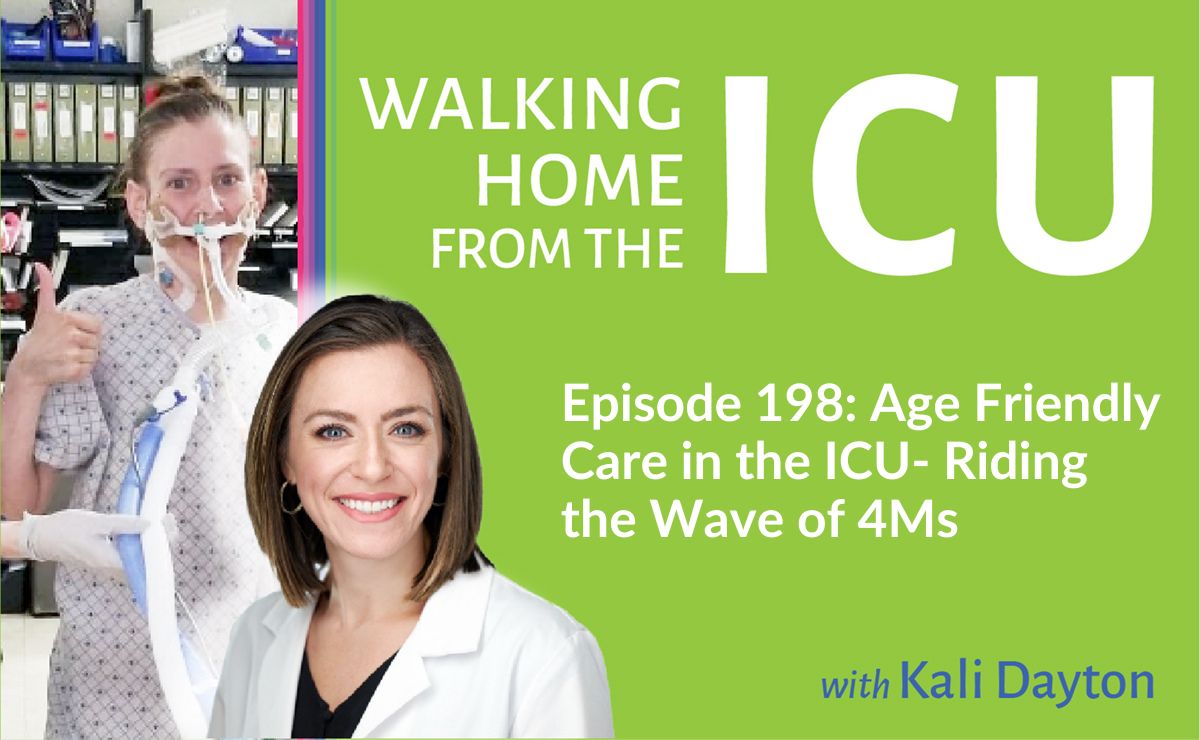
CMS is rolling out a new initiative to require hospitals to have age-friendly care: 4Ms. This means that we must prioritize: Medications, Mentation, Mobility, and What Matters. Karen Mack, DNP, MBA, APRN, executive director at NICHE, shares with us how leverage age-friendly care in advocating for Awake and Walking ICUs!
Episode Transcription
Kali Dayton: [00:00:00] This is the walking home from the ICU Podcast. I’m Kelly Dayton, a nurse practitioner and ICU consultant. I help teams create awake and walking ICUs through evidence-based sedation and mobility practices. By hearing from survivors, clinicians, and researchers, we’ll explore how to give ICU patients the best chance.
To walk out of the ICU and go home to survive and thrive. Welcome to the ICU Revolution,
okay? By wave announcement. Don’t miss out on the American Delirium Society Conference next month in Nashville. I will be helping to run a pre-conference simulation training on delirium management, as well as participating in the conference. I will [00:01:00] also be presenting on the power of verticalization therapy on June 5th in a webinar.
Link to the registration is in the show notes. This episode, I’m really excited to share another card to play to gain hospital leadership support to create awakened walking ICUs. The advocacy of the Four ams initiative and promoting age friendly care. Karen, thank you so much for joining the podcast. Can you introduce yourself to us?
Sure, Lilly. I’m Dr. Kieran Matt, I am the Executive Director of Nurses Improving Care for Health System Elders at NYU Worry Myers College of Nursing Niche we call ourselves Niche. Niche is a 350 member organization whose mission is to create age-friendly healthcare services. For older adults, we’re an award-winning nursing practice model.
We’re an American Academy of nursing age runner model designated in 2022. Our model positions nurses to lead substantial changes in the design and delivery of nursing care to older [00:02:00] adults and to improve clinical outcomes, reduce the cost of care, and meet national quality goals. As the executive director, I oversee the growth and development of the niche practice model in all our organizations.
And work to improve care of older adults in all healthcare delivery systems. I’ve been a part of the niche program office for two years now, but I work to implement niche in a 10, uh, member hospital system in the Mid-Atlantic for a decade, and really love the program and have seen it do wonders in terms of clinical outcomes, nurse engagement, and really featuring geriatric nursing as a career destination.
Raising the profile of geriatric nursing, particularly in our med-surg core of nurses. I’m board certified as Q Care nurse practitioner. I have a degree in business, which helps me with the program, and I hold a DNP in nursing practice from the George Washington University School of Nursing. I’m really excited to be here with you today.
Thank you so much. And you’re [00:03:00] also very experienced in critical care. Yes, yes, I’m an acute care np, adult acute care. And then I did hold a critical care nurse specialist certification until recently just ’cause I’m so busy in terms of keeping up all the requirements. But yes, I’m a, a lot a career along, certainly critical care emergency department, but I’ve worked in all kinds of settings, including med surg and then I practice as a cure cardiology NP for about 14 years as well.
Yes, I love critical care and I’ve been past president of the American Association of Critical Care Nurses Greater Washington Area Chapter. So yes, love my critical care colleagues. It’s so nice that you have all this advanced education, but experience in critical care as well as this really important expertise in elder care and understanding what happens in the ICU, why we do what we do in the ICU, all the things.
But what happens to these older patients throughout the continuum of care, and that’s been [00:04:00] your big focus for so long. And so I’m really excited to have you come on and talk about some of the new initiatives that are coming down the pipeline, what’s gonna be happening. But let’s zoom out and talk about what do we know about our aging patients and critical illness?
Sure. So the most important thing is that older adults. Susceptible to geriatric syndromes and our niche framework really helps nurses identify and manage these syndromes using a framework developed by our innovator and founder, Dr. Terry Fuller. Terry developed the spices framework. We really need to focus in on optimizing sleep, identifying and mitigating problems with eating and feeding.
Managing incontinence in a way that’s positive, respectful, and avoids having any incontinence devices that really can cause pressure injuries, for example, we also wanna optimize sleep wake cycles, cognitive engagement to avoid confusion and avoid delirium. And then we focus on [00:05:00] fall prevention. But really along fall prevention, it’s really more mobility, right?
We know that. Mobility is fall prevention and we really need to change that message. And then also we focus on prevention of skin conditions. So hospital routines, unintendedly cause geriatric syndromes. When that happens, it’s a term we use called iatrogenesis. So essentially we can do things to prevent older adults from becoming deconditioned or developing geriatric syndromes by changing our workflows and our processes.
We wanna increase the independence of the older adult and avoid trade-offs in terms of caregiving efficiency that cause decline. I know over the years we focus on fall prevention in our new protocols, textbook, evidence-based geriatric nursing protocols for best practice seventh Edition, the fall protocol is gone and the mobility protocol is in ’cause.
The focus is on mobility. So we really wanna make sure we’re maintaining functional capacity. We [00:06:00] also partner with the a early health system that Dr. Fulmer went on to innovate as well, that movement. And they have the four ends that focus. Similarly, it’s a framework for care processes. These are positive care processes and it’s really what matters, the goals of care, medications, meditation, and mobility.
So we really wanna make sure that the older adults have chronic illnesses. It can exacerbate when critical illness strikes are benefiting from appropriate care processes and preventionist syndromes. I also know that families are often surprised by the fact that the older adult has chronic illness, is really, has an acute episodic illness, and it gets very scary for families.
So making sure we focus on what matters is essential and decisions that impact the patient long term. Really arise quickly, but I love your focus on non sedation so that older adults can participate in those key decisions. I [00:07:00] remember years ago when I first started presenting, when I think put in the chat during a webinar, but our patients are really old and frail as of to say, oh, but this doesn’t apply, or This won’t work, or This won’t be safe for our patients because they’re older.
And it really sent me into a tailspin. Because we talked about post IC syndrome, the damage of sedation and immobility, even in young, healthy people. This is happening in children who still have neuroplasticity coming out with cognitive impairments that are able to quickly regenerate and rebuild and heal their muscles.
And yet we still have long-term impairments and disabilities from what we do during the few weeks in an ICU. So. Why wouldn’t it be especially imperative for people that are already having neurodegeneration, already having weakness changes? They’re not able to just rebuild those neuro pathways or the muscle mass.
They’re already at risk for falls. [00:08:00] Does it make sense to then give them neurotoxic sedatives bio myotoxic sedatives? Don’t let them move their muscles for days to weeks and then expect any kind of proper outcome. I love the four mss, the medications, mentation, mobility, and what matters. But I can see with the current or the long sustained culture in the ICU for people to be like, yeah, not important.
Not that it’s not important, but not for us because we’re working on just keeping them alive. We’re working on septic shock, we’re working on the immediate things, and obviously there are times when all you can do is run the rapid infuser, but why is this so important and at what point do we start thinking about.
What matters? Medication implementation and mobility. When does it matter for our aging population? So I think it, number one, I think it is important to reframe, right? There’s the leadership concept of reframing and I love how you reframe, right? How you’re really actively engaged in [00:09:00] reframing, for example, what it means to implement, really implement, not just touch on it lightly, the A, B-C-D-E-F bundle, right?
So we really need to reframe and so in, in terms of the fours framework. I think what matters is part of the critical care outcomes, right? What matters? Because if the carrier rendering leads patients to have a horrible quality of life, then the trade-offs aren’t really good in the long term. So I think what matters is key in that area.
And then Medica, you touched on medications, right? We know that if you look at the. 2023 updated beers list of potentially inappropriate medications sedating me benzos are really very impactful, particularly to older adults. And we, the other thing we work with Dr. Donna F, Dr. Fick is what worked with Dr.
Fulmer and she’s one of the leader, the leading nurse [00:10:00] researchers in terms of delirium and using the, she has a brief cam or UB two. The whole idea around delirium prevention is really important because delirium conveys mortality. And so critical care nurses and our colleagues are physicians and a PP colleagues really care about mortality.
So I think we need to reframe this in the sense of this is mortality related as much as the pressors. This is really important in terms of the work you’re doing and to avoid mortality. So I think that’s very important. We’re so backwards in some of this. I’m thinking about even just specific scenarios.
So you’ve got someone with CHF exacerbation and they’re on bipa, right? And they’re getting uncomfortable and they can’t communicate because they have this big mask and this noisy machine next to them, and they’re getting worked up, right? And so what do we habitually do? Give them an Ativan push and maybe some morphine to get them calm.
So they can get oxygen so they can survive. But then we cause another brain injury. Ativan is [00:11:00] lethal. It increases the risk of delirium by 20% by one milligram. So if we get two milligrams, that one push, you increase the risk by 40%, which for that 76-year-old CHF patient, that that could ultimately be lethal.
But they may not see the death on their shift. It happens in two weeks when they’re not waking up. It happens when they fall and they hit their head like it, it’s later on. And so we need to be thinking about that mortality, not just on our shift, but for it. The next few days and weeks, and we’re so good at second, we have an older patient coming in through the doors.
What’s the code status, which is so important? I don’t think any of us would disregard how important ha the code status is because we want to know what do they want for their care? How far do we go? What kind of care do they want? But with that, we need to prioritize what matters to them as far as what was their quality of life before, how functional were they, and.
What are we gonna do now to get them back to that? [00:12:00] If that’s what they’re willing to do and with that should help us navigate what we do with their sedation and their mobility and all these things starting from day one. But it’s just not our culture, right? Karen? Like we just, they’re like, we’re just looking on, keep the heart beating.
Can we keep them oxygenated or our shift? Do they want that? Do they not? Okay. And if they want that, if they want to be intubated. Now we’re gonna start this whole other conveyor belt and send them down this whole nother rabbit hole without thinking about what actually matters to them. Yeah. So for every day a patient remains immobile.
At best case scenario, you’re looking at three to 10 days of deconditioning recovery. Right. And the other really important part is think about your care in terms of how many of your patients go home, how many go back to their prior setting of care. I mean, that is really the goal. Because patients who end up in subacute sometimes that just begins a journey to never go home again.
And in terms of someone’s quality of life, our long-term care facilities are awesome. [00:13:00] And though I know that older adults, ’cause I’m nearing what in that age, we care about really that quality of life, our independence really matters. So think about the work you provide. The care you provide essentially is a set of interventions, right?
A bundle in itself. If we go into an operative procedure, they look at the 30 day and one year mortality typically. So think about like of our patients, how many are graded 30 days, and how many are graded one year? And think about it that way. That’s one thing that had just occurred based on what you just said in my mind, of why are we not looking at what we do in terms of an intervention set in long-term outcomes?
That’s not just the scope of our focus, usually in the ICU, even though. Obviously what we do in the front end for these patients in particular, drastically impact the backend, right? Given the Ativan push today, when they’re uncomfortable on BiPAP, means that they’re gonna be really confused tomorrow [00:14:00] and they’re likely to get more Haldol or more Ativan, or be on a D strip at rest, negative two and lay there and it just builds on itself and this whole spiral and domino effect.
Just perpetuates by what we did early on, and these patients can be really hard to manage Once they have, maybe they already have dementia baseline, now they have delirium. Now they’re really weak. Now they’re really trying to get outta bed. They’re at high risk for falls. Then we just keep giving them pushes or sation, and then they lay there and they get skin injuries, and then they stay there for weeks while we’re waiting for a nursing homeroom to open up.
And it really is impactful on our healthcare system. It’s impactful on nurses too. In our niche member community. We have a special interest group this year. They’re meeting together and discussing the challenges of delirium and behavioral emergencies because we know delirium can be significantly worse, mortality, but it also conveys a lot of nurse challenges as well.
[00:15:00] Remember discussing delirium with our niche nurses in the health system where I practice. And I would always begin the talk with, how many of you really wanna care for more patients with delirium, right? We wanna care for patients that have cognitive function intact and really getting better versus really offering lots of concerns.
And then when you get into those behavioral health emergencies, guess what happens? Somewhat. What are some benzodiazepine that worsen rates? Obviously we want mortality benefit. We want people’s. Functional independence, but it also does create a lot of nursing stress. Delirium does. We know it. It’s one of the main psychological burdens of nurses that’s been proven in the studies.
It doubles the nursing hours required for care. And I think any of us that have cared for them at the bedside, we know what that’s like. You’re in and outta the room saying, don’t climb outta bed. Don’t touch that. Don’t pull on that. Turn ’em down tighter. You’re in and out all the time. Even when you’re not in the room, you’re stressing about what kinda mess am I gonna walk into when I go back into the room?
And that’s when you really feel panicked and [00:16:00] unsupported. You don’t have someone there at the bedside watching them, but they’re your responsibility. But you also have other patients. It’s really heavy and no one wants to harm these patients, but once you’re walking into the patient’s room, after four days of sedation and immobility and all these things have happened, it’s really hard to then rehabilitate them.
And that’s just something that I think we’ve come to accept as normal. IT nurses don’t like to care for older patients because they’re oftentimes confused, impulsive, fall risk. And sometimes this is the reality. Nurses get all the blame for it, all the liability. But who ordered that benzo who didn’t order PT N ot, who didn’t let PT N OT come in the door?
There’s so much of the whole system that plays into this burden that ends up on the nurse’s shoulders. And this isn’t just gonna get better what’s happening with our. Patient population in our communities and society. What do we know about what’s to come? If you’ve been listening to this podcast, you are likely convinced that sedation and mobility [00:17:00] practices in the ICU need to change.
The ICU community is facing incredible difficulty with the trauma from the Pandemic staffing crisis and burnout. We cannot afford to continue practices that result in poor patient outcomes. More time in the ICU. Higher healthcare costs and greater workload for the ICU team. Yet the prospect of changing decades of beliefs, practices, and culture across all disciplines of the ICU is a daunting task.
How does this transformation start? It can begin with a consultation with me to discuss your team’s current practices, barriers, and to formulate a plan to help your ICU become an AWAKE and walking ICUI help teams master the A-B-C-D-E-F bundle through education consulting, simulation training, and bedside support.
Let’s work together to move your team into the future of evidence-based ICU care. Click the link in the show notes of this episode to find out more.[00:18:00]
So we know in the next six years there’s gonna be more older adults than children in the US and if we think we have challenges here in the us, let me tell you, we have wonderful, three wonderful member organizations in Singapore. Their population of older adults, I believe is quadrupled in the last 20 or 30 years.
They’re way ahead of us, to be honest. I was just on a conference with them. They had their six Singapore regional geriatric nursing conference last week. I was on Zoom and gave a presentation, but I learned from them as much as anyone. But they have, for example, a whole National Singaporean Ministry of Health Realty Protocol where they’re starting really in the ambulatory setting to optimize patients.
But yes, I think that’s what the head really as we look at our partner organization in the American College of Surgeons, geriatric surgical verification program. In the American College of Emergency Physicians Geriatric Ed accreditation [00:19:00] program in the geriatric ED collaborative, it promotes the geriatric ED guidelines.
Realty’s the new horizon, right? And having systems that begin in the ambulatory space to optimize diminished realty and then really see frailty as its own issue to optimize the spices right, is really an early precursor. A lot of the frailty work that older adults are more frail and are run to getting geriatric syndromes.
In my mind, the near term is a focus on frailty, and we see in the new 2025 CMSH friendly measures that frailty is one of the domains. So I would say frailty, cutting edge goals of care, cutting edge, and then medication’s, a huge focus there as well as age-friendly leadership. Think about when a patient comes in with some sort of chronic kidney disease.
We already know that their baseline kidney function is poor. We baby those kidneys, right? We watch it like a hawk. We are so careful at what medications we give, but when it comes to someone’s baseline functional level, [00:20:00] or their frailty, it’s not part of the discussion. But can you imagine if we treated it like a creatinine level, where we’re like, okay, what’s their score at baseline?
What were they doing at baseline? Oh, it changed today. Why? What happened? How are we gonna going to protect it? How are we gonna make sure that we don’t make it worse? Because if we make it worse, it’s going to. Them off into a whole nother life. Like we do kidney function. Oh, they could end up on dialysis.
They’re on the fence. Right? We need to think about that way, especially for these patients and watch their functional levels, their muscle mass, their cognition with the same kind of diligence and preoccupation like we do the kidney function. And that’s sounds like that’s what’s being pushed onto our hospital systems with this four M initiative to really help us prioritize.
Mentation mobility and what matters, how are they going to do this? So it’s CMS right? That’s rolling this out. What kind of repercussions or ramifications does this have for our hospital systems? So this [00:21:00] measure was sponsored by the H one L system. The A CAP and a CS Knit was among our other partner Organizations provide a letter of support.
Um, to be frank, it currently it’s process level. They’re not asking you for to achieve certain clinical outcomes. There’s a number of processes your organization needs to report. Um, and it’s for the inpatient perspective, payer system and the long-term acute care, I believe hospital, uh, and I have it. I don’t have that ation with me, the long-term payer model, and then they just need to report where they’re at, but they also will wanna achieve these things, right?
Because it’s gonna be reported on hospital compare. So failure to report is where there’s a penalty, a monetary penalty coming probably I think 2027. So if you’re reporting, you are compliant, but you also wanna think about your organization’s reputation, and it’ll be a part of CMS compare, so the people will know, it’ll be front facing to consumers what your [00:22:00] focus is in terms of age-friendly care.
So how are they going to prove, or what metrics are they reporting on to show that they have age-friendly care? So it’s an attestation model. There are five domains and for each domain there’s several attestation statement. Once som only have one, some have several. I don’t wanna misquote it, but for example, do you have an age-friendly, either someone appointed for the age-friendly leadership domain, do you have someone appointed or do you have a committee?
So in our niche member organizations, they all have a steering committee and so they’re really trying to meet that and then they’re focusing on implementation. Of age-friendly practices and protocols that we have, and then also the other partner organizations have have physician protocols that align well.
But anyway, I would say that’s what the organization has to attest to. They also look at the age-friendly health system initiative around having data specific to geriatric, the geriatric population. A lot of [00:23:00] organizations, you get unit data about general nurse sensitive indicators. It isn’t categorized by age group, and so there’s a requirement around age group data collection and data provision.
So those are some of the things, and so they’ll be penalized starting in 2026 if they don’t report on these. 27, I believe is the one and don’t know what the penalties. American College of Surgeons does have a nice penalty statement about what they estimate the penalties to be. If anyone wants to go and look at that on their iatric surgical.
Verification website Having worked, I was a leader in the hospital readmission risk reduction program and I know in our organization it was quite a large penalty that we worked to minimize. So it can be really significant, but I would say the a CS has a nice penalty statement that gives people an idea of what organizational penalties might be.
Um, I’m always looking for waves we can ride to get this work route forward. Tries to trying to feed IC Revolutionists. More [00:24:00] ways to advocate for these changes in their own systems and units. But I’m hoping that four MS can be one of those things. How can Revolutionists leverage this initiative? How can they bring this up and use this to get more support for awaken walking ICUs?
So I think certainly if you’re a niche member organization, I talk to your niche coordinator to say, can we come to your committee meeting? You know, I’ve heard on this, on the podcast that there’s a new protocol for mobility in the most recent seventh edition of the protocols book. We begin to consider that as part of our niche implementation because the niche steering committees usually have other disciplines that join the committee to work together on initiatives such as the, the H Friendly measures and the certainly the four M’s initiative.
In terms of niche organizations, we have several roles. One of the frontline leaders called the Niche coordinators. We have additional training for them, and they have a front [00:25:00] facing role as experts and leaders in geriatric excellence. That is one of the things I love about niche. It puts nurses at the for forefront of leading in clinical excellence.
And then we have a frontline role called the Geriatric Resource Nurse Role. Critical Care nurses can be geriatric resource nurses. We have an extensive online learning pathway for our niche member organizations and they have a specific role around being change agents and advocates, providing some simple education, being influencers, getting involved in quality improvement efforts at their unit level.
So I think that’s a great way if you’re niche member organization, to certainly get involved with your niche steering committee and advocate if your unit isn’t yet a niche unit. To advocate for joining the niche program within your organization. If your organization isn’t niche, we’d love to talk to you and your leaders about the benefits.
We see amazing benefits every day, huge reductions in falls or mobility [00:26:00] programs, and I have to tell you, as a balancing measure of falls when we implement mobility, and we do not see upticks in any serious events. They’re usually the only uptick is if they haven’t been reporting falls previously very well, they get a little better of it.
You might see a little uptick in general falls, but we do not see any uptick in any falls with serious injury. But yeah, getting involved at that level really is important. And we do have an accompanying role for CNAs and techs, all the geriatric patient care associate ’cause they are equally important in this work.
The CNAs and the texts are our eyes and ears at the patient bedside. And can really advocate and assist in that work. The other thing is, I know we have a, there’s another organization developed by Dr. Sheer Nui that’s managed by the American Geriatric Society called the Co-Care Health, the Hospital Elder Like program.
And that’s a great way also to empower and expand the workforce, particularly in that step down in other areas where you can have volunteers [00:27:00] trained to come in and do. Reading and cognitive activities with older adults. On the other areas, they can, any patient that is stable in terms of mobility, they can keep them mobile and that really does free up the nursing workforce to be more engaged with the more the critically ill patient.
So if your hospital has an health program, it also encourage you to engage with them to assist in the work. And I love that Nietzsche’s making the focus more about mobility than falls. I think we’ve. All seeing what happened when we fell for the falls culture and increased restraints and keeping patients in bed, keeping them stuck to the chairs, how detrimental that was.
I have this image that I just made with a tree and the roots have poor nutrition, forest sleep, pie chain, sedation, bed rest, or and immobility, and then the trunk leads to delirium ICO or hospital-acquired weakness, vestibular dysfunction, orthostatic hypertension. Pause by those roots. And then the fruits in the tree are falls [00:28:00] and there’s a sun that’s labeled Foley or puric.
There’s a rain cloud and the raindrops are Haldol Ativan, and there’s a little watering can that’s labeled bedpan. We feed these roots and we pause this trunk, and the first of it are falls, but we’ve only focused on the fruits. We haven’t focused on the roots of it, so I love that niches lead in the way and hopefully help us taking the same direction too, to focus on mobility.
As much as we have falls because in the delirium and the falls and the weakness that will all get better. Even the revolutionists that are not part of a niche hospital, can they quote the niche book and publications on this? Sure. Yes. So the textbook’s amazing. And though we also have a, we have a sister organization at NYU Myers called the Hartford Institute for geriatric nursing hgn.org.
If you go on there, not be whole blah, but the protocol recommendations are on there, and I think they [00:29:00] have updated it to the seventh edition. If you don’t find it there, you could always reach out to Kay or me and we can let you know when it’s available, but I know they’re working on updating. It just came out in November.
But we do have those available and they’re free of charge, just the recommendation level, and we’ll put all these citations in the show notes with the transcript of my website so that you can just go in, click check it out, and use these initiatives. Speech forums help. A lot of times the ICU gets left out of this.
Is that kind of culturally true? I got that sense when I was at the conference that people were like, oh, we can influence the ICU. It’s like we focus on these things on acute care floors, but the ICU is it’s different there. It’s too critical. These things don’t matter yet. Wait till they’re out of the ICU for.
Now to be able to focus on mobility and what matters and all these things is am I? So yes, I think that’s just structural. To be frank. One, one of the hospitals in my health system, just in their 900 beds, I think they have 46 units and now they’re launching after a decade [00:30:00] launching into critical care.
But they are, and so it’s absolutely great to implement the niche practice model in critical care to be free. There’s been other drivers, right? Niche has been a driver in terms of med surge units because. As critical care nurses. We have a lot of special things already, different programs for us, and so this was something for particularly med-surg nurses.
So a lot of organizations started there. And then with these other programs with the ED and the per op, there’s been drivers that way, but we haven’t seen, for example, S-C-H-C-M older Adult program yet. They may have one in the works, but those structural things really do drive implementation as well in prioritization.
But yes. Critical care nurses can and shouldn’t be geriatric resource nurses and advocate and be change agents and implement evidence to practice. My experience has been that organizations believe practice changes by putting it in a policy, doing some didactic education and updating the EMR, not even validating if the EMR is working [00:31:00] very well necessarily.
We put in a pool, we might have put in two tools for delirium. We found that last year somebody, when they went to the bedside and sets. Evidence-based protocol against practice did a gap analysis. They found out there were two delirium tools and they didn’t really help the nurses decide which ones to use, make sure they’re using them well, or even tell them when to use them.
So you learn a lot. Now it’s the whole day, and you and I are D nps. This is the work we do, bringing research to the patient. So it reaches every patient reliably. But yes, I think taking the mobility protocol up, the HIG insight. Looking at it and saying, where could we improve? And certainly the work you do is all evidence-based implementation work.
So implementation is the critical component of success. I was a senior nurse leader during the pandemic, and every patient of safety event began with the nurses need to be reached, needed re education’s. Foundational education in itself is a weak intervention. Policies are foundational, weak intervention.
EMR [00:32:00] can be a weak intervention depending on how well it’s structured. I’m an adult trained N-P-C-N-S. It’s really that CNS fear of practice around implementation, but NPS certainly have that ability and certainly dps around going to the bedside and looking at what’s happening and engaging. The other key part is unless you engage the nurses who are delivering the care in the practice change, you’re gonna recycle it.
You might achieve it for a few months, and then you’re gonna fall apart, and then you’re gonna go. We need reeducation that’ll fall apart. You really need to, the nurses need to be encouraged to look at the protocol, discuss the protocol, look at the gaps with the leaders, and you don’t have to fix it all at once, but make strategic gains over time in improving your practice.
It should make it joyful and fun and, and positive, and I know we all need that. Age-friendly care should be about humanizing medicine about. Doing what’s right for each individual patient and keeping them safe and protecting [00:33:00] them, which is, it’s all aligned to the A, BCDF bundle. It just sprinkles in a little bit of extra focus for the aging population, but it’s already what IC Revolutionists are concerned about, thinking about fighting to change.
This just gives us another hard to play to say, we should be doing this. This is expected, and especially for aging population, instead of, oh, they’re the exception because they have dementia. We have to sedate them. Because they’re already confused at baseline. That should flip to say, whoa, that’s not looking at medication.
Mentation what matters, or mobility. That is absolutely the opposite of age-friendly care and it matters day one upfront. And so I think there’s an opportunity for revolutionists to bring in that geriatric perspective and revolutionists join these organizations, push your hospitals to join these organizations, get involved, get certified.
Take leadership and really bring these real changes. Let’s not just talk about it. Let’s do something about it. Absolutely. And I’m so excited to partner with you. We were so [00:34:00] thrilled to have you join us at the Niche Methodist Regional Geriatric nursing conference in Omaha in November, and the nurses were so energized by your presentation.
The line was long to meet you and discuss, and I think you bring a unique energy to the work and and unique implementation oriented mindset. So we’re really excited to be partnering with you and having you. Work with our niche number of organizations. Yes, this is a huge amount of work that needs to be done.
We all need to join the forces and encourage one another and promote each other’s work because it’s very important. I learned so much at that conference and from the people that I met, it was fun to learn about the exciting work that’s happening throughout the spectrum and continuum of care. And I think there’s a lot of opportunities for critical care to learn a lot about the geriatric resources that are out there and to build those bridges to make sure that we’re.
Applying those safe practices even during critical illness. So Karen, thank you so much. Anything else you would share with the ICU community? Well, I, I’m an [00:35:00] ICU nurse at heart. I do think that I’ve been an IIC nurse since the eighties, right? So it’s been a long time and no one goes to work to do the wrong thing for the patient.
But now knowing what I know, I cringe when I think about some of the things in terms of my practice, but that’s because we’re evolving and getting better. So I want people to kinda let go. This is the way we do it to, let’s say, let’s imagine a better future together and join forces. And be revolutionist.
So I’m really excited to partner with you. Perfect. Thank you so much.
To schedule a consultation for your ICU as well as, find supportive resources such as the free ebook, case studies, episode, citations, and transcripts, please check out the rest of my website.
Transcribed by https://otter.ai
SUBSCRIBE TO THE PODCAST