SUBSCRIBE TO THE PODCAST


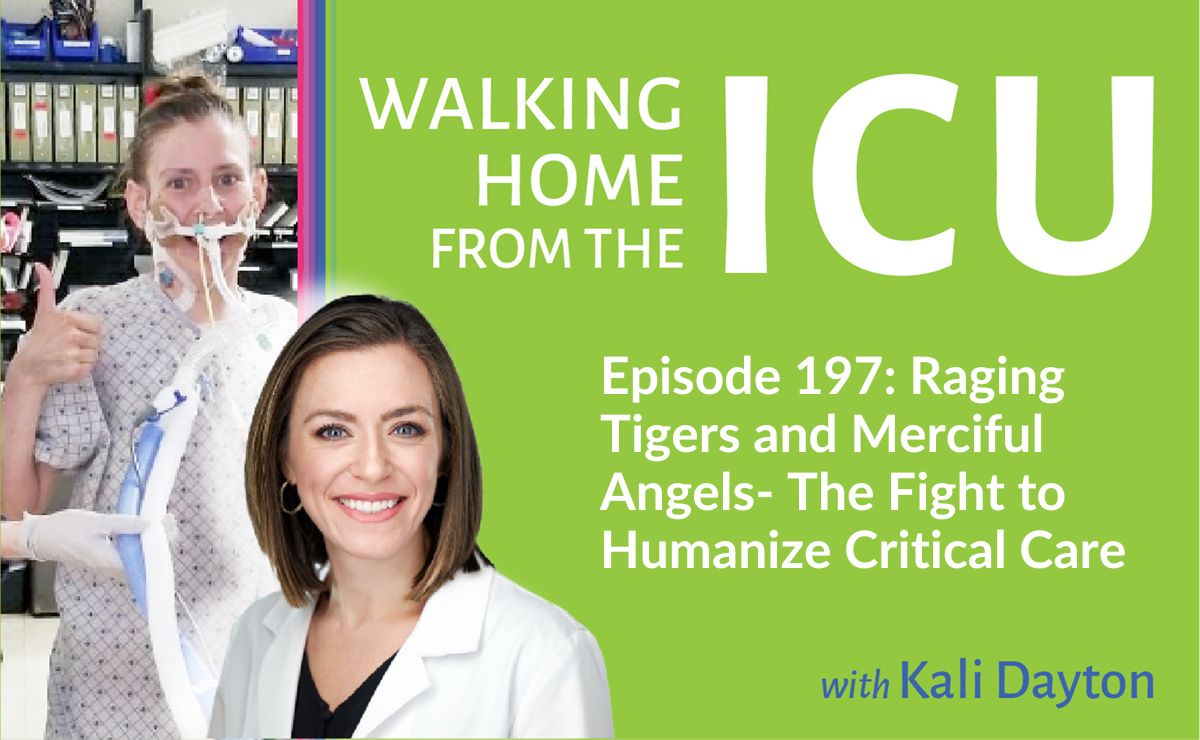
In this powerful episode, we hear raw, heartfelt stories from ICU revolutionists who are bravely challenging the status quo in critical care. Amidst threats to their jobs, personal attacks, and widespread resistance, these clinicians refuse to turn a blind eye to the harm caused by sedation, immobilization, and dehumanization. From battling bullying by colleagues to risking their careers, they stand as fierce tigers and compassionate angels- fighting for dignity, autonomy, and humane care for our most vulnerable patients. Join us as we explore their courage, struggles, and unwavering dedication to transforming ICU culture against all odds.
Episode Transcription
[00:00:00] This is the walking home from the ICU Podcast. I’m Kelly Dayton, a nurse practitioner and ICU consultant. I help teams create awake and walking ICUs through evidence-based sedation and mobility practices. By hearing from survivors, clinicians, and researchers, we’ll explore how to give ICU patients the best chance.
To walk out of the ICU and go home to survive and thrive. Welcome to the ICU Revolution.
If you’re new here. Hi. Welcome. Come on in. Take a seat. Please get comfortable because we need to talk. I want you to step into the shoes of an ICU revolutionist. An ICU [00:01:00] Revolutionist is someone that is fighting in little to big ways to provide the A, B, CDEF bundle to patients to keep them as awake, communicative, autonomous, and mobile as possible.
Why you may ask, this sounds crazy. After decades of a well-established conveyor belt in which every patient that needs ventilator support is automatically sedated and immobilized, why would they want to do the exact opposite? It’s called the Santa Claus effect. The moment you realize what you’ve been trained, groomed, and raised to believe isn’t real at all.
See these revolutionists once saw patients sleeping peacefully, unaware of their circumstances and surroundings, but now they know better. Now they sense brains being injured, leading to death, or life long impairment. They see patients trapped in [00:02:00] their bodies hearing and feeling what is going on around them and happening to them.
Having that sensory input being twisted into something more morbid, sinister, and traumatic than anything that could actually happen to them. In the ICU, they’ve heard survivors weep from the psychological pain that they still live with years after their discharge. They feel the muscle mass and function rapidly slipping away and know that their patient’s chances of survival and independence go with it.
They’ve heard dozens of survivors recount the horrors they’ve experienced from delirium while sedated. They’ve heard survivors that have had it both ways. Emphatically say how terrified they are of being sedated and how much they preferred to be awake while intubated. They’ve heard clinicians from awakened walking eyes use Talk about how only the absolute minority of patients are sedated in their [00:03:00] ICUs.
Many Revolutionists have listened to nearly 200 podcast episodes, read dozens of studies, and basically have another graduate degree in this. And now they can’t unsee and unknow what they know. They are filled with horror and hope, but what can they do? This isn’t the first time there has been a revolution.
Medicine is a field of evolution, and yet even after decades of advancements change is still met with just about the same level of resistance. Now, in 2025, as it was 102 hundred years ago, in the mid 18 hundreds, Nessim Vice, a Hungarian physician, noticed that women were dying at high rates of child bed fever.
After childbirth, he then had a friend that was a pathologist die of nearly the same thing, and recognized that it was common for pathologists to die of a similar fever. He realized that mothers were dying [00:04:00] more in doctor’s clinics than in midwives clinics. He theorized that the physicians were carrying contaminants from the cadavers.
They were studying to the birthing mothers. When Igna proposed this, he offended the physicians because if he was right, this would mean that they were making their patients sick. Instead of being humbly receptive to a solution, INESS lost his job. He went all throughout Europe trying to get doctors to wash their hands with chlorine, but they refused.
He became so desperate and even angry at the avoidable harm that was happening that he did speak to doctors pretty harshly. In 1865, he was committed to an insane asylum where he was beaten and ironically likely died of sepsis. Isn’t that relatable? Clearly seen preventable suffering and mortality from outdated medical care and being desperate to fix it, only to be scorned and even shut out.
Another ironically relatable piece of [00:05:00] history is the story of Elizabeth Kinney. She was a nurse in Australia during the polio outbreak. In the 1940s, doctors standardized the use of splints and casts to immobilize the affected limbs to quote, prevent further damage to the muscle. Elizabeth challenged that instead, she applied warm compresses to children’s limbs, massage them, and got them moving to preserve and rehabilitate that muscle.
There was a stark contrast in the outcomes of the children she treated. Even those that had become wheelchair bound from the old treatment usually ended up walking under her care. She started to gain recognition for her treatment and was very verbal about her opposition to the immobility approach physicians were taking.
So of course, this became controversial even as a female nurse in the 1940s, Elizabeth did not back down. She has been called a raging tiger and merciful angel. [00:06:00] She went on to leave the skeptics of Australia and started kidney clinics in the USA and transformed polio care. She personally treated over 7,000 children and influenced the care of many thousands more.
She saved lives, mobility and quality of life by persevering through the skepticism. She didn’t even have large powerful studies to support her approach, but she knew it was right, and that was enough to take the heat from an entire medical community. Okay, so you might say that’s so moving and tragic and frustrating.
But that was then we had such little science research and medical literacy. Of course, they were skeptical then They didn’t know better. Now, we have been touting for decades that we practice evidence-based medicine. We have millions of studies at our very fingertips. We are so much more open to change and up to date than they were.
Right. But are we. After all we went through during COVID, you would think that our [00:07:00] community would be ecstatic to learn and adopt a new way of caring for patients that would decrease seven day mortality by 68%, delirium by 50%, and even costs by 30% that we could keep patients and clinicians safer and happier.
Critical care is a lot of work, so might as well do the kind of work that helps patients survive and return to lives worth living. After decades of research showing that harm of sedation and immobility and the benefits of keeping patients awake and mobile, wouldn’t we all agree to stop harming patients and practice the evidence we shouldn’t have to face opposition like gans or Elizabeth Kinney.
We really shouldn’t have to be, quote, raging Tigers now in 2025, unfortunately. Far too many revolutionists are suffering oppositions. So similar to the revolutionary pre, it is uncanny. I have the honor of being the smokescreen. [00:08:00] Revolutionists have shared with me glimpses of the unbelievable opposition and even persecution they faced.
As told an episode 168. I had a whole social media campaign waged against me with thousands of nurses in efforts to have my license revoked for advocating for patients to be awake and mobile. I think that is nothing compared to the personal attacks revolutionists are receiving and the torture of being willing and prepared to save lives, but being prohibited at the bedside there is so much great talk about healthy workplace environments, but is there anything more toxic than being demeaned and belittled for advocating for best practices for patients?
Here are some examples of the insane abuse that Revolutionists have shared with me. One said had a VP of nursing come tell me. The medical director of the ICU told her I was talking about sedation, quote, way too much on rounds and it has to stop another revolutionist. [00:09:00] Recently had a nurse threatened to report me, but I’m not sure what she would report me for.
She told me that even though I have presented the research, our patients are quote, too sick and I shouldn’t tell the nurses what to do with sedation levels. I reminded her that I simply ask questions to understand and advocate, and I’ve never told anyone to turn down or off sedation. I’m trying to have a different approach to advocate for patients these days.
Another revolutionist said this past week, I had a patient who was on minimal sedation. By my second day with her, she was completely oriented with little sedation. She was communicating through writing and following commands. I removed her restraints right away with my first assessment. During my med pass, she didn’t want the RT coming into her room, I went to talk to the RT about what was written.
He tells the RT charge. She comes up to me aggressively and asks, why is this patient fully awake and not sedated? My response was, she is completely oriented and communicating with us. Her [00:10:00] response, she’s intubated it. She can’t communicate with you. My response, she is communicating through writing her response.
You need to sedate her. It’s nighttime. My response, no, I will not do that. She’s completely oriented. Didn’t you know there are awake and walking ICUs? I’m not increasing sedation, and she’s visiting with her family member. Her response, she needs to go to bed. I walked away from the conversation. My charge nurse told me I needed to restrain and sedate her because I was getting the patient and that I didn’t have time to deal with her.
I even had RT threatened to go over my head to get restraints. The patient was not over-breathing the vent or in distress. Another revolutionist said, what about the harm or burnout that this also brings to us? When I started over at new hospitals, due to taking a new job, it feels like I have needed to start all over again.
It breaks my gear when I have to stand in the shadows for patients who I knew were appropriate to be awake and could [00:11:00] be mobilized, it would take a long time to get the what ifs outta my mind. Would they have not had to experience delirium? Would they have been able to say what treatment they wanted?
Would they have kept the ability to walk to the bathroom and sometimes worse writing this? I am brought back to those moments where I knew we could have done better. Another revolutionist said this is word for word would I deal with too. They have a femoral line, they are on CRT, they are anxious and therefore need more sedation.
The list goes on and on. I go through cycles where I just can’t push for what we should be doing because I’m so exhausted of running into a brick wall. Another revolutionist said I work at a hospital that claims to be quote, pro early mobility unquote. However, have not seen the culture change that needs to happen from our providers, and I’m frequently told.
Why would we change how we do things? Getting them up is your thing. And on top of that, have been told what’s the point? They’re going to die [00:12:00] anyways. Another revolutionist said, I got blamed for my patient crashing out outta the blue. I was told that it was because I walked them on the vent that day.
They had neuroleptic malignant syndrome and had lifesaving dantrolene held for 24 hours. A speech language pathologist said, advocating for passing mirror valve use and dysphagia treatment in tracheostomies patients and a a c. For intubated patients, how did someone tell me it was their job to advocate for patients?
Imply my job was not to do the same, that the patients were too sick to do passing mirror valve or too sick to know what they want. Huh. And that I was out of line how a smear campaign and a nasty nickname made about me. I had to compile a literature review and ask for classes about passing MI valves and dysphagia management to be taught by RTS outside our institution to get the name calling to stop.
It’s an uphill battle. In the meantime, patients have had pain ignored and untreated because they can’t communicate. [00:13:00] One patient’s son said he felt his father died because passing mirror valve use was stopped. I’d actually seen other providers lie about aspiration occurring when objective instrumentation proved it had not.
Also by providing best practices and mean advocates, revolutionists jobs are being threatened. Check out the following one, revolutionist said, being written up for practicing outside of my scope, being yelled at to stay in my lane, how patients do is none of my concern. I have no right to question medication or sedation.
Safety reports for moving intubated patients. My own team verbally attacking me that I am too young and inexperienced. The list goes on. I have more if you need them. Another revolutionist said, yep, I’ve got lots of these too. I’ve been told quote, your standards are just too high. These patients are too sick, unquote.
Definitely was written up by an RT for moving an intubated patient. Written up for moving a femoral CRRT patient written up many times for [00:14:00] taking a patient off my list that was walking with a nurse to see ECMO patients. You can’t expect everyone to practice like you do. It goes on and on. Another revolutionist said, thank you for doing the series.
I have a meeting with HR on Monday because the same crap is happening to me at my new job. So I’m taking these screenshots to show hr. It’s not just me. It’s an early mobility revolutionist. Another revolutionist said, being threatened to be reported to the state OT board because I’m not PT being told OTs can’t and shouldn’t be doing mobility.
OTs shouldn’t be walking patients management saying hospital therapy sessions shouldn’t last longer than 25 minutes, et cetera. Another revolutionist said, I’m an acute care PT with 24 years of experience, 15 of them in ICUI have been yelled at in front of other members of the medical team for asking questions regarding sedation.
I’ve been written up for lines and drains being pulled and self extubations that happened with nursing staff. Caring for the patient, not me. I was told I didn’t know what I was talking about when I pointed out that the patient wasn’t [00:15:00] unresponsive. They were just sedated as plan of care was being discussed.
My own coworkers at times have called me reckless for working with completely stable patients on high flow and BiPAP nurses have accused me of causing them too much anxiety for even asking to work with their patients. Okay, I have to stop and dive into that. PT causing nurses anxiety? I don’t get it.
Obviously, my perspective is unique, but as an RN, I love to see my PT and OT colleagues roll in. I recognized that it was going to be easier to toilet that patient when PT helps ’em get to the toilet. Before the walk, I knew my restless 85-year-old Betty was going to be a lot easier to manage the rest of the shift after PT worked her.
So I wanted first dibs on pt. The second they walked in, OT was helping them do all sorts of ADLs, family education, toileting, et cetera. That relieved my load. I knew when I was working with my other patient, someone was [00:16:00] entertaining, engaging, monitoring and wearing them out. Why wouldn’t we as nurses want that?
I started in the ICU with my associate’s degree, so I really admired and respected my therapy colleagues with their master’s and doctorate as experts in a discipline that was hardly covered in my associate’s and even bachelor’s or doctorate program. I saw ’em as part of the ICU team, not just visitors in the ICU.
I understood that these were our patients, not just my patients. Why would I want to shoulder the burden of being the only one to care for patients? That is too much work. I see the culture in the ICU being that nurses want the control, but do not want to take responsibility for the care. Being raised in an ICU in which mobility was treated like an antibiotic, I knew it was my job and that it was not okay to skip it at night.
I worked a day and night shifts, so I didn’t think it was a big deal at all to have my intubated patients sitting in a chair [00:17:00] standing at the bedside while we changed the bedsheets and even walking the halls with RT and myself while a CNA or family member pushed the wheelchair at night. So understanding that mobility was in my scope of practice and my job.
I was so tickled to have someone come help me with my job during the day shift with PT and ot. What a treat. I obviously knew that nurses ran the ICU, but I never had the expectation or desire that we would rule it like it is now that nurses get to decide the scope of practice of other disciplines.
Even when there is an order for a consultation with an expert, PT or ot, nurses get to decide what care they are allowed to provide. I can’t imagine stopping a gastroenterologist trying to do an endoscopy and saying, I, I know they’re here for dry bleed, but I don’t want you touching my patient. In my eyes, that is the same as thain.
Quote. The patient’s too confused and weak. You can’t mobilize [00:18:00] them, unquote. And expecting our rehab colleagues to protect their license with the excuse of quote. The nurse said I couldn’t, so I didn’t provide any care. My license allows and obligates me to provide ’cause The nurse said no. If you’ve been listening to this podcast, you are likely convinced that sedation and mobility practices in the ICU need to change.
The ICU community is facing incredible difficulty with the trauma from the Pandemic Staffing crisis and burnout. We cannot afford to continue practices that result in poor patient outcomes. More time in the ICU. Higher healthcare costs and greater workload for the ICU team. Yet the prospect of changing decades of beliefs, practices, and culture across all disciplines of the ICU is a daunting task.
How does this transformation start? It can begin with the consultation with me to discuss your team’s current practice. Barriers and to formulate a plan to help your ICU become an AWAKE and walking [00:19:00] ICUI help teams master the A-B-C-D-E-F funnel through education consulting, simulation training, and bedside support.
Let’s work together to move your team into the future of evidence-based ICU care. Click the link in the show notes of this episode to find out more.
This even happens when rts don’t allow PTs and OTs to do inline suctioning, even when it is within the state scope of practice, hospital policy therapist training, and even past experience and competence. Why do the RTS get to have the final say in the end? This is a team sport. When patients are sedated and immobilized, everyone suffers.
Rts have more ventilators to care for longer, more ventilator to synchrony, to wrestle with. More high flows and BiPAPs to set up more percussive vests and suctioning after extubation because patients are too weak to breathe. Cough clear secretions, more ABGs and re intubations to [00:20:00] do because patients can’t support the work of breathing.
Nurses have more Q2 turns bottles of sedation and fentanyl to hang a charting backlog of patients poor outcomes, delary to wrestle self extubations falls, stress, moral injury, et cetera. PTs and OTs get to spend days to weeks doing the hard work of helping them regain the ability to sit, stand, walk again.
Speech language pathologists have more dysphasia treatments during this weakness and delirium, more trach care, et cetera. Physicians get to see their ICUs turn into LTACs and round on the same patients with the same care for days to weeks longer. It affects the entire team when we put our heads in the sand and persist in what we know rather than what is right.
If you’re a nurse and feel anxious when your rehab colleagues come around, please lean into that. Do some soul searching and find out why and address it. When we work together and empower each other to work at the top of our licenses and rock an efficient process of care, the workload is [00:21:00] minimized and shared throughout the team.
This culture of being territorial and hostile to each other is holding everyone back and weighing everyone down. Also adding to the moral injury, distress and toxicity. Some revolutionists aren’t even allowed to educate families about delirium, mobility, and the risks of sedation. A revolutionist recently shared with me the written reprimand from her manager advising her to stop educating families about delirium, mobility, post ICU syndrome, and sedation, as the rest of the team did not agree to disclose that information to the families.
I could see the attempt to mask the muzzle under the guise of team collaboration, but it clearly banned the revolutionist from broaching these topics with families as the rest of the team was going to sedate and immobilize patients and did not want families to know any other options. A nurse revolutionist said.
I was told that it’s not my place to tell them that I need to stay [00:22:00] in my lane, that the doctors know what’s best, that it’s just for the night. It’s fine. I’ve been told to be a little less myself when interacting with patients and families because not everyone can be that way. An RT Revolutionist said nurses have wanted to write me up for speaking with families about engaging patients during the day, normalizing sleep wake cycles with light during day and calm environment to sleep at night, explaining sedation is not restful sleep.
Major pushback with older nurses who told me not to say that to families because they asked to reduce sedation. It’s all common sense, but I find that my institution would rather do things for the sake of convenience due to lack of staffing and resources, rather than what’s actually safe and best progress to patients.
This includes staff being aware of these issues and not speaking up more to senior staff or MDs. An occupational therapist said, I spoke to a family of a patient that suffered from a brain injury. Techniques to minimize agitation rather than deep sedation, which was working. The MD not only pulled me aside and [00:23:00] told me I shouldn’t talk to families, but also showed up to an interdisciplinary meeting talking about everyone’s role when educating family.
Luckily, we had a culture that supported therapists in the ICU and minimizing sedation. However, when you are constantly fighting other providers, it takes energy away from providing best evidence-based care. That MD still won’t talk to me. The patient on the other hand. Went to acute rehab and home throughout the years, I have been told stories like the following from an occupational therapist, one out of four intensivists support early mobility on my unit.
Most of our trauma surgeons support it, but frankly do not push nursing or respiratory to practice at the top of their license or hold them accountable. I’m an OT and have been very steadfast in trying to promote change. Even if it’s minimal, we must start somewhere. Recently, myself and two PTs were recognized by a trauma surgeon for helping get a patient extubated, who they were adamant would be trached, paved and sent to ltac.
I coordinated the sedation, ween pain, medication, vent weaning, and a [00:24:00] family present for two days after being intubated and sedated with no S-A-T-S-P-T for five days with a doctor who then held nursing and RT accountable to the plan. He sent a very thoughtful email to upper level management about the efforts that were made, the confidence in pushing normal boundary.
The outstanding impact that it had on patient outcomes and requested consistent presence in our M-S-I-C-U. I was never told about this email from my boss. Instead, myself and the two PTs who helped with this co-treat were pulled into a meeting and reprimanded for going outside our scope of practice, not following the chain of command, going to the MD over the RN, telling nursing what to do, not including our team in the session, et cetera, et cetera.
They told us we are arrogant thinking we know more than anyone else, and that it’s not just about what the research says. They said change takes years. They explained that the upper level management from multiple departments, including themselves do not understand the A, B, CD, F bundle [00:25:00] or believe in it.
So we cannot continue in this manner, or no one will want to work with us. Since this meeting myself and those two PTs have been pulled off the ICU to staff, the floors, they have placed novice and new grad therapists in the ICU instead who are not comfortable with early mobility on critically ill or ventilated patients because they are quote, licensed clinicians and understand what is safe, even if it’s bed level.
Those therapists would never have a challenging conversation or push any boundary because they simply are not experienced enough to have it. They do as they’re told by nursing and keep their day moving instead of advocating for the patient and what is right. Talk about burnout. I ask myself daily, how much longer I’m going to be able to keep up with this.
I got a written warning for explaining to a nurse that it was okay for therapy to work with someone on 0.4 of prosthetics. If they were intubated and educating on sedation, use delirium and preventing icy weakness because sedation isn’t my scope of practice and if the nurse says no, I should just write [00:26:00] a hold, not prove that I’m right, unquote.
I was initially hired because of my IU experience and this hospital has just built a critical care tower with 78 beds. I have done countless lunch and learns with the therapy department, created resources, provided one-on-one training for comfortability, developed the therapy ICU competency and so much more over the last two years.
There’s no internal drive and no external motivators at this place, and people just simply do not care. There’s no incentive to learn. Our management makes people clock out if they want to attend organizational presentations or conferences. I most recently got reprimanded for telling our staff about a critical care symposium led by our ICU doctors because it would take away from productivity.
I also received a verbal warning for asking one of the ICU doctors presenting delirium and early mobility if I could collaborate and do the lecture with him because it’s over my head and out of my pay grade to sign myself up for that. Thankfully, he pushed for it, and my managers now have no choice but to let me.
Now, my [00:27:00] management is making me do a mock presentation for approval prior to the symposium. It’s all about politics. At this place, they worry too much about stepping on toes instead of accountability, best practice, and evolving as an organization. I’ve done about all I know to do. I’m so thankful for what you do.
Kaylee, you are to inspiration. I have your QR code to the podcast posted in every break room and bathroom, hoping I capture the attention of someone. I’m a religious listener and constantly challenged myself to learn and grow. You have to in medicine, it’s always changing and evolving. That’s why it’s so great.
I went into healthcare to help people. I am now questioning my morals and values at the end of the day instead. This is insane for a revolutionist to have pulled the team together to provide life-saving care. Get a patient extubated, prevent a patient from getting a hole in their throat in days to weeks longer on the ventilator, and then be berated and kicked outta the ICU because of it.
I’ve heard nurses that no longer receive intubated patients [00:28:00] because the rest of the team doesn’t like how they get patients awake and communicating. We know that prolonged sedation increases the risk of delirium by 214%, and delirium doubles the risk of dying. Having patients on no sedation decreases the time in the ventilator by 4.2 days on average.
Mobility within 72 hours after admission is one of the only ways to actually prevent post ICU syndrome, and yet revolutionists are the problem. I was recently chatting with one of our leading revolutionists, Dr. Wes Ely, who is a devout follower of Jesus Christ, and truly one of the most Christ-like people I’ve ever met.
Obviously, when you read his book, you can feel how good he is, but the more you get to know him personally, it just gets better and better. He is kind, patient, loving, humble, and so gentle. Yet during this chat, he was fired up. Someone had told me during the call that I was too aspirational that we needed to adjust the project we were working on to quote, meet people [00:29:00] where they’re at.
Dr. Ely essentially said, sure, yeah, we can meet them where they’re at, but we can’t leave them there. He said recently he had to really lean in and get after a renowned academic center he was visiting because they were not keeping patients awake and mobile. He reminded them with great passion that quote.
These are people. This is someone’s mother, husband, loved one. They matter. Their lives have value and we must protect them. Listening to him get worked up reminded me of when Jesus flipped tables in the temple when he was filled with the righteous inking nation at vendors doing business in such a sacred place.
If we don’t have righteous indignation for increasing death, suffering, and disability in our patients. We need to take our own pulse. Throughout the years, I’ve spoken to numerous revolutionists that have left their hospitals and or critical care entirely because of the moral injury [00:30:00] of witnessing preventable harm from sedation and immobility and having no power to change it, being bullied, harassed, and completely blocked from patients just because they were challenging the status quo.
Why is this? I believe that it is human nature to fear what is unknown and unfamiliar. We all find safety and convenience in what is expected and normal. The ICU is full of constant change and unpredictability, so we clinging to what we can predict and rely on, which has been to have intubated patients completely comatose.
That brings us a sense of control, a false perception of safety, and when it is what everyone does, it leads us to believe it is correct. I believe that the ICU community continues to fall into this trap of malignant normality because proper training and education has not been provided. When I train teams, I’m continually reminded of this as I see the surprise shock and horror on clinicians’ [00:31:00] faces as I learn this information for the first time.
Most truly do not know the harm of sedation and immobility. They don’t know how to treat and prevent delirium and icy acquired weakness, and they’ve never been exposed to another way. Revolutionists have shared their conflicting and controversial perspectives and beliefs on what is causing this. One revolutionist said warning, hot take, controversial topic.
I’m curious to hear what others. Rn, MD rt, PT TS LP, farm in the field. Think about this perspective. I think the true root of the problem is that some RNs who choose the ICU specifically choose this setting because they were under the impression that they won’t have to interact with patients because majority of the patients will be sedated, restrained, and on bedrest.
I’m not judging those RNs for having that rationale when they choose the ICU, but some people are just antisocial and still passionate about healthcare. Therefore they choose a specialty that involves minimal patient interactions such as radiology or the operating room. [00:32:00] Unfortunately, these ICU nurses were misled.
Times have changed, and now ICU patients are expected to be awake and interactive, which many ICU nurses strongly dislike. Another revolutionist said these barriers we face when we’re reported by RNs or get pushback by RNs isn’t because nurses are uneducated about the benefits of mobility or the harms of sedation.
Nurses are very smart. They know all that. Regardless of that, they choose to heavily sedate patients come up with ridiculous reasons why patient is inappropriate for mobility report. Those who advocate for awakened walking ICUs simply because the RN doesn’t want to have an awake or interactive patient because that’s not what I signed up for.
We’ve seen hundreds of memes and videos on social media made by IU nurses about this topic that they love to heavily sedate patients at any minor inconvenience. We’ve seen RNs making jokes about not wanting to work the same shifts as certain intensivists because that doc is pro mobility and they don’t want to deal with that.
We’ve seen pops about if a patient is able to click the call [00:33:00] light, that means they’re able to downgrade out of the ICU because in no world should an IC patient be awake enough that they can interact and click the call light. I’ve had nurses tell me, quote, I left med surg for a reason and I’m not doing all that.
When I attempt to discuss mobilizing an intubated patient. Another revolutionist said recently, an ICU nurse who I have a lot of respect for, told me that he is considering leaving the ICU and going to the OR or PACU because the reason he became an ICU nurse. He was under the oppression that he would not have to interact with patients.
And now that our ICU is becoming more awake and mobile, he no longer has an interest to work here because he does not like interactive and awake patients. Nursing schools and the nursing profession as a whole need to stop pushing the narrative that if you don’t want to interact with patients, then you can work in the ICU because you can heavily state patients and don’t have to talk to them or interact with them.
Another revolutionist said. I also think the exodus of bedside nursing staff during the pandemic has led to an overall younger demographic bedside with less veteran nursing as [00:34:00] leadership. They’re scared. ICU has more veteran nurses than other units, but I’m seeing lack of wanting to get people up on all units and think that the sedation during early COVID set the IC culture.
Back several years. I’ve had patients on med-surg floors walk with standby assist on first day with me in pt. IC them from the caseload since they’re at baseline and can get up with nursing. They get left in the bed for days and end up declining while admitted, so I get reconsult five days later. Also, had a surgery resident call our office to see if we could get a chair for a patient’s room because a nurse told her that PTs are supposed to get the chairs.
What the heck? There’s a chair that had been tucked out of the way in that patient’s bathroom when he’d been taken to imaging. I know all of this is really enraging and uncomfortable. I don’t like conflict. But this journey on the revolution has taught me that we cannot fix what we cannot confront on the Nocturnists Podcast, a recent interview was with a patient safety officer, Dr.
Ron Wyatt, who talked about how the most serious and avoidable medical errors don’t really [00:35:00] stem from a lack of knowledge or skills. They happen in environments where fear overrides curiosity, where hierarchy suppresses questions and where speaking up can feel impossible. If you are a leader, rehab our team, medical director, nurse manager, CNO, et cetera, and have been invited to listen to this episode by a revolutionist, please join us.
Please reconnect to your personal why you entered medicine and why you took on the challenge of leadership. Use your position to lead the revolution. Educate yourself. It’s hard to lead something you’ve never done before, but learn about it. At the very least, go to bat for your revolutionists support, but even challenge your colleagues.
Lives are at risk and you don’t want patient death and harm to be on your pans. This revolution has been going on for decades, and yet in many ICUs it is more and more unsafe to speak up. Polly Bailey, the founder of the early awaken walk in ICU in episode 21, [00:36:00] faced an incredible opposition when she started making these discoveries and developing the process of care in the nineties when she published her study in two thousands and seven, and then presented at conferences the findings that proved it was safe and feasible to walk intubated patients with a median PF ratio of 89.
She was basically booed off the stage. This was around 2008 or 2009. She was supported only by a few and yet still persevered. We are now thousands throughout the world, supported by vast research and far more experience. I’m so grateful by the companionship and inspiration of so many of you out there that are absolute heroes, that are brave enough to speak up, push advocate, and try something new.
For example, a nurse recently approached me after I presented at a conference and said, quote, years ago, I heard your podcast and thought, Hmm, why not? I got a cool RT to jump in and with me, and we got a patient standing and sitting in the chair during night shift. Everyone thought it was insane, but the patient [00:37:00] did so well.
I’ve done it ever since. I think that is amazing to just hear this on a podcast. Be open-minded enough to have your own training and bias challenged. Use your common sense, and then be one of the first to try it. Wow. I was born into an awaken walking ICU, and I still succumbed to the culture for years.
Please share your stories anonymously with me. I want everyone to continue to connect together, learn from each other, and move this mission forward together. Thank you so much for being here. Thank you for your incredible heroism as you demonstrate at the bedside every day. Don’t give up. Keep fighting the good fight.
You are not alone. May we follow Elizabeth Kinney’s example of being a raging tigers and merciful angels.[00:38:00]
To schedule a consultation for your ICU as well as, find supportive resources such as the free ebook, case studies, episode, citations, and transcripts, please check out the rest of my website.
Transcribed by https://otter.ai
SUBSCRIBE TO THE PODCAST