SUBSCRIBE TO THE PODCAST


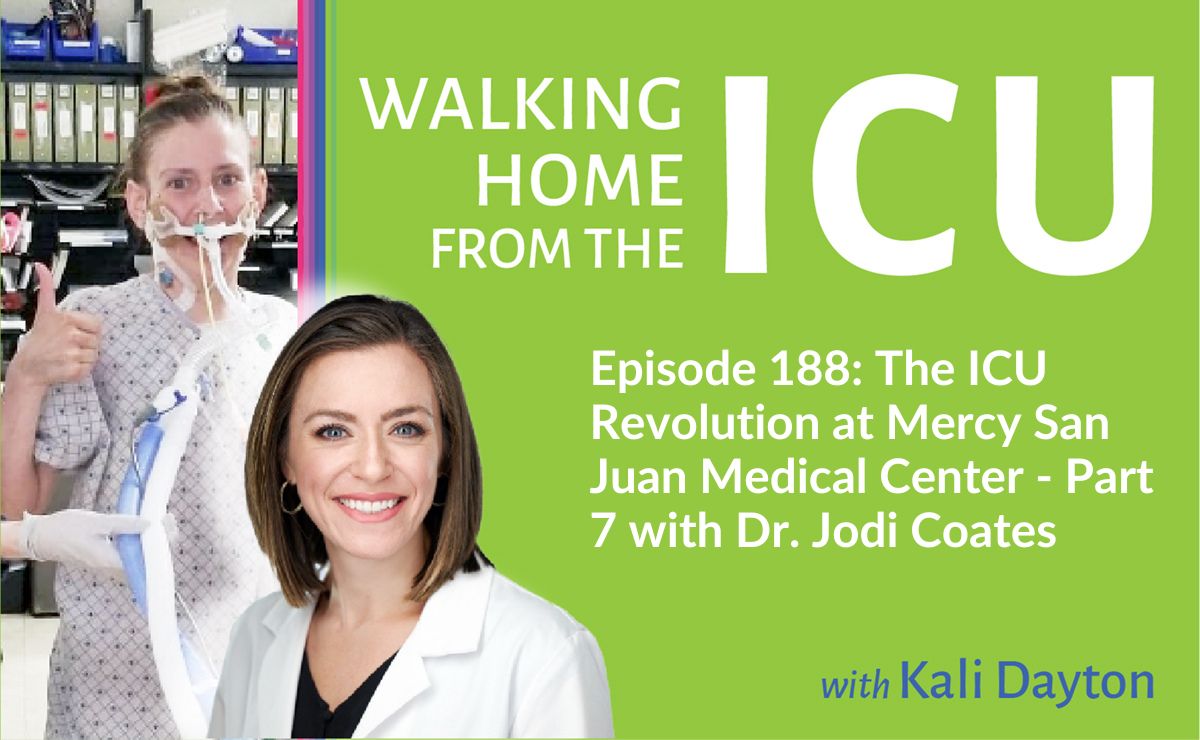
When the harm of “normal practices” shifts the perspective of an ICU revolutionist and medical director, what is the next course of action? Dr. Jodi Coates shares how her personal convictions inspired her to lead her trauma ICU to radically transform their sedation and mobility practices.
Episode Transcription
[00:00:00] This is the walking home from the ICU Podcast. I’m Kelly Dayton, a nurse practitioner and ICU consultant. I help teams create awake and walking ICUs through evidence-based sedation and mobility practices. By hearing from survivors, clinicians, and researchers, we’ll explore how to give ICU patients the best chance.
To walk out of the ICU and go home to survive and thrive. Welcome to the ICU Revolution.
Thank you so much to all those that voted in the best of nursing award competition. Awakened walking, ICU one Best Nurse in innovation. This is such a tribute to Polly Bailey and Luis Bestian, the true nurse innovators that founded [00:01:00] and awakened walking ICU process of care in the late 1990s. If you haven’t listened to their episodes, go back to episodes 21 and 26 to hear it from them directly.
This is also a win to all IC revolutionists throughout the world. Some of you have been working on this since the early 2000 and teens. Some of you started after you listened to this podcast for the first time in 2020. Some of you are just learning about this revolution nonetheless, it’s everyone’s win.
It’s acknowledgement that this is a lifesaving transformation in critical care medicine. These changes really don’t happen overnight. For most revolutionists, it takes years of perseverance and fortitude. I’m excited to have Dr. Jody Coates share with us how she really magnified her role as the medical director and led her trauma ICU to become an awake and walking ICU.
Dr. Coates, welcome to the podcast. Thank you. I’m beaming because I’ve waited for [00:02:00] like years to say that. Will you introduce yourself to us? Yeah, so my name is Jody Coates. I am, uh, a trauma surgeon and emergency general surgeon at Mercy San Juan Hospital in Sacramento, California. I’m the trauma medical director for our hospital.
We are at a level two trauma center. Um, and I have been there for about 12 years now. Wow. And so you as a trauma surgeon, trauma intensive, how are you trained to manage patients on mechanical ventilation? Well, when I came through my training, I came through what I consider to be a very rigorous and really good program for ICU level care and also trauma.
Specifically, I trained at uc Davis here in Sacramento, which is very trauma heavy to the point that. Most junior residents feel like there’s no way they would ever wanna do trauma because they’ve already done so much trauma. But a lot of senior residents, by the time they are trying to decide on their life path, actually decide that that is what they really love to do.
And maybe some of that’s [00:03:00] brainwashing. I don’t know. ’cause we do so much of it, but we do get a lot of ICU experience at uc Davis. When I came through, we were exercising some of the practices for how I manage ICU patients now. Doing spontaneous breathing trials on the ventilator. Actually, I, my training program I feel like was quite progressive in terms of sedation.
We really had almost nobody on continuous sedation. When I was a resident even, and a fellow, but we did still use a lot of sedations. We didn’t have continuous drips, but our orders were usually like one to 10 milligrams of versa. Q1 RPRN, not PR one 10. Yep. One to 10 or one to eight. And it was rare that that much of it was used, but that was our standard order set.
So we had some sort of analgesia, but almost every patient had sedation as an option, even though it wasn’t common to use Continuous. But otherwise we got pretty good at vent management, I feel like. But it was very unusual to have a patient that was really very alert or [00:04:00] interactive while on the ventilator and in the ICU really for me until just recently because it wasn’t common in my training.
And then when I started my practice out after training, a lot of patients were managed with continuous sedation. Even that was something we were trying to move away for quite a while. Until, I would say we had a little bit more of a intentional direction the last couple years. Yeah, it having patients really wide awaken on the ventilator except for within the 30 minutes before we would extubate them, was pretty rare until recently.
And what shifted your perspective? What led you to see beyond that? So my journey in this whole process started to be quite honest with Dr. Peter Murphy, who is one of the medical intensivists at at Mercy San Juan. He a few years ago, recommended to the other critical care physicians throughout the hospital, medical surgical neuro that we read Dr.
Eli’s book, every Deep, calm breath, and I love book recommendations and I personally have a lot of [00:05:00] respect for Dr. Murphy. And I didn’t really know much of what the book was about, but I got it and I started reading it and. It took me a couple chapters to really get into it, and then once I did, I could not put it down and once I was done with it, it was, this was like, I had a single-mindedness about making this happen at our hospital.
That was really the pivot point for me, was truly gaining more of an understanding of what life was like for most of our patients after they had been under our care. Through no mal-intent of the providers, of the nurses of the physicians, but just because of the nature of the beast, I really had no idea that not only some patients, but the majority of patients had such significant disability after the ICU, quite honestly.
And so once I read that book, and then once I started paying attention to how things could be with the right stories, and honestly your podcast was a big part of that, but reading and learning about. Different places that have implemented these things and the stories in Dr. Eli’s book. And [00:06:00] then it just became something I, not only could I not ignore, I could not unlearn, but it just wasn’t even really an option aside from figuring out how to do this within my own practice at my hospital.
And so what was that like having this huge awakening, learning these things, like listening to the podcast on the way into work and then. You get into work and now you’re in an environment in which the culture is very established. And we talked to your nurses a few episodes ago about what it was like for them.
But as a medical director, what is it like to have that kind of weight of responsibility? Yeah. First, um, the care and management of patients in your ICU. Right. I think you put it really well, having to operate within a, within an established culture because. It started to become something that I would just start talking about and talking, talking to people about, and I was talking to Dr.
Murphy and Dr. Be Strong and Dr. Barcha and some of our other intensivists that, that were aware of these things and [00:07:00] also on board with wanting to make the change. But I think we all felt a little bit and, and I know I felt a little bit stuck in how to make the change. While at the same time seeing patients that were in a state that I knew they probably didn’t need to be in and that it was causing harm and as as I saw it by that point and knowing I could only do so much, and quite honestly initially when I would try to make, it just doesn’t work to be the only person or to be in a minority of people trying to make changes.
When you work within such a collaborative system like we have. Our group, we manage patient. It’s a service-based group, so when you’re on call, you’re managing the service, but when you’re not on duty, you’re not managing those patients. And so you don’t really have, say from start to finish on an individual patient’s care.
You have some input. And we we’re a pretty small group, and so we talk to each other a lot, but unless everybody sees it the same way, you can manage a patient one day with no sedation, and it’s very likely gonna be turned back on either the next [00:08:00] day or at night or whenever you’re not around unless everybody.
Understands why not to, and that, and what things look like if you don’t. So there were several months in there where it was, it was pretty, it was just emotionally draining because I felt like this is, it doesn’t have to be this way. And it, it was hard. But I love the notion of there being a tipping point.
You just gotta keep going in, in a certain direction and get enough people on board and, and have enough people really be exposed. To understanding the why, and then eventually the opposite is true. It’s like a, it’s like a momentum that you can’t stop because it’s reached that critical point of enough people understanding not only why but how, and then it’s feasible.
I remember a couple very specific instances. One, when I was first, I had finished the book and I was actually getting ready to do a lecture at our institution for one of our education days. So our, one of our trauma education days, our trauma symposium, my lecture. I was gonna be on this on ICU Liberation and the [00:09:00] bundle and, and on pics and, and I was in the OR a couple days before the talk and had a case that was like, it’s every trauma surgeon’s dream.
Quite honestly, it was like a gunshot wound of the abdomen but hit almost everything in the abdomen and I stayed dream ’cause I’ll skip to the end. The patient did very well. Not only survived, but did very well. It had hit everything, the liver, the spleen, the stomach, the pancreas, the colon, the small bowel, a kidney.
It like took the path of most structures that, uh, and went through the diaphragm and the lung as well. So we did, of course, a damage control operation and the anesthesiologist tried to be proactive and ensure a smooth transition to the A ICU said, what sedation are you planning to use in the ICU? And I said, actually, we’re gonna try none.
And that was literally the first patient that I had done that on, like from the very beginning, especially one that was that sick and that injured. And I got even from my own partner that I was operating with, they’re like, what are you talking about? And I was like, well, first of all, right now he’s too shocky to really tolerate any sedation.
’cause blood [00:10:00] pressure was pretty low. He was under anesthesia. But I was like, we’re gonna try to do none and if we need a little bit, we’ll try a little bit of sedex. And that was the only thing I ordered. And his nurse that night was very frustrated with me because his blood pressure was never high enough to actually start the precedex.
But it turned out he didn’t need it. He didn’t need sedation. We kept his pain under control. When they came to, to get him ready for his next, his takeback operation. A couple days later, the anesthesiologist came to me and was like, I have never seen a patient that injured that critical with an open abdomen who’s that wide awake and interactive and able to write and sign his own consent and write down questions and clearly understand the discussion.
And for me, I think have these stories of these Hallmark patients once we start doing this. But that was one of my biggest, like actually putting it into practice, seeing it work. And seeing the effect on other people of seeing it work, and, and that guy did so well. He went back to the, OR one time we got him all finished up and closed up.
He never was delirious. He got extubated, right. I, I think he [00:11:00] actually, if I’m not mistaken, he might’ve been extubated before his last trip to the or. So then he got intubated and extubated for the OR and he didn’t remain on the vent. He was outta the ICU in a few days. And then it was almost like, like a bowel obstruction patient.
Like we were just waiting for his intestines to work again and set him and went home. It was just. Unheard of up to that point for a patient that’s severely injured. But yeah, the individual patients were hard for me until we could really get things into place as a system to try to move these practices forward more intentionally.
And I think it is so courageous of you to just go for it. See something that you’ve never done before, but you believe in. You read the book, you listen the podcast, you could see the logic behind it, and you had a hope. Faith that it would work, but to be the first one to say, we’re gonna just let him wake up and you’ve never done it before and it was someone so critical who was likely to have so much pain and if it didn’t go well, the rest of your team, that would [00:12:00] paint the whole, I don’t wanna say experiment, but the whole journey.
Right, right. But you had enough to just go for it. That is the of a revolution. I understand the harm that we’re doing. I’m gonna do something different. I’ve never done it before, but I’m gonna give it a try because I know that the alternative, I know that what we’re doing as a standard is not working and it’s not helpful.
And there are risks involved with that. So why not just see what he needs? Mm-hmm. Why not just let him wake up? And that was really impactful to your team to be able to see it even though that they were frustrated. Yeah, and that’s hard too, as a physician, you’re the one in charge of the orders, right? But you’re not the one constantly at the bedside with the patient.
Right. You also special as medical director, but as a physician period, you have to keep good relationships with your nurses, right? They need to be heard and respected, and their opinions need to be considered and their experience at the bedside. [00:13:00] So how did, how did you navigate that when your team didn’t have extensive training?
They hadn’t been doing all the research that you had been doing, they didn’t see it the same way. They still saw patients as sleeping and that you were depriving them of restful, peaceful sleep. Right, right. Well, I think, honestly, I think there’s a, a couple factors, like you said, they need to see you as caring about how it affects them as well, and that’s always been important to me.
I hope that I come across as a physician who does care about the wellbeing of the nurses and want to see. Everybody have not only job satisfaction but get out of it the reasons that we went into it, which is for the care of the patients and because for some reason people in the medical field have this internal drive that that is what makes us tick like that we get satisfaction out of seeing people do well, that that we have helped.
And so I think the biggest factor is just understanding the why honestly, because that’s what did it for me. It’s like the [00:14:00] people I would talk to once more and more people started to read the book. Um, or just listen to the stories. The, the common thread is once you know, you can’t unknow, like you just, there’s no way to pretend that you don’t know that you don’t know this anymore.
Once you’ve. Been exposed to it. And so I focused on, we round do multidisciplinary rounds with the bedside in the ICU, and so I really focused on trying to educate in real time. One of my favorite comment, I mean it’s my least favorite, but also my favorite ’cause it gives you the opportunity to speak to it is when somebody’s, if I was then in that position, I would wanna be sedated.
And I’m like, actually you wouldn’t, because I used to think that too. But then when I learned what people under sedation are actually experiencing. Believe me, you would not wanna be in that situation. And then we talk a little bit about it and then I really do try to encourage people to like explore for yourself.
Look this up, read the book, or listen to the book. Audio books is one of my favorite things now because it’s something that I’m in the car anyways. I might as well be listening to a book and [00:15:00] passively reading and so the podcast and audio book and the book and just really pay attention. What it is like for these patients.
’cause you’re right, you wanna think about it Ev, all of us should think about it is what would I want in that situation? If I’m in the hospital or I’m in the ICU or my loved one is, what do I want them not only to have to go through, but how to come out on the other side and what does that really look like?
But to be able to implement that, we have to know what that really looks like. And so I think it’s all about education because once people know that in this field. They’re gonna do the right thing because that’s why they’re in it in the first place. It’s just that for so long we didn’t really understand what that was and what that meant and what it’s like, uh, to be in that situation and that it wasn’t part of your medical training, not part of anybody’s training.
To know the patient’s side of it and to know about this really lethal organ failure that we’re causing, right. And I see you, it’s just crazy that we go this long without knowing the reality. And as a medical [00:16:00] director and as a physician, you’re teaching during rounds, I could see that you did a really good job of that, that the team felt really supported.
That it wasn’t just, you were just the scene, the orders in the mar, and then walking away or saying, turn that off and walk away. But you were there explaining why you were physically present at the bedside to help with these patients, to support the nurses. And I heard from the team that they felt that.
I knew that you were really invested in this and in them, but there are so many logistics that go into how to manage these patients without sedation. This being new to you also, this being such a complex process of care, how do you go about bringing this huge system wide change? Because I think a lot of pressure comes down to, medical directors always say, well, leadership should do this.
Well, they need to make it happen. It’s all up to you. You’ve never done this, and it’s, again, very complex. What is that like to feel like? You have to bring the system. Why changes with all these barriers? Well, yeah, so that’s, I think that’s the next thing. [00:17:00] The first step is people really have to understand the why, but then there’s a very, very big, very big how.
It’s not just why. It’s how, and like I said, when I really got interested in this, I used the next opportunity. I had to give a talk at our education day to really go through the, the logistics and the literature and the data and the hallmark studies. Intermix patient stories in there and some stories for my own family and try to really personalize this ’cause it’s mostly nurses at this educational conference, but there’s some other disciplines too.
There’s therapy and physicians are invited and, and it’s for anybody that interacts with trauma patients. So floor nurses, ICU, patient ICU nurses, ER nurses. And I got some mixed feedback after that lecture. Some. Most of it was pretty positive, and to be quite honest, people don’t usually give me negative feedback to my face, so I hear a second, but I did hear some things after that talk, which were along the lines of, oh, this is just another sort of attempt to shove the bundle [00:18:00] down our throats.
One person did tell me this is the best way that I’ve ever actually heard the bundle explained, and that it helps to understand the individual components and why. They are even components in what this bundle even is because I think it was gone about the wrong way that the bundle was something people had heard of.
It was not a new thing. It’s not like, uh, this was a, all the terms I was using were landmark terms, but to me, the concepts really were landmark. I had been writing in my notes for years a F bundle being applied without really truly understanding what that even meant, because quite honestly, I think it was presented to physicians and nurses a long time ago as this is something you have to do.
But it was never really fully explained what that means or why. Yeah. And so I think for nurses especially who, like you said, are doing really the brunt of the work throughout the shift, at the bedside of these patients, they’re being expected to chart that they’re doing something. But if you don’t give them the logistical how and you don’t also give them the support, and then you’re coming with an [00:19:00] even more focused expectation.
It just feels like more work and with less hands and how, and so I think that was a lot of the very clear and appropriate messaging from nurses, which is that we’re not opposed to doing this. And especially as we understand why it makes sense. But if you want it to be done, you’re gonna have to help us figure out how, and we need the resources.
’cause it can’t just be, this is more of an expectation for what nurses have to do with less. So when you say leadership, I think it’s on all levels. It’s not just the physician leadership, it’s nursing management and physician leadership and physician management, but also the administrative support within the hospital.
And I feel like our administrators really in the last few years have done amazing things to help out with that as well. So logistically for us, the way that we made this culture change was after I. Spread the book and listened to your podcast. I know I reached out to you directly and was like, help, how do I make this happen in my hospital?
And you had a few suggestions and [00:20:00] offered to do some training and to meet with anybody that it would be helpful to meet with at the hospital to help explain. Not only the benefits to the patients, but the benefits to the system, right? Because obviously we are a system that has to take care of a lot of patients and it requires a lot of money to do that.
And people initially see this as something you’re gonna lose money over instead of something that the hospital really is gonna save a lot of money over. Not only money but lives. We care about the lives. Appropriately. So to keep the hospitals going, they have to care about money on a certain level. So once I started to talk to more people, I realized that several people are in our system already, had been focusing on wanting to do this for a while, had brought it up a few times, and so we got together.
Our critical care educator and our ICU director and some of the other intensivists got together and said, we think really the first step is we gotta get administration to understand the value of this to the hospital as well. And then they can help us with the lift of how we’re gonna implement it [00:21:00] and eventually get the resources down to the nurses to, and the therapists, the respiratory therapists and physical therapists to, to make it happen.
And I think it, it really does require, like I said, an individual. People understanding why and wanting to you need, but it’s not gonna happen unless you do have a systematic approach and the ability to change the culture within the hospital. That was a big thing. You came and gave a talk, um, that several of our administrators were there for as well as ICU physicians and nurses and about all the benefits to the hospital and to the patients.
And after that happened, there really was a lot of, then it was more of an intentional. How are we gonna do this logistically? What do we need? What additional staff do we need? How do we need to direct the staff? How do we train the staff? What does that look like? And then things started to happen and I said I could see, like I started to light up when I talked about the financial benefits and I, [00:22:00] I know you’re salivating that this huge return on investment, but that doesn’t mean that you just turned your clinical leadership and say, okay, no sedation.
Get them up. It is not that simple, right? You need to be turning to them and saying, what do you need to be successful? Because you will have 20 times the return on investment, at least when you do actually provide the tools needed to be successful. And I felt like they, they really received it well and heard what we were saying.
Um, I’m hoping to interview them as well to get their perspective because I think there’s a lot to learn about the administrative side, right? That a lot of us clinicians don’t really understand and it’s important to be able to speak their language. Because they can really make or break this kind of initiative.
Sure. Yeah, for sure. What kind of impact did you see? Obviously when we started the training, it wasn’t just a light switch. Everyone wasn’t like, oh, the Dayton team is coming and we’re just gonna do this. So for you as a medical director, how did you support the team during all those hesitations? In episode [00:23:00] 185, we had a group of your trauma nurses talking about the hesitations that they had, the reservations that they had.
How did you help support your team to keep them open to the training that they were receiving? If you’ve been listening to this podcast, you are likely convinced that sedation and mobility practices in the ICU need to change. The ICU community is facing incredible difficulty with the trauma from the Pandemic Staffing crisis and burnout.
We cannot afford to continue practices that result in poor patient outcomes. More time in the ICU. Higher healthcare costs and greater workload for the ICU team. Yet the prospect of changing decades of beliefs, practices, and culture across all disciplines of the ICU is a daunting task. How does this transformation start?
It can begin with the consultation with me to discuss your team’s current practice. Barriers and to formulate a plan to help your ICU become an AWAKE and walking ICUI help teams master the [00:24:00] A-B-C-D-E-F bundle through education consulting, simulation training, and bedside support. Let’s work together to move your team into the future of evidence-based ICU care.
Click the link in the show notes of this episode to find out more. Sure. So I think for me, my, my group, the physicians and apps that I work with know that at any given time, well, and sometimes it’s very per pervasive and long lasting. I have my soapbox issues. I have my things that like really I harp on a lot or that I revisit a lot or that I mention in our meetings and in our.
Sign outs and, and this became one of those things on the clinical side of things. Every time we had a meeting or every time we reviewed a patient in m and m, I would review the sedation practices we had used and many episodes of delirium and how long it took to get them out of bed and how long they were in the hospital.
It was one of the things we focused on and I started encouraging people to try them without sedation or don’t even put the orders in for sedation unless [00:25:00] you assess them with the nursing staff and determine that you need it and that there’s not other ways. Maybe they need their pain better controlled, or maybe they’re just restless.
Maybe their, our nurses have gotten so good at figuring out what is agitating a patient now. It’s just, I, I don’t wanna say night and day because it’s not like they were terrible on this before. It’s just, it’s hard for anybody if a patient’s sedated to figure out why they’re upset or why they appear physiologically, if they get tachycardic, their blood pressure shoots up or they start getting really restless and they start pulling on things you don’t know when they’re sedated.
If it’s because. They’re in pain because they’re withdrawing from something because they, they’re Foleys clogged and they are feeling the need to urinate, but now it’s. The nurses by the time they come to you and even say, I think we might need to use something else, they’ve already looked at all of those things they’ve already figured out, and a lot of times they’ll say like, oh, they were really agitated this morning.
It took a couple people in there to settle him down. But then I realized he needed to poop and now he’s just chilling and he is happy and he is looking at his phone or [00:26:00] whatever. So we talked about it a lot and I talked about it a lot, and it just, I would joke like, I know, I know, you know, coats is going off on the thing again or whatever.
Mobility stuff, but I think especially leading up to your visits and your training, I tried to use any opportunities I had for my, for education or talks or lectures for that, for that topic. And then on rounds we would talk about it In our meetings, we would talk about it. And then leading up to your visits with the nurses.
I would try to, while I was on the job in the ICU talk about like, oh, well, when Kaylee comes, when Kaylee’s team comes. They’re gonna help us learn how to do this better or whatever. And, and there, there was definitely skepticism. I think they mentioned in the nursing episode that they did that some, I think it was Dan had said like, well, who died and made Kaylee King or something, one of our N sms, and like, who is this person who’s supposedly gonna come in and tell us how to do our jobs?
I think that was part of the feeling of what this was gonna be. And again. I mentioned we need [00:27:00] administration to help us make things happen. But I think also the fact that they knew that this was supported by administration, there was still a lot of cynicism about like, what are they trying to make us do?
Like there, there still was a lot of feelings that you’re just gonna expect more work, more results, more return with less. And this is just another person being brought in from the outside to tell us what we have to do. I encouraged my surgeons, if at all possible, especially if they were on duty to try to attend some of the, the simulations and the trainings.
But even if they were unable to attend them, I sent out the resources and sent out the, the packets and the checklists and we had talked some about the book and it’s just, I think just the more people here about it and see it and are reassured by it. And there was some resistance for sure, I think on all sides and, and I think most of that resistance is just born out of.
Uncertainty about what is being expected of me. There’s an appropriate level of cynicism sometimes, or a learned level of [00:28:00] cynicism when people are being asked to change practices, you know? Yeah. They talked about having been a lot of work kicked and hit and Yeah. You know, really wrestling some of your complex mm-hmm.
Abuse patients and I’ve lived it, I’ve done it Ironically. I’ve done it more out of my awake, walking. Can I see you than in my awake walking? Can I, you. And it wasn’t until years later that I actually tied it all together to realize those patients were probably super delirious and we had made making it worse, and it was all escalating because of the things that we were doing to them.
Whereas in awake walking ICU U delirium wasn’t so common. It also wasn’t as severe. And we had a whole team know how to respond to those emergencies so I could understand the reservations and thinking, yeah. If you, if that’s all you experience about having a patient quote office sedation, then that’s what they expect is that every patient’s gonna be a bucking rodeo.
Yeah. So they at least had some successes, like you’ve described those early right away, sedations off, no delirium, and that really helped open [00:29:00] them up a little bit By the time I came, knows that you, I saw. You had a patient or two that was intubated and totally awake, hanging out. So cool to see. But then the question was how do we standardize this and how do we make this sustainable for every patient?
So how do you feel like formalized simulation on site, hands on training? Help take your team to the next step. I think it’s always helpful to be able to practice and have hands-on and be able to ask questions in real time and get honest answers and not feel like they’re having the wool pulled over their eyes or not feel like people are sugarcoating things too much.
I think that one of the biggest benefits to having you guys on site was actually your ability to sometimes intervene on real patients. We had in the ICU at the time. Um, and so most of the simulations were with somebody from your team or somebody from one of our teams that was the patient, and we were talking through scenarios and bringing up issues, but there were a few patients that were in our [00:30:00] ICU and, and you guys rounding with us and overhearing some things and making some suggestions.
Or I would ask some things like, what have you seen done that’s worked in these scenarios? Or I would sometimes call you or text you and be like, I, what should we try? Because I don’t just want a bunch of sedation to be turned back on or, and. Seeing those successes, I think every time somebody saw those little things actually work and helped.
That’s what really allows the change to happen. You know, my sister’s an ICU nurse too, and when we first started talking about this, she was, I got the same look from her that I got from most of the ICU nurses I work with, which is get outta here with those expectations and expecting me to do more with less.
Yeah. If you expect me to try to walk out of a room and a patient who’s not sedated and not restrained, and they’re not gonna pull everything out and make my job harder or hurt me or themselves, like you just really don’t know my job. She also became a total convert and started using these practices in her own patients, as in her own patients as a nurse.
And I remember one time her telling me like, [00:31:00] it’s amazing. Like they, they’re doing their own oral care and they’re doing like half the things I used to have to do for them they’re doing for themselves. And it, you know, makes my heart skip a beat to see them reach up toward their mouth. ’cause I automatically think they’re going for their tube.
But the awake ones are not for the most part. When some of the time they do and they’re right that that’s who’s gonna to come out. I just don’t like it to come out that way. But, but yeah, I think the onsite training was helpful because. It a lot of people to see you and your team as real people who have real experiences who are on or have been on the clinical side of things.
And you’re not, nothing against our administrators and we have very good administrative support, but you’re not just, um, an administrator coming in and telling them expectations. It’s helping figure out how to do this thing that once everybody learns about it, they really do wanna do and choose to do and enjoy doing.
Yeah. In the webinars we talked, it was more didactic. Giving, talking about their research, the big picture of what we’re doing and a [00:32:00] little bit of the practical things. But really you have to have that foundation of knowing why, what’s actually happening with our current practices. That alone is it’s expensive.
Yeah. Really have to know a lot of things in order to be willing to try something different and to be able to have tools to critically think through each scenario, but then the logistics of how to prevent and manage agitation. How to mobilize someone, how to talk to each other, how to determine when sedation is or is not appropriate.
All of those things is its own training. Yeah. And so we did the webinars as a foundation. Then the simulation training was opportunity to talk through a lot of those practical logistics and the entire team, every discipline was there so that they could talk to each other, express their perspectives to each other, and really collaborate.
And we used your own case studies. So these weren’t just unrelatable patients, these were your actual patients within the recent few months and talked through [00:33:00] what could have gone better. Why was this difficult? How did this impact you? What would you do differently now? And yeah, to be able to weigh in on current patients and seeing real time the impact of these ethereal concepts, mm-hmm.
Mm-hmm. In practice and see what that actually means, I think really helped your team. And they already had so many wonderful elements. I think your nurses innately are extremely compassionate, very skilled. When we talked about how to assess for causes of agitation, that was a big focus in the training. I think they started to realize that they already knew how to do that.
It was just had a different context with a patient that’s nonverbal, that has a lot more things that could be bothering them. Mm-hmm. Such just a tracheal tube. But now, like you said. They already know. They already managing these patients so well without even coming to you. Yeah, they did trouble. They did their own troubleshooting.
And the last option is sedation. Right. But even when they use [00:34:00] sedation, especially for agitation, it sounds like these patients are still awake and riding on clipboards. Yeah, it really is. I think walking through, probably a couple weeks ago, we had a very full, very sick, high acuity trauma ICU with several vented patients.
And walking through our ICU now and seeing the state of those patients compared to even a year, but definitely 2, 3, 5 years ago. So different. So different because those patients are awake. A lot of them are out of bed, they’re in a chair, they’re writing on clipboards, they’re communicating with family.
The nurses and the therapists and everybody have gotten so much more. Comfortable with finding nonverbal ways to communicate. I’m a big fan of eye gaze myself, of using the eyes because I have a daughter who communicates that way. But the nurses have gotten so creative they’ll use if a patient can’t write or you can’t read what they’re writing, that we had one patient who they had her point at a letter board with her foot ’cause it was like the only extremity that wasn’t all [00:35:00] broken and bandage and splinted and was functioning.
And they like. Basically would go through, we didn’t know who she was and they had her spell out her name and give us her date of birth by pointing at it with her foot, and that was all nursing led. And we never would’ve been able to do that in a patient that was as sedated as we used to sedate patients, especially with that many injuries.
And she had some psychiatric history and some substance abuse history and a lot of that stuff we didn’t know until we could identify who she was and look up more about her and learn about her. But it’s definitely a difference in, it’s a different vibe when you see the majority of patients. And like you said, even the.
The ones that are needing sedation, and sometimes we may need it transiently for procedures or for something going on, but it’s used in a much more targeted and specific approach. And the sedation that we reach for is very different than what it used to be used for, which is just that patients need to be very som when they’re on the ventilator and there’s no longer that mentality, which is wonderful.
Oh, and in the trauma population you, you do have a lot of patients show up un [00:36:00] unidentified. Yeah, they all do. So, I mean, when a patient comes in as an activated trauma, they all come in with an unidentified name, a generic name, our our trauma name, and a brand new medical record number, brand new account number.
And if they can’t tell us who they are and have, there’s some way to validate that their stuff doesn’t get changed in the system. So patients that come in that are head injured or they’re comatose or they get intubated right away, if they don’t have family around and they’re not able to communicate with us, we don’t know who they are.
And so. They all come in when not under their real name for the most part. And the history is so important in managing their care. Yeah. Just like this situation you described where she had psych history, polysubstance abuse, that was important context to know how to manage her. Right. And yet we would miss all of that.
And you mentioned that your daughter uses an a e, C device. Mm-hmm. And so does my daughter. That’s been a really sweet bond for us to talk about our daughters with. Special needs. Sorry, I hope this is okay. Yeah, yeah, this is [00:37:00] fine. So that’s my journey with my daughter and using eye gaze technology for communication has really transformed my perspective of how we care for patients in the ICU.
And I spent years in awake walking IC well before my daughter taking that for granted. And if they couldn’t speak English, I was like, well, we’ll just use the family. We’ll just figure it out. We’ll do. Charades or whatever, but I have a totally different perspective, and so when I see you and I realize how we culturally in the ICU, see people that are nonverbal, which are a lot of our patients, all vented patients, patients, they’re nonverbal, and the assumption that they don’t have anything to say or that we can’t communicate with them, that hits me a totally different way.
Now what’s it like for you as well? Yeah, a hundred percent. Just what you said. It’s not only with our patients in the ICU who can’t communicate ’cause they’re intubated, but even with my practice in patients like my daughter who may have certain special needs that has rendered the nonverbal and it’s [00:38:00] so easy to underestimate people.
And as you probably know in the special needs community, there’s a key phrase, which is presume competence. So we have to start with a presumption that they’re there, that they comprehend, that they understand, that they’re aware, that they know. It’s just the output that is lacking and so they’re not able to communicate that well with you.
And so that then the burden is on the people with them. And in the healthcare setting it’s us to try to do the best we can to, to allow them to express themselves with whatever tools we can. So for me, I revert to the, the way that I communicate with my daughter a lot, she has a very high end technological device that is eye gaze controlled and we can’t provide those for all of our patients.
And not all of our patients can even use their hands and tap and use an iPad or a touchscreen. But a lot of patients can use their eyes or they can give us some sort of indication. Even just starting with a basic yes no, trying to figure out. Let’s figure out a way that you can indicate yes and no to me and then go from there.
Or spending a little extra time with those trached patients trying to read the [00:39:00] lips. Combination of lip reading and asking questions and clarifying questions to try to get at somebody’s desires or what’s going on with them, right? Assessing them or, or whatever. So it is giving me a completely different perspective and level of patience and willingness to really get more creative and spend more time trying to figure that out because truly.
If the patient understands that you’re understanding them or they have a say and they have a voice, I think they’re so much easier to take care of. They’re aligned with you. They’re more willing to do what you want them to do, what you know might be or feel might be best for their care. And they’re not fighting you every step of the way if they really feel like you’re aligning with them and their goals.
Having lived in other countries, and I couldn’t speak the language, it left me feeling so. Vulnerable, helpless, frustrated, irritable sometimes. Mm-hmm. And so that gave me a whole new perspective as well to say what is it like for them in this very vulnerable situation, to not be able to communicate [00:40:00] with those that are taking control of everything about their body and their lives.
Right. And obviously this is a skillset. So it sounds like your team is really developing that skillset of non-verbal communication. And it just blows my mind that we don’t, in intensivist training, nurse training, even when we’re onboarding into critical care respiratory therapists who care for a lot of non-verbal patients, none of it we know get any nonverbal communication training right.
Yet, so many of our patients are nonverbal, and so I just look forward to this shift in the IC community in general, but also in society that just because someone doesn’t have. Can’t talk doesn’t mean that they don’t have something to say. Right. And again, that’s just become really personal for me. I don’t know if you’ve seen the movie Out of my Mind.
I have read the book. I haven’t yet seen the movie ’cause I wanna watch it with my daughter and her siblings and we haven’t had the opportunity yet since it’s come out. But yes, we have read the book and I, I recommend that you, it’s an I ICU as well, that this is the movie that it just shows you [00:41:00] the perspective and of what’s going on in someone’s head, even when they’re nonverbal.
And we need to see our ICU patients the same way. Right. Right. And maybe with traumatic brain injuries and things like that, obviously their cognition’s gonna be a little bit different, but let’s assume competence first. Yeah. Yep. I think that is the, the biggest thing, and not only that, but with level of alertness, because we know that our patients, even that are sedated or that are brain injured or that are comatose for whatever reason, they still have, they still have a sense of hearing and their brain is still doing something, even though we can’t see from the outside what it’s necessarily doing.
And it’s been a big reminder for me too, even in patients that I expect will be able to communicate when they’re awake, if they’re not awake for whatever reason, and they’re in the ICU, be careful what you say in front of patients. Like I now, I walk into every room pretty much with the perspective that this patient, at least I tell myself, this patient can hear what I’m saying and understand what I’m saying.
So be careful what you’re saying about them in front of family. That’s one of my daughter’s biggest sources of [00:42:00] frustration is being talked about in front of her, but not included. Or not talked to the point that when she’s at doctor’s appointments, if like the doctor and I are talking about something in front of her, even if it’s not something that’s really hurtful or a sensitive subject or anything, she gets very frustrated.
She does not like it. She will start vocalizing, she doesn’t have spoken language, but she’ll start vocalizing to drown out the sound and you can tell that she’s okay. Yeah, I don’t really like what’s happening here. And so I do try to intentionally, even if I’m not getting any output from the patient, try to do what I can to include the patient in the language or if it’s something that I feel like.
Probably if this patient was wide awake, wouldn’t wanna hear or maybe shouldn’t be involved in this conversation. Ask the family to step out because it’s so easy to just talk about somebody in front of them, assuming that they don’t understand or they don’t hear, and maybe they do. This whole, all of these practices have been bind opening in that regard too.
Learning about what patient’s brains do under sedation. They still hear things and then their brain makes up crazy, terrifying scenarios to explain it because. They’re not really, they’re [00:43:00] not really tethered anymore to reality because of sedation or their injury, and so it’s made me much more cognizant of patient’s awareness in lots of situations.
Yeah, that’s one of the main things that I wish I could go back and change. You know, from many years of practice not knowing this information. Patients with altered level of consciousness, even when they’re not sedated, they have hypoactive delirium. It just, I think about times when we were doing procedures and we’re talking about.
A body habit isn’t, we’re just logistical that we have to figure out, but we, I know that I didn’t, I wasn’t being very mindful of what they could hear and how that might be interpreted on their side. Right. But all we can do is move forward, and that’s what I love seeing your team do is just moving forward, learning from the past, but building a better future.
And so when you walk on your unit, most of your patients are awake, even sitting in chairs. Running, walking the halls, so if they can, standing on the verticalization beds, and it’s just amazing to hear your nurses. [00:44:00] You’re just now listening in. Go back and listen to episode 185 to hear the nurses’ side of all of this.
But really, Dr. Coates, your team wouldn’t be where they’re at without your incredible leadership. I learned a lot about, oh, thank you. What a medical director really can accomplish. I appreciate that. I appreciate you saying that. I think that they, I think they probably would get there regardless, because we also have some amazing other voices and physicians and nurses that have been passionate about this even since before.
I was excited to do this within our unit and really push for it. One, because like I told you, once, I knew I couldn’t not know, and so then it just didn’t, it wasn’t even a question of are we gonna do this? It was just, we have to do this. How are we gonna make this happen? The trauma ICU, I think as the nurses will tell you, and almost anybody who works in trauma will tell you is unique for a few particular reasons.
And every place has its nuances, but trauma’s hard to think about making these big changes. And because patients are broken and patients come in with very complicated histories and past and they, [00:45:00] you get that on all fields for sure. It’s not like you don’t get complex patients or patients with psych history or patients with substance abuse history or patients with homelessness.
When other ICUs, but it’s really just the incidence of it is pretty high in trauma and it complicates all this stuff. But what I’ve found just in seeing it done more and more and more, is it seems like the more complicated the patient is with regard to all the things that we thought would make it impossible to do these things, the bigger the reward and the easier they are.
Compared to what it would’ve been if you didn’t do these things. So if they come in already with five different substances positive on their tox screen and three different psych diagnoses, none of which have had meds for the last two years, and you sedate them, it’s gonna make it even worse. And then it’s like a month, month and a half of them hurting themselves, hurting other people, kicking, needing restraints, not not being able to reason with them, yelling at them, yet, just it becomes so much more complicated than if we try to.
Let [00:46:00] all the stuff they come in with, get out of their system, support ’em through any sort of withdrawal or rehab, get psych on board early in social work, especially if we know the patient and we know their history to try to get, get them adequately treated or get some assistance in that regard. But then not worse things.
It helps a lot and, and the nurses are passionate. Like you said, one of my funniest and fondest memories was my, one of my very first nights in the ICUI was actually moonlighting at Mercy San Juan. I was a fellow. And I came into the ICU after I had operated on a patient and I was not a familiar face around there.
And so one of our strong ICU night nurses who’s now our critical care educator. Was like not about to let me near that patient’s bed. ’cause she didn’t know who I was when I walked in. I didn’t really introduce myself. And I walked in and started asking questions and she’s like, I’m sorry you are, you know, like something like that.
And then when I introduced myself, she was like, she was so sheepish and she was so embarrassed. And I was like, no, I’m sorry I didn’t, yeah, you had no idea who I was. But they’re so protective. They’re protective of their patients. And they’re [00:47:00] strong personalities and they all wanna do the right thing for the right reason, and there’s a lot of energy behind what they do.
So I knew once people realized what is the right thing to do in these situations now that we know what we know about our practices. It would be in some ways, yeah, you might get some resistance upfront, but once people get behind it, there’s no stopping in the nurses on teams like this. So that’s really exciting.
And one of my objectives with training is that. The culture in these practices don’t just hinge on one person, right? You’re not there today, right? But they’re doing the right things today, right? And so, not that you’re gonna leave, but if you were to those nurses, especially that we interviewed in episode 185, they’re not gonna let this drop.
They’re so protected of their patients that they will keep running the ship, which is so nice that day and night shift. All disciplines, everyone’s working towards the same goal. And that’s what’s making this so feasible and hopefully I feel very confident that it will be sustainable. [00:48:00] Yeah. As you guys are cracking the code.
I do think that we have passed that tipping point, I think, and not just in the trial ICU, but it feels like to me across most of the hospital and most of the other ICUs too, is to. It’s no longer about like, okay, we’re supposed to do this thing, and how are we gonna make it happen, and are we gonna be able to make it happen?
Now? It’s just that like, wait, no, this is, this is what we do. What do you mean? And I’ve seen some small little things even recently where we may have somebody who comes in, maybe a traveler or somebody who has not been exposed to a lot of these practices and they’re, I don’t wanna say police, they’re supported appropriately by their colleagues too and by other nurses.
We had a patient who was. Head injury on top of a head injury, on top of new injuries a few months ago, and it was frustrating sometimes to take care of him because it was very repetitive. And also very active and wanting to get up and wanting to move around. And so he was busy. He was a busy patient for a nurse, and the nurse that had him at the time was starting to get frustrated.
And other nurses were ones that would step in and be like, he doesn’t, he, he’s not trying to be that [00:49:00] way. They were intervening on the patient’s behalf, but then also offering to be like, Hey, why don’t we, I gotta finish this up with my other patient, and then why don’t we get, I’ll help you. Let’s get him up.
Let’s get him to a chair. Let’s take him outside. Maybe it’ll wear him out, and then he’ll sleep better tonight. So. It’s really exciting and heartwarming to just be sitting in the ICU charting and see some of these things happening and just be like, ah, they’re so good. It’s just a pla. It gives you so much pride to work in a place like that when you see what can be.
What I told the nurses says, you’re gonna have all these applicants trying to work at horses, Santa Juan, dignity Health in Sacramento or Carmichael, California because this is a dream. This is why people get into the ICU and the fact that you guys have been able to build this kind of environment. In a short amount of time.
I’m excited to hear what’s happening a year from now. I want you guys presenting at conferences because there’s a precedent set for trauma critical care. Yeah, in your ICU really exciting and we love our patients to come back. We have a trauma survivors day every year and so, um, some of the nurses that are the most passionate about these things too get [00:50:00] very involved in the trauma survivors day too.
And they’re already like identifying we gotta get this person back for trauma survivors day. And it’s such a touching thing to see what happens to our patients. And so I think that’s why these stories make such a big impact when we hear how patients. Often turned out after historically, how we manage things in the ICU versus how they can be when we manage things this way in the ICU because everybody loves those success stories and seeing how patients are doing a year later, two years later, just amazing compared to what they were like in the ICU.
I hope your current team and your future clinicians never take this for granted. Yeah. The fact that I could work seven years plus and in a way can walk in IC you and not know the value of what I was doing because it was so normal. I hope that never happens. I hope you guys are able to always realize taking that person outside or getting them up at the side of the bed that was saving their lives, that’s protecting their brains.
That’s getting them back to work. I hope they always are able to see the value and how bad a these interventions are [00:51:00] even, especially as they become so routine and normal, right? But it never loses its magic. Yeah, I hope so too. I’m sure it will. I’m sure it will be because it just becomes more retained when you don’t even realize what things.
But it’ll be one of those things where some of us date ourselves as physicians be like, well, when I first started my practice, we used to need everybody on a ventilator. If everyone will be like, wow. Yeah. Wow. Any last recommendations that you would give to other people in trauma? Medical directors that are wanting to embark on this journey?
I think we covered most of it. I think do whatever you can to try to find a way to change the system and the culture and, and things as a whole, and not just be trying to bark from a corner. It just, it doesn’t work very well. And then I think just the more you can do to continue to talk about the benefits and frame how it’s gonna be, frame expectations.
Um. I now individual patients, I would talk to their families about it too, so that the families aren’t alarmed if they come in and I’ll say, you know, [00:52:00] we, we know now, it’s crazy. But we used to give people these strong, sedating medications to keep ’em asleep on the ventilator. And then we realized we weren’t actually helping ’em that much by doing that.
And so we’re gonna really try to keep your mom as awake as possible. We wanted to communicate with us. We’re gonna try to, we’re gonna control her pain, but you’ll be surprised if they’re getting her up tomorrow morning. And so we really set the expectations for everybody. But in terms of going from where we were to where we are and where I know we’ll continue to, to strive for, it’s a process.
And the nurses are already there in terms of their mindset of their goals. So even if they don’t know it, and the therapists and the other doctors, because everybody wants this thing at the end, um, it just, they do need the resources. So figure out what can be done to provide the resources for the hospital.
Support the teams that are already doing the clinical work. Because yeah, like we said, if you just put it in their lap that this is the expectation and now you need to make it happen, it won’t happen. And I told, I warned that they would have a mutiny on [00:53:00] their hands. Yes. And they tried it that way. And I still stand by that.
I think this is especially co post COVID, we have to be careful about green on that kind of expectation. Mm-hmm. But even by the time, it was six months after we had launched that the mobility tech actually came on. Right. And the team was already doing this. I still stand by the Mobility techs. I still think they’re amazing internal investment and they’re being used and they will be for many years to come.
And that wouldn’t have happened if we hadn’t spoken the financial benefits language administration. So this is the best way to advocate for safe staffing, for more education, more equipment, those kind of things by spelling out the financial benefits. And I would’ve had that opportunity if there weren’t strong revolutionists and leadership there begging and demanding for these changes.
So congratulations on. Everything you’ve accomplished over the last few years, Dr. Coates, this is an accomplishment of a lifetime, so congratulations. Well, it has been. It’s been really wonderful to see and be a part of that. [00:54:00] Yeah, I’m excited for. Whatever comes next. We’ll keep us posted. Yes. Thank you.
Thank you so much. Thank you.
To schedule a consultation for your ICU. As well as find supportive resources such as the free ebook, case studies, episode, citations, and transcripts, please check out the website at www.daytonicuconsulting.com.
Transcribed by https://otter.ai
SUBSCRIBE TO THE PODCAST