SUBSCRIBE TO THE PODCAST


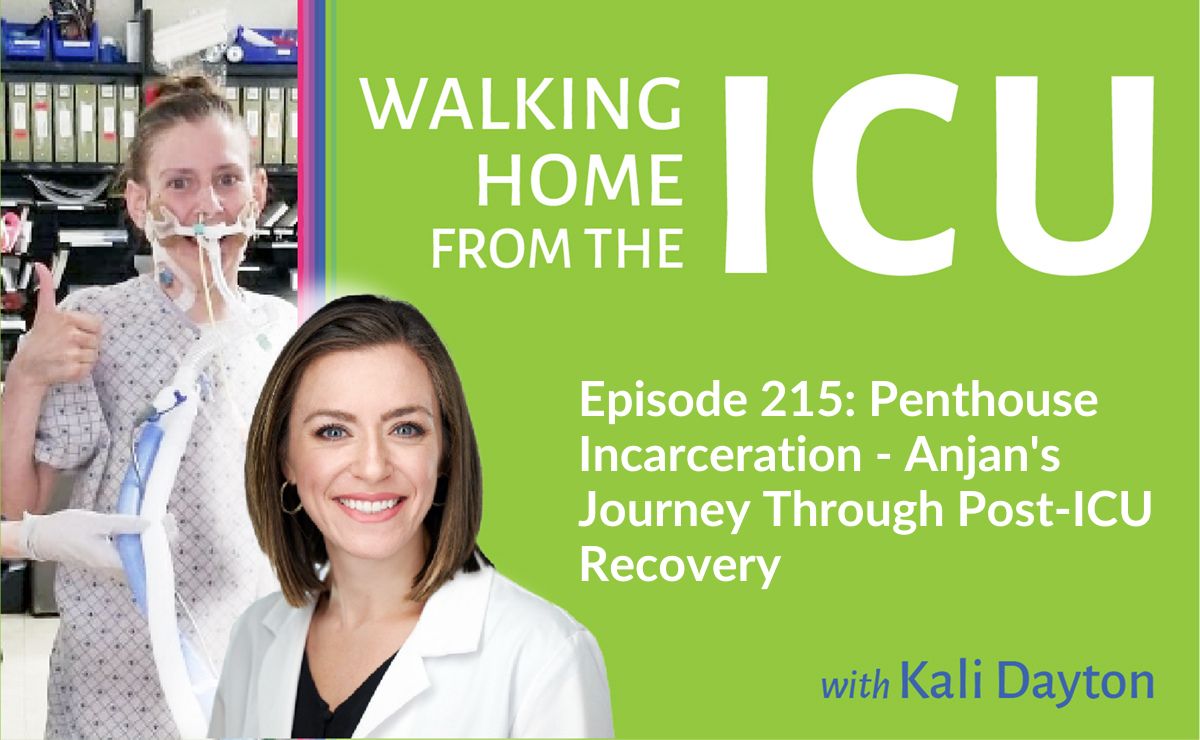
Anjan Chatterjee shares his journey from surviving a traumatic brain injury and medically induced coma to facing the hidden challenges of ICU recovery. He describes severe physical loss, hallucinations, brain fog, and months of isolation — revealing that surviving critical illness is only the beginning of recovery.
Episode Transcription
[00:00:00] This is the Walking Home from the ICU podcast. I’m Kali Dayton, a nurse practitioner and ICU consultant. I help teams create awake and walking ICUs through evidence-based sedation and mobility practices. By hearing from survivors, clinicians, and researchers, we’ll explore how to give ICU patients the best chance to walk out of the ICU and go home to survive and thrive.
Welcome to the ICU revolution.[00:01:00]
Anjan, welcome to the podcast. Thanks so much for coming on. Can you introduce yourself to our audience? Sure. My name is Anjan Chatterjee. I’m here in Manhattan for the last 20 years, born in Chicago. I’m a recovering lawyer and have been a startup founder, investor, operator in medical device and pharma for the last close to 20 years.
Okay, so you were already into this field even before you became a patient and survivor. Yes, that’s correct, which was quite ironic. Very. Very. And, uh, you’d gone through law school, you were very busy, very involved, and what led you to become a patient? On August 14th, 2022, I went for a run. I’m an avid runner, and basically came home, was dripping in sweat, and slipped and fell and hit my head on the corner of the dining room table, [00:02:00] and that’s the last I remember.
I live in a high-rise building, so my doorman afterwards told me that my dog, Kingston, my hero, was just going crazy and barking, barking. And so the doorman came up after complaints and called the paramedics, and they found me dead and resuscitate- re- revived me, and then I was placed in a coma for two weeks as I healed from my TBI and multiple facial injuries and all these other things.
Did you have a brain bleed as well? I didn’t have a brain bleed, but I cracked my orbital bone and had just a lot of cognitive issues, and they couldn’t really find any brain activity and except for some myocardial little seizures they called it. And so they put me then in that coma and it- the rest just I have no memory.
So you were obviously intubated on a [00:03:00] ventilator. Yeah. They saw seizure activities. They had you sedated. Yeah. And what did you experience during that time?
It was very strange. My mother was there, and I could hear her voice while I’m in the coma. I could hear her voice. I could hear nurses saying things like, “We should test him for HIV,” these things like that. But I was hearing them in a different setting where I was hearing, “He has HIV,” or things like that, or…
I just remember seeing all these different types of horrible events, like when they were putting me in prone positions. I thought they were putting me into a guillotine. I was very highly sedated. And when I woke up, all those seemed very real to me. And I think if you read about delirium and the effects on your lungs and things too, like ARDS, it, your whole body [00:04:00] kind of resets.
You’re a different person. And, but the problem is you still believe all these things that have happened, and you’re scared to talk to anybody about it, especially when you’re trying to get discharged or step down. And of course, there’s psychiatrists all around you thinking… ‘Cause some of the stuff did spill out.
I thought I got arrested for something while I was in the coma. I thought I was shot at by the cops. So of course, psychiatry got involved and was telling my mom, “He’s not really gonna ever be the same. He’s gonna be cognitively impaired forever.” The most dramatic part about this, which is very hard for people to even understand or believe, is They had been telling my mother that while I was in the coma too, and so we had a little gathering of small family and friends ’cause they were gonna, it hurts to say it, pull [00:05:00] the plug.
And I actually awoke because I thought they were gonna hang me or something. I don’t know, and it took… I just went crazy, and I burst through the hand restraints, and it took 14 nurses to try to fight me down, and I’m a pretty strong guy, and- And that’s, like, how far into being comatose? I mean, you lose so much muscle- That was-
so quickly. Yeah, but I’m- And you still were able to break through. You know, I’m an ex-athlete, and again, I’m, was running 20 miles a week, and I’m very strong, and I think the mind is also very strong. My, somehow- You were literally fighting for your life. Yeah. And it ended up that I pulled my own plug out.
That’s so sick. Insane at that moment. So you pulled your breathing tube out? No, I pulled the, literal, like, all the wires out. Okay. Yeah. And then they sedated me again, and then got me back, and but that was just the beginning of the battle, to [00:06:00] be honest. And I apologized to those nurses. And but yeah, I woke up during that kind of goodbye party, and it was traumatic to see who was there and also who wasn’t there.
That’s one thing us ICU survivors learn. So I think the latter hurts the most. Wow. And this is so important for us to hear, because on our side of the bed, all we see is you are dangerous. You’re trying to hurt other people, harm yourself, pull out life-sustaining interventions, and it’s, it is an emergency.
Yeah. But in your mind, that’s the part that we don’t understand or don’t get to see, is that you thought you were going to be hung. Yeah. And you were just fighting for your life. And so we- And then it was, we were having a tug of war with some wires with them, and they were trying to pull, and they were like, “He’s too [00:07:00] strong.
Just…” And then they gave me some haloperidol or something shot, and I just went down. What helped you come back to reality and to stop being so panicked and so aggressive and agitated? I got, I was still hallucinating after I was, I was put down, sed down. And so I don’t even really remember that part much.
I thought I was in some luxury spa. I had no clue what was going on. And so I was still seeing things, and then they put me in a mental tech for 72 hours. So I had to go to a mental hospital s- the side of the mental hospital ward. And imagine I’m hallucinating. My brain has always been my anchor. I’ve been very strong.
I’ve never had psychiatric issues in the past, and here I am in a mental ward with people who are definitely in a different state. But I just lear- I just [00:08:00] kept my mouth shut and just dealt with the dreams and talked my way out of it. And it was- So you, you play- you played it off. You knew that if they n- you were- Heard anything, I would be in there forever.
So you, you were with it enough to pretend to be normal? Yeah. Yeah. ‘Cause you knew that what you were experiencing was not normal. You knew you were in a psych ward, you knew that something was going on, but you didn’t feel like you could let the other people know, otherwise you would be trapped there. No, just like similar sedation patients with delirium, I thought I was
I’m just gonna be open. Yeah. I thought I was pregnant, I thought I had HIV, I thought I had half my brain burned. I did not know anything. I just knew that this is not a place where I can get back. And nobody told me about delirium. Nobody told me that all [00:09:00] of a sudden I have tachycardia, and I’m, my heart’s racing and they’re thinking it’s anxiety, and I’m like, “It’s, I don’t know.”
I was having a resting heart rate of 135, in that range. And they had a little- Because you had been in bed for so long. Yeah. That’s what happens. Even a young, strong athlete, you lay there for, sounds like it was weeks, your heart gets just as weak as your other muscles, and so it has to race to keep up with the weakness.
And I don’t think, from the ICU side, I don’t, we don’t consider that. We think we can’t move them because it’s gonna destabilize them, et cetera, but then I don’t think we appreciate the discomfort and the challenge to rehabilitation just from that cardiac deconditioning. Yeah. Laying there and your heart rate’s in the one teens, 120s, 130s.
Then when you start to get up and move and actually exert yourself, what was that like for you? I started just pacing a lot and walking in the [00:10:00] mental hospital, and just ’cause I’m, exercise is my brain, really. So I was doing that, and then just doing crossword puzzles, trying to see if I was still smart.
I’m a- Always been known as a very smart guy. Anyways, I got out. The worst was when I got home. There was no referrals from the hospital, mental referral to go see a psychiatrist. And then I wanted to go run and get my body back, and all of a sudden I couldn’t run. I was out of breath just going a quarter of a mile, and my heart was at 180.
And I’m still hallucinating, and what happened is- Wait, you were still hallucinating at home after discharge? Oh, yeah. Right, so you played it off in psych ward. You’re like, “I’m totally fine. I’m normal. Get me out of here.” But this was still carried back home? All the dreams were so real and vivid. It’s not like when you wake up in the morning and you have a [00:11:00] great dream, let’s say.
You’re like, “Oh, I want to remember this,” and then poof, it’s gone. And no, it just stayed, and that’s when I started talking to my mom about them, and she’s, “I was thinking maybe you should have stayed longer there.” And I had nobody who believed me, and there’s massive brain fog, too. You can’t think clearly. I kept doing the crossword puzzles, and just started googling about it, and then I saw about ICU delirium and watched this great short video by The Atlantic on YouTube.
And all of a sudden, as I mentioned, when you have a dream, when you wake up, it pops away. All those dreams started to slowly pop away. I couldn’t remember them in detail anymore because my mind understood they were just dreams. And it just took that one video, because there was a guy who actually went to Northwestern as well, saying, “I thought I was pregnant.
I thought they were frying my brain,” [00:12:00] literally on that video. And I’m like, “Me too.” And yeah, they started to just pop away. Um, and so I started digging. I’m an entrepreneur, and one day I’m … I gotta tell you this one thing first. There’s actually- I lost all the trust from my friends, business people, everything, because there was supposedly nothing else wrong with me.
But I couldn’t remember my email passwords. I couldn’t remember anything. They lost my wallet in the hospital, and so I had nothing, a form of identification, zero. And I basically was too scared to talk to anybody, and I’m sitting in this lavish penthouse, and I was a prisoner. I didn’t talk to a single soul for six months after everyone just gave up talking to me.
And so I have a book that I’m writing called Penthouse Prisoner, and it’s– I literally didn’t pick up the phone, [00:13:00] do a text, nothing, ’cause nobody believed me. And so I just sat there in depression, figuring out what’s going on. Then I saw that video. Then I started to understand, and then I started to train my brain.
And every day I’d do a hundred crossword puzzles. Failure. I would start writing out math problems, just doing anything to get the brain activity going. If you’ve been listening to this podcast, you’re likely convinced that sedation and mobility practices in the ICU need to change. The ICU community is facing incredible difficulty with the trauma from the pandemic, staffing crisis, and burnout.
We cannot afford to continue practices that result in poor patient outcomes, more time in the ICU, higher healthcare costs, and greater workload for the ICU team. Yet the prospect of changing decades of beliefs, practices, and culture across all disciplines of the ICU is a daunting [00:14:00] task. How does this transformation start?
It can begin with a consultation with me to discuss your team’s current practices, barriers, and to formulate a plan to help your ICU become an awake and walking ICU. I help teams master the ABCDEF bundle through education, consulting, simulation training, and bedside support. Let’s work together to move your team into the future of evidence-based ICU care.
Click the link in the show notes of this episode to find out more.
When, because this was in August and I spent that six months, I went through winter, when I started to go out for runs again, I was having major episodes with my heart. I could not handle it whatsoever, and I was 185 pounds before ICU, [00:15:00] and then down to 120. So I just started eating massively, force feeding, working out at home, doing pushups, too scared to go to the gym ’cause I looked so frail, and scared of what I would say.
And finally I started to build confidence. I just began to really get smarter. Slowly the dreams weren’t occurring while I was sleeping, and just get as strong as possible. I gained the weight back, went to the cardiovascular doctor and they gave me some beta blockers for the heart, and just crushed it.
It took me about a year total to get back to myself, my brain, a very quick-thinking person. So I was on LinkedIn and Dr. Sean Degnetich, he’s a trauma surgeon, just pinged me for no reason, ’cause it says investor on my profile, [00:16:00] and he’s, “I have a new ventilator that I wanna build.” And I said, “Wait, it’s, he’s, it’s gonna prevent sedation needs, it’s gonna prevent RR, it’s gonna prevent tachycardia?”
And I’m like, I haven’t told anybody this story. I’m like, “How do you know me?” He’s, “I just thought you’re a medical device investor.” And then I told him my story, and then he told me his trauma surgeon stories from being COVID, and that was his own trauma too. And we connected and we, we built VentSafe and went through animal trials, and that was a great healing process for me, and it all sounds very dramatic and hard to believe, but life came together.
Totally dissipated for many months and then it came together and just so the universe works in very strange ways It was just such a crazy run. How old were you when this happened? I was 45. I’m [00:17:00] 49 now. It is just such a reminder that it could be any of us. You were financially doing very well, successful, bright, healthy, athletic.
Went on a jog, slipped, hit your head, had a tr- TBI, seizures, medically induced coma, and you lost 60-plus pounds of mostly lean muscle mass and severe cardiac deconditioning. A few ki- different kinds of brain injuries, right? You’ve got your TBI, you got the, everything that happens during a seizure, plus the sleep deprivation from sedation.
And- I also had the occit- optical bone break, so I had vision problems. I learned to rely on my hearing more, and now when I’m on, like, calls with my team, I can say, “Hey, your smoke alarm needs batteries.” I could hear it in the dist- You start to- Compensate … become a… Yeah, compensate for lack of sensories. And it had to be that hard [00:18:00] with someone that was that healthy, that stable a baseline.
In the ICU, you’re not our normal clientele for a while. No, I’m not. Yeah. Even in our trauma ICUs, we do have younger, stronger people, but just you were not who we usually see, and so it’s just, it’s very humbling to realize someone as well as you were beforehand can be this crippled by these kind of events and in this kind of care.
And I- you’re actually the first survivor I’ve talked to that was sent to a psychiatric ward. Oh, that wa- that was my step-down And but even, I, it just blows my mind because traumatic brain injuries are not a new thing. People come out very confused, very scared, and very scary sometimes. Delirium is not new, and I know we, we all appreciate, everyone on this podcast knows there’s a lot of ignorance when it comes to delirium.
But with such, I just, it just blows my mind that you come to the primary hospital- It wasn’t [00:19:00] just the delirium. It was more there was no idea what happened to me and how I got in that state. They don’t know or you didn’t know? They didn’t know either. I live alone, so I was in my apartment when I slipped and fell after the run.
They did a drug test on me that came completely clean, but then they kept saying, “Are you sure you weren’t trying to do some harm to yourself?” And I’m like, “I don’t think so. I don’t remember.” 2022, I still don’t remember. I never will, and I’m okay with that, but it is what- But the thing with hallucinating, right, is that part of what led you to be there is that you were very- I was saying crazy things, for sure.
And I was very violent with the nurses. Yeah, and we don’t have this proven in the literature, but it’s my theory that young, strong, healthy, especially male patients can oftentimes receive the most sedation because they are so scary and dangerous. But we don’t necessarily know how to work them through that.
And I don’t think in your case with how violent you were, [00:20:00] I don’t think a no sedation approach would’ve been it, but going from thrashing, levitating off the bed to slammed down again, that, that’s a really hard, that requires a lot of skill on the clinician’s side to say, “He’s clearly had a couple of different, different neurological injuries.
We don’t wanna give him more neurological assaults with sedation, but we have to give something to keep him chemically restrained enough to then bring in interventions like really engaging with the family, mobilizing.” Sounds you know, you were down for a long time, which has to exacerbate the sense of panic and vulnerability and terror that you were feeling just to be on your back for that long.
Do you remember wanting to sit up or wanting to get out? They would see little kicks in my feet and during the coma they said, I’ve read the medical records inside out, and things like that. I just remember the bed prone going up and down, and I thought they were literally [00:21:00] just trying to slide me off into the garbage, and scary stuff like that.
But I didn’t get a physical therapy referral after. I- that’s surprising to me. But again, I was a very strong athlete, and so I know how to PT myself. I’ve broken many bones in my life, and… But it’s, it’s strange. You said I do have a very strong pharmaceutical and medical device background, and I still didn’t know anything about this when I got out.
And to further it, I’m Indian, so obviously one of my parents is a doctor, my brother’s a doctor. They didn’t know, and they didn’t believe me, and I don’t blame them. We’ve gotten through it, talking about it. But they just kinda gave up. They just thought I was coasting off of this injury to enjoy life, and instead I just became best friends with my dog and sat alone for a year.
I’m [00:22:00] not even kidding you And for society to be so unaware of recovery from an ICU stay really leaves survivors without a safety net, right? To be expected to go back to who you were before. It’s like you were X, Y, and Z beforehand. Yes, you had this little blip, but you’re out of the hospital now, jump back in.
To still have those same expectations for you. And it’s amazing because I would think that most people would understand, okay, he had a brain injury, he had seizures, that most people would have common sense to know that doesn’t just bounce right back, even if you don’t know anything- No, I ended up jacked up on Keppra, and Keppra was new for me, and that’s one of the major side effects is mania.
And so I ditched the Keppra on my own. I was like, “I don’t have seizures.” And yeah, it was difficult. It was a very difficult time. And I really think it’s not just about the clinicians who don’t know, it’s [00:23:00] the patients who don’t know either. And that’s why I think had I not had the resources that I did or the mental strength, then I wonder about those who don’t.
And I see the statistics of suicide after ICU and homelessness, and I could have been homeless easily. If I had not seen that video, I would have completely thought I was nuts and never even tried to go raise money and build new companies and do all the things I do. So that’s why you see me all over LinkedIn expressing love and gratitude, and I get so many post-ICU guys and survivors or their loved ones DM’ing me, “Can you talk to my husband?”
Or, “Can you talk this?” And I take those calls every day, and I will for the rest of my life. It’s a very large passion of mine. And again, with Randomly meeting the founder of VentSafe on [00:24:00] LinkedIn, and now I’m able to, was able to promote a safer ventilator and things haven’t changed in 50-plus years.
They’re … There’s new bells and whistles on them, but that’s about it. And we’ve been very isolated as far as like respiratory stuff is just separate from mobility, separate from neurological. Everything is very separate when it, in reality it’s all intertwined. And so I find that a lot of our education, our innovations don’t consider the whole picture.
And so that’s very exciting that there’s more technology, and it’s important to do a podcast episode on the research that’s been done, the impact that we can have on outcomes with some of the, these innovations and advancements. ‘Cause I think there’s a lot of opportunity, and who better to help lead that than a survivor themselves?
Oh, I’m involved now in several companies that we call the ICU is white space. It just needs to be updated, [00:25:00] and adaptive ICU is very important. Just like you said, all the different body parts and systems get discoordinated, and at the same time there should also be just simple things where you can monitor all the different medical devices that are working at one time, from the ventilator to the infusion pumps, to, to everything, right?
And just make them more coordinated so that … Because I know there’s a shortage of nurses when it comes to beds, and with technology these days, we can make that more efficient and not strain the providers. Because I know they want the best. They don’t want to see you go out like that. They want you to survive.
And that’s why I’m not angry at the hospital, I’m not angry at the practitioners. I’m just more angry at the lack of voice out there, and that’s why I’m very thankful for you, [00:26:00] because you’re giving that voice. You’re giving me the voice on a larger platform, and it’s important, and I think that you’re doing the work from above.
It’s the survivors that are the most compelling. The research is- I- indisputable, right? But it’s the survivors that actually change our hearts and help us understand our why. So hearing a voice like yours helps us approach the next patient that’s young, healthy, strong, jumping out of bed, terrified, with more compassion, more i- insight, more of the big picture in mind.
And the objective of this revolution is to fill those clinicians’ toolboxes with more than just sedation. Sedation will be there as an option, but understanding the patient perspective helps us navigate what’s causing this, what they need, what’s gonna help them, and that’s what we’ve lacked because there’s been a gap between the ICU clinicians and survivors, and obviously that’s detrimental to all parties involved.
But I’m [00:27:00] excited to continue our collaboration and to find ways to continue to support and innovate the ICU to protect future patients. Anything that you would leave with ICU clinicians as far as what you wish would change, maybe three things that would’ve really impacted, especially that first year after discharge?
I think one, as you just said it, is you don’t see your patients after they leave the ICU. Most doctor, if you go to a doctor visit, they say, “Come back in three months,” right? But the ICU, you’re not gonna come back in three months. In fact, I never wanna see one ever again. I’m on a DNR on my power of attorney now.
Never resuscitate me. So I would say that somehow there should be some check-in to build that experience from both parties, and to let the patient know what happened during that coma, and ’cause that would be interesting for me to talk to that doctor again. The second thing is [00:28:00] education, and I think that being a survivor means more than just living.
It means thriving. So be a warrior and fight for yourself because you have to. It’s … You can’t just give up. And the third thing is- Just treat life very fragile because even someone who had everything, and now I’ve actually built even more, but you can lose it at any moment. And I’m not even gonna let you, I’m not gonna even deny that still to this day I have nightmares and a little afraid to sleep at times.
And all three of those put together, I would say, is just everybody should just understand life is fragile, and clinicians like yourself really need to find a better way to communicate with [00:29:00] survivors and make sure that they remain survivors Thank you so much, Anjan Oh, it was my pleasure.
To schedule a consultation for your ICU as well as find supportive resources such as the free ebook, case studies, episode, citations, and transcripts, please check out the website.
Transcribed by https://otter.ai
SUBSCRIBE TO THE PODCAST