SUBSCRIBE TO THE PODCAST


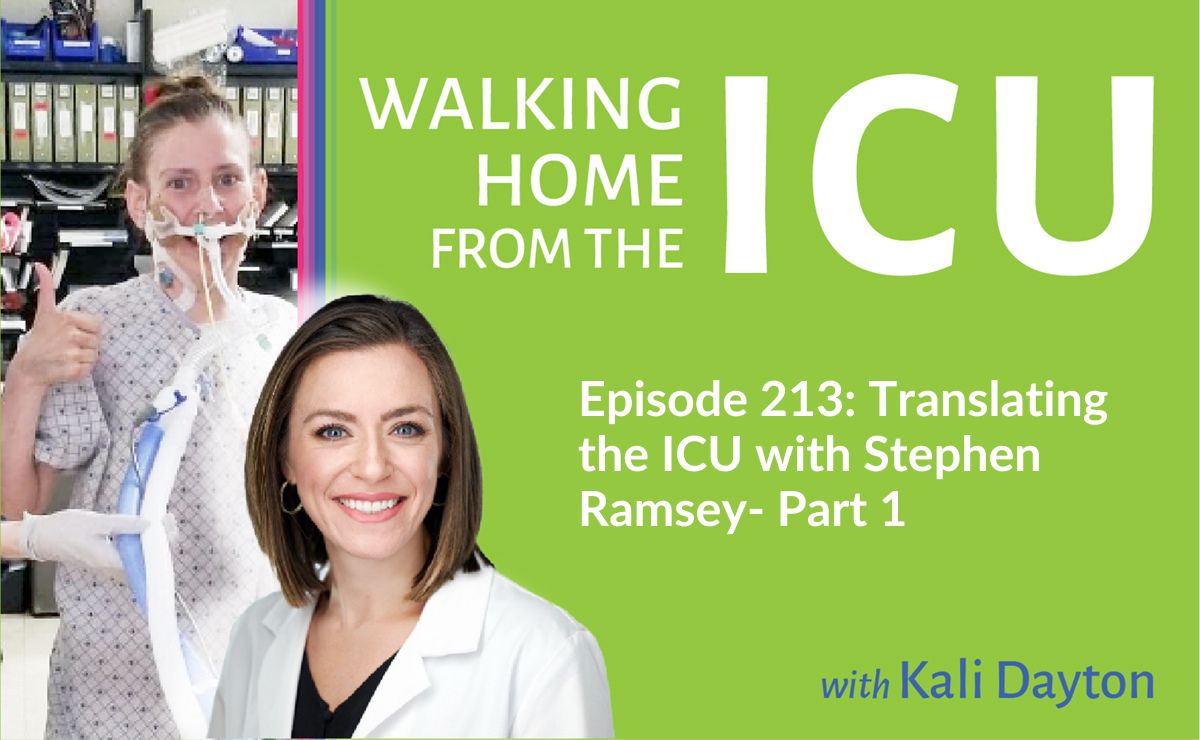
Kali Dayton officially welcomes Stephen Ramsey — CVICU physical therapist, creator of the Ramsey Protocol, and lead author of the ELSO guidelines — as the newest member of the Dayton ICU Consulting team. In this kickoff episode of Translating the ICU, Kali and Stephen explore why physical therapists and occupational therapists are often rotating generalists in the ICU rather than dedicated specialists, and what needs to change to elevate rehab’s impact on critically ill patients.
Episode Transcription
[00:00:00] This is the Walking Home from the ICU podcast. I’m Kali Dayton, a nurse practitioner and ICU consultant. I help teams create awake and walking ICUs through evidence-based sedation and mobility practices. By hearing from survivors, clinicians, and researchers, we’ll explore how to give ICU patients the best chance to walk out of the ICU and go home to survive and thrive.
Welcome to the ICU revolution.
Okay. Welcome to series one of Translating the ICU with Steven Ramsey. We have Steven Ramsey back with us, who’s been previous episode, but we’re gonna just start from the very beginning. [00:01:00] Steven, can you introduce yourself to us? Sure, yeah. Thank you again for having me. I’m Steven Ramsey. I work in Atlanta, Georgia.
I work at Piedmont Hospital, which is a large non-academic facility, but we just have a really high acuity, so I’ve been really fortunate to be there for 11 years and working with some of the sickest patients in the country. So I got my start there because I realized I didn’t know what I was doing, and I wanted exposure to a higher level of care, and got, was, again, fortunate to have great mentors through that process.
And I’ve been in the CVICU now for 10 or 11 years, working primarily with patients on mechanical support. You may also, I don’t like to talk about it much out loud, but you may also have seen me do, like, point-of-care ultrasound stuff. So my, the tagline is the POCUS PT, so I also teach some continuing ed courses with that.
So I’m glad to be here. And I guess this is the official announcement that Steven’s joining the Dayton ICU consulting team. And when I talk to people about [00:02:00] Steven, I always say that he’s kind of the god of all things CVIC mobility, and true leader and disruptor in this realm, created the Ramsey Protocol, which he talks about in his previous episode, which we’ll continue to touch on.
And so Steven and I both recognized an opportunity to provide more didactic on this podcast. Cl- case studies, critical thinking, a lot of application. Steven’s gonna be doing his own series on this podcast called Translating the ICU with Steven Ramsey, and this is gonna be for all disciplines, but provide a lot of- Very specific, high-level critical thinking and application to real case studies, maybe some theoretical case studies that will help empower the listeners to bring this back to the bedside.
I totally agree. I think this is timely. As we just walked away from CSM in February, I felt like the, there’s a big identification of this, hey, we want to get to this level as PTs, but in general in the ICU, we want to take [00:03:00] great care of patients. And what we felt like we needed was a little bit more understanding of the basic physiology and how that relates to pathology and pathophysiology, and that’s the stuff that I love.
If anybody that I’ve worked with is listening, you know that’s what I love to talk about. So I’m excited to get to talk about it here. And I’m glad you brought up CSM. For those that don’t speak PT, I’ve been having to try to learn their world. But APTA is the American Physical Therapy Association, and CSM is their just very big, the ultimate general conference that they have.
And Steven and I both got to participate in different sessions that were very disruptive to the PT world in regards to ICU. So I was part of a panel with Jenna Hightower and Heidi Ingle, and we talked about what early mobility should be. I shared the history of the bundle, all the things that you as listeners know.
But I also mentioned and begged and exhorted the PT world to move towards having physical [00:04:00] therapists in the ICU, not just visiting the ICU. And so we’ll talk about why that’s such a hot topic. And then Steven, what did you talk about at CSM? I was lucky enough to have a couple talks. So I talked with Paul Ricard, Ben Purrington, and Megan Gushurst on redefining our role in the ICU, which I think it aligns with what you just mentioned.
So how do we provide more value than just moving the patients? I think that’s something I’m really passionate about. And then I had the opportunity to talk a couple times on point-of-care ultrasound, so one in the context of assessing patients on mechanical support devices, and then one more in the outpatient sports realm, assessing muscle function with Johnny Owens, which was a lot of fun, too.
Well, when I brought up these topics and we had some discussion on Instagram, you know, my Instagram stories is where it’s an open mic, open forum. I pretty much will re-share any comment that comes into my DMs without filtering. It’s the safe place for people to anonymously say what they’re thinking, [00:05:00] feeling.
I found just so much education and insight where nurses will say things that to the PTs and OTs and vice versa, and RTs will weigh in. You can’t necessarily say those things to your colleagues ’cause it’s not as comfortable or easy. You can get, you know, retaliation and things like that, but this is a safe place.
So when we brought up these topics and we’re talking about these things, some PTs were really offended. Mm-hmm. There was some hostility, and I’ve realized that this is kind of kicking a hornet’s nest. You know, I guess, I guess just share with us why are we in this situation in which PTs and OTs rotate through the entire hospital?
From a nurse perspective, we would never do that, right? I had like six months of ICU training as far as the didactic courses, mentorship. Even after that, people were watching over my shoulder making sure I didn’t kill people in the ICU, right? And so we have this onboarding process where we want people to come in the ICU.
We need nurses in the ICU, but we also make it a safe onboarding experience. But [00:06:00] PTs and OTs can rotate through the hospital. Why aren’t they part of the ICU team, and what’s the kind of history of education for the ICU? So not every hospital practices that way, and so again, I’ve been fortunate to be at a place that has a contained staffing model where we have dedicated PTs and OTs to the ICU.
But I think that was actually a very forward thinking. So I think a lot of facilities, again, I think there’s a narrow view of what the rehab team can provide, and not that it’s not valuable, but that our role is mobilization, building strength, throughput, discharge, disposition. And I think that stuff is very important, and there’s a lot of evidence to say starting that earlier, short-term outcomes.
I think what, what is missed sometimes is that there’s a lot more that we can provide and to do those things safely. Even if our role is mobilization and discharge recommendation, there’s so much medicine and physiology that impacts patient performance, uh, with us, and I [00:07:00] think we don’t really get that in school.
So we get the basic conditions, medical conditions and pathology. If you’re in a really unique school, maybe you apply that in the critical care setting, but we’re not really getting invasive hemodynamics. We’re not getting diagnostic imaging in a way that’s deep enough for us to relate to patient care.
We’re not really getting pharmacokinetics and pharmacology in a way, again, that’s tailored to the ICU. So we don’t really get that. It is my belief that if I’m gonna go practice in the ICU, and this was my story too, y- we need to have at least Six months of mentorship. And so that might look like early on dida- very didactic heavy in walking through this with a mentor, later on being more independent and having some, some supervision.
So I know at our facility, it, it is rare for somebody to get through the orientation process in less than six weeks when done at that full capacity, and that’s per unit. So if you have three, four, five ICUs in your facility, you can imagine how long that would take to, to get through all that. So and we’ve seen just [00:08:00] anecdotally a ton of value to being contained in our ICU.
It, it would be really hard, I would imagine, to walk into an ICU and not have relationships with any of the inters- interdisciplinary team and then make recommendations on the patient’s short-term or long-term outcome or even the medical management. Imagine me walking into someone I don’t know and saying, “Hey, we need to change ventilator settings.
We need to change the medications they’re on. They’re not, it’s not supporting the patient well enough for us to do our job.” The first name basis long-term relationship that you have with that person and having a colleague-to-colleague discussion that often happens around patient care. The last thing I’ll say is we, I think we think of patients in black and white, right?
And I don’t think that that actually applies to the ICU. There is so much gray and there’s, it’s so dynamic. So even as the PTs or OTs, we think we’re like, “Hey, I think I have a good understanding of the physiology. I think I understand what’s happening with this patient. They have heart failure,” [00:09:00] and they may look very different from Monday to Tuesday, and their hemodynamic response may be very different each day.
So it’s not just the black and white, can I define these concepts? It’s the critical thinking piece that I think is probably the biggest gap that we have in, in our profession. And kind of on the behalf of the rest of the ICU team, it is so imperative that we have a relationship and trust with our therapists, especially for facilities in which mobility, the bundle, it’s very new or it’s not very progressive yet, or it’s just fragile.
My personal experience, obviously in a awake walk-in ICU is they were part of the team. They actually did see patients on the ca- care floor, but they had a prioritization of the ICU. They were still able to work with them twice a day. I think a lot of that has to do with the way that the rest of us manage these patients, right?
They’re already awake off sedation, sitting in a chair. They kind of swoop in and get them up and we could work with them. Nonetheless, I knew those [00:10:00] people, and I knew that they had so much expertise, and that was so much value. So as a nurse, I didn’t question them. I trusted them to go in without me, and I also trusted when they needed my help, that that was because they needed me, right?
And we just, we were all just really good friends. And so it was hard. When we had COVID and we had other people floating in, it was like And we saw an impact to the levels of mobility that patients were performing when other people came in. It was not the same skillset as a nurse practitioner when they would come in and give me a rundown on everyone in the unit and what they were doing.
There was such valuable feedback and information, and I Trusted them without question, right? If they were concerned about something, I’m like, “Absolutely, let’s do that,” right? “Let’s go in together and look at the patient.” And they just had assessments that I didn’t have, uh, during my brief interactions with them, and then hours later, they’re mobilizing them, they see something else.
That was so important, but if I was meeting someone new every three months, six months, it would’ve just really impacted the care at the bedside. Now that I do consulting and I’ve trained 14 teams, [00:11:00] it is really just, there’s just a spectrum of, of competency. And these are extremely bright, skilled PTs and OTs.
Some of them, many of them have taken Christian Perme’s ICU rehab course, which is so valuable. But then they say, “I got so stoked, so excited, I learned all this stuff. I came back to the bedside real excited to apply these things to really start to become an expert, and then I wasn’t allowed to even touch the patients that had these devices or these kind of things.”
So they meet a lot of barriers, and so how do you become an expert in something you’ve never been able to do? So we might get frustrated that we see a lot of hor- hoarieing to the chair with a trach, but in reality, that’s a lot of times the only access they’ve been given. And so now if we’re trying to get patients up with high ventilator settings on multiple vasopressors, in actual ongoing active critical illness, how do they know how to do that?
How do they m- have the skillset to screen for that if this is a new experience? But I, I think I have [00:12:00] offended PTs and OTs by saying, “I think it’s really important that we do some coaching or mentorship to work on these very specific ICU con- principles and skills,” because they’ll say, “We’ve been in the ICU for a long time.”
Right. But they’re not necessarily working with high critical illness and acuity, right? They’re working on a lot of rehab things, which is rehabilitation is a skillset. Huge skillset, right? Now that you’ve had someone extremely weak, delirious, orthostatic, orthostatic hypotension, that’s a skillset, which I also don’t th- know that if our ICUs are even that skilled at.
But anyways, it’s a different skillset when they’re still hot, still critically ill. But that’s a gap, and I don’t know that they’re, we really realize that that’s the gap. No, I think what you’re describing is so true across all my experiences when I’m talking to colleagues as well. I think that speaking as the PT to the rehab team, I think we have to take a second and [00:13:00] decide what we want our role to be.
If we decide our role is just do the bendy bendies and do exercise, the competency doesn’t have to be that robust, okay? So we can just walk in and make sure that the numbers look good on the screen, and we can ask whoever’s around us to make sure the patient’s okay, and we do our, do our exercise with the patient, and we walk out, and that’s fine.
If we wanna be experts in physiology, if we wanna drive some of the decision-making around the care of the patient related to their mobilization, related to their ventilator settings, related to the dosages of medications and which type of medication, not that we’re prescribing it, but if we wanna have an impact on that, the competency level necessarily changes.
And I think what’s been hard for me in my career, that term competency is such a negative word it seems, especially with the group that disagrees at what our level should be. So what you and I are not saying is people that are not competent are not smart, right? They’re [00:14:00] fully capable, very intelligent. I think it’s probably a misalignment of what we think our role is more than it is a level of understanding.
So I think once people agree that our practice standard and our level of practice is here, pretty high, then I think we’d all would say, “Well, then we’ve got some work to do to get there.” And that’s been, yeah, it’s been my experience. But I think it’s been hard as I’ve oriented 20-plus people over 10 years, I mean, much more than that.
I think the ones that are the most successful are independently say, “Hey, I wanna be, I wanna practice at the top of my license and do the most for the patient, and so I’m gonna learn as much as possible for the benefit of the patient.” So it’s not just to say, “Hey, I’m a PT and I know things.” This is for the outcome and the benefit of the patient, and I think that that changes our approach to, to orientation in general.
And absolutely. Competency is not synonymous with potential. Right. I agree. So, you know what I mean? These people that are so experienced in so many things that I see a lot of [00:15:00] potential, but the experience or the competency is not their fault. If anything, I think they’ve been blocked out from the opportunity to learn those things.
So when I come in and train teams, I’m like, “We’re gonna take sedation out as the barrier- Now we have this opportunity to learn, and it kind of seems like it’s up to the individual whether or not they want to learn. There’s just a lot of pride and security in what they’ve always done and what they know.
That’s human nature. And I don’t– That’s not just a PT thing. I see that with everybody, right? It’s like, “Ooh, this is gonna be different, but I already was feeling so comfortable with what I’ve done in the last 15, 20 years.” I see that especially with our seasoned clinicians, not just therapists. I mean, I have physicians being like, “I trained at Stanford 30 years ago.”
I’m like, “Okay, should we be doing the same things we were doing 30 years ago?” And also, there’s a sense of we have our doctorates, which is a huge accomplishment, and that shows how much potential they have, their capacity to learn. But I have my doctorate as well. My experience is in critical care. I’m not gonna show up to an oncology floor and say, “Give me [00:16:00] your bone marrow transplant patients because I have my doctorate like you do, you other acute care NP.
I can take your role.” We would never do that without, again, a lot of education, mentorship, the whole process of becoming safe to do that. So I would love to see rehab having the shared mentality. Physicians, they’re- they all have MD at the end of their names- That’s right … but they don’t just show up to IR and say like, “Okay, I’m an ED doc.
I can do all the things you do.” We don’t do that. So if we want PTs to practice at this a- advanced practice provider level Then they should be more excited to take on that kind of education and excellence. Yeah, and I think that’s what PT in general says, right? They want to be direct access and outpatient primary care, kind of advanced practice provider, as you said.
And I do think that necessarily means we need to step our game up from a knowledge standpoint. And I think just [00:17:00] from my own experience, what changed the narrative for me, I didn’t walk into the ICU as a PT and then garner this massive amount of respect. I think it was actually the opposite. I think the assumption was, right or wrong, “Well, you’re a PT, and so you know this.
I’m gonna put you in this box. This is kind of where you live, and so outside of that, you’re not really the expert.” And I think that really bothered me. Uh, and as you s- spoke about, like, none of us want to feel like we’re not capable or allowed to do something. So I think that really bothered me a lot.
And I think as I started to learn more, as I started to… I’ll use that same term again that has negative connotation, but as I started to increase my own competency, that changed my confidence level. So, like, I started to become a little bit more vocal. I started to interact in a different way with the team, and I think that really did change the, change the game for me.
So they stopped seeing me as, like, Steven the PT in this box and, “Oh, he, maybe he knows a little bit more about this. Maybe we can ask him to take on bigger roles that are, like, [00:18:00] mobility adjacent. Maybe we can ask him to assess their hemodynamic response after this medication. Maybe we can ask him to assess how they do so that we need to know do we need to increase their afterload reduction?
Do we need to increase their pressor amount?” Like, having that different scope and lens, which all falls under mobility but is a very different perspective. I’ve always tried to mentor in that way, and I– But I do think at baseline, as a mentee, if I’m the one hearing all this, I have to accept that I have to decide what I want my practice to look like, and am I willing to have the humility to get there and have the mentorship along the way?
Yeah, I think it’s been accepted for a while in some teams. Again, this is very variable by team. And you’re talking about a team that’s been well-established, and a standard’s been set, and you’ve been part of setting that, and you’ve created this residency program and this mentorship, this competency. Uh, I hear from other therapists, other revolutionists that are like, “I come on and I look back at documentation.
I don’t see any [00:19:00] documentation of whatever medication or drips these people were on. It’s like my colleagues didn’t think that was important part of their assessment or maybe they didn’t even know what those were,” which to me is terrifying ’cause I just never… It’s been this journey for me during this consulting to realize maybe they don’t all understand what amiodarone is or what these medications are or do.
But that’s a safety issue. But then you have the other side where sometimes PTs are like, “Nurses won’t let me touch anybody.” And the nurses say, “I didn’t know they understood vital signs.” But the team doesn’t expect therapists to know how to treat patients, and sometimes they do. Sometimes they’re coming from out- other facilities where they’re absolute experts.
Right. But they don’t now. The, the trust isn’t there. The expectation isn’t there. And, and also, it’s also not safe to say, “Okay, this person’s extremely competent, so all therapists must be prepared to practice at this level.” Like, that’s very unsafe. So when you have all this quick turnover or even from day to day, therapists function at different [00:20:00] levels.
You want them to practice at the top of their scope what they’re prepared to do, but if not everyone’s practicing at that level, that’s confusing. That’s not safe. Like, that’s so Yeah. Where do we go from there? Well, l- let’s call it what it is. The ICU is like a little group that you go to war with, right?
It is what it is. So it is a very high-functioning, maybe dysfunctional at times, group of people. It is a h- like you c- if you said any discipline, you would say your demonstration of competency is what matters. It’s not your title. It is how you practice, what you’re able to provide to the patients. That’s what builds trust.
And I think for, again, I’m painting with a broad brush, but I think in the PT world it’s like, “Well, I’m a PT, so I’m an expert in these things.” And I, I don’t think that we’ve understood that walking into the ICU, just like the physicians, the APPs, the nurses, the RTs, we have to demonstrate our competency, demonstrate our capacity to help the patients, demonstrate our ability to be a [00:21:00] part of the team, and then that’s what changes the narrative.
Like, that changes the game once you spend extra hours helping the nurse do something that’s not your job. You spend extra hours helping the RT run and get equipment for a patient that they’ve had to bronc three times in a row. Like you s- and you helped- You jumping on codes. You jumping on c- uh, all that stuff is us saying, “Hey, we’re here and we wanna be a part of the team, and we provide value outside of what you think we do.”
But that does not happen just because you graduate school, okay? That happens when you’re in the environment, you’ve demonstrated competency, you prove the value you can give to the patient, and that honestly i- is months to years. But to your point, I mean, you could do that at one facility and go to a different facility and it starts all over.
You don’t bring any merits with you. I don’t get the idea that like, “I’m an expert, I should- I’ve done all these things.” Like, yeah, okay, well then, then it should be easy to get the respect of the team and prove your value. That’s great. Well- There’s- To be fair, though, [00:22:00] right, each unit is its own ecosystem with its own politics, and so the rest of the team has to be willing- Yeah Let the therapist show them what they know, what they do, right?
I’ve kind of ridden the ride with numerous people where they are practicing at one level in one hospital, they go to another, and now everyone’s sedated. Nobody really cares about mobility. The physicians are super against it. The nurses want to sedate. So, like, then they’re really stuck, and that’s exhausting.
But then, you know, they do have to start from the ground up. Yeah. But then a part of the barrier is they get rotated, right? Yeah. So when I’m training these teams and we’re working together and they’re starting to make progress, three months later, their PTs and OTs get, get shifted. Yeah. And now you have a whole new group coming in.
It really kills or impacts the momentum. Of course, mobility should not just be dependent on which therapists are there that day, right? Yeah. Right. But especially in the early phases, it is fragile, and I am just… It kills me, and I will beg them not to switch for [00:23:00] another, like, six months to a year at least.
When you have leadership that doesn’t understand the ICU, the unique beast that it is, the competency that it requires, they’re just Beholden to these pressures of staffing and productivity and all these other things that are very conflicting in the ICU that really hold us back. I love what Heidi Ingle says, that we should be focusing more on optimization than disposition in the ICU.
Right. But that is, like, a foreign concept to s- the leadership. I mean, they’re under so much pressure. I would love for the ICU to own their own therapist instead of it being part of the rehab department- Yeah … so that they could just keep them, train them, absorb them into the team as it should be. Yeah, I think there’s a lot of hospitals that have pushed for that.
I think we- I know we have, uh, maybe annually for 10 years. It’s hard. You describe a real problem, right? That doesn’t just live with the therapist. It’s totally true that rotating and not having contained staffing is a momentum killer, [00:24:00] and is dependent on the person that’s rotating in, their philosophy, their capacity to invest the time.
It’s not just a pick up and keep moving kind of thing. Maybe at the most established hospitals with a small group of rotating therapists, it can sustain, but it’s just really… That’s not a realistic expectation, and I do think from an administrative standpoint, looking at our therapist as, you know, the only objective things we look at is basically patients seen or units billed.
And maybe if you’re in an advanced facility, you were sharing numbers from one facility that I think had a robust amount of quality outcomes, key performance indicators, if you will, but most places don’t do that. Most people don’t look at length of stay or value added outside of billed time, and I think that’s gonna be our biggest…
If you wanna talk about what is the barrier to changing the mentality of the ICU for PT is it’s gonna have to be data collection and publication to prove the value, but it’s something that’s not quantifiable [00:25:00] always. So I can’t- But, well, well, here’s a reference to an amazing study. Johnson 2019, it was from a CVICU.
They increased their staffing of PTs and OTs dedicated to that ICU from two to four clinicians. Length of stay in the ICU decreased by 3.6 days. That’s huge. We need to be throwing that everywhere and saying, “We can’t afford not to have them very specialized, practicing at a high level, and living in the ICU.”
Yeah. Right. As I was trying to define like, all right, what does early mobility data tell us and how do we change what we think we should provide? I mean, I was looking at the, like, randomized, the meta-analysis from 2025 over 60 RCTs that were, I think it was like 8,500 patients. But basically, yeah, it, it talked about some of the clinical endpoints that were impacted, length of stay, ventilator days, which we all know and we have in our rhetoric.
But there’s, it’s moderate to low certainty of [00:26:00] evidence, right? And we’ve had these articles that you have discussed on your podcast that have maybe been inconclusive or even refuting some of the kind of historical data. But the biggest key finding in my mind was that timing seemed to matter more than intensity, and I think that we all agree with that, right?
That’s 100% true because we experience that on a daily basis. But again, these are the nuanced things that you can’t walk in and just do and know. Like, this is some of the part that we have to understand what the data’s telling us. If you’ve been listening to this podcast, you’re likely convinced that sedation and mobility practices in the ICU need to change.
The ICU community is facing incredible difficulty with the trauma from the pandemic, staffing crisis, and burnout. We cannot afford to continue practices that result in poor patient outcomes, more time in the ICU, higher healthcare costs, and greater workload for the ICU team. Yet the prospect of changing decades of beliefs, practices, and culture across [00:27:00] all disciplines of the ICU is a daunting task.
How does this transformation start? It can begin with a consultation with me to discuss your team’s current practices, barriers, and to formulate a plan to help your ICU become an awake and walking ICU. I help teams master the ABCDEF bundle through education, consulting, simulation training, and bedside support.
Let’s work together to move your team into the future of evidence-based ICU care. Click the link in the show notes of this episode to find out more.
And then understand how we can tweak it going forward with new roles that we might propose we should do. And I really hate that we’re so dependent on our therapists to jump in and beg and beg and fight and advocate to see these patients that the rest of the [00:28:00] team thinks are not appropriate for mobility, and mobility’s not a priority yet, X, Y, and Z.
But that’s the reality of where we’re at. And I loved joining the APTA conference in Salt Lake with mostly cardiovascular PTs, right? Mm-hmm. Yeah. Um, and it was such a, a chill presentation. It was 90 minutes, but really it went over- Here are the barriers and here’s how you approach it. Like, here’s how you talk to nurses.
Here’s how you speak that language. And I wondered if it would be meaningful, but people were excited ’cause they’re like, “I don’t kn- I haven’t known how to approach these situations, but I face it all the time.” And these were the cream of the crop, the best of the best- Right … therapists, but that’s, th- to me, does- said more about the environments that they were in, right?
Even the most progressive units were still fighting the barrier of how do I ask the nurse to turn sedation off? How do I dispute this? And I think having more training as far as what sedation is, what it does, when it should be on, when it should be off, what do we do when patient’s agitated, what do [00:29:00] we do when they’re not perfectly hemodynamically stable, that’s not something they learn.
And I was at another system just, I think, last week, and was talking about the same problem and mentioned it’s really hard when people rotate through and they’re not necessarily PT, ICU competent or specialized, or s- I can’t remember the word I used, but whatever it was, it, it triggered. Someone yelled out, they’re like, “They are.
Everyone has, that comes to ICU has to be ICU oriented,” or something like that. And I thought that’s probably true, but what is that orientation like? If- Right … your therapist, they said that they rotate every three months, and yet they’re ICU competent. Yeah. As a nurse, I was not ICU competent after three months of being in the ICU, even with all the classes, all the mentorship.
So are you ICU competent? And then how do they jump into these discussions where they’re challenging- Yeah … medical management- Yeah … for mobility, but they’ve never been trained on how to make that [00:30:00] discussion, and they’re gonna be gone in three months. Uh, that goes back to, uh, competence breeds confidence.
Like, your knowledge and your understanding of the patient’s situation, the bigger picture context, and even down to the minutiae of the physiology and the support they’re on drives the conversation. But you have to be confident. Like, you have to know that’s true and be resolute in that because you will, for my entire career, I feel like I’m hitting my head against a brick wall that never moves, and it’s just gonna be there.
And I think, uh, maybe this was you, maybe other people said, described it as like swimming against the current. That might’ve been Heidi as well. I agree with that. I think it’s… That is, it is exhausting, right? It’s exhausting to always be on your game to argue the points, but it’s also the most valuable thing you’ll ever do in your career.
So I do think, yeah, I totally agree, it’s hard. And, but even when I started in CCU, uh, everybody that was ventilated was sedated, no questions asked. To even talk to the nurse about like, “Hey, can I be there during [00:31:00] a spontaneous awakening trial?” That would… They would’ve been like, “What are you talking about?
Like, why do you want to be there?” So I think even if you’re at a place where you’re like, man, I think the barriers are so significant, interdisciplinary barriers, there is hope in the steady plodding along, the continuing to push. There’s hope that it takes, honestly, it took one case- Of moving somebody who was on multiple inotropes and a presser on a ventilator that they would’ve said, “Don’t even wake him up.”
It took one successful mobilization effort for the team to say, “Oh, okay. So now how can we apply this to other patients?” And I think, and there’s so many stories like that, that it takes that grassroots steady plodding along that changes the narrative. So to the people out there that are super frustrated with that, first of all, it’s real, and it is frustrating.
But there is hope at the end of it if you can get to a place where you can stay there for longer than three months, right? That would be important Yeah, and I wish I had, like, the magical recipe or advocacy packet to say, “Here’s what you [00:32:00] do to g-“, but honestly, like I, I still face those struggles with the teams that I’ve trained, even with so much support and the whole team begging for them to stay, stay, and stay, and then it, they still- Yeah
rotate. So a- and part of it, I remember talking to one director, and she’s like, “My therapists won’t go for that.” So part of the fear was- Yeah … the therapists themselves will have a problem, which I think kind of goes back to how do they view their role? How do they view- Right … the ICU and the skills required?
A- and my hope is that when we say, “You’re gonna be in the ICU,” that you draw therapists that want to be in the ICU, just like ICU nurses are like- Yeah … “I’m here because this is what I want to do, not because I am rotating through the ED, the acute care, the oncology floor, the L and D. It’s just part of my rotations.”
I can’t imagine if nurses did that. It would be- No … so unsafe. I mean, don’t throw me into labor and delivery. I will… Absolutely not, right? Yeah. But we all have the same degree, and that’s something I hear all the time is, “Well, we all have the same degree.” I’m like, [00:33:00] “No, it’s not the same,” but I think they need to see it different themselves.
Yeah, you hear, I, “Hey, I want variety. I want, like, these different flavors to my job.” I do think, though, we do have to acknowledge that the ICU is a specialty practice area, and these same people wouldn’t be saying that about these other specialty practice areas probably, like, that exist in our profession.
But I think the ICU, sometimes if the perspective is it’s just another unit with the patients that are just slightly a bit sicker, then it’s probably the wrong perspective. But I totally understand the thought of, like, “Hey, I’d love to be able to see the ICU, but I don’t want to stay there forever.” But I do think if we’re defining competency for the ICU, I do think that there is a relational component that necessitates somebody being there for long enough to build the relationships, and then there’s a competency component, and that’s not to say other people are not smart enough or competent, but there are just extra things to learn.
And, and it’s just even if you wanna stay out at the baseline, there’s different lines and different drugs [00:34:00] and different devices, and so you can’t just see that every six months to a year when you end up rotating back through. And, and you can speak to this. How often does it change? How often does our standard of care for these patients on all of these devices change?
It changes regularly, so you can’t learn that just by rotating. And then who are you mentoring with? I just think about my onboarding as a nurse. I was being trained by nurses that had been there for 10 to 15 years- Yeah … that were total bosses, and they were good at educating, and, like, I just had such a special experience- Yeah
training with them. But if you are being mentored by someone who has accepted a certain role within the ICU, they’re gonna see the Patients after they’re extubated or lower level patients or they’re gonna be Hoyering or, like, not to, again, brush with a broad stroke, but if that’s who we’re, the experts that we’re mentoring with, like, that is passed down, right?
We are just all a product of our own experiences and [00:35:00] training, and so we perpetuate those things from our predecessors. And that’s why I’m so excited, I guess, with this announcement that Steven’s gonna be doing coaching. To have an expert that you can meet with and go through case studies and bounce ideas off of and have an outside objective, uh, perspective, because you can sometimes feel like the crazy person.
I asked this in that APTA meeting, “Raise your hand if you sometimes question your own judgment and feel like the crazy person because of your team questioning you.” And everyone raised their hands, right? I also asked, “Raise your hand if you’re afraid of nurses,” and they all raised their hands, right? Yeah.
Myself included. We love nurses, but just the reality of that environment, how do we navigate that? And so I’m really excited for Steven to be able to meet with your rehab team or even one-on-one personally and to really provide that intimate coaching so that you have an expert to bounce ideas off of and have the validation that you’re not crazy, and then what do you actually do about these situations you’re in.
Yeah. I’m really excited. I [00:36:00] think just because of my story, I think you mentioned, like, potential for people. I would say, if I’m being honest, and this is not humble, I think I have, uh, compared to the team that I work with, I probably have the least potential, okay? That’s just what I’m gonna say. And I think that the separator is that I just have no limit to what I think is part of my scope of practice for me to learn, and so that’s, like, what breaks down some of those barriers.
But if you’re listening and you’re like, “Man, one, I don’t know if I believe or agree with this mentality that we should be dedicated to the ICU and all that stuff,” I would say just consider what you want long-term your role to be. And then two, if you say, “Hey, I really want that, but I don’t feel like I have the support,” then I think, yeah, this is a great opportunity to be able to talk through really complex cases and something that I love to do and probably do on my free time more than anything.
So I’m just really excited. And I feel like some of these really awesome rehab managers that are like, “I wanna support my team, but I’m [00:37:00] not an expert in this,” right? I think it’s amazing that rehab has these three very different disciplines- Mm-hmm … throughout an entire hospital. You know, my nurse managers almost always had ICU experience.
They were at least nurses. Like, they had some context into our experiences and needs at the bedside. But what a huge job. Sometimes it’s an SLP over all the PTs, OTs, and SLPs. Yeah. And so for this to be an extra resource to say, “I do wanna support my ICU rehab department. We’re gonna have these meetings with Steven Ramsey to, to actually provide that support that I, as a educator or manager, I personally can’t provide,” and you’re already in charge of so much.
So we wanted to make sure that Steven was available to everyone that needs him. He’s also gonna be d- going on site with me to teams, especially CVICU teams, to provide a really high level… I think about some of these CVICUs that I, I don’t, uh, I don’t wanna offend people, but we say the quiet things out loud here, right?
So I was just at AONO. [00:38:00] I had a booth there, and all these nurse leaders were passing through, and I had a video of patients awake, mobilizing, usually vented, some- sometimes on ECMO, and they would nod their heads. And I’m like, “So d- when you walk through your ICU, most of your patients look like this?” And they’re like, “Yeah, our post-CABG patients, yeah, look exactly like that.”
Mm-hmm. I’m like, “Yeah, your post-CABG patients. Yeah, I’m sure.” Right? I’m like, so they think that they’re doing it just because that this certain subpopulation is doing it, or it may be some of their ECMO patients might be mobilizing. But I don’t think there’s a very clear, high standard of excellence that they know that they’re supposed to be attaining to.
But a lot of times, the perception is, we already do it. Right. And then I say, “Okay, maybe your CVICU patients do, but what about your neuro, your trauma, all your other patients?” So I don’t think they really understand what the standard is. Yeah. No, I think it’s being redefined, though, in real time. I think that’s the hard part.
I think we have ideas, but I don’t think that that’s agreed upon, generally speaking. So I do like that you’re able to give those examples and [00:39:00] speak from your experience of going to mentor at, at various places, ’cause I think you don’t know what you don’t know, and oftentimes we get so inundated with our own local culture that we don’t actually know what’s going on everywhere else.
Like, just literally doing the balloon pump research early days, I was like, “Oh, everybody’s probably doing it,” you know? I’m just late to the game. Come to find out, like, nobody’s doing it. And so I think that’s an example of, hey, you don’t really know what’s going on out there until you peek your head out and start to look around.
So I’m glad you’re able to share all that important experience. ‘Cause I think I, again, for many years I assumed everyone’s doing it. Even throughout my experience of consulting, there have been certain elements that I just assume are already in place that I’m building on, and then I get deeper into it and I’m like, oh, that foundational piece actually wasn’t in place.
Things like SBTs. You know, they document SBTs, I assume they know it, and I still don’t speak really fluent RT, right? That is a very niche expertise. So I’ve had a lot of trust that that was already in place, and then I realized that actually [00:40:00] wasn’t. So we kind of rewind and go back to the basics with that.
But that’s what people don’t even realize is happening. Something that’s why it’s so important to have expert mentorship, but that’s not available most places. So Steven’s available now, and I love your thoughts on mobility not being just for exercise, but it’s a physiology test. Yes. Will you speak more to that?
Yeah, so I think that was an idea that came out again of this combined sections meeting with the APTA. As we were talking about Redefining PT’s role in the ICU. Again, this was a PT conference, so I’ll speak specifically to PT. We were taking all of the data from early mobility, and as I mentioned before, I don’t think any of it speaks to anything other than mobility as an intervention.
It’s just a treatment, and we track outcomes based on it. And I think that in my own personal practice, I feel like sometimes the least important thing I did in a patient’s room is actually move them. There was a lot of other things I felt like I was adding and providing that was valuable, whether it was [00:41:00] recommendations on medications to optimize the patient, recommendations on different devices that would better support their physiology, you name it.
And I felt like that was a lot of it, this re-optimization, as you said earlier. And so the talk was about how do we redefine what our role would be in an ICU that, yes, emphasizes mobility and doesn’t say that that’s not important, but says, yes, there’s more we can provide. And we used some case examples with that in that talk.
But I think out of that, it’s not thinking of PT as a physical therapist, but PT equals physiology tester, because at the end of the day, while I’m moving a patient, the most important thing I think I can provide is feedback to the medical team of how they tolerated it or didn’t tolerate it, and then again, recommendations to them about what I think would be something to optimize.
So I tell my team all the time at Piedmont, you go to the team not with a problem, right? Don’t just go with a problem, but go with a solution to the problem. And guess what? You may be wrong, but that’s why we [00:42:00] have multiple differential diagnoses that we come with and say, “Hey, I think if it’s volume, here would be the treatment.
If this is just a cardiogenic problem, here’s the treatment.” And letting– Like inserting yourself as part of the decision-making team. I think that, by the way, if you, if you’re listening, you’re like, “Man, I’m frustrated as a PT like I was in 2017,” you want to talk about extreme value and extreme feeling like an extreme owner.
I think that changed everything for me. That changed my ca- yeah, why I wake up and why I go to work. So it was a big deal for me. And I feel like you guys get boxed in like, “Hey, that’s not in your scope. Why are you on some ventilator management? Why are you…” A- And so push back. Yeah. I think about my perspective.
I started in the ICU with my associates as a nurse Even worse than that, I had my associates for three years. I gallivanted through the Middle East and Central America. Then I came back, and I had this license I had never used, and so I was com- a complete hazard, right? [00:43:00] So here I am with my associates, and I was making recommendations for medication, right?
After some experience and time. No, I wasn’t a prescriber of those medications and those interventions, but I would bring those ideas to my nurse practitioners or physicians. They would listen to me. A lot of times they would follow through with that. They would write the orders. So then to have PTs been to- be told, “No, you’re not a prescriber.
You’re not involved in offering those suggestions. Stay in your lane,” that just doesn’t make sense to me. You’re advanced practice providers. RTs make recommendations. RTs a lot of times can cancel medications, order certain breathing treatments, so why can’t therapists, if they are, again, trained and competent- Yeah
why can’t they fulfill that role? But I don’t see them oftentimes challenging that or wanting to fulfill that role because they’re not empowered to do that. Yeah. But it provides so much information, even just, you know, I was remember, um, I was on site with a team and we were verticalizing a patient and I texted Jen.
I said, “This patient’s been so orthostatic for [00:44:00] so long. What would you do?” Mm-hmm. And she’s like, “I would give midodrine and put her in compression socks.” And I was like, “Oh my gosh, duh,” right? Why didn’t I think of that? But that was a physical therapist providing- Suggestions for medical management. Yeah. And that is what we so desperately need.
Yeah. I do, I agree with that. And again, not to reference this again, but I will, the, the talk at CSM, I think I gave an example of you, if just going to the team with the problem of hypotension and not a solution, the medical team is fully capable of discerning that, differentiating what the cause is, and treating it, but sometimes that’s days of seeing it and hearing it.
And sometimes they’re too in… And, and you can speak to this as a provider in a high acuity ICU, you’re, you have, what, six to 10 patients, and you’re inundated with all of this stuff. And by the way, when we asked medical providers what they felt like where PT was on their prioritization, it was often low, especially in a CVIC when they’re resuscitating patients, recovering [00:45:00] patients from the OR, six people are getting br- Like, I mean, there’s so much stuff going on that I’m like, “Hey, my patient’s hypotensive.”
And they’re like, “Well, I’ll have to think about that later.” So I think it just out of necessity where I work, it’s like I need to be able to come with some, like, hard-hitting facts and some recommendations. And thankfully the trust is there with it. It leads to hopefully some change in management. That’s such a huge piece for us is, yeah, what are you providing to the team?
And then are you going with more than just here’s the problem? Because I do think that changes outcomes, and we don’t measure that in the early mobility data ’cause it’s not part of our metrics yet. But I do think, you wanna talk about decreasing length of stay, manage the physiologic intolerances early, get them out of the ICU earlier, get them home earlier, and then maybe, again, not even just out of the ICU, but to home and not to rehab.
I think some of that stuff, as simple as managing hypotension that we see early days in the ICU could change the long-term trajectory. And here’s a more, like, generalized example of like, for example, why [00:46:00] PT should be very knowledgeable of ventilator management. When we’re doing SBTs, there’s been this mentality of, “Well, we’ll do mobility after the SBT,” right?
And then they don’t pass the SBT, and then mobility falls off the radar, right? Instead, we need a physical therapist to know what happened in regards to work of breathing, what kind of support do they need. Do they need more support to empower mobility? And then give that feedback to the providers. ‘Cause if someone cannot sit up, up at the edge of the bed- Without ventilator support.
Yeah. And they need, we need to increase that support. I wanna know that before I order an extubation, right? So- Yeah … we need them to be challenging them and giving that feedback, ’cause yes, we wanna decrease time on the ventilator, but sometimes it’s more beneficial, it might prevent a re-admission, re-intubation if we get that kind of feedback before we extubate them and maybe give them a little bit more time.
Yeah. So, but unless they know that information, we are, we’re missing that part of the team. Yeah, and I think that’s such [00:47:00] an important example, and you’re speaking my language because, again, early on when I knew nothing about anything, I thought, “Well, all right, moving people on the vent has gotta be better.”
And then that evolved to like, all right, well, they’re awake and on the vent, but they’re on this assist control mode, and again, in the cardiac ICU, typically pressure control, and I was like, “Well, what is that doing for the patient? Am I actually really getting a physiologic assessment or a ventilatory assessment?”
And then starting to argue for an intermittent mode or even a fully spontaneous mode. And so I think it’s, again, these are stages, so I think this is where it gets a little bit overwhelming for people, especially when you’re first starting out. It’s like, I wanna do all that stuff, but I can’t just walk in and start doing it.
But it does start with walking in with the idea that I wanna move people on all these devices. Then, how do I optimize the devices to support the patient? And then how do I, third step is, how do I minimize the support to assess the physiology to make recommendations? And I think it does happen in series.
It doesn’t happen overnight. So who I was year one when I had the nurses at… [00:48:00] This is a small hospital and nobody’s listening right now. So I would ha- the nurses, when I first graduated, I was in a cardiac ICU in a small city. I, the nurses would disconnect the arterial line, the central line, everything, and just say, “Go.
Walk ’em.” And I was like, “Okay, I’ll do it. That’s my job.” And it, that, it actually took me about four to six months of doing that before I was like, “Hey, something is not right here.” And so it can start there, believe it or not. You can start there and still get to the point where you’re like, “Man, not only do I want the lines, I want you to throw a swan in while we do exercise because I wanna see their response, and I wanna assess their stroke volume changes.”
It doesn’t happen, again, overnight. It does take some time. And I think the ICU in general, and maybe this, I don’t know what, if this is specific to PTs as well, but we really don’t tolerate mistakes. It’s a point of pride, it’s a point of fitting in, which is a very unsafe environment. It’s not psychological safety.
So I feel like part of our barrier is we don’t wanna [00:49:00] try something new or challenge it ’cause we don’t wanna be wrong, we don’t wanna ask questions, we don’t wanna make a mistake. Especially when you’re the only one testing these boundaries, that’s a really scary place to be. I have so much respect for revolutionists, those lone visionaries in an ICU being like, “So I’m thinking we should try this thing that no one else believes in and feels really new and scary, but I’m pretty sure it’s safe and it can work.”
I have so much respect for that, but I think that’s part of our barrier is we’re afraid to make mistakes. But when you listen to these great experts like Steven, Heidi Engel, Jenna Hightower, you guys learned through mistakes. Yeah. Well, uh, can I say this? There’s a fine line between ingenuity and insanity.
So I just believe that. Like, I think the things that sound crazy, as long as there i- there’s a true need, like I– there’s a value I’m providing, right? We’re not doing something to do something. It’s not, “I just wanna see if I can move this person.” That’s just cool. Uh, if there’s a true value and a true need, you see a gap that we can address, then even if it sounds [00:50:00] crazy, it’s probably at least you’re having the right conversations.
And it is scary, though. I mean, it is… Like, yeah, you think about these people, I’ve talked to how many hospitals that have started mobilizing femoral balloon pumps, and they had a bad, I say bad outcome, like hypotension or maybe migration of the balloon in the first few weeks, and it just derailed the whole program, and that’s scary stuff.
Like, when you’re thinking about being progressive and something doesn’t go perfectly, yeah, the team is gonna take notice of that. At the end of the day, if you reframe that to anything in healthcare that’s a practice, there is a known set of potential side effects or complications, and we treat mobility as if it’s 100% safe, and it’s not.
Even the right decision for the right patient at the right time can lead to a bad outcome, and that’s not the PT’s fault, even though we shoulder that responsibility. And by the way, the wrong patient at the wrong time, uh, with the wrong intervention can still end up okay, and people think it’s fine. So I, I like, by [00:51:00] the way, I like the accountability that we would show to say, “Hey, I feel responsible for this.”
But it is truly a multidisciplinary kind of approach. It should be And it kind of comes back to having expert support and guidance. Yeah. I, uh, was telling these nurse leaders, I’m like, “You’re expecting your clinical leadership to lead something they’ve never done before.” Yeah. When else do we ever do that?
We don’t just say to our providers, like when I was in, in P school, they’re not like, “Okay, here you learned how to put in a chest tube in Sims. Now go do it at the bedside by yourself.” Like, or, “You watched it on a YouTube video. Go put that central line in.” That was never how we learned it, but that’s how we keep on expecting mobility to be.
And so obviously we need proper didactic, proper coaching education, and bedside support, and that’s where I’m excited to send you to the bedside of these ICUs and have you there and walk in the hallways and stand at the doorway and coaching them through it, which is so valuable. But if you guys are feeling like this is really [00:52:00] overwhelming, you’re not alone, and that’s reasonable, right?
These are big changes. I think we put a lot on revolutionists to just challenge these huge beasts of barriers, but we want to be providing even more support. So Steven is starting a whole series of walking you through physiology, actual knowledge didactic, critical thinking, application to real case studies through his whole series.
And obviously, again, coaching, consulting, that’s an option. But we’ll have online courses coming out soon as well. So we’re presenting these big ideas, this big need, this revolution, but we are gonna follow through with more supportive resources for you guys. 100%. Thank you for letting me be a part of it.
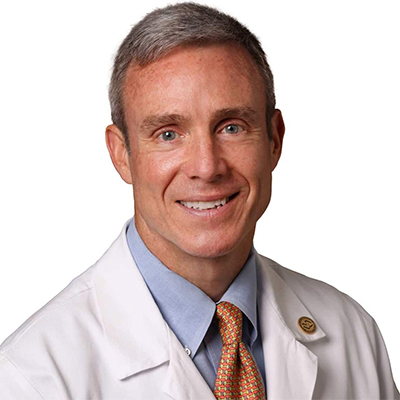
Thank you for this huge role you’re playing in the ICU revolution. Steven’s the author of Steven Ramsey, or The Ramsey Protocol, as well as the lead author of the ELSO guidelines. He’s legit. If you guys need help talking about how to get him into your unit, email me. We can work out the whole return on [00:53:00] investment conversation, ’cause he will help t- save your teams millions of dollars annually.
So utilize this amazing resource you have at your disposal now. And the last thing I’ll say, and I don’t like to talk about this stuff, but again, if you are, “Hey, I’m an expert in mobilization, and I wanna start using diagnostic ultrasound,” so I have a separate critical care ultrasound course for people in the ICU that, that is coming out now.
So, um, you can see that at the Focus PT as well. Amazing. Yes. And if you feel like our team does a really good job, but are we doing everything we can? Are we really cutting edge, innovative? That’s what Steven can help you understand. I mean, he’s done vast literature reviews on all of this, knows what’s possible, has practiced personally at a high level.
And so I think that’s important, too, ’cause again, we get very comfortable with where we’re at, but is there more that we can do? But we don’t necessarily have different experiences or experts at our disposal, but now you do. So thank you so much, Steven.[00:54:00]
To schedule a consultation for your ICU as well as find supportive resources such as the free ebook, case studies, episode, citations, and transcripts, please check out the website.
Transcribed by https://otter.ai
SUBSCRIBE TO THE PODCAST


 When patients are so ill that they require a ventilator in the ICU, the antiquated approach of heavy sedation and immobilization should be avoided in order to help prevent the immense burden of physical and cognitive disabilities suffered during survival. To understand this better, listen to Walking Home From The ICU. You will see what ICU consultant Kali Dayton provides to your team.