SUBSCRIBE TO THE PODCAST


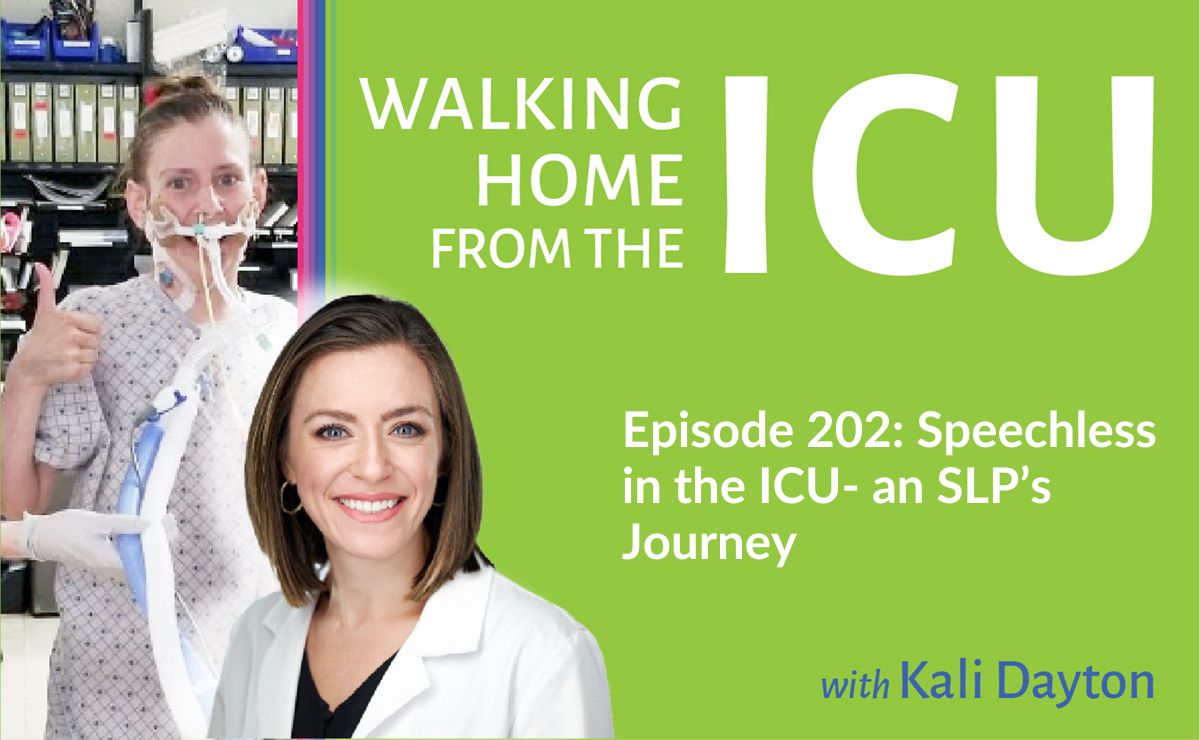
Vanessa Abraham is an expert speech language pathologist. She had given innumerable youth access to communication. Then she found herself speechless in the ICU. Dr. Jared Rosen was a medical student with Vanessa and was a key player in humanizing her journey through critical illness.
Episode Transcription
Kali: [00:00:00] This is the walking home from the ICU podcast. I’m Kelly Dayton, a nurse practitioner and ICU consultant. I help teams create awake and walking ICUs through evidence-based sedation and mobility practices. By hearing from survivors, clinicians, and researchers, we’ll explore how to give ICU patients the best chance to walk out of the ICU and go home to survive and thrive.
Welcome to the ICU Revolution.
It is time to circle back to the experts, the survivors. If you haven’t listened to episode 103, I insist that you go back and listen to that episode. Before or after this one. If you’ve heard any presentation or [00:01:00] podcast I’ve done before, you know that I am deeply passionate and even obsessed about nonverbal communication.
We’re going to lean into the intimate insights of communication in the ICU with a communication expert and ICU survivor, Vanessa and Dr. Rosen. I am so excited to have you guys on. Let’s just jump to it. Will you introduce yourself to us, your professional background, a little bit about you. Oh, hi. Thank you for having me on.
Um, yes. My name’s Vanessa Abraham. I am a certified speech language pathologist and I am also a patient, um, that was on the receiving end of speech pathology services in the ICU. I’m now a critical illness survivor speaking. Um, wrote a book called Speechless about my medical journey and what it’s been like being a speech pathologist.
Unable to communicate. That’s. Basically use anything from eye gaze to a passing your valve to obviously now verbal communication. Also the tube fed. So I’ve had every experience being a speech pathology [00:02:00] patient in the bed. So that’s a little about me. I will let Dr. Rosen take it from there. Thanks for having me on, guys.
So I’m Jared Rosa and I’m a pulmonologist and critical care doctor. I had the pleasure of getting to take care of Vanessa when she was critically ill in the ICU. It was actually my very last month of medical school that I got to take care of her and it was very special. She was the very last patient that I had as a student and, and she and I kept up during my residency and fellowship training.
And now here we are several years later still talking about it and you know, hoping to share this Vanessa’s story and what both of us took away from it. And I think one of the people can take away from her story as well. And I have to ask, because you mentioned that you were supposed to be on vacation, you would fill in all your required hours, but you chose to do this optional rotation in the ICU.
Were you always planning on going into critical care? No, I was always the like indecisive one, think, oh, my mind is open, I’ll do anything. And I remember my friends in medical school, they’re like, no, we out. What you’re [00:03:00] gonna do. They were taking hot shots at me and guessing what subspecialty I was gonna do with an internal medicine.
And so I had known at the time that I was gonna, when I chose to do that extra rotation in the ICU where I met Vanessa, I knew that I was gonna become an internist, but I didn’t know what I was gonna do with that. Was I gonna do primary care, work in the hospital, do a subspecialty? It was something that sort of grew over time and it was certainly influenced by that month that I spent in the ICU U as a student.
Well, we’ll circle back. I’d love to hear, once we know Vanessa’s story a little bit more. How that impacted your choices at that point in your life. Vanessa, what were you doing? What was your specialty as an SLP and what led you to become a patient in the ICU? So I am a school-based speech pathologist, so I work with school-aged kids, primarily high school adolescents, ninth through 12th grade.
Um, started out working in preschool with school aged kids, but once I got my master’s degree figured out that I really liked the functional component of. Working with kids, working on that transition component, helping them from [00:04:00] ninth grade, helping them find employment. So that was always really passionate for me.
Um, but my medical journey as a speech pathologist started in 2019 actually. Um, so I’m a little over six years out and it really just came on out of nowhere. One minute I was out camping with my family. It was spring break. Just needed to get away feeling some immense burnout from work. A lot of very high profile cases were coming down the pipes and, um, just yeah, needed a break.
Um, went to a conference a couple weeks before that. I just needed to get away. And we got away and I think about 24 hours into this camping experience, I woke up and I just looked at my husband and I said, I am not well, just figured at that time it was a weird case of some flu bug or something. So this was 2019 or prior to COVID.
COVID wasn’t even on the map then. So we packed up and left ’cause there was just no way that I was gonna be able to make this camping trip happen any longer. Um, the week progressed and usually at least my body give it a couple days of rest and [00:05:00] hydration and sleep as a tired mom of a toddler at the time I thought, you know what, I’ll gimme a couple days, I’ll be fine.
I wasn’t. Um, the week progressed and I was slowly losing my voice. Um, just getting very weak, very lethargic. Uh, my neck was starting to get really cramped up tight. Went to urgent care. They gave me a V because I was throwing up a lot, just dehydration. Gave me some anti-nausea pills ’cause I was very nauseous.
Sent me home on the night of March 31st. Woke up in the middle of the night, fell outta my bed. I kind of looked as like, this is just getting more bizarre. You’re not getting better. Let’s go in. So within 24 hours, I think I had, I don’t know, 2, 3, 4, possibly random diagnoses. Think from MS to botulism, NMO, neuromyelitis Optica.
And my husband was told I was gonna die of a slow paralysis, like all these. Terrific diagnoses. And then within 24 hours, this paralysis started taking over my arm. I kept telling my husband, I can move my arm. At this point I was very sedated. So when I talk about it, I was [00:06:00] probably just saying a couple words or a word here and there.
Um, but my arm was getting really heavy. I couldn’t move it. Um, they ended up moving me to ICU, uh, locally where I was at home and within about, I don’t know, 24, 48 hours, they just ran a bunch of tests. They didn’t know what was going on. All they knew is I kept declining. And that’s where I was transferred to UCSD, San Diego, where I met Dr.
Rosen. Um, and our relationship started there. Um, and I was at UCSD for about a month where I slowly started getting worse before I started getting better. And what were you diagnosed with? What did it end up being? It probably took. Three, four-ish months later, I was in rehab for another month and they still had no idea what the diagnosis was.
Fast forward three or four months. I ended up going to see a different neurologist and I walked in. She looked at me, I’ll never forget it, typed in her computer and then turned her computer screen around and looked at me and she goes, this is what you have here. I was living three, four months or so. They didn’t know what I had [00:07:00] going on.
Um, so it turns out I had a variant of GI called the PCB variant, pharyngeal Cervical Brachial. So Dr. Rosen can speak a little bit more to this, but they did test me for that. I, that was something that they did look at, but my feet were okay and my feet weren’t paralyzed. Usually typical gans from the feet up, mine was the exact opposite.
So they rolled that out. They thought she can stand. I wasn’t walking or running marathons in the ICU. I could at least. I wiggle my toes and I could at least stand up. I could walk two, three feet. It wasn’t typical of typical gure, uh, but it was cervical, PCB, pharyngeal, cervical brachial. So my arms, my neck, everything for a voice and swallowing was hit.
So that’s what kind of threw them off. And it required mechanical ventilation? Yes. And after intubation, were you sedated? Yes. What did you experience while you were sedated? Oh. There’s that smile if you’re able to talk about it. I don’t want No, I’m, I’m 100% able to talk about all of it. Okay. So when I was transferred from the [00:08:00] first ICU to the second, I was very heavily sedated.
I thought I was being dropped off in like a Costco warehouse. I was convinced that I was in this, you know how you have these operating tables where the white, the bright lights are beaming down on you? At least that’s what it is in like Grey’s Anatomy. You see these white lights beaming down on you. And I was convinced that I was laying there like completely naked and they were harvesting my organs.
They were cutting me open in a Costco warehouse. It felt like, you know, the, when you’re in an empty building and all the sounds are echoing and you can hear instruments falling to the ground, because it was echoing and like hollow, I was convinced that’s what was going on. Like my body was being tossed around.
Um, and I was just laying there dead and like being cut open. I was. Convinced that this is it. This is the end of it. Goodbye everybody. The next day I wake up and I’m in the ICU where Dr. Rosen was UCSD, and we were just talking about this the other day. On the windows, there’s bars like cross, like the [00:09:00] seismic reinforcements for an old hospital.
So it’s these sort of like giant steel beams that go as an angle across the building that she interpreted as prison bars. Yeah, so in my mind I was thinking, okay, I died and I’m like in jail now, or maybe I’m alive and I’m in jail now. My mind was just going, they slowly started to wean me off all the medication, all the sedation medication at that point in time.
I think that’s a blessing about my journey is I remember a lot. That part was crazy and weird, but for the most part. My memories of what went on are very crystal clear. I remember extubation, I remember trying to walk again. I remember the swallowing trials. I remember the work that the PMV took to communicate.
I remember all the suctioning and all the work that went to, I remember my tube G-tube surgery. Um, and what that felt like. I remember a lot. I think that’s probably what has triggered some of those PTSD moments for me too. And when [00:10:00] you were being weaned off a sedation, how long did that take and how long were you intubated overall and.
How did you communicate while you were intubated? Great questions, and I’m gonna rely on Dr. Rosen for some of this because even though I remember a lot, I don’t remember a lot. Intubated, I’m gonna say for, I don’t know, two, three weeks, Sharon. Yeah, I would say it’s somewhere in that that was more getting your tracheostomy, like I vividly remember.
The first time we tried to extubate you and you failed pretty quickly, and that was a pretty dramatic scene. Very dramatic, very scary point. I remember that like it was yesterday, the feeling of not breathing and then everybody in the crowding over my bed trying to figure out what to do next. I remember waking up after that and wiggling my toes.
It was my way of communicating to my nurses and whoever else was in the room at that time. I don’t remember I blacked out [00:11:00] or whatever they gave me at the time to knock me out. But that was my way of communicating and I knew, this is my speech pathology background. I thought I need to let these people know that I’m alive.
Maybe they think I’m dead. I don’t know. But my anxiety was flowing so hard, and Dr. Rosen can talk to you for days about my anxiety, but that was my way of communicating. I was wiggle my toes, so they knew that I’m like alive. I’m alive. I don’t know what just happened, but I’m alive. One of the nurses could sense that like I was wiggling my toes and it was so awesome.
And I talk about this so heavily because this is the kindness that I was shown at UCSD. She like rubbed my leg or patted my arm something. She just gave me some kind of body contact and she said, Vanessa, you’re okay. You’re okay. We’re here. You’re okay. ’cause in my mind I thought I just died, but my toes are wiggling, but I’m dead.
When your anxiety is flowing that hard, your mind goes into weird places. And I just remember that to this day, her saying, you’re okay. We’re here. You’re okay. And even though it didn’t. Totally take away the fear and the anxiety. It still was comforting for me [00:12:00] as a speech pathologist that anxiety tell me some of the roots of it because kind of hit everything that’s anxious with sedation, but we don’t treat what’s going on underneath.
So from what I’m hearing, your anxiety is caused by thinking you were dead, being completely vulnerable, dependent, confused, knowing you’re confused. What else was causing your anxiety? Oh, you’re gonna make me cry now. Um, the big one for me is thinking that I was gonna lose my daughter. That was a huge one.
And I know Dr. Rosen and my husband could sense that in me, and they decorated my room with wallpaper of my daughter. Um, so it gave me something to work for. And I would look at those pictures whenever it came down to, you know, things like trialing the PMV or suctioning. And I would look at that wall and I’m like, that’s what I’m fighting for.
But that was a huge source of anxiety for me, that she was gonna grow up without a mom. And what was her life gonna look like without me in it? What was my husband’s life gonna look like without me in it? How is he gonna raise her? I remember being in [00:13:00] ICU and thinking, oh, well if this is it, at least I just renewed my life insurance last month.
She’ll have some money, he’ll have some money to take care of her if I die. But that was a huge underlying. Fear in me and Dr. Rosen. What were the clues that helped you understand that she needed pictures of her daughter? I think that Dale brought those in, I think, I can’t remember between the two of you whose idea that was to do that.
I do remember helping him put them up, but I think it’s one of the things, the longer I’ve done this and I’ve gone to conferences and heard people talk about this, who are experts in the field, is like we, it’s so easy for both the patient and for the provider to have the person in the bed be depersonalized much easier for this to be the woman with the unexplained weakness, the man with pneumonia, the person with COVID.
It’s so easy for that to be the case and it’s particularly when you go through really challenging, stressful times and you in an ICU, you deal with critical illness all the time. Very easy to become [00:14:00] more detached as a protection mechanism. But then you have to remember, so this is a human chick taking care of in front of you.
And so those little things that humanize people putting up pictures. I went to a conference once they were talking about, they put up a board that has things that that person enjoys and likes and tells you a little bit about them so that you just remember, oh, this. Jim, he likes baseball and he’s got three grandkids and it’s not just a guy with pneumonia.
So it’s a little thing like that that I think it helped to, helps us to be more connected with our patients and to remember that they’re human and it’s something for the patients to be like, we’re making this a little bit more like home. I’ve got pictures of my daughter in the room, and Vanessa will tell you, once those went up every day, I would walk in that room and she would with her one okay.
Arm, would point up at those pictures and make a fist. Like that was what she was fighting for and that helped to give her some additional strength to push through to get her to where she is now. So you were able to connect with her, with you talking to her and signs like that, [00:15:00] obviously that was very intentional.
That was clear communication. What about higher level things, Vanessa? Were you able to write point. What did you use during that time while you were intubated to communicate to your husband and to your team? So at first, like I said, it started out as using eye gaze device. Oh, and tell us more about that.
Because I think eye gaze is not a really recognized tool in the ICU, which it should be. My daughter uses eye gaze computer, Toby Dynavox. But before that I don’t think I really knew about it and I wouldn’t have thought about it in the ICU. So what gave you access or who gave you access to that? The eye gaze device that I used.
Let me back up. I became sick roughly first part of April of 2019. Um, 2018 September, I was as a speech pathologist. I went to a conference and the point of going to the conference was learning how to assess students with complex communication needs. And one of the assignments one of the days was to construct a eye gaze device.
[00:16:00] So I went into the conference and then I showed us an example of what one looked like that they used, and they gave us a folder. Trans glue every, it was just gonna be a piece of paper, eye gaze device, very simple, low tech, um, nothing like a Toby Dynavox device like your daughter uses. This is just very simple.
I made it and I came back from the conference and I filed it away in my cabinet and I just figured, you know what, I’ll just leave this here in this file cabinet for when the time comes that I may have a student maybe that has some complex communication needs, that needs is maybe locked in of some sort that needs eyegate.
So, filed it away. Um, didn’t really think of anything about it. Fast forward six-ish months later, and I was in the a CU and unable to communicate. My husband knew I was unable to communicate. He had questions to ask me. He wanted to know about my pain levels and just ask me simple questions, and I was so sedated and numbing in and out.
My vision was blurred. I was seeing double, so everything was fuzzy for me. But one thing I do remember before they were getting [00:17:00] me into the ICU, I woke up. I knew what was going on. I knew there was some transfer going on, and I looked up, and that eye gaze device that I had made six months earlier that I thought was gonna be used on someone else was now being used on me.
So little did I know that I was making that device for myself. So my husband ended up contacting my lead speech pathologist at my job and said, Hey, Vanessa can’t talk. I don’t know what to do. This is obviously outside his scope. And my lead just said, here, I’m gonna send somebody down there and they’re gonna meet you at the door and we’re gonna give you this.
And Oh yeah, very. It was surreal for me waking up and seeing my device with my husband using it. It was like, this is not my life. This is, no, this is a bad, wicked dream. I remember that device from six months ago. He only used it on me a few times. And then I was taken off to UCSD, so that’s where I got an ambulance.
Number one. I rode in three different ambulances, but the first one, and that’s where I was so heavily sedated thinking that I was gonna be cut open and in a Costco [00:18:00] warehouse, all that crazy stuff. Um, so after eye gaze, I progressed to, when I was at UCSD to a paper alphabet board. It was just like a board type thing with letters on a piece of paper.
Huh. And this is where it gets really fun. Dr. Rosen will chime in, I’m sure about. How frustrating and how hard that was for me as a speech pathologist. I was very aware too. I knew what was going on. I had a whole lot of questions. I wanted to know about my prognosis. What’s going on? What are you guys doing with me?
Why am I here? How’s my my daughter? Where is she? Is she okay? Is she getting to school? What is going on? My anxiety about that was huge. Of course, I had my paper alphabet board and I was like firing off question after questions, and my questions weren’t just like short phrases. They were full on like conversations that I wanted to have.
I wanted to talk. I’m gonna let Dr. Rosen fill in from here about how frustrating that process was between him and I and my husband. And you couldn’t hold a pin, right? Not at this point in time. Eventually I [00:19:00] was able to, once my right hand started, my fingertips started moving a little bit better. That’s where, and I came a little bit more aware.
I thought, oh my, this is 2019. There’s better forms of communication out there. Why are you guys giving me a piece of paper? Like, like you were saying about your daughter Toby Dynavox. There’s text to speech app for free. Somebody give me my phone, I’m gonna let him take over. Yeah, no, I mean, it was funny.
You’re using the communication board and pointing at things and as a speech pathologist, just rapid fire because she knows that board inside and out. And Dale and I are sitting there trying to watch her like, Hey, what, did she spill out there? Did we miss something? And she’s getting pissed at us because we’re not keeping up with her.
She’s got a lot to say and we’re just like, I’m so sorry. Can you go better? And it is driving her nuts. Absolutely insane. I think that sort of like choke point on communication for her until she was able to learn, get enough dexterity with both hands to use the text tope device on her phone, which made things a lot better.
It was that choke point in communication. It was another [00:20:00] huge anxiety point for her. Did she felt limited in how she could interface with us, and it goes along with that loss of autonomy. What did that anxiety look like for you? You’re a med student, obviously this is new to you right now. You’re more seasoned and you Yeah.
When patients. Have symptoms of anxiety, the bedside clinicians panic and then turn to sedation. Mm-hmm. So you weren’t tainted by the culture yet. You were a med student, you had time and you were like fresh and you expect to humans to communicate and be intimate with them. That’s such a great position and use of a med student by the way.
Mm. But what did that look like? She explained to us harass level, kind of her facial expressions. What showed you that she was anxious? Yeah. And why didn’t your team just turn to sedation? What I will say is a lot of that was going and sitting down and talking to her, you know, or communicating with her through the board and whatnot and heard, telling us how anxious she was.
Her sleep was absolutely crap. And some of that just ’cause you’re in the ICU and sleep is bad and we do generally do [00:21:00] not a great job of projecting people’s time to sleep and get rest. Checking vitals, drawing labs, whatnot. You could just tell in her face that she was anxious, she was frustrated, and then it was just going in and taking the time and letting her communicate.
Or I’d go in the room, we’d round and we would invite Dale to join our rounds, and he’d be like, Hey, so I was talking to Vanessa XY Z’s happening. Some of it was, she wasn’t the like agitated delirium, RAs positive four, trying to get out of bed, that kind of person. It was more just like she was just sitting there, anxious, not able to move, not able to get up.
You could just, there was just this pit in the bed that you could tell, you could just walk in the room and feel the energy and then she would communicate that to you. We did sometimes turn to sedation to try to help her a little bit, but a lot of what we realized, at least certainly what I realized, and I think the team did too, is well, what are the alternative means?
How else can we get at her anxiety, how that was going in chatting with her. We, Vanessa, you remember we came [00:22:00] up with like different apps for you to try to use to relax at night. Especially when Dale had gone home. Just finding different sort of non-pharmacologic ways of addressing her anxiety so we weren’t just pumping her full of benzos the whole time, you know?
Or keeping her on a Prosthe strip. I remember asking in the middle of the night, 1:00 AM, 2:00 AM anxiety flowing, couldn’t sleep, and I knew in my head like, I need to sleep you guys. I need to sleep to heal. That’s just basic common sense. We all know that. And I remember asking and my team was like, no, Vanessa, Jared and Dale, you guys got me audio books.
Mm-hmm. Using apps, things to websites to go to, because I had my phone next to me all night and yeah. I remember wanting it and first nurse Laura coming to my bed. Mm-hmm. Just sitting there next to me and just listening to me talk or type on my alphabet board at that time just being heard. And letting me, I think sometimes as patients, just people in general, you wanna be heard.
You want your feelings to be heard and validated. And they would come into my [00:23:00] room and just sit there with me. Even if it was two minutes, I knew that they had other patients to get to, but just sitting there with me and like hearing me out or watching me cry. That presence, you don’t have to fix, you know?
Yeah. You are the nurse and the doctor. Yes, fix me please. But that presence and just being heard is so critical. And then they would leave and then I could just calm myself down or I’d rely on my app or whatever. Um, but it was hard that. I never considered myself an anxious person either, but it’s such an anxiety provoking situation and I often talk about trolling in other countries where I can’t speak the language.
I went to the orthodontist in El Salvador in my first two weeks there and I couldn’t speak Spanish and I was healthy. I could talk, I could run, I could get away if I needed to, but it still was very anxiety provoking. You know, so many valid reasons to have anxiety. And you experienced what it was like to have anxiety, quote, sedated away.
You also experienced what it’s like to actually experience what’s happening in your room with your equipment. You’re hearing the alarms, all these [00:24:00] things that we’re culturally taught to protect patients from. Mm-hmm. And even this is gonna be controversial, but even on M’S website, I just saw yesterday under their Spontaneous Awakening trial section, it says that light to moderate sedation can protect patients from.
Traumatic memories and experiences. I see no research validating that. Instead, we see the less sedation used, the less trauma patients have, but from a survivor. Vanessa, if you had been in another ICU, you easily could have been deeply sedated the entire time. You also didn’t love being awake. What value did communication and being informed during your journey half for you?
The big one was when I came to writing my book. I knew a lot. There were some pieces that I thought, I need help piecing this together, and that’s where Dr. Ro and I came in and my team speech pathologist interviewing them. But if I was sedated, I wouldn’t have the memories and I wouldn’t be able to piece together in my head like what happened to me.
I know in my head what happened to me. I know that I was anxious. I know what my room looked like. I [00:25:00] know my nurses’ faces. I know what they look like. I know the conversations we had, and I think knowing has helped me heal instead of just waking up two months later and thinking what happened to me? I don’t even know.
I can’t even piece this together. I think that’s why, and you’ve talked about this too, is ICU diaries, why those are so helpful for people that are completely sedated. For me, I don’t really need an ICU diary. I know what happened. Um, except for that first like week or so, everything was going downhill significantly for me.
That’s when a lot of the sedation, I don’t have those memories, but everything else I remember and I’m really grateful for that. I think it just helps me understand what happened and from my own perspective, like I could ask my husband, Hey, what happened? But that would be his perspective. I wanna know from my own eyes, from my body, this is what this felt like.
I know what the PMV felt new. I have vivid rems of that first time getting outta the ICU bed and walking down the hall, it was like three, four feet. And I remember seeing Dr. Rosen in the distance, like, what, five, six feet ahead of me. But at my [00:26:00] time in my crazy state felt like he was like a mile ahead of me and I’m like, oh my gosh, I’m gonna plow through these guys.
And I was going like so super slow. And I remember like looking at my husband and pointing at them, like telling him to move because I’m coming and I have a team of five people behind me. But this is like my mind. But again, I remember all of this. I think it’s hard. I think the. My mind as is now my seventh year in practice as a doctor.
I think the key thing is to come up with an individualized plan for that person. Not any one of these things is gonna work. That plan is not gonna work for every person. I think it’s just how you can’t put a bunch of people on Valium and send ’em out into the ICU and expect to have good outcomes. If you do that for everybody, not everyone is gonna do well.
Vanessa was the kind of person who, yes, she was anxious, but she wanted to be there and she wanted to be outside and she wanted to be aware, and that was her preference. And I think this comes back to the whole idea that we structure the hospital, we structure the ICU very much around systems, around ourselves.[00:27:00]
Not always very basic patient-centric manner. If you’ve been listening to this podcast, you are likely convinced that sedation and mobility practices in the ICU need to change the ICU community is facing incredible difficulty with the trauma from the pandemic staffing crisis and burnout. We cannot afford to continue practices that result in poor patient outcomes, more time in the ICU, higher healthcare costs and greater workload for the ICU team.
Yet the prospect of changing decades of beliefs, practices, and culture across all disciplines of the ICU is a daunting task. How’s Transf start? It can begin with a consultation with me to discuss your team’s current practices, barriers, and to formulate a plan to help your ICU become an AWAKE and walking ICUI help teams master the A-B-C-D-E-F bundle through education consulting, simulation training, and bedside support.
Let’s work together to move your team into the [00:28:00] future of evidence-based ICU care. Click the link in the show notes of this episode to find out more.
I think that it’s hard ’cause we still have to get a job done and we have to make sure that we’re taking really good care of the patients and that we’re all responding to emergencies and we ourselves are also people. I think it’s, is, again, a reminder of the sort of patient, patient-centric, individualized approach that you know, we have to take.
That’s what we owe our patients. I think it was also important for me to be aware so I could advocate for myself. I was that patient that had questions. Maybe it was because I’m a speech pathologist and I just had a million questions as to what’s going on. What’s this tracheostomy, what’s a, you’re gonna give me a modified bearing swallow?
Talk to me about this. What did you just see? And being aware was something that it allowed me to advocate for myself and ask those questions and be a part of those conversations. Yes. I couldn’t go to DR. Rounds like my husband did, but I could, at least once they came back into my room, you [00:29:00] know, with my alphabet board or my Texas speech, whatever modality I was using to communicate at that time, I could be involved in that.
And that helped calm my anxiety. And that’s something that’s not commonly taught. When you look at a doc physician orders, it says, verse said, bolus for anxiety or whatever, because best clinicians we’re not always taught. To turn to communication, to treat anxiety, especially for someone on mechanical ventilation.
And so I love that. And I kinda had the same experience. You know, I was very novice when I went to the ICU, so it made sense to me to communicate with patients. It was also modeled to me in my environment. But for Dr. Rose to go in and be like, I’m just gonna talk to her. That is such a humanistic thing that I think sometimes we lose when we are used to expecting patients with these devices to not be communicative, to not be responsive.
Mm-hmm. It’s also really uncomfortable when someone is frustrated and struggling to communicate and you know that they’re suffering. You just wanna fix it. And a lot of times we have a lot of fixes for things and they usually come in the form of a [00:30:00] vial, a bag, a pump, a drain. We can just immediately do X, Y, Z, and we get such and such result.
You can low blood pressure, you titrate the pump up. That’s hard for a bedside clinician with you and Vanessa. ’cause we can’t just fix the fact that you’re critically ill, that you’re intubated. That’s something that hard to teach, to be like. You have to get comfortable with some discomfort for you, yourself as a clinician.
And you have to be able to coach your patients through that. We do that with knee surgery, hip surgery. We’re like, it’s gonna hurt so bad, but you are going to get up because that’s gonna help you get back to your life. You know, I had tough sayings that I would say to patients like, you stay in bed, that’s where you’ll stay.
This isn’t a hotel. You don’t stay around in bed all day. We’d kinda make a joke out of it, but I was also very serious. But when they’re like, I just hate this so much. I’m like, tell me more. What do you need? What can we do? What do we need? A fan, full washcloth, ice bowls down your feeding tube. Like those little things.
But I couldn’t just take it all away and I as a clinician had to accept that. Just like Dr. Rosen said, we can’t fix it, but we’re here, we’re listening. And so for hear from your perspective, Vanessa, how much that [00:31:00] meant to you, that’s really encouraging. ’cause we just, we feel bad. We wanna fix it and you rec fix all the things, but listening and allowing you to express those things and fix what we could, made the difference.
I think that ties into what I do as a speech pathologist too. I have. A hundred percent of my caseload. I wanna fix every student that comes through my door and I help their parents, the families, I wanna be there for them too. And I know sometimes I can’t. I don’t have a magic wand. I knew my nurses and my doctors and my entire team.
I knew they didn’t have magic wand. I knew they were all doing the best they could. I knew it took the whole team, including myself to work. I couldn’t just be the patient laying in the bed just expecting miracles, like I had to work for it. But I know that, and I think that’s just, again, coming back to my role as a speech pathologist, I can’t cure everything, but I can be present.
I can sit with the family, I can listen to them. I can hold their hand, I can, you know, offer them a Kleenex. I can call him afterwards after a meeting. Just say, Hey, how are [00:32:00] you? Make that human connection. Those things are free. May take a little bit of time, but that goes a long way. Dr. Rosen called my parents in the ICU.
Wow. I’m a grown adult, married with a child. And what did he do? He told me, he goes, do you want me to call your parents? Because I think he knew how anxious I was that they were gonna come. Mm-hmm. I think he was able to read some of that anxiety of having my parents come to visit. My parents were gonna bring my daughter in.
I think I’m probably getting way off track here, but I think this is important to discuss, but he was able to see that and say, look, this might take some anxiety off her shoulders and help her heal if I just take half an hour out of my day. Sure enough, that’s what happened. He came into my room, gave in my cell phone.
My mom and dad were on the phone. I’m a grown, I’m have a child. But that was like, wow, this is so helpful. I just felt like this weight was off, like, okay. My parents, I wasn’t embarrassed, but I was just more fearful of, oh my gosh, I’m a mom. What’s my mom gonna feel like walking in this room and seeing her daughter trached?
Tube [00:33:00] fed, laying in the bed, unable to move. And for him to do that and make that phone call and just talk to my parents and say, this is what’s going on with Vanessa. This is what we’re doing to try to help. These are what test results are saying, so on and so forth, was just so kind. And yeah, it took time out of his day, don’t get me wrong, but it was, I remember that feeling today.
Again, I was aware, I was so aware that I remember these things now I can talk about ’em. And some of these things are, they’re so personal. Dr. Rosen said this has to be personalized for each patient. Mm-hmm. Someone with a illa where you can’t write and specify things very easily. Thank goodness you could eventually text, use a letter board patient with I cord weakness.
Stroke certain conditions. It gets really hard because especially when we’re just doing an awakening trial. Sedation, often patient is very confused, they’re agitated, they’re likely delirious. Um, they’re super weak. They can’t use those tools. We’re shooting in the dark, right? We’re like trying yes or no questions, but are you worried about your parents coming?
Would not be a yes or no question, I would’ve thought of, [00:34:00] or are you worried about your daughter? Maybe eventually we get down to it. But what did it mean to you to be able to specify and articulate your specific and variable concerns hour by hour? What did that mean to you? Oh, it was huge because again, it comes back to me being able to advocate for myself.
I felt like I had a voice in this awful situation. I was very anxious. We all know that. But it did help a little bit being able to be an active participant in what was going on and unfolding in my health. I couldn’t imagine, and I know there’s a lot of men that are admitted to the ICU that aren’t able to communicate.
Yeah. And they can’t. I think too, a lot of it was just the SLP in me that knew I need to be able to communicate. I need to get outta here. I need to fight. I need to work. And Dr. Rosen, as a med student, there’s all ton else you can be doing in that situation, so I’m sure you were eager to do those. Small things.
We know they’re not small, but sometimes in critical care they’re perceived as fluff. Small things like accessory intervention [00:35:00] that aren’t that important. It’s like if we have time, we’ll get to it. And obviously you’ve got a patient coding next door, right? Maybe letter board doesn’t mean, but now that you’re seven years into your career, you do.
Lifesaving interventions, high demand. You’re running the entire ICU. What did these moments and these things like communication, mean to you now in the position you’re in? I was in a different position when I took care of Vanessa as a student. I had fewer responsibilities. I wasn’t the most important person in the team by any stretch of the imagination.
And I was fortunate that I had the time to go and explore and try different things and to learn and to give back to Vanessa in that way. And it was really formative in my sort of education, in training. Do I get to spend on a day-to-day basis the same amount of time that I had with Vanessa, with all of my patients?
No. And it’s just not, it’s not feasible. But what I took away from that was the importance of that. So even I don’t do it to the same extent to every single patient, every single day. It’s just those extra couple of moments. [00:36:00] You know, Vanessa and I were talking earlier this week about what are the things that you can do?
We we’re talking a lot about the clinician burnout and how that relates to all of this, and how do we humanize our patients again, and how do we do things that don’t cost us as the clinicians? Your cost is very little, you know, how is it just maybe a slightly different mind shift? A different way of thinking about things, a different approach that really doesn’t cost us anything and is valuable to our patients and hopefully brings us some extra satisfaction.
So I think it’s important to just remember those little things and to think, what can I do that’s slightly different that takes an extra minute of my day, or maybe even not an extra minute, just I’m changing how I’m framing things. Come back and run this patient later because their family member’s in the bathroom and I’m gonna see someone else and then come back so they can be apart.
It didn’t like doing stuff like that doesn’t cost me anything. And so I think it’s about how do we create sustainability, challenging healthcare environment to really still be able to give the most to our patients. So I wanna just correct something that he just said. He said, and I just wrote this down, he said that he wasn’t the [00:37:00] most important person on the team.
I disagree 1000% because he is part of my anxiety. He left me to go graduate. So he was not there until I left on my discharge date. I think he probably left two or three days before I left. And I was so highly anxious about him leaving my team. I know he didn’t have those fancy letters after the end of his name, but I journaled when I was in the ICU very little.
It was very illegible, but I can read it and some of the notes in my journal are shared leaves in two days. Jared leaves tomorrow, Jared leaves today. What am I going to do without him in the room? What is my husband gonna do? I am so worried about Dale. I was so anxious over my husband to like, how is he gonna navigate this?
And when that day came that he was leaving, you were the most important person on that team for me. Because he relieved so much anxiety when he’d walk in the room. It was like, okay, I got somebody here to advocate for [00:38:00] me. I may not be able to talk, but he’s there for my husband, he is there for my parents, even though they’re two hours away.
Um, and I relied on him so much because I felt like he was my voice when I couldn’t talk. He knew what I needed. Yeah. To the point of, I feel like it was yesterday, the day that you walked out of that ICU room and I watched him walk out and I remember looking at him and saying, I’m gonna write a book may take me five years.
Which it did. It took me about five years. Um, and you’re gonna write the forward in it. And sure enough, here we are. So he was very important and he couldn’t intubate. The central line in, you know, run the ventilator, the drips, any of it. But if that made such an impact on you, I might be like, okay, you felt better.
But if you had been really anxious and getting up to a rasa three or four and or getting delirious without that kind of engagement, you would’ve ended up sedate. It would’ve changed your actual physical outcomes. But you know what? As a patient, I didn’t know at that time that he couldn’t do all those things.
All I knew is that there was this guy that would come into my [00:39:00] room. At first, I hated him. He was like, this guy is 12 years old. He is Doogie Hauser. I can get him outta the room. And then I realized, I want this guy on my team. I want him in my room. Anytime there’s any massive discussion going on, where’s Dr.
Rosen? I want this guy in the room. I didn’t know at the time that he didn’t have the letter. I didn’t care. Like I just knew he was there for my husband. My husband was less anxious. My husband could have somebody to, um, dissect all this medical language with that would sit there and hold his hand through this procedure.
And that helped me immensely. So at that time, I could care less if he was the one that. Gave me my pig tube or sat there during the modified barium swallow studies, like whatever he was there for me, like on an emotional level. And for me, trying to bring in this element into critical care, trying to get people to be aware of it can do it.
I’ve had hesitation ’cause during COVID and even post COVID, I don’t wanna exacerbate the workload and the burnout. And it’s all reminded me so much of one of the first teams I trained years ago, uh, my [00:40:00] first day there, we were there during that visit training, doing simulation training, but we were also in rounds.
And I heard about this patient that had just been intubated for aspiration pneumonia at high ventilator settings. They were talking about proning and paralyzing him and my other consultants and I, we kinda raised our hands we’re like, hear us out. What if we got him standing and in the chair and maybe even walking before we did all that.
And they thought we were crazy. But that’s what we were there for is post new ideas. So we went in there and he was just on little whiff of propofol. Took that off and he was writing on a clipboard. He was harder hearing, um, and he was very anxious. The nurse at the time had not listened to the webinars that I had done, so he didn’t have context as to why the patient wasn’t sedated, why we were getting them up.
He was really hesitant. Um, there was just a lot going on. And one of the physical therapists was so used to having patients be very physically debilitated and he was very nervous about getting him up. And so the patient basically got himself to the side of the bed and this physical therapist kind of manhandled him, basically picked him up and dropped him in the [00:41:00] chair.
And later that patient wrote on the clipboard to his nurse and said, Hey, I have PTSD, it has a lot to do with people touching me. And it gave him so much more context to how to work with him without elevating his anxiety. But it was really hard ’cause he didn’t want to use the hearing amplifiers. So the nurses having to write things out on a clipboard as well to communicate back to him.
And I was like, oh my gosh. This is like one of the worst scenarios as far as. Someone that doesn’t know why they’re doing it, it’s gonna be a lot of work. It takes a lot of patience. And I like what I’m like as a nurse when I’m like, I got to get stuff done. I thought he’s gonna hate this. And they mentioned he’s a culture leader.
That nurse, if he doesn’t buy in, this team’s never gonna buy in. And I just had so much dread. So we got him a Starbucks gift card, keep him in the next day. Hey, thanks for keeping him awake and not sedating him and thinking that we would have to smooth it over with this nurse. And the nurse said, yeah, that was really hard.
That was like so tedious all day. But it was one of the best shifts I’ve ever had. And I just felt this wave of relief. I mean this, he was like in his mid twenties, he was super [00:42:00] cool. You could tell he was like maybe a skateboarder or something. I just didn’t know if he would care about having those connections.
But he a thousand percent cared. And he said it was so fulfilling. Now do I wanna do that every day? No. But it was so fulfilling and it was so reaffirming that we get so much out of those interactions. I think that’s such a key thing as. How much you talked about COVID and I did my residency during the worst part of COVID.
I remember the unit being locked down. Nobody’s in there. The only way to communicate is to pick up the phone and call every single patient’s family. And it was at times really challenging. We’re exhausted. We have our own burnout from living through COVID and now we’re stuck at, we’re in the hospital working extra shifts, extra hours, acute on the ICU is really high.
Like it was tough to pick up the phone and call. It was a lot of time. It wasn’t as efficient as just rounding with the family at bedside. So I get that and it’s just this sort of, we took this kind of, I think a lot of ways we took the step back where we didn’t necessarily have the communication. We didn’t go in the [00:43:00] room as much because we were short on PPE.
And I remember for a while there we had the pumps sitting outside the ICU room and the door was closed and the nurses were operating pumps from outside because we didn’t have enough masks. And they took, we took a hit during that time. Now it’s. Sort of, okay, how do we find our humanities? And yeah, we have really tough jobs, but if you recognize that person as a person in front of you and not, like I said earlier, a patient with pneumonia, a patient with illa bere is that person, and maybe you can’t do this with every single person every day, but there’s a tremendous amount to give back that you get back to yourself as a clinician.
And a reminder of why did we get into this in first place, Vanessa, when you were then braked and you keep on mentioning how hard the path mirror valve is. And I haven’t talked to a survivor that has expressed that before. I love path mirror valves. I love the thought of giving people an actual voice, streamlining communication.
What were the challenge? And also even before the passing your valve, you were aware of the struggles of breathing independently again. Right? [00:44:00] What was that like to. Have respiratory weakness. I think we see a lot of anxiety during SATs and SPTs, and I always wonder what percentage of that is because it’s a lot of work to start to breathe on your own when you haven’t.
For so long it was work and it was scary. It was terrifying. I don’t even know if terrifying as the strong enough word to describe the sheer fear. I was listening to something recently and somebody said, oh yeah, the paer, when I put on the PMV, it was relatively easy and I was able to talk or use it for all day or whatever, and I thought.
Whoa. That’s not the experience I had. I put it on and I don’t even know if I tolerated an entire minute before. I was like signaling like, take this off. I can’t talk. I can’t breathe. I need to be suctioned. And Dr. Rosen would probably be able to tell you exactly why it was so hard on me breathing wise.
But I had so many secretions coming up too that they were constantly having, and I was like, I would just point and they knew. Suction. That was nice. And like sometimes they would come to me like, Vanessa, we just did it two minutes ago or five minutes ago. I’m like, but [00:45:00] I had so much so then when that PMV came on, it would just stir up all those secretions and when I would go to vocalize and they would have to suction, it was horrific.
And just the flavor of, oh, it was just horrific. But they wanted me join longer periods of time. So maybe I started up in, and then maybe like five minutes had their goals of tolerating the PMV for 20 minutes and then eventually, if for an entire day, then we were able to move on with the whole, drawing a blank of the term right now.
But doing like a capping trial, you mean? Yes. All of that. I think I was using the PMV for approximately two weeks or so before I finally got strong enough. This is when I left UCSD and went to the ltac when they finally removed it all, it was hard, hard work before I was able to tolerate it. And I had the lung strength to be able to just go from early conversing and wearing it all day long.
But at first it just started out with, okay, just vocalize. And I would do that and it was like, oh, take this thing off me. I was sweating. I was hot [00:46:00] needing ice packs on me. ’cause not only the anxiety, but just the sheer effort it took for me because the nature of my illness and the paralysis. Just go from to, my name is Vanessa and I think the first question she asked me, she goes, you know, like one of the first questions was like, what is this like or something?
The first words I described was the flavor of all the secretions coming up, and it was horrible. That’s all I could say. And so I working in awake and walking ICU, it was a very small minority of patients that ended up with Tracheostomies, even during COVID because we had such a strong focus on keeping those respiratory muscles strong and intact, that they were able to be successfully extubated even after three plus weeks of mechanical ventilation.
So it’s fascinating to hear what it’s really like to rehabilitate those muscles, what it’s like to have those muscles so debilitated. It was unavoidable in your case, right? By the nature of your condition. I do hear a lot of clinicians, if I post a picture of someone walking while intubated or sitting up while intubated without fail, someone always says, why [00:47:00] aren’t they trached?
Why don’t you just do a trach? Sometimes I have to say they’re on a peep of 16 to 90%. They wouldn’t be appropriate for a tracheostomy. Um, but there’s this mentality that tracheostomies are much more comfortable, that they’re benign. Obviously when they’re on a world, they’re great to hear what it’s like to try to come back from that kind of diaphragm dysfunction.
And the struggles of like, if you’re strong enough to use a PA mirror valve, you can just pop it on and talk. But that’s not the case. If you can’t pull those lung volumes, that is a huge struggle. But we’re not thinking about that early on. Very rarely are we thinking after we intubate someone. How are we going to keep those muscles intact?
But once you could finally breathe independently and talk on your own, what did that mean to you? And what would you recommend for ICU clinicians to consider when they are able to prevent that kind of respiratory um, deconditioning? For me, it just meant immense progress. Okay. I am no longer at the ID. I am making progress.
Albeit it was very slow. I never, first of all, never imagined I’d be the patient in the bed. Just knowing that I was making that progress and I [00:48:00] knew once I got dec cannulated and all that process unfolded, I was one step closer to getting home. And for me home was where healing began. I kept telling myself that the whole time, just get me home, get me well enough that I can get out of the hospital setting, the rehab setting that I can go home, be in my own bed, in my own environment, and just rest.
No machines beeping, no people interrupting me throughout the day to get blood draws at 4:00 AM just get me home. So that was, you know, even though it was a very frustrating process, it was just like, okay, I’m one step closer. And I kept telling myself that over and over again. I think for me is just treating us humanely treat.
It’s scary. It’s scary being tricked. It’s scary not being able to communicate, not being able to talk. The whole procedure, the whole process is just absolutely mind boggling, scary, and just being present. Like it goes back to what we were talking about before, being present and just being there. Letting them cry, letting them, I have a vivid memory.
This is gonna [00:49:00] go off topic, but still be on topic. Waking up in the middle of the night. I couldn’t talk. It was in the middle of the night and I was just, my anxiety was flowing. I was, I’m thinking about my daughter and I’m thinking I’m gonna die. And the flu, everything was flowing outta control, absolutely out of my mind.
Scared. My call button was gone. I couldn’t move. Covered in tubes. I could barely, like my left hand was able, but I was like, where is this call button? I can’t really move my legs or kick my sheets off my legs to, and the panic, it just escalated. I didn’t have my call button. I couldn’t talk. So I think I remember getting like my one good arm and like trying to hit the side of the bed hoping that somebody to hear me out in the room or outside the room.
But the doors were closed and it was like 2:00 AM no one heard me, no one heard me. And I’m just thinking, oh my gosh, I’m been dying here. I don’t have a means to communicate, like I need someone just to come into my room and talk me off the cliff. Right now. Somebody just distract me or something. So I’m hitting the side of my bed, hitting him.
And of course I’m like, no one came because who would hear that? Oh, there’s machines going and ventilators, sirens going off. And so [00:50:00] then I thought. Okay, I have my phone, but I can’t talk. What the heck am I gonna do here? So I called my husband, I know I couldn’t talk, but he picked up the phone and I just started pushing numbers.
Beep. And he’s like, Vanessa, I know it’s you. And that’s when I texted him because I knew that if I called him, it would wake him up and then he would know to check his phone. So I texted him ’cause I could text, nothing else I could do, but God, thank you for the, the phone was right next to me. So I texted him, call the nurses’ station.
I just need someone to come in here right now. And sure enough, he called the nurses’ station and they were in within seconds or less than a minute. And they’re like, what’s going on? And I think this is one of those times, Kaylee, where I said, I need meds. I need something because I’m scared. I need something to pull me down.
And sure enough, what did she do? She talked to me, put some lavender on my feet. Maybe give me something that wasn’t like fentanyl or anything, like maybe a Benadryl and just to bring me down a little bit, just put me to sleep a little bit. I don’t know if that answers that question completely, but just the fact that she came [00:51:00] into my room, that would be my recommendation.
I know there’s just being presence and holding somebody’s hand or just looking at ’em in the eye, talking to them and getting to know who they are. That was the thing. Looking back at my use experience, that stands out to me about UCSD versus the LTAC that I went to next, which is a whole nother conversation.
Yeah. Any thoughts on that, Dr. Rosen? I think this goes back to what we were talking about earlier, which is just we’re all humans. Yes, I’m the doctor, Vanessa’s the patient, but we’re all humans. How would you wanna be treated if you were in that bed? Would your parents treat if they were in that bed? And like I said, what are those little things that you can do that are free?
It’s holding someone’s hand when you’re going and talking to ’em. It’s taking those extra few seconds of pausing to give them time to collect their thoughts. What can we do to make them feel more human? When I was a first year medical student, we had somebody come and give the quote unquote first lecture of the year, and it was a woman who was a physician who worked at the Laguna Honda [00:52:00] Rehabilitation Hospital in San Francisco, a public rehab hospital, Sherif on the idea of slow food.
And she described this idea of slow medicine, which is you go and you take all this time with the patients. And you get to know them, and it’s just this very relaxed, uh, very humanistic way of practicing medicine, which was a tremendous gift that she was able to give that to her patient. The reality is, who’s got two hours to spend with every patient every day?
This is just not the reality, especially in the ICU. Nobody’s got time for that. But how do you take little pieces of that and say, I spend an extra two minutes with this person, or I’m gonna sit down. I had a faculty member when I was a resident, she was a geriatrician by training, and she carried around this little tiny folding chair.
It was like a little cane folding chair, and she would carry it around with her in the hospital. She would always take a seat in the patient’s room and do I sit in every single patient’s room every single day? No. If I had to have a more serious conversation, we’ll try to sit down or at least kneel down or squat down.
Get at that level. It’s just those little humanistic things that I think end up [00:53:00] going along way. And if everyone’s taking that same approach, it becomes a more steady flow of human care, human touch for that patient. And you set that example. And then other people say, oh, okay, I’m gonna do this too. We’re doing this.
You build that kind of momentum. I think another thing that stands out to me is communicating to the patient what’s going on. So many people take the approach that, oh, they’re sedated. They don’t know what’s going on. We’re just gonna flip ’em over and we’re gonna adjust them in bed and we’re going to take blood and we’re gonna, but there are many times that.
I was like when I was coming into the second ICU at UCSD. I think if somebody were to say, Vanessa, you’re at UCSD, you’re okay. Maybe those crazy thoughts of I’m being cut open, I’m in a Costco warehouse and they’re just harvesting my organs. Maybe that would’ve taken that away. I don’t know. But there’s just so many times where like when I was extubated, I heard the nurses in the room and it was so great when she touched me and said, Vanessa, you’re okay.
I heard that and that made [00:54:00] me feel so comforted. And when you feel safe and secure, even though this is a very unsafe environment, your nervous system on some level can heal and relax. And when your nervous system’s a little bit more relaxed, you’re able to absorb these treatments a little bit better. Um, but when you’re in that fight or flight, which is completely natural and normal in the ICU setting, how much can your body really heal?
Especially like when you’re in a rehab setting, how much can your body really heal when you’re just so scared and you don’t know what’s going on? You out of control. I think one of the other small things that I’ve learned to do over time is even if I can’t communicate very well with somebody or they’re really sick, I always try to tell ’em if they’re awake enough.
I say, you know what? I’m gonna call. Your spouse, your child, whoever their sort of decision maker is. I, I’m gonna give them a call or, oh, hey, I spoke with your daughter today. I updated little things like that. Like I was gonna call the daughter anyway, but I’m just gonna tell ’em. So they’re like, oh, okay, cool.
You’re communicating with my family. You’re communicating with people who are helping to make decisions, little things like that. You talk to them [00:55:00] and you must know them, and you must be a safe person. Mm-hmm. You’re on the inside As a patient, I know, I was so anxious about telling my family about what’s going on.
I didn’t wanna be the one to say, Hey mom, I, I just had a tracheostomy and I can’t talk. And for him to make that phone call for me took a lot of pressure off me. Yeah. I hadn’t thought about One of the final questions a COVID survivor shared on the podcast that the scar from his tracheostomy was really traumatic.
That it’s very triggering for him to see his scar. Has that scar been any kind of contribution to your long lasting trauma? No, not really. I have a lot of other things. Trust me, I don’t like seeing it ’cause it’s like, oh, that’s just a reminder. And then somebody told me, that’s your battle wound. But look at you’re a survivor.
Like you show that with pride. Um, but other things get to me. I’m like, we were talking about before, sounds of lawnmowers, ambulances, I drive down the road. Well, how often do you see an ambulance on the road? Pretty much every time you go out. I don’t like seeing those. Then recently I found out I have a new one that I never even realized, but I have [00:56:00] this like bone in my tooth that’s like bone loss.
So I called my dentist and long story short, they went to a periodontist, to an endodontist. And so basically they said, you really need to be flossing in there, getting that out of there, getting anything type of food that’s impacted in there, get it out. So I’m flossing and I’m like, I tell my friend that’s actually my dental hygienist and I said, I actually think that the dental floss is making it worse.
She goes, Vanessa, get a water pick. Oh, wow. Did I realize a water pick reminds me of my Yaker suction device? And it’s like Jack, not jackhammering, but power washing, like this stuff outta my tooth, but it’s like the same shape. It’s going in my mouth. It sounds awful. It’s so similar to all of that stuff that they use for suctioning.
And the crazy part for me is that this water pick actually helps my tooth more than flossing, more than brushing or anything. So this is like my cure to my problem with my tooth, but yet it’s a trigger. So I’m like, I’m not, [00:57:00] yeah. Now what am I gonna do? This actually works for me, but ooh, I don’t like using this thing.
I don’t like the fact that lawnmowers are at my house every week and I have to now figure out strategies to deal with all this stuff when I drive down the street. See the ambulance. Gotta remind myself, they’re not here for me, they’re here for someone else. I’m okay. I’m safe. Keep going. Just put my blinders on.
But there’s a lot of triggers. But the scars, not that I like ’em, but they’re definitely not as, trigger some as. Other things and I, I’ve learned so much from survivors ’cause all these different symptoms are oftentimes similar but different triggers and it’s really interesting things that I wish I had known so long ago, I feel like I could have better prepared families to better support their loved ones leaving the ICU.
So, so many things that. We just don’t understand from our side of the bed. Dr. Rosen, how, how has being in contact with Vanessa throughout the years impacted your approach to preparing families for life and patients for life after the ICU? [00:58:00] I mean, I think that’s a great question. I think I met Vanessa at a very formative time in my training.
I think I learned a lot. I took away from a lot, and I think one of the cool things is you’re able to get feedback afterwards. We never get that. I’m able to hear from her like, oh yeah, this was good or, I didn’t like this both for things that I did or just things in the ICU. And so I think it goes to helping me understand, how do I explain this is what’s going on, this is why we’re doing this, how do I explain the experience in the ICU and what things are gonna look like going forward?
Okay. You know what? Unfortunately, we’re at the point, you’re gonna need a tracheostomy, you’re gonna be at a facility like this. And so, because I’m able to get that feedback. From what worked, what didn’t work from Vanessa. It provides me with a different context to explain things to people. It’s just, we were just talking about is Vanessa triggered by her tracheostomy scar.
Little things I practice, the way I was trained was to make a horizontal incision, and now you could see that’s what Vanessa’s got on her neck. A lot of people will make a vertical incision. It’s actually easier to [00:59:00] do it that way. It’s a little bit more challenging to do a horizontal, you get a better cosmetic effect, and so you talk about survivorship and just something a little, is that gonna fit better into the fold in somebody’s neck?
And so it’s not gonna be as obvious as a vertical scar. We think about things like that. How do we maybe hide the scars literally and figuratively of somebody’s ICU experience and make it so that they have fewer ones to carry with them? I remember when I came out of the surgery, I don’t even know who it was, nurse, doctor.
Somebody made a comment that, oh, when you get older it’s gonna be right where the wrinkles take place in your neck so it won’t even shoulder. I was like, oh, great. Gimme 20, 30 years. It won’t even show anyways. Things to look forward to. Yeah, and we all carry scars from different things in our lives and we get to choose what we do with those.
I’m so grateful, Vanessa, that you have dedicated your experiences and your insights to educating the public and empowering survivors. It’s really fun to watch this group of survivors rise up together, [01:00:00] be louder, and I want them to know that the ICU cares and that your voices, your stories. Teach us so much impact how we then approach care to future patients and ultimately can save lives.
So thank you so much. I’m gonna put the link to Vanessa’s book, speechless in the show notes. Please check it out. Share it with your colleagues. That’s all learned from Vanessa’s and Dr. Rosen’s stories. Thank you.
To schedule a consultation for your ICU as well as, find supportive resources such as the free ebook, case studies, episode, citations, and transcripts, please check out the rest of my website.
Transcribed by https://otter.ai
SUBSCRIBE TO THE PODCAST