SUBSCRIBE TO THE PODCAST


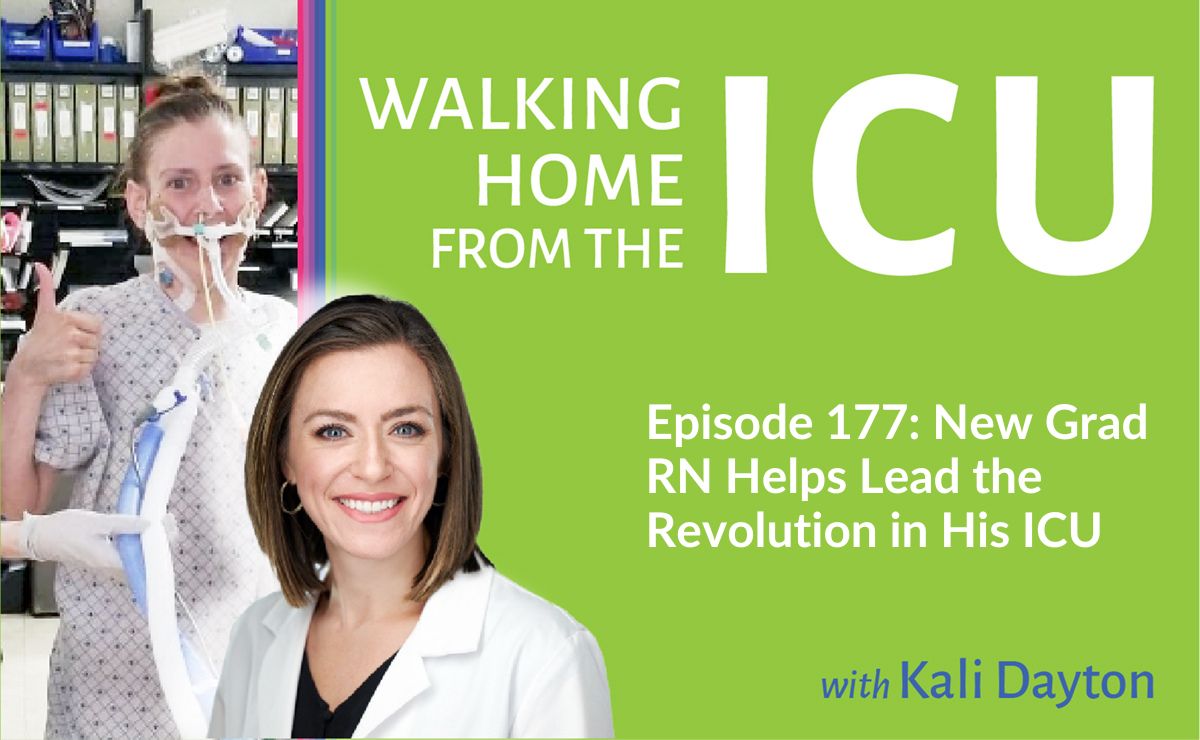
The ICU is an overwhelming and daunting environment to start a new career. While learning so many new skills from experienced mentors, how did Michael Glade, RN, BSN also see past “what is done” to “what should be done” in his ICU?
Michael shares with us what led him to help lead the revolution in his ICU.
Episode Transcription
Kali Dayton 0:00
This is the walking home from the ICU Podcast. I’m Kali Dayton, a nurse practitioner and ICU consultant. I help teams create awake and walking ICUs through evidence based sedation and mobility practices by hearing from survivors, clinicians and researchers will explore how to give ICU patients the best chance to walk out of the ICU and go home to survive and thrive. Welcome to the ICU revolution. Hello, okay, by way of housekeeping, let’s talk about some upcoming events. I’ll be presenting on an Arjo webinar with Margaret Arnold, September 18, and a webinar for RTS with draker November 5. Check out LinkedIn, Instagram, Twitter, etc, for links to registration. I will be at some conferences, and would love to set up ICU revolutionist meetups in these areas. So even if you’re not going to these conferences, if you are in those areas, living there, want to travel there, stay tuned for sign ups for meetups. I’ll be at UCSF in San Francisco for an early mobility conference. September 14, SCCM, Houston chapter conference. September 27 through 28th chest conference in Boston. October, 6 through ninth. Health conference in Las Vegas. The 20th through 23rd of October, regional geriatric conference at Methodist Hospital in Omaha, Nebraska, November, 7 through eighth. Stay tuned for conferences in the Salt Lake and Florida areas this coming spring. You can find links and more information on my website under the speaking tab. Okay. Now the most important part this episode, I was pumping my fists in the air during this interview, and I know you will be too. I absolutely believe in the next generation of clinicians to come in fresh and help us turn this around. I’m thrilled to have Michael glad to share his journey of helping do just that as a new grad. RN, Michael, welcome to the podcast. I am so excited to have you on. Can you introduce yourself to us? Yeah,
Michael glade 2:19
absolutely. My name is Michael glade. I graduated from the University of Colorado, College of Nursing in 2022 and I began working in the ICU as a new graduate nurse a year and a half ago. I float back and forth between the neuro ICU and surgical trauma ICU on a weekly basis, for the most part, here at Lutheran Hospital in Denver, Colorado, and I serve as the critical care unit based Council chairperson at my hospital, and earlier this year, I received a nomination for a Denver regional Nightingale award related to my work with the ICU liberation bundle at my hospital.
Kali Dayton 3:04
Oh, that’s awesome. And so you’re how many years into your career are you just a year and a half?
Michael glade 3:08
So I started nursing in March of 2020, I’m excited to continue my career. Yeah.
Kali Dayton 3:18
So think many podcast listeners are pretty seasoned clinicians that have been in critical care for a long time, been working on these things for a long time. A year and a half in and you’re already getting the nightingale award. You’ve worked a lot on this, and I want to really dive into that. But first, let’s talk about, since you’re not far out from school, when you were in nursing school, did you learn anything about IC liberation, AF bundle, mobility, what’s going on out there in the nursing schools, at least the one that you went to?
Michael glade 3:47
Yeah, so I would say a yes and no. I was educated on the importance of assessing, managing and treating pain and delirium as well as family engagement and empowerment. So I suppose that takes care of a, b and f, so that’s like half the letters in the bundle. But I didn’t receive any formal education on the ICU liberation bundle itself. However, I worked as a nurse extern in an ICU during nursing school, and in one of her weekly update emails the manager linked to your podcast, and that’s how I discovered the concept of the awaken walking ICU was by listening to your podcast, and
Kali Dayton 4:30
so you were still really new. And this is where I get excited about new grads or people that are new to the ICU. To have a blank slate is really nice. It has challenges. Obviously, it’s really overwhelming to suddenly start in the ICU. Lots of new skills, new concepts, things to learn. But you don’t carry with you the inherited culture, myth, preconceptions, expectations of having patients sedated and immobilized. So when you, as a fairly new nurse, heard about the cause of. Have No way can walk in ICU. What were your first thoughts or impressions?
Michael glade 5:03
I mean, my first thoughts and impressions were, oh, of course, this makes sense, right? I didn’t have those preconceived notions or those. I don’t know if habits is the best word, but those habits of really sedating patients or just following those sedation orders, it just seems like everything makes sense. You are able to maintain patients sleep wake cycles a lot better by promoting exercise, and if you get them up, then their abdominal organs are able to compress down on their bladder. They’re able to empty their bladder more easily. And it seems just like everything works together. And it’s just a weird realization that I had was, oh yeah, of course, that’s how we’re able to maintain our daily life at home anyways, right? Like we get up, we get out of bed, and it just, it makes sense, so why don’t we mimic that in the ICU? It obviously takes more work when patients don’t have this strength, but let’s work to maintain that strength and promote it.
Kali Dayton 6:11
And when I started in the ICU, it was in a team that obviously had this very established culture. And I think one of the reasons I never questioned it is because I was so new that my thought was, okay, they’re human. Of course, they’re going to communicate. They’re going to tell us what they’re experiencing, what they need, what they feel, what they want. Of course, they’re going to be awake during the day, sleep at night. Of course they’re going to be moving. I didn’t question it because it made sense to me, because I saw them as so human. So here you are, fresh perspective, newly out of school, new to the ICU, learning all the new things, and now you’re hearing this concept that makes sense to you. But then what was it like to then go on shift and face reality in your team and the way it was at the time?
Michael glade 6:54
Yeah, well, like you said, it was a lot to learn. Definitely starting out as a new grad in the ICU, and I was not only trying to incorporate this ICU liberation bundle into my practice, but also just trying to figure out how to hang a secondary line and how to safely administer medications. I wasn’t able to really incorporate into my practice as quickly as I wanted to, but I set goals, and I knew that it was something that I was going to continuously work towards, and I’m still working towards that to make sure that we can give the best care to our patients, so that they’re liberated from the ICU, are
Kali Dayton 7:39
overwhelmed, learning all the new things. And then on top of that, trying to figure out how to critically think through the ICU liberation bundle and a team that was at baseline, you guys were not really having your patients awake and moving right. And so you see that there’s a need to change. You’re trying to do your best. And then on top of that, you volunteer to be an ICU liberation champion. What inspired you to do that? Because I think, as a new grad, it’s easy to think the season people will take leadership. I’m just going to figure out the basics first and then maybe work my way up to that. But what, what got you to just go for it and help lead this? Yeah,
Michael glade 8:16
so I alluded to this earlier, but I definitely can’t say I can’t respond to this question without saying that like you alien, your podcast, your webinars are like my initial inspiration for helping spearhead this movement at my hospital and discovering through that like The bundle is not only beneficial for our patients, but it seems like it’s an obligation that all critical nurses and physicians should feel on a very profound level, to give people just the very basics of taking care of their pain, providing them with means of Communication and giving them the opportunity to exercise and get better, and like the in person training that you provided for our team, was a huge catalyst for us to work towards implementing the bundle, and to work towards really just to work out the kinks of, how do I say this? How do I educate my patient, how do I educate the family members on the benefits of this? And what do I do if the if a patient is super agitated coming off of sedation, how do I calm them down? What tools do I have in our in my disposition, to take care of that agitation and to figure out what is causing that agitation. And I say that having the support of a clinical coordinator and a manager that really promote this movement has been so helpful, so that it seems like they’re they’re doing what they can with their authority from the top down and. And me as a new grad on ICU, doing the best that I can on the bottom up.
Kali Dayton 10:04
Ooh, I love that. And we’re going to have Andrea on the podcast as well to talk about her role as assistant nurse manager and the leadership that’s been happening to make this possible. I remember doing the simulation training with your team, so I came with Margaret Arnold. It was a very abbreviated version of what I would usually do. Usually I stay there the team for a few days, three to four days, and my goal is to train every single member of the team. I felt really guilty and bad that we were only able to be there for one day. We did two beautiful four hour simulation trainings that were very thorough, but only hit a portion of your team, which is the challenge. I remember the looks on your faces so when you’re Hey, but what about the rest of our teams? So I want to hear, how did your perspective change, being able to sit with your colleagues to practice these things, really talk through some of the logistics of how to treat patients this way. How did that change? But then what was the challenge, then of being one of the few to have this perspective and this training? Yeah,
Michael glade 11:06
so being one of the few people that actually went to the training made me realize, oh, wow, I suppose it’s my responsibility, it’s our responsibility, to be the champions of this on our unit. Not everyone received this training, and now again, I’m a new grad ICU nurse, but now I have this responsibility to help train, like my more experienced colleagues, to implement the tools that I learned in this brief training. And so it has been challenging, but what I did first was, like, educate myself. I re watched your webinar, and I read the book every deep, drawn breath by Wes Eva, fantastic book. It describes post intensive care syndrome, also known as pics, and it goes into the negative effects of delirium over sedation and immobilization. And in chapters nine and 10, which are you don’t have time to read the entire book, I think are, in my opinion, the most important chapters for ICU nurses and physicians. The author relays a history of the ICU liberation bundle and talks about the successes and barriers that he encountered during its initial implementation. After I read this book, I developed a presentation for the rest of my team that was about the indications adverse effects and the clinical guidelines of sedative use in the ICU. And then I’ve been doing the best I can to implement the IC liberation bundle with my own patients and to encourage my colleagues to implement the bundle, and especially with regard to minimizing use of sedation and promoting early mobility.
Kali Dayton 12:57
Yeah, let’s move into that more. We’ll talk with Andrea about what she’s done as a leadership side the big oversight, but this is something that I don’t know how to fully capture, which I’m hoping you can help us do. How do you have those moments when you have your own patient load and you’re on the unit and you work nights, correct? Yes. How do you then lead that? I mean, I see the opportunity as an assistant nurse manager, go around the rooms, charge nurse. You’re putting the patient load. But then there’s something equally, if not more, powerful as another nurse, part of that team working there, that shift. How do you, even as a new grad, how do you influence management of these patients that are not necessarily assigned to you. And how do you support your clinicians in making this shift?
Michael glade 13:45
Yeah, so when I’m on the unit, I’m always, in general, trying to be aware of what’s going on with the other patients on the unit, but with a particular interest on who’s on sedation, who’s on a sedation trip, and why are they on it, and what rate is it running at? So one example I can think of is that there was a patient who had suffered a drug overdose and had to be put on a ventilator, and this patient was admitted at around midnight, one o’clock in the morning. I wasn’t the primary nurse, but I knew that the nurse assigned to this patient was a nurse that how could I put this was typically more liberal with their use of sedation, you could say. And so I noticed that the patient was on a very high dose of propofol infusion when they were being admitted. And so I made a note to myself to after I helped settle the patient, and once that nurse was able to. To get organized to go into the room later and ask questions about the case. And this nurse has had several years of experience in critical care, and at the time, I had only had about six months of experience. I was probably two months off of orientation, and I just started asking questions, what happened to the patient, and when were they intubated? And, oh, well, how does that work with a paralytic? How soon is that metabolized from the body, and how much sedation do you need until the paralytic is metabolized? And just kind of asking these questions, one from a sense of genuine curiosity, but also reminding that nurse to go through the thought process of, okay, why is this patient on a sedative right now? Oh, it’s until their paralytic wears off. When does that happen? And I said, How do you know that? And is alright if we look at the orders, just for example, like in case, I have a patient like this next week, or something like that. And then we reviewed the orders, and the nurse said, Oh, it looks like our rascal is negative four right now, but the rascal is going to be zero at 330 in the morning. And I said, Oh, okay, so how does that work? Like for sedation and making sure that it matches up in your charting? And the nurse said something like, well, I’ll probably just turn off the sedation at the end of my shift, like 630 in the morning or so. And I said, Well, how is that going to work? If your rascal is zero starting at 330 I said I heard that they’re like cracking down on the charting, like, not only management, but daco is doing that. Nurse said, Oh, you’re right. And I allowed the nurse to think through what they would do, and then we came up with a plan to start taking the patient off sedation. And I went in several times throughout the night just to see. Oh, so is the patient kind of waking up now? Oh, it looks like there’s still what negative two, negative three. How do you assess that? And the patient was off a couple hours before the end of the shift, and I came back the following night and found out that the patient was actually able to get extubated very early in the day shift, and was already transferred out of ICU. And I just thought, Wow, what a difference that made. And it’s so encouraging to think how we can promote this change, but it’s also super scary to think how if we I hadn’t done anything, or if we had just continued that that drip, which nobody was going in there and telling us to turn it off, then that patient could have had a completely different outcome. Could have spent multiple days in ICU, could have gone down this totally different path where he might not have been able to recover from and those
Kali Dayton 18:02
patients, logically, it’s simple, right? Probably had a GCS of three to five, something really low because of the overdose. We’re just putting the airway right, but then that sedation runs. They go to do an awakening trial. He develops delirium. He’s going to come out fidgety, restless, maybe even agitated my theory, I don’t think we’ve captured this in their literature, but our young, strong drug addicts, or just certain things that make us worried about their behavior and their strength and our own personal safety, not that that’s unrational. I think we’ve all experienced being having our safety compromised by certain patients, but then we project that into the patient like that. And so when they start moving and getting restless, we panic, we turn it back on. And that’s how we end up with someone that should have been extubated hours after they no longer have an indication to be intubated other than now they’re sedated. Now they’re in debate because they’re sedated, and sedated because they’re so until you come bringing in the critical thinking, you’re right. It could have just gone on for however long. And I love that you took the approach of just curiosity, asking innocent questions, writing on the fact that you were new, that asking questions was not unreasonable. I love that you have a great work environment. I really liked your team, wonderful people. I could tell that they’re the kind that would be happy to teach new grads answer questions, so using that to find a very non threatening way to guide them to critically think, did you have you found a difference in those discussions between those that attended the training and those that did not? Yeah,
Michael glade 19:30
I think that there were a lot of people that wanted to attend the training that support the movement, that just maybe they had a scheduling conflict. But I think there is definitely a difference that you can see in the not only in the nurses, but the respiratory therapists that were able to attend the training and PTs, OTs, that it seems like we almost have this unspoken bond or community. Indication that we know what our plan is in terms of mobility, we are all against escalating sedation, and we’re all for promoting mobility. And I think we’re all just in this time where we’re trying to figure out the best way to do that and how to manage that with if we’re short on staff or overnights, if therapy isn’t there overnight, and, yeah, it’s definitely a work in progress. I
Kali Dayton 20:30
would love to be able to bring this, like magical post into teams to say, wear this certain color this try this badge on, and everyone will know how to do this, and everyone will be bought in. And it’ll be perfect. Unfortunately, it doesn’t work that way. But my goal is, for most teams, is to provide this training and to train everyone so that there is that unspoken code, or at least we can actually talk about it and know what we’re working towards. Everyone has received this information and now understands why, or at least had the opportunity to understand why. My motto has been, when you understand the why, you can find the how do you agree with that? And how have you seen that in your practice? Yeah,
Michael glade 21:06
absolutely. We all know what the why is. It’s so that we can decrease length of stay in ICU, or decrease length of stay in the hospital and decrease time on the ventilator, and prevent these horrible effects of like delirium and pain and suffering, pressure ulcers, all of that, and finding the how is just you utilize the resources that are available to you, if it’s overnight and you don’t have the therapy staff with you, physically there to help you with it. You still have their notes from the previous day to go off of inspiration for a mobility goal. You can even discover in those notes, like what the patient was able to do, what their weaknesses are. Were they able to maintain their balance in a seated position, or were they like leaning to the left? Then how many people do we need to assist them? And when they were dangling on the edge of the bed, did they have more weakness doing the foot pumps with their left side and work on that with them, I’d say, to definitely use the resources that are available to you. If you have a CNA or a tech, have them help you with their bedtime mobility routine, which will get them exercise that they need, but also allow them to sleep better at night and promote a better sleep wake cycle. If you’re preparing for a mobility routine, and there are nurses that are available at the nurses station, grabbing them in there and having them help you do that mobility session. It is great to have the expertise of an OT PT there, but we can still do that with those notes, the therapy notes, and any staff that we have available on the unit.
Kali Dayton 23:01
That is such a good point, because I think something that is mistaken a lot is that mobility is just for PTs and OTs, that is their job, and only they can do it and are going to do it, when really they are consultants. They’re evaluating them, they’re providing recommendations. Yes, they’re performing mobility with them. But that doesn’t mean that they’re the only people in charge of mobility. They are consultants, so you’re basically taking their notes, using them as recommendations, and following through with mobility, because it is within your scope of practice as an RN to mobilize these people. And so let’s say your next shift, after you attended simulation training, you’re all fired up. If you were to grab people from the desk, just come help mobilize an intubated patient. How would that have been received? Or How was that received? It’s usually received very now or back at the time, like when you first started this. Yeah,
Michael glade 23:57
it’s it seems like it’s always received positively. People are always willing to help out the I will say, like the barriers that we’re facing is the initiative to start those mobility sessions. I’m starting them on my patients, and I might not see another nurse. They might finish their initial assessment, their medication pass, they’re charting and then they’re ready to take a break or ready to calm down for the night. But then,
Kali Dayton 24:29
if you’ve been listening to this podcast, you’re likely convinced that sedation and mobility practices in the ICU need to change. The ICU community is facing incredible difficulty with the trauma from the pandemic, staffing crisis and burnout. We cannot afford to continue practices that result in poor patient outcomes, more time in the ICU, higher healthcare costs and greater workload for the ICU team, yet the prospect of changing decades of beliefs, practices and culture. Across all disciplines of the ICU is a daunting task. How does this transformation start? It can begin with a consultation with me to discuss your team’s current practices, barriers, and to formulate a plan to help your ICU become an awake and walking ICU. I help teams master the ABCDEF bundle through education, consulting, simulation, training and bedside support. Let’s work together to move your team into the future of evidence based ICU care. Click the link in the show notes of this episode to find out more
Michael glade 25:37
that nurse might experience that their patient is awake throughout the night, or they’re constantly responding to their call lights, and so it’s something that we need more initiative for, but you also learn that it works out better for you in the long run. If you’re the beginning of your shift is really busy and you have on top of that, initial assessment, medication pass, and charting, a mobility session on top of that, but then throughout the night, your patient is sleeping like an angel. They’re just they’re really out of it from that mobility session, they’re sleeping so well, and you have a smoother night, and then are able to help your colleagues more, and throughout the night, and they say, Well, your patients sleep in well, and you can explain why, and then they might try that the next shift. And so it’s something that people have to realize for themselves in order to take that initiative. Because I’m just one person. All of the other champions on our unit are just one person, and we can all we can’t be taking care of our patients and mobilizing everyone else’s patients, but we can set an example and yet
Kali Dayton 26:51
bring them in to help you with it. That’s that example. It helps expose them to that concept. Learn the logistics of it easier would this have been for you had your entire team attended simulation training? Yeah, I
Michael glade 27:04
think would be different. It would have been really great, even for myself, to attend, like the full training and not just the abbreviated one. I feel like our day shift staff got a lot of training, but our night shift staff, there were only a few of us at that training that was at the time that was appropriate for night shifters to come in. So yeah, I would love for you to come back, but I understand limitations of that.
Kali Dayton 27:30
And when you talk about night shift, I think that there’s so much tight teamwork because you don’t have the full staff on that you would have during the day. So I worked a lot of night shifts as well. So when I think back to how do we get this done? Because we were mobilizing all of our patients, like, if they mobilize during the day, they’re going to mobilize at night. Now, granted, if they required a lot of people to walk around the unit, they took tons of breaks. Maybe we’re just going to stand at the bedside, maybe we leveled down a little bit. For night shift, we had to do something. It was non negotiable. It was like you couldn’t just skip the antibiotic for the night. You’re not just going to skip mobility. We also, we understood it was part of getting that quiet night love that you’ve you’re doing the same thing that that we always did. We’ve grouped it all together. So if you’re going to do a bed bath, we’re going to have them sitting up at the side of the bed, and we’re going to do the bed bath at that time. I’m going to be doing my assessment. I may be like while they’re sitting up if they don’t need me to hold them, I’m going to hang the meds. I’m grouping it all together so it’s not this whole extra session. It’s in addition to what I’m already doing, and I’m doing it. My goal would be to have everyone tucked in by 11 o’clock at night, right? That’d be perfect, or 1030 or whatever. I think that’s pretty normal to have your want to have everyone settled down, right? So we would do this big push. And so yeah, it was really busy, but everyone’s got each other’s backs, right? So helping each other. And I remember I also did flow pool within this multi system hospital, and I filled other units, and I wasn’t part of the team. No one knew me, so maybe that’s part of it. But also, I remember my patients were really easy. I had them all tucked in, so I went around and I said, hey, you need help with your bed bath, or do you need help? And they looked at me like I was crazy, not just that they didn’t know me, but they were like, Why are you offering? And I just, I felt like the crazy person, but I was like, Well, isn’t that what we do? Isn’t it’s the ICU, you have to help each other. It’s night shift. We only have each other. But so i That was the first time I realized that those dynamics are not normal, but to make this work, especially on night shift, day shift as well, you have to be a team. So you watching out for other patients, even as a new grad, when you’re already like overwhelmed with your own patients, you have to be aware of what’s going on throughout the whole unit and watch each other’s backs. That provides you safety if your whole team’s doing that for your patients as well. But that is essential. I don’t think we’ve talked about that enough on this podcast. Is the whole team understanding the why, understanding the how, having clear expectations that shift we have to mobilize our patients and we’re. Gonna help each other. The charge nurse needs to be going around saying, Have you mobilized your patient or already tracking it, and saying, Can I help you get your patient up? I see that you’re struggling with your other patient. I’m gonna go with a CNA. We’re gonna go take care of your other patient and get them sitting up, or whatever they’re gonna do. So it takes the entire team, and that’s my struggle. Is when we do this radiated version. It falls a lot on you as a champion, one of the only people that really understands, having done all your homework and trainings now you have this perspective, but now you get to train your your colleagues, but you have been working on this. Your team’s been working on this for how long, I would
Michael glade 30:38
say about a year, maybe a little less than a year we’ve been
Kali Dayton 30:41
working on this. And what changes have you seen throughout the past year? We’ve
Michael glade 30:45
seen some great changes. We have less average time on the ventilator for our patients. We are also really good about minimizing our invasive lines, and we’ve been, I forget the exact number of days, but zero acades So far, zero CLABSI so far, zero VAPs so far this year. And yeah, it’s been really great to see, and there are so many other improvements that are not quantifiable that we’ve been able to see just attitude changes and changes of sedation, practices and tendencies. It really has been a great thing. My understanding
Kali Dayton 31:26
is that night shift already has most of your patients up in a chair by the time day shift comes on. Yeah,
Michael glade 31:31
it’s sometimes a hit or miss, but if the patient isn’t in the chair at the end of the shift, regardless, I am getting that chair ready to go like at midnight, and that chair has, like, fresh linens on it, Chair alarm and the waffle cushion is ready to go like hours, hours, hours before, because things always come up at the end of the shift. But I am always trying to start everything like 30 minutes early, so that I have enough time to do a mobility at the end of the shift, as well
Kali Dayton 32:06
spoken, like a true IC nurse having it planned out. And that’s a lot of it just comes down to making it part of this well run system that we already have, and making it just as important as other interventions. And again, it always sounds like it’s something extra, and may feel that way initially, but does it feel so heavy and so extra now? No,
Michael glade 32:28
no, not at all. And I was going to say that, like I said earlier, it just makes sense for for us to empty our bladder when we sit up right? And it’s so much easier to get a patient fresh linens on their bed when they’re standing up next to it. And when you grab that extra team member in the room and get a fresh pair of sheets on there, wash their back while they’re standing up, then it’s so much easier to do. And like I said earlier, it simulates what we do at home on a normal basis, like when we make our beds, we don’t just roll side to side while our spouse holds our sheets and tucks them in. So we get up and we make it with an unoccupied bed. So simulating that as much as possible, how
Kali Dayton 33:18
do you utilize family have family dynamics changed on the unit? Yeah, family
Michael glade 33:23
is super important, and it’s super important because they are one ones that can ease anxieties for the patient, as they’re standing up for the first time, they can be in there saying it’s okay, like I got you or I’m right here, you’re doing a wonderful job encouraging the patient using their anxieties and also knowing their preferences. Some patients prefer to have like certain music or certain they might want to wear their slippers or something like when they stand up. And it’s really great to see family engagement, but also super important to engage the patient, because they’re the person that is ultimately putting in the effort to participate in those therapies, so making sure that no, like you said earlier, the why and the how. So we’re doing this to prevent delirium. We’re doing this to promote your sleep weight cycle, to decrease, days on the vent, days in the ICU, days in the hospital, overall, and to promote your overall recovery, making sure that they have that buy in. And there’s nothing that is more powerful than the patient’s willpower. And
Kali Dayton 34:37
so you’re considering this, and you’re doing this with families and patients even at night? Yes, absolutely. I want to clarify, because many hospitals right now, they kick families out at night, and I consider the family just as important as any other member of the ICU team. We don’t kick out RTS at night. We shouldn’t kick out families at night, and they’re, I mean, like I talked to my husband the most at night, it would feel abnormal to me. Do not have him there in the evening. So when you’re trying to get them to calm down, wind down, why not have the expert and the most important person there, someone familiar to help them get ready to sleep? Yeah,
Michael glade 35:14
I think the only caveat with that is that, like we do, sometimes encourage family members to go home at night, if they’re keeping the patient awake, if it’s taking away from the patient’s sleep wake cycle, then that is the huge consideration that we have, because patients always number one, family is their support system. If family is trying to support, trying to love, but maybe it’s a little extra, then we need to remind them sometimes, yeah,
Kali Dayton 35:42
and I think it’s appropriate to have clearly outlined expectations and their role, our roles, sometimes behavioral contracts are needed. So it’s important to have boundaries so that everyone has the opportunity to work well together and do absolutely to really focus on the patient. I love, love what you’re doing. How do you envision the future of ICU care? The
Michael glade 36:06
future of ICU care? I would say what comes to mind immediately is, do you remember in the book by Wes Eli, when he talks about the ICU at Odense University Hospital in Denmark and their no sedation protocol, where the patients are, they’re still ventilated, they’re intubated, but they spend the majority of the day in the chair. They’re completely alert. They’re reading newspapers. The windows are open and there’s nice view outside. There’s sunlight hitting their face, and that is what I envision, and that I think is what should be our goal for ICUs here in the States and in other countries as well. I think that in the future, there needs to be some more focus on promoting cognition to prevent post ICU dementia. So there’s so much discussion about promoting physical exercise in our patients, but I think we should also think more about promoting mental exercises. I’ve been trying to think of like a new letter for the bundle, and I can’t think of a word that starts with a G that would represent cognition, but maybe we could add like a second C for cognition or for E, we could include like early mobility and exercises for the body and the brain to make sure that our patients are not only preserving their physical function, but preserving their cognition so they can still be as independent as possible after an ICU stay. That’s definitely like one of the biggest things that I think future ICU care should incorporate. And if you don’t mind, I’d like to just for share a few of my favorite quotes from the book. So one of them is we generally think we’re most likely to harm our patients with an errant scalpel, a central line placement gone awry, or a medication error, but sometimes we cause more harm by blindly accepting usual practice as best practice. Another quote is a long habit of not thinking a thing wrong gives it a superficial appearance of being right. And then another quote, the last one that I’ll share here is the success of intensive care is not to be measured only by the statistics of survival, but by the quality of lives preserved or restored. I
Kali Dayton 38:35
love that, and I’m so glad that you have this perspective so early on in your career. There’s so many things that I wish I had been taught, which I’d known years of practices that I did without knowing the why. So that’s just how amazing to start your career off, really having the tools and a team that’s willing to work towards this with you. What advice would you give new grads when people reach out to me say, Hey, I’m a nursing student, or I’m a PT student, or all these disciplines, I get people from all over saying, I love your podcast. I say, good. I’m so glad you’re catching this early on. No pressure, but I’m changed this. I have a lot of hope and optimism and belief in the next generation. I think we have a lot more access to research, to this podcast. There’s so much more available to us now. I also think there’s a lot of strength and having an open mind, being malleable, being teachable. Sometimes our most educated clinicians are the hardest to educate, but the students like that’s a great place to start. It’s also a very scary place to start. The ICU is overwhelming. So what would you say to new graduate nurses, PTs, OTs, or anyone that’s new to the ICU, coming from other specialties?
Michael glade 39:49
Yeah, for nurses, I would say, like I alluded to earlier, that you can read the physical therapy, occupational therapy, speech therapy, notes for. Inspiration for not only mobility goals, but those cognition goals, as I was talking about earlier, so that you can set a goal for these patients. Should it be bed in the chair position, or work even further, dangling at the edge of the bed, and you can even push that further with leg raises. You can have them stand and just do some side stepping or marching in place. I did have one patient who, instead of marching in place, he wanted to dance instead. I will never forget it, but it was great exercise. And so there’s so many he was not intubated, but he was on heated, high flow oxygen, and could definitely use the mobility practice. He was recently extubated. I
Kali Dayton 40:46
think he was dancing after being recently extubated. Yeah, that says a lot, but you guys didn’t knock him down with all the sedation and immobility. Dancing after extubation is a huge sign of success,
Michael glade 40:58
exactly. Yeah, and here it was, one of those young ones that was able to bounce back quickly, thankfully, because of, like, the protocol that we implemented where we’re not going down that wrong path that I was talking about earlier. In terms of other advice that I would give would be to utilize your resources, or, if you’re on day shift, utilize therapists, not only let them mobilize your patients, but be in there in the room, watch what they do, get familiar with the different slings that they use. Ask them as many questions as possible, because they are, like you said earlier, the consultants. They’re the experts, and it’s still our responsibility to do it. So ask them questions, so that you can become independent with this. And if you’re on night shift, then recruit whoever’s available, whether they’re CNAs, patient care techs, if there are nurses sitting out at the station, to do a mobility session, even family members to promote those mental exercises, family members to encourage the crossword puzzles or word searches, or asking them to do those instrumental ADLs, like, what would you get from the grocery store right now? Or can you tell me the steps of how you would pay this bill or send a message to someone so maintaining that super important, and that is something that family can help out with as well. I have a few others. So I’ll say, if there’s a sedative that isn’t being used, like if it’s still hanging on the IV pole, then I would just tell you what to do. But I would say highly consider just throwing it away, discard it, get rid of the tubing. Take away that temptation, so that the next nurse who comes on isn’t tempted to use it so, out of sight, out of mind, right? And then clarify the rascal at the beginning of each shift, especially if the rascal is anything other than zero. And related to that, if you’re taking care of a patient who was recently intubated, then if you don’t have that automatically timed setting back to zero, then ask the physician when the paralytic should be fully metabolized and when we can start titrating to a rascal of zero, or at least negative one, so that we can start moving in the right direction, because that is something that maybe some physicians at your facility aren’t in the habit of thinking after intubation. They’re just thinking about the procedure. And so, yeah, maybe even implementing a protocol where that becomes something in the order set as well, where you can time that rascal becoming zero. Other things you can do is utilize your unit based Council, or form of shared governance, whatever it’s called, your facility, to develop protocols to promote the bundle on your unit. What I did was I added a little space to my report sheets that says mobility goal and cognition goal for the patients, so that I remember to ask about this when I’m receiving a report, and I remember to state this when I’m giving report. Those are my tips that I have for you. And like I said, it’s a work in progress, and I’m constantly trying to improve my practice and implement this bundle as best I can. Oh,
Kali Dayton 44:27
Michael, I’m such a fan. I’m a huge fan. I just I remember doing simulation training and just seeing how receptive you were, engaged you were, it was so encouraging. So it’s extremely fun for me to follow up a year later and to hear how much you learned, accomplished the lives you’re impacting. Your influence on your team. As consultant, I would say, recommendations for your team, finding a spot maybe on the whiteboard to write down for PT and OT to write down what they did with them, or recommendations or ideas. I think ot has the secret magic where they find out exactly what kind of. Music they like and what kind of temperature they’re like. Hey, they find out all these little tips that as nurses, we’re just trying to keep them alive, right? We don’t necessarily understand all those things. We don’t always have the luxury of time to find those things out. So having a place where, PT, OT, SLP, they can write down those tips for us, especially night shift catches on. I love that looking back in the notes, because I’m sure, as I say this, the therapist will be like, we don’t need to write more things down. We write very their own notes. Kaylee, right? But with the workflow of a nerd, it’s just nice to have something in the room. Okay? They walk 200 feet with a walker. They like Broadway music. It’s just nice to have little tips. Let the family give little tips. So having a place where it’s localized, but what you talk about having this nurse handoff is so important that’s something I really encourage with teams, is making a standardized part of it. We would never skip over how many lines and drains someone has. Let’s not skip over mobility and cognition. That’s so good on that. My other recommendation is we focus on communication. So our goal should have people be writing or texting shortly after intubation, because that will really tune our sedation practices. Because arrest negative one, you can’t necessarily sit there and text at arrest and negative one, right? You’re still pretty sedated, so having that be our goal, to have them fully communicative and autonomous. We might say, awake to someone that opens their eyes, makes a mind contact, but awake should really be. Can they communicate with us? Can they tell us when they’re having chest pain as a new symptom? Or do they require us to wake them up, arouse them and ask them questions? Or are they really communicative with us and part of their journey?
Michael glade 46:44
Yeah. Are they aware of their surroundings? Are they turning their head when we enter the room, that’s really what we want, and they hear just like some light footsteps entering the room, that’s I love.
Kali Dayton 46:54
That are they able to write in a clipboard? That’s right, that’s right. Michael, thank you so much for everything that you shared with us, utilize you in the future. This is so exciting, and thanks for everything you’re doing. Of course, thank you so much.
To schedule a consultation for your ICU as well as, find supportive resources such as the free ebook, case studies, episode, citations, and transcripts, please check out the rest of my website.
Transcribed by https://otter.ai
SUBSCRIBE TO THE PODCAST