SUBSCRIBE TO THE PODCAST


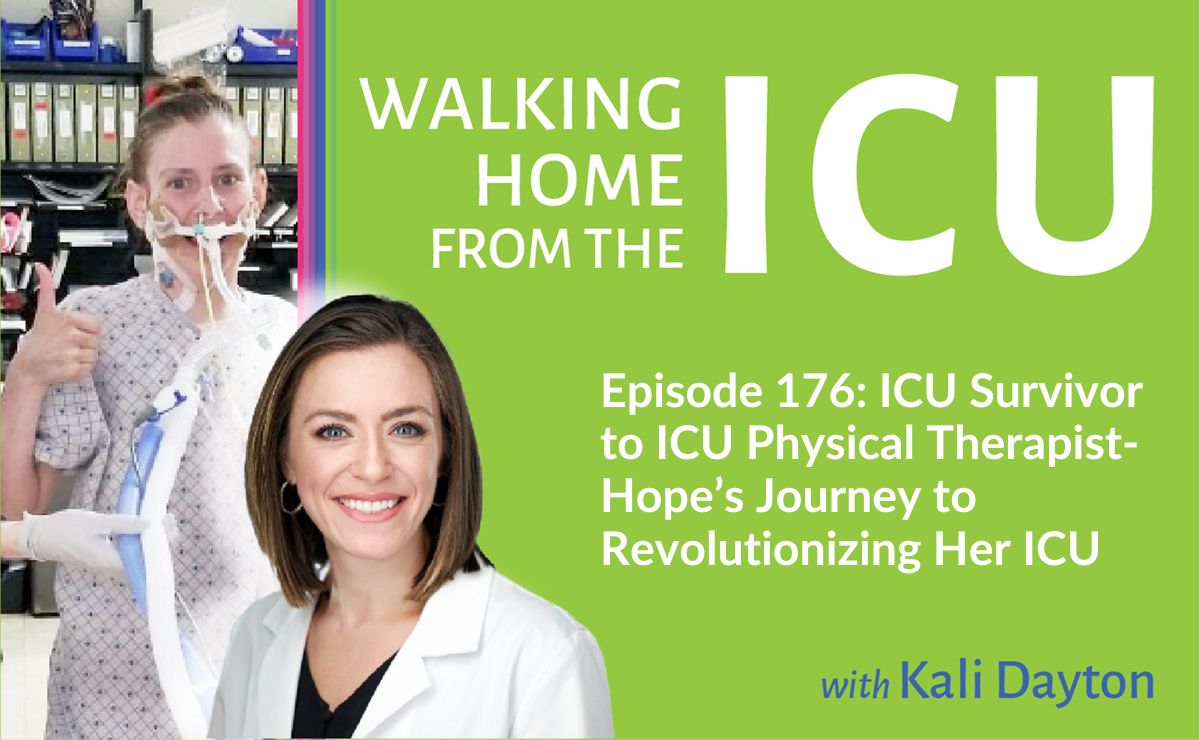
The best empathy training is personal experience. Hope Newton joins us now to share how her personal experience in the ICU leads her to revolutionize her ICU as a physical therapist.
Episode Transcription
Kali Dayton 0:00
Kali, this is the walking home from the ICU Podcast. I’m Kali Dayton, a nurse practitioner and ICU consultant. I help teams create awake and walking ICUs through evidence based sedation and mobility practices by hearing from survivors, clinicians and researchers will explore how to give ICU patients the best chance to walk out of the ICU and go home to survive and thrive. Welcome to the ICU revolution. You the best inspiration for humanization of the ICU is empathy. The best empathy training is personal experience. Hope. Newton joins us now to share how her personal experience in the ICU leads her to revolutionize her ICU as a physical therapist. Hope, thank you so much for coming on the podcast. Can you introduce yourself to us?
Hope Newton 1:10
My name is Hope Newton. I am a physical therapist by trade. I work mostly in the ICU these days, but I have a unique story that I am an ICU survivor and now a provider.
Kali Dayton 1:28
So I’ve been doing this for about four years now, and it’s been a wild ride, which is such a unique perspective to have been an ICU patient, especially your insight into ICU delirium, which you’re going to share and then now be treated in the ICU. It’s pretty amazing that you’re one able to do so, and really special that you’re willing to do so such a unique perspective. So what led you to be in the ICU?
Hope Newton 1:46
I started off mainly, actually, one of my clinical rotations was at an academic center. That was my first job out of school. And I really liked the interdisciplinary side of things. I liked working in the hospital. At that time as a student, I was like my CI in the ICU, but at that institution, you don’t necessarily start that way as a new grad. I think a lot of places they do that, hopefully, because there’s a lot of things that you have to learn and be comfortable with to really be ready to do that. So for me, when I switched jobs, which I’m sure we’ll get into further in the podcasts, I found that we really weren’t treating in the ICU that I work in now. And it was really a big opportunity. It’s a small med surg ICU. We have about 20 total beds, plus six cardiac surgery ICU beds in that same so I saw that there was a big need. We weren’t getting our patients up. Nobody else really wanted to be in there. And so I thought, You know what? Why not? This seems like a exciting thing to do. I went from a big academic institution to a smaller complex community hospital when I was getting bored on the regular units, honestly, I seem to crave chaos. And so I started to get in there, started to get comfortable, started to go on browns, and just seeing these opportunities, this particular IC was already using the A to F bundle, so when we got to the E button part in during rounds, there really wasn’t much discussion, and so it was just a lot of observation and conversations in the beginning. Are there any protocols here? And that was the biggest thing for me. I came from a place that had a lot of protocols and a lot of expectations, and then to come into the wild wild west, it was a little overwhelming, but also that opportunity of, okay, I have some experience from somewhere else. Still, it’s within the same hospital system, so let’s start seeing if we can bring some of this stuff to this hospital. And as I started to build relationships, and particularly with the nursing staff. They wanted to get their patients up they were seeing what I was doing, patient by patient, I would go to them and say, Can I see your patient for PT? And at first it was I had to talk to the provider, because the consults weren’t even there yet. So I had to seek out and say, Hey, this patient looks like they’re awake and ready to work. They’ve been in bed for, I don’t know how many days now. Why haven’t we been seeing them? And they were like, Oh, I don’t know, here you go. There’s a consult. So I would go see them and sit them at your bed. And at first it was, I think, pretty scary for everyone. I was like, What is this girl doing? These patients can’t do this. They’re like, this is they’ve never seen this before, or it’s been so wrong, I think it started off very slowly. So I would maybe go see a patient that had gotten to the chair. Oh, maybe they lifted them to the chair. Or I would say, Listen, I know this looks a little bit crazy, but all they have is an IV and maybe one other line, it’s okay. I do this every day. Or I would take somebody with me and be like, Oh, OT or rehab tech just to make them comfortable. Or, Hey, can you just come in and you can walk? So as the success was happening when we’re getting these patients moving, I think that trust started to build. It took a while, particularly when I would stay, I would get them up and they. Say, Well, how am I going to get them back? And that was the biggest battle. Well, aren’t you coming back later? No, no, I’m not. I have a lot of patients to see you can use the lift I left the lift sheet under there for you, or come here, I’ll show you how to put the lift sheet underneath the patient in the chair. This is training that you’ve had, and I know that you’ve had, so you just need to make sure that you’re building this into your day. And if you need tips and tricks, I will come back and I will help you get them back. But the expectation is, when I come back, I’m not getting them back for you. We’ll do it together, or grab your buddy. I know this person knows how to do it. They can help you as well. So it started that kind of case by case, patient by patient, and then a lot of those people happen to also be charged nurses. So I tried to really pick out the people that I know when they’re going to be charged, the accountability holds on to the other patient people. So it slowly started to go that way, and then it was okay. I’m doing this consistently. I’m here now you know me. You trust me. Let’s start getting a little bit deeper. Let’s start moving these fed to patients. Do we have a protocol for that? No, I was like, Okay, here’s how it goes. Either I feel comfortable doing stamp, pivoting it to the this patient to the chair by myself. I can manage the event. They move well, or I have somebody with me, or I have respiratory just or I’ll say hey to the nurse, can you just watch the event? Tubing for me. Can you do this? And I’m very lucky that our providers all pretty much came from other institutions. This particular academic institution we are partnered with, they’ve there’s really been very little pushback from the providers, which is very lucky. That’s not always the case,
Kali Dayton 6:47
but do they help lead it, or they just allow you to do what you want to do when you ask for it?
Hope Newton 6:54
I have to ask for it, and that can still be a big barrier, that even though we have these patients getting up and moving. It is still constantly me going through the caseload, going through the census, walking the unit and saying, Hey, why isn’t there a consult? Or is this patient appropriate?
Kali Dayton 7:14
Okay, if you’re saying no, why? What percentage time is spent on that?
Hope Newton 7:16
Probably a good hour or two a day, because it happens through the day. It happens each morning. Some days it’s fine. It could be zero there. We have all the appropriate patients. We have the orders are in. It can depend on the provider. If I come in and I know a certain provider is working, I know those compounds are going to be in there, in there, in there, I don’t have to worry about it. Sometimes I have to say, maybe that one’s not appropriate. But I’d rather be able to say, No, I don’t feel comfortable with this patient yet, than to have to chase after the orders. So that is still a work in progress, for sure, and it has been realized.
Kali Dayton 7:50
how much time it takes or the impact on what resources or resources are available by how they optimize their own role. So the physician example is prime when we don’t put the orders in. Now you have to chase down the provider and determine if the patient needs an order, and can they have an order. It depends on the physician. That’s not efficient. Then if sedation is still a barrier, I don’t think nurses usually realize how long it takes to go figure out who has that patient, where the nurse is, and can they turn down sedation. And then when is the patient going to be arousable? Now, can they work with them? And who it just takes, from what I hear, 25 to 30% of your shift, it’s not efficient. And what happens when we create awake and walking? ICUs is therapist. Could walk on and be like, let’s roll. Let’s do this. And they’re just quickly, by the beginning of the morning, rolling with actually treating patients, rather than having to do the chase, do the hunt down. So what you bring up is a very common phenomenon that I’ve seen throughout the community.
Hope Newton 8:49
yeah, and it’s everybody’s on board. They want to do it, but that coordination of care and the standard is not there, and that is one of the biggest goals of mine right now is patient by patient. We’ve made it happen. We have taken I’ve said this patient looks like they might be appropriate to be off to the patient. And we’ll still say, yep, we’re going to turn it off. All right, great. Give me 3035, minutes. I’m going to go in. I’ve woken this patient up. We’ve gotten up, we’ve gotten moving. We’ve got an extubated mid session. We’ve kept them off, we’ve gotten them out, and it’s great, and everybody’s on board, but it’s not on the forefront of everybody’s mind. And that takes a lot of time, like you’re saying throughout my day, when I have to chase everybody down on the team and say, we’re going to do this, we’re going to do this, we’re going to do that. And then a code happens, and so the team’s dispersed, and we’re like, Okay, now we have to push it. Okay. Now who’s ready? Oh, this. We didn’t get the sedation off, so now we gotta wait. Like, okay, now I’ve waited all this time. I could have seen another patient, and yeah, so that’s it’s a lot.
Kali Dayton 9:56
It reminds me about medical ICU, I just trained in May. I. They were at the point where you’re at right now, where they wanted to, people are willing, but the nation was still a thing. Getting the orders on time was not consistent, and they were wanting to, but didn’t know quite how to. Now turn to them in May, and now they tell me that their night shift has their intubated patients up in a chair by the time day shift comes on, and they’re awake and ready to go, and now it’s so much more efficient for everybody, and they’re enjoying that, but it takes so much work on your side, and I think it’s so commendable that you’ve put in legwork over the last few years to bring these changes. I just want to commend you, and I want physical therapists understand impact you’ve had on hundreds 1000s of patients, because you’ve intervened as early as you can. But there’s an opportunity to make your job and your life easier as the rest of the team takes everything to the next level and really reinforces their own roles in this.
Hope Newton 10:49
Yes, so that’s where I’m at with meeting with our critical care ops teams and trying to find champions for each discipline and say, I can’t do this on my own. I can’t hold other disciplines accountable. I can only do what I can for our team. And being able to look at our awakening protocol, there are some things up there that are maybe not making the most sense, and maybe we need to review that so that it is what’s best moving forward. So there’s definitely a lot of moving pieces. It has been what feels slow, but I think is ultimately a lot of progress. And just learning as a young leader how to navigate some of those barriers and those conversations moving forward, and just knowing that the majority of our team, I’m very lucky, they want to do what they can. They want to do what’s best for the patient, but bringing that education and awareness and accountability and even higher up, getting that buy in to say this is a priority, because our patients are getting sicker. We’ve had a really rough couple of weeks, particularly in our ICU, with patients just coming in very sick, and the outcomes have been harder, and everybody’s feeling so when we have those protocols that are in place and those standards of care, it can make those situations easier. And right now, it just feels like we’re in limbo, and we’ll get through it, but I think once we get some of that stuff a little bit more standard and easier to follow for the next people coming in with our turnover and all that, we can really get off the ground. We’re right there. We’re so close.
Kali Dayton 12:30
And really it’s because of the work that you’ve put in. So I just want physical therapists and occupational therapists. I’ve heard similar stories from OTS. You can make such impact. And yes, it can be gradual, it can be painful, it can be arduous, but it’s amazing what you’ve accomplished with your dedication throughout the last few years, and let’s say you were able to go in your next shift. What would you like to see happen in your dream world? How would you like your shift to go?
Hope Newton 12:58
Yeah, actually, I’ve created a little bit a standard sheet from some work on my end, so that when I actually am in the end of my shift the night before, I have respiratory charge nurse, the next day nurse and the therapist written out on the sheet. I have the patient who we’re going to identify with, the provider for the next day of when we’re going to do their awakening trial. So that way we’re going to, let’s, for example, we’re going to say patient in bed one their sedation is going to be turned off at 9am the nurse is going to send a message to me at nine saying it’s off. I’m going to come in, hopefully around like 945 we’ll keep in contact about our rescue score. I will do therapy, and then I’m going to message the respiratory therapist and let them know I’m finished. They may Can you come check if they’re appropriate for their SBT or during that time and have that coordination? What I would love is, when I come in the morning, I’m going to confirm that patient by patient. We may have one patient, we may have two patients. Ideally, it would be every patient that’s on a bed and it’s medically appropriate. And we go down the line and I’m like, okay, the eight o’clock was turned off. Bed one was turned off at eight. I’m gonna start there at 845 okay. Bed two was turned off at nine o’clock. I’ll go there when I finish with bed one, check in on them, and go down the line, and they’re getting therapy, they’re getting up, they’re getting svts and then they’re getting ext and what that would be amazing?
Kali Dayton 14:23
Are you awake? What if the patient wasn’t that normal? Would be even better
Hope Newton 14:27
if I came in and I found every patient sitting in a room, in the recliner, awake, excited for therapy. I’m coming in and I’m just doing loops and loops. I just walked to this patient. We walk around the unit, we stand we do whatever intervention we’re gonna do, play some games, make it fun, and then that person is watching through their door, the first person, so now they’re getting excited. That would be ideal. Every patient’s got their family member at the bedside. We’re getting them involved. We’re. We’re doing all the thing, meeting all their goals, sit, stand, walk, whatever fits them, and we’re just having a big therapy party in the ICO.
Kali Dayton 15:10
And it sounds like your team is so close to getting there, right? Like it wouldn’t tell teams, especially this medical ICU I just trained that I think is similar story. But what they were doing was hard, but they were doing it mobilizing someone three, five, sometimes seven plus days after intubation. That’s hard. Awakening trials are hard when it’s been going for a while. So if you can do that, you’re going to love having the mean awake right away, mobilizing right away, because it’s going to make everything easier. So if you can do it the hard way, you can do it the easy way. Yeah.
Hope Newton 15:41
I’d also like to make a plug that for the standing bed, so if they are not ready to be in the chair or walking, I would love for them to be upright around also ready, like maybe they’ve stood or they’re getting ready to stand with me for the first time, because they should be standing three times a day. We’re working on that too. Love it the whole nother thing that we’re working on with getting nursing staff trained and comfortable, to realize it’s not just a therapy intervention, but also another tool in the toolkit for the nursing staff. And we’ve got a wonderful expert from Craig that works with us, and she comes in and helps us train the nursing staff. But that’s also another thing. And last week, for the very first time, we started our first femoral IVP patient in the standing bed. We got, they are a pre op card yet surgery patient, and so we finally got clearance to start with them, and it went great. You got the balloon pump out, and haven’t been back since. But I’m really hoping when I get back tomorrow, the balloon pump has stayed out and we’ll be able to walk and do the rest of our pre op testing, so that when he gets his open heart surgery, he’ll be ready to walk day one.
Kali Dayton 16:49
Oh, awesome. No, great plug for verticalization beds. Episode 158 goes into all the geeky science stuff behind verticalization and the ICU and the benefit of those beds, but thank you for helping the whole team realize and utilize the benefit of those beds. So we’re very lucky to have them, and it feels like a lot of what you’ve been doing the last few years has been influenced by your personal experience as an ICU patient. Tell us how that all happened and how that has kept you going in this big endeavor.
Hope Newton 17:22
So nine months into my career, when I was working the first academic institution, I unfortunately contracted hepatitis A from a patient. There was an outbreak in the whole hospital. One in 100 million. I had a very crazy response, very rare. Went into rapid, acute liver failure, multi organ failure. First 12 hours were little dicey, getting ready to actually, so I had gotten admitted to the hospital I work at now because I thought it was a gallbladder. I spent a week thinking I had mild flu, like symptoms went through, things weren’t getting better. Kept going to urgent care. They’re like, we don’t really know what’s going on. Head on over to the hospital. It’s probably your gallbladder kidney, and within an hour it was your LFTs are in the 1000s. We don’t know what’s going on. We’re getting ready. Would you like to go x hospital or y hospital, get your transplant all in the middle of the night? So yeah, it was the first 12 hours. It was you’re going to actually get transferred to the unit where you got sick, burning with it for a liver. Very lucky that they were like, we’ve never seen this before, but you’re young, you’re healthy. Let’s wait it out. We think that we’ll flush your liver. We’ll just keep doing things. If take a turn for the worse, we’ll send you down. But we actually think that maybe it’ll all work out for the first I was there for five days, that first 12 hours is when I actually did experience metabolic encephalopathy. There are parts that I don’t remember, and a couple weeks later, I had actually gotten readmitted for a couple days because if I had pancreatitis, and so when I had gone back to the ER same nurse that was there that first night that I was going through everything, I was actually able to see her and talk to her, and she’s like, we didn’t really tell you how bad it was. And you were like, it was really bad. You did X, Y and Z. And I was like, I don’t remember doing that. All I remember is I couldn’t sleep. I didn’t sleep for 46 hours straight. I remember laying down trying to watch TV just like this, parts of that first 12 hours I can’t remember, and that’s a pretty scary feeling. I remember the anxiety. I remember the fear, kind of numbness, of just not accepting that this was happening. I had worked an entire shift that day. I had gone home thinking, oh my gosh, I’m gonna go to the pool after work. I’m finally starting to feel a little bit better. And then I had dinner, and things just took a turn for the worse. Yes, yeah. And that was. Yes, I will never forget the first 10 words that the provider said to me. And he said, you walk in the room, and I just got in triage. I just gone back and he said, You’re an acute liver failure. We don’t know why. You have any question. And I remember looking at him and just spinning through my head of hepatitis B, hepatitis C, I’m not thinking a, we don’t get that anymore, or, like, when they do. I just didn’t even know. I didn’t know about it. I you know, it’s not a vaccine that’s required to work. And again, most people mild flu, like symptoms, they don’t even know they have it. They end up getting immune. And I just looked at him, and I said, Where did I had to have a Titus from and he was like, I don’t know, and he walked out of the room. And that was the first moment when I look back and I think how I never want to be like that. I could never walk into a room. They words that are going to change somebody’s life and walk out. And I remember calling my mom just like sobbing, I don’t know what to do. They’re telling me, I need a liver transplant. They’re telling me X, Y and Z, I don’t want you to come, because we’re still in the height of COVID. This is July of 2021, my mom is immunocompromised. I didn’t want to do that. I also was already in denial, of like, I don’t know but what’s happening, but I’ll be fine. Don’t come. My dad was getting ready to go get on an airplane at 3am or business trip. And I, again, deny it, what am I like? I’m just gonna lay here. And the nurse walked in and out. Never forget, she said, Oh my god, are you okay? What’s going on? They didn’t tell me. And I’m stopping, oh, I don’t know. It just told me. I mean, liver failure and I need a transplant and I don’t know if I’m gonna make it through the night. And I’m like, Just stop. She’s like, did they tell you’re gonna be okay? And that’s like, no, no one said that. And I just remember that it was just a revolving door of people coming in and out and diagnoses. At some point, my mono came up positive. They thought I had mono, but that was a false negative, and they finally figured out it was hepatitis A and then that was, we don’t know what to do with this. Do we send you out? Do do we keep you so they’re throwing everything at that point at me. They could. We also didn’t have any IMC or ICU that’s available, so I am in the ED at this point and just boarding in the ED. Though, by the morning, things had settled down, and they were like, we’re pretty confident. We’re gonna keep you here. We’re gonna watch flush your liver. We can’t really do much else keep an eye. At this point, my gallbladder wasn’t functioning at all because my liver wasn’t functioning, and across those four or five days, it was just hanging out, test after test after test. And eventually the liver numbers started to recover. I started to get better. I was very lucky. I kept my mobility. I was able after the first 12 hours, I was up, I was going to the bathroom, I was walking the halls, but nobody was encouraging me to do that, and when I look back at that, it bothers me. I only did it because I knew I’m a PT. I have to stay moving, and it was exhausting. I mean, my body was so tired, I would walk a lap around the unit, and I’d have to go lay down and take a nap or a full day of testing. I was exhausted. I wasn’t eating past time. I wasn’t allowed to eat. When I did. Was eating. I couldn’t eat. Wasn’t hungry. I got I would feel sick, it would hurt, it was uncomfortable. I think there was just this assumption, because I was 26 at the time, that she’ll bounce back, she’ll be fine. She knows what to do. And I think it would have been a lot different had I not had a medical background begin with at all.
Kali Dayton 23:48
How long do you think it would No, I wouldn’t put up if you weren’t a physical therapist advocating for yourself and calling your own backside out. How long would you have laid there? Probably
Hope Newton 23:56
the whole time. I mean, getting up to the bathroom and being like, back and forth. Somehow I was like, I really would like to take a shower please. I don’t think anybody, I never would have put a PT thought salt in for me. They might have said, Have you gotten up and walked and I probably would have said to the back of my back, and they honestly would have said, Yep, that’s good. You’re good.
Kali Dayton 24:14
If you’ve been listening to this podcast, you’re likely convinced that sedation and mobility practices in the ICU need to change. The ICU community is facing incredible difficulty with the trauma from the pandemic, staffing crisis and burnout. We cannot afford to continue practices that result in poor patient outcomes, more time in the ICU, higher healthcare costs and greater workload for the ICU team, yet the prospect of changing decades of beliefs, practices and culture across all disciplines of the ICU is a daunting task. How does this transformation start? It can begin with a consultation with me to discuss your team’s current practices barriers, and to formulate a plan to help your ICU become an awake and Walking ICU. I help teams master the ABCDEF bundle through education, consulting, simulation, training and bedside support. Let’s work together to move your team into the future of evidence based ICU care. Click the link in the show notes of this episode to find out more.
Hope Newton 25:20
It’s fine, and I remember the first day I got discharged home and I went and I stayed with my parents. And that first day I walked outside and I walked, they’ve got a pretty big property, and I walked maybe a half an acre down to see them, and I went back. And I couldn’t even get in the shower after that, I had to lay down and take a nap because it was so exhausting just doing that.
Kali Dayton 25:47
How much you were incapacitated or how much muscle mass you lost?
Hope Newton 25:51
yeah, and I think just how hard my body had been fighting to keep my organs, it was A 30% survival rate from that left for failure, it how much?
Kali Dayton 26:04
When people probably retained fluid, right? So maybe you didn’t see it.
Hope Newton 26:07
I did. Within a month of everything going down, I lost 20 pounds. I didn’t have to lose I was hitting 100 pounds.
Kali Dayton 26:21
It was incredibly scary, and it took assumption, because you’re young, you have muscles, you’re gonna have muscles. You’re not a priority because you’re so strong and active. But a month 20 pounds,
Hope Newton 26:30
20 pounds, that strength has probably really just come back this past winter. So it’ll be actually three years. This coming Saturday will be a three year anniversary, so two and a half years it really took to get back into the groove, to be able to feel like my body again. Always been active. I played sports my entire life. I played girls in college. I stayed up being active through PP school and into my career. Now we add another layer to this, that I had a syncable event right before I got admitted that it’s hard to say, but they think I might have had a TIA and I ended up with bright side weakness, particularly my face and my upper body, but that even still, that wasn’t something that anybody was looking for we went back and said because it wasn’t quite so obvious at first. It wasn’t like my entire right side was flaccid. It was just seeing differences in my face that kind of evolved, and even my right hand, like right side afterwards within the first couple of months. I think we forget that this can affect anybody at any age. It’s not just our elderly patients. It’s not just people with underlying conditions. I have pretty much zero underlying health conditions. That would be a reason to say this girl’s at risk. But there were so many factors, not just the physical response, but even the emotional, mental effects of that. So to go into now, where, how I got into the ICU and all of that, unfortunately, it was just really bad timing of trying to get back to work. It was nine months into my career. I didn’t qualify for long term disability at the time. I only got two weeks of short term disability and workers comp, that was a big thing. It took them a long time to investigate and to realize where this came from, going through that process and trying to navigate that by myself, that I was not approved until the end of August, so I had to go back to work two weeks after it happened, or I would have lost my job. I had rent to pay and bills to pay, and that wasn’t an option for me to not work. So that first week was really tough. I felt like I was falling I was working the eight hour shifts, and I was falling asleep, driving cold. So I went to my doctor and said, Hey, we got to figure this out. I need some to have some kind of reasonable accommodation to get through this until I can get workers comp. We don’t really know how long this is going to take for you to recover from and you have no restrictions, but your body just went through an incredibly difficult time. So you’re looking at response to a year at least of chronic fatigue, getting back to your normal. You could relapse at any point that you could become contagious again. We just don’t know. This is one in 100 million response to a very it was tough that first week. That’s the week that they thought I had pancreatitis. And I think it just my body got so stressed, physically and emotionally, being back on the same units, being back in the same environment, but you just been admitted as a patient. This time, it was where I had gotten sick. So where I was admitted was the hospital I work at now, actually, yeah. So that was tough. And then I finally got the workers comp, and I took about a month to about. Goal, which was really needed, especially on a mental side of things, I was able to start to get into therapy at this time, but that’s when things were starting to hit, of what just happened to me, how it was handled, and the lack of support, because people are always checking in on you when these things happen, because again, you’re kind of expected to bounce back, particularly when you’re young.
Kali Dayton 30:24
It’s as you are in a profession which you are the caregiver.
Hope Newton 30:27
yes, and it was things that I a lot of things that were happening I didn’t realize were happening. So when I would get to work and I would hear things, and I would start to have what I now realize were trauma responses, and have since been diagnosed with PTSD from that was, Oh, my heart’s racing because I’m having this experience in this environment that I was in before, or I’m seeing these patients that could have fed me, that was almost me, or these are the patients I got sick from things that I couldn’t put into words to other people, and I didn’t understand what’s happening to myself. And I was getting to that breaking point, that sabbatical hit at just the right time, and so it was a lot. It was a great for me to step back and start to figure out what was happening, start to work through that. And I did after that, go back. I was still working that same job, and I think there was just moments where that environment, I couldn’t be in it anymore. And I remember going on a weekend, I was working a weekend shift, and I walked into a supply closet and there was a nurse vaping in the supply closet, and I was wearing a mask. I was only in there for a minute, but then that week, I found out she was out, and she had COVID, and I immediately lost it, because I’m still recovering. I if I get COVID, am I going to go into healthy organ failure again? Am I going to die if I get COVID? Because I’m not fully healed yet. I am now at a higher risk than I was before, and that was definitely a turning point. It just felt like there were things that I couldn’t stay more and so I was really lucky that the final day, the final straw that broke the camel’s back. That day, a position opened at my current hospital, and I just knew for my own mental and physical health, I got to change what I’m doing, and it was scary. My ego was bruised because I was moving from this really big academic center where they’re walking patients on ECMO. They’re at the forefront of early mobility, from neuro ICU to cardiac surgery ICU to trauma, or they’re one of the leading trauma centers in the country, how I’m gonna be so bored going to this community hospital? It really was my ego talking, but I just knew that something deep down I needed to get out of there and have a change. And I couldn’t have been more wrong in what that opportunity brought for me to be able to go in and be in this ICU and work at the same hospital that saved my life. So that was pretty incredible to walk back in those doors and say, I’m back. I’m here. I see that there’s work to be done, and I felt like, for the most part, my care was excellent at this hospital. It really felt like I was appreciated as a patient, and it helped me understand that difference of what care should look like, and how
Kali Dayton 33:26
does this change, how you approach advocating for patients and treating patients, that has probably
Hope Newton 33:31
been the biggest change and amazing part for me and growth as a therapist, is Taking the time and the patients, to focus on what’s best for the patient as well as what the patient wants, and to listen. I think there’s a lot of demands, particularly in therapy, we have a lot of productivity demands and billing and timing, and we’re trying to see as many patients as we possibly can. Many disciplines are are feeling it, but I have been one to step back and say I’m okay with getting some pushback from other people, if that means I’m going to sit here and listen to you and you’re a caregiver about what you really want, what’s important and what matters to you, and to give you a voice that has been a huge battle for me, to say to other people is, I want to hear it from the patient. I want to hear it from them. What’s going on? What are you feeling? What can I do that is going to make your experience better? And here’s what I’m seeing. Here’s my expertise in it, but I want to know what’s important to you, because if getting up and walking 150 feet isn’t going to make a difference in your day to day, what is if your fault like, what’s your quality of life? How can we get these things involved? I’ve seen as someone that has experienced what I call hypoactive that. Delirium, the encephalopathy, it is really scary when you don’t know what’s going on. And I’ve changed my understanding of maybe I need to break this down a little bit more and say and just start with some reassurance. One of the big things that one of my favorite ot partners is we go in every time, and when we co treat, it’s one of us starts with a patient, the other one starts writing on the whiteboard, and it’s today. Is Monday, July 1, 2024 you’re at this hospital. You’re here because x, y, z, are doing our very best to take care of you. Do you know why you’re here? Especially some of these patients that have been here for 30 days? I’ll give them a quick summary of you came in with this, you had a breathing tube in. Either it’s still in, we’ve taken it out. You’ve done this. Do you have any questions? And we start there. We start with the mind. Because if we can’t get mind engaged with us, then everything that we do is done. We can’t get them to participate. We can’t do this. I think just that patient voice is so incredibly important. Sometimes we forget that, and that’s such high level skill set.
Kali Dayton 36:04
If your team’s still at the point where they’re sedating, that they are allowing you to come in right when sedation is off, that is, in my perspective, really difficult and really skillful to be able to work patients through merging from sedation being an active delirium that takes a lot of skill, compassion, understanding, patience and expertise that’s really challenging, and that’s where it’s easier to just turn sedation back on, but for you to see the bigger picture and see the patient as a person, and to work them through such a sensitive and scary time that takes a lot, having the perspective of a survivor, knowing what it’s like to be missing time, be in a hard environment, be voiceless, be vulnerable. That makes a huge difference when you approach a patient with that kind of perspective that not everyone has, but you’re forced to have as a physical therapist.
Hope Newton 37:01
Yeah, I think about it as even the things that I still struggle with from a cognitive or energy or level, or something like that, where I used to be really good at by collecting names and things like that, that sometimes I still struggle with that of before I was sick, I knew that I could remember these things, and sometimes I had to take a beat and say, okay, like take a little extra second, or just sometimes the anxiety of things that pop up, or giving yourself grace, that’s one of the biggest things. Even with some difficult patients, I’ll say, I see that and hear that you’re having a really difficult time, and that’s okay. Sometimes you can’t speak to me like that, but we’ll work through it. But I hear, is there something that I can do right now that’s going to make you feel a little bit better? So that? Or why are you worried about this? Are you scared? It’s okay to be scared. It’s okay to feel that way. I just need you to trust me, or we’re gonna do it together, or let’s just break it down. And that’s a big thing that I’ve noticed a lot of times, that the patients that are the most resistant or hesitant aren’t quite getting it is they’re overstimulated, they’re scared. They just don’t know what’s going on. And when you can just recognize that, it’s pretty incredible, like you can change a patient’s mood and their engagement, like the flip of a switch when you just break it down for them, or be a little bit of a listening ear and just say, What’s going on here? Are you okay? Because sometimes we just go in there, we get it done, we tell them, This is what we’re doing, and we don’t actually ask. And I think some people may disagree with me on this, when I will give one or two chances, when I go into a room and they say I don’t want to do it right now, I will say, Okay, I do have time later I’m going to come back. Would that work better for you? Is there anything I can get you right now? Is there and just start to build that rapport? It may not always be the most efficient, but it’s my belief that sometimes, particularly in these really high complexity and scarier environments, that you can get that buy in, or we didn’t get much done this first session, but when I pop by your room a couple of times and I wave to you, and I engage you in the conversations, and I come back The next day, and you’re ready to rock and roll. You know who I am. You’ve seen my face, you know my name. You trust me, and we get it done. And I think that sometimes that’s where that pressure from some of the outside sources can make it really difficult. And so in the end, it’s a business, then there’s efficiency, and there’s things like that, but for me, I have learned that I will total I will push back, and I might sometimes be labeled the crazy lady or revolutionist. Yes, I have been told to stay in my lane. I’ve heard a lot of those things. But. Bottom line, I know what it’s like, and I don’t want anyone else to experience that. There’s parts of my story I’ll never share, and there’s parts of the story that other people’s stories, but I hope that in all this, people understand that there is so much good that can come out of it, and so much that you can learn. I think I have learned so much in the last two and a half, three years of how to be a better practitioner, because I take off the lens my own lens, and I start to put theirs on and say, oh my gosh, I can’t believe they want to take that patient home. That’s just so unsafe. That’s not that. But when you break it down, that’s not my job, that’s not my perspective or my value, that family member or caregiver says they can take care of them. My job is to say, how do we make that the safest and best quality for you and your loved one? And I’ve had to have those conversations sometimes in rounds, it’s difficult and say from therapy, we tend to actually spend the most direct air time with the patient at once than any other in the ICU. I could be in those rooms for 75 to 90 minutes at a time, and that’s including patient, family, caregiver. We are engaging everybody in that conversation, and it can be really hard, but we have to listen to them and say, what is it that you want and what’s best? What do you think is best for you? And we’ll go from there, and we’ll work together that plan.
Kali Dayton 41:28
I love the focus that the rehab department brings in to communicating with the patient, having communication from the patient, the patient’s goals, life after the hospital, life before the hospital, there’s just so much more that you bring to the table that needs to be part of decision making in the ICU. But it’s so easy to dismiss and say, we’re going to focus on the kidneys, right now, that stuff doesn’t matter right now. We’re focused on the liver, on the lungs, right? But you bring in that perspective, and especially as a survivor, to say, this is just a like a moment in your life or in the patient’s life, but there’s a whole life afterwards, and what we do now is going to impact whether or not they can walk half an acre, whether or not they can pick their own shower later. Just that perspective is so invaluable in the ICU. What three things that you wish the ICU community understood across the board, it’s not just about right now, the mortality rate in the first year when somebody has delivered the return to work, return to life.
Hope Newton 42:25
All the decisions that we’re making now of what somebody’s life is going to look like. And it’s not just being alive that was one of the biggest things in my journey. And I’m alive, but I’m not I survived, but am I really living? And what’s important to that we can start to compound our decisions and how we see for the patient a year, three months out, six months out, a year from now, the decisions that we’re making with the patient and our caregivers and their families, we can’t just think about getting them through this moment, this hour, this day, all the time. Yes, there are times with our unstable patients, they’re not appropriate for therapy. We are going minute by minute, hour by hour, day by day, but when we’re out of the unstable part, we have to start accounting for the brain and the body all being one, they are not separate, and there’s so much that we can do, and we can work together to do that. So I guess my next thing is a little bit more rehab driven, even for the nurses and the providers, please ask other disciplines their expertise and things. I actually love co treating speech. I love ot too. It tends to be that ot PT partnership, particularly some of those lower level patients, I love to have speech come in when I sit those patients edge of bed, because that’s all I can really engage with them. I’m so focused on their balance and their endurance and their positioning that then we’re just sitting there and we’re missing these opportunities to get their family engaged, to get the patient engaged, to do some of that cognitive stuff. Because when they’re laying supine, they’re not responsive. Sometimes they’re very hard to stimulate the minute I sit them up and get that vestibular system going. Their eyes, is one of my favorite things. They just go the lights come on and their eye the lights come on, they start looking around. They start moving their arms and their legs. And that is the perfect opportunity for speech to you, and even ot they can also do cognitive things and ADLs, but I want to hear the patient’s voice. I want to hear they’re so amazing at getting the patients to start communicating with us and having that opportunity, whether they’re vented, they can speak. They can whatever it is that they’re getting them pointing on. A visual board, or using the iPad, or verbally saying, being able to see someone say their name for the first time. It’s really incredible. So don’t forget that there are so many disciplines that can do that work, even respiratory. I’m like, Hey, you want to come in and do some of these respiratory activities your chest? PTO, that while we’re up, because they’re awake, they can participate. Can you get them on incentive spirometer? Can you get them on the acapella, all of the different things? So I think that there’s a lot of push again, to separate things, but there’s something really amazing and beautiful, and being able to see every person have just that little moment of getting that patient and their their family engaged, and then I think the third would be, you can’t do it alone. It’s really hard, but you can start patient by patient. So if you have this drive, whatever discipline you are, doesn’t have to be PT, it doesn’t have to be nurse. It doesn’t have to be the provider. If you’re a CNA or a tech or something, and you found this podcast and do you’ve seen the amazing things, and you’re part of this bundle, there’s somewhere to start. And I would say, Start patient by patient, whoever you are, get the team involved. Make them see it. I will pull any provider, I will pull any nurse, whoever it is, and say, look at your patient right now. They are awake, they’re engaged. If we’re walking down the hallway, it will make every person in that hallway congratulate the patient, celebrate them, clap. Look at this patient, go because every win has to be celebrated, particularly in critical care, it is very difficult balance certain ICUs are harder. Can be more complex or more emotionally driven. And to keep moving forward, we have to celebrate those wins, and you have to get people to buy in. They have to see it, because I have it all the time, yeah, you do you do it. It’s all good, like we support you. And I need more than that. I need everybody to be involved. And there’s no win too small to celebrate exactly. I mean, just the crazy thing. So you wave at me, you open your eyes, you say your name, you move your leg for the first time. Everybody knows that patient that’s been there for 60 days and they’ve been sedated for way too long, except for they awaken walking. They don’t. They don’t know those patients, but every day you’re in the bed, you’re losing two to 5% of your strength. So by day five you’re 50, you could be 50% of your strength is gone. And we’ve had these patients who’ve been temporarily on echo they the fact that they’re even alive is a miracle. And then we’re getting them, and they can’t even move their fingers. And it is so much patience and encouragement and trial and error that if you move your leg, you bet I’m running around booting and hollering and telling everybody I could find the patient moved their leg today, and next week they’re gonna move their other leg. And this time, they’re holding their self up with moderate assist instead of Max assist on the edge of the bed, and they lifted and turned their head today. That is so fun to watch and so incredible to be a part of. And
Kali Dayton 48:23
the nurse ordered the Craig bed, and I didn’t even have to ask for it. Yes, shout out to the nurse or the RT. Got the pulmonary treatments, and I didn’t even have to ask for it. Shout out to the rt. Everyone has a role to play, and for every 10% improvement in compliance with the bundle, there’s a 15% improvement in survival. So every little movement, every little tiny milestone, counts and plays a role. Obviously, we want to be at 100% compliance with the bundle, but if you as one CNA, as one nurse, you make those adjustments and improve compliance within your scope and within whatever you can do for that patient, your shift, you are leading to greater chances of surviving and thriving. And if that’s all you can do right now, and that’s all your team will allow right now, then you do that, and as you demonstrate hope is that over time, the buy in increases, the team starts to collaborate. I want to follow up in a year or so and see where your team is at now, because you’ve already made such a huge impact, and I just I’m sure that your team can and will continue to grow and in the buy in and compliance that’s very
Hope Newton 49:28
excited. Just a little plug for a really awesome opportunity, I was able to find some grant funding for we have an atrium in the middle of our ICU that’s been a wasted space since COVID, and now that we’re including all of that, and things have relaxed. It’s an amazing space that four of our rooms actually open into this area, and then their feeling is all windows, so there’s natural light. It’s right in the middle of the unit. We have central monitoring hookup. We have oxygen to get our vents in there. So. I found some grant money that we have finally started getting some items to put in there, but it’s all self care, games, activities, books, iPads, anything that just makes that space feel a little less a little less medical and a little bit more like home, to get our patients out of their rooms to get their caregivers involved, to have a little bit more sense of normal, seeing that there is life after this. My favorite doctor that I have been to in the last couple of years said, You survived, now you’re living, and there’s life after surviving. And I think I walked out of there crying because I was like, that’s that is what every person needs to hear, that you’ve gotten there, but we’re now getting to the point where you get to live again, and I really hope
Kali Dayton 50:52
on the bed, even in the IC.
Hope Newton 50:55
Yes. So I’m really, really excited for this. It’s been a long process of trying to get through some of the red tape of what we can order, where we can order it from, and all that, how we’re going to track this stuff, all the stuff that they like to know, and I understand. So I think we’ll probably go live in the next couple of weeks, getting patients in there and getting them engaged.
Kali Dayton 51:19
So I’m really excited to give you an update on that too, because send
us pictures, stories, do all the things, I think that’s something that’s really going to be of interest throughout this community. Hope. Thank you so much for sharing your journey and your expertise with us, and please keep us posted. I
Hope Newton 51:32
will thank you so much for having me.
Kali Dayton 51:54
to schedule a consultation for your ICU, as well as find supportive resources such as the free ebook case studies, Episode citations and transcripts.
Transcribed by https://otter.ai
SUBSCRIBE TO THE PODCAST


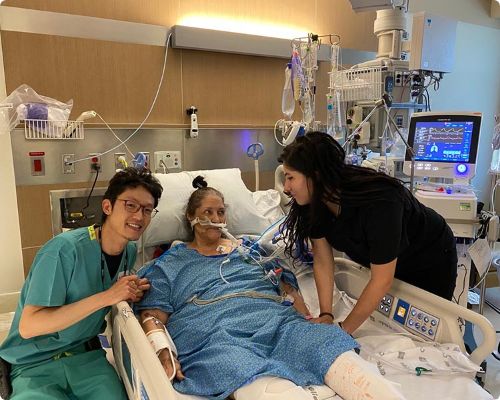 I stumbled upon Kali’s podcast midway through my anesthesia critical care fellowship in February 2021. At our institution, I got the impression that patients in the ICU either got better on their own or had a prolonged and complicated course to LTAC or death. In her podcast, Kali explained that LTAC was rarely the outcome for patients in the Awake and Walking ICU™ in Salt Lake City.