SUBSCRIBE TO THE PODCAST


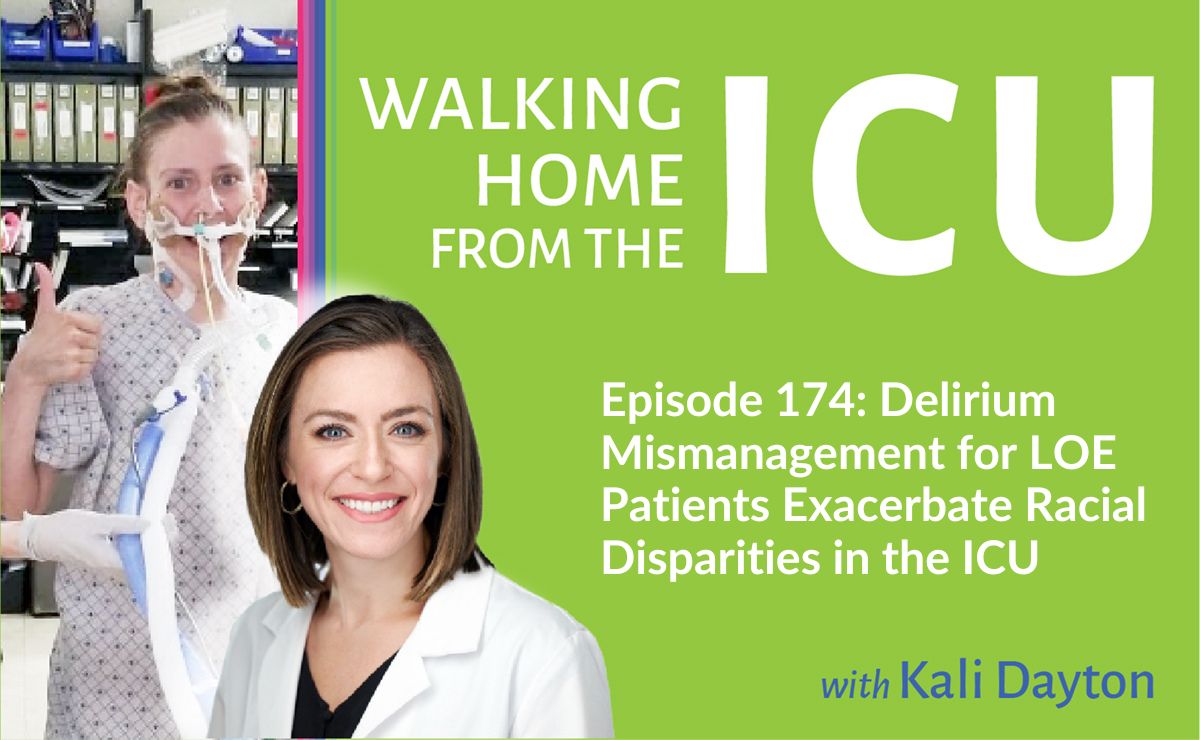
When patients have a primary language other than English (LOE), how does this impact their access to the ABCDEF bundle? Is it standardized to provide nonverbal communication in other languages in the hospital? Emily Ahrens, MS, RN, CCRN joins us now to dive deep into her post-doctoral studies dedicated to this gap in critical care medicine.
Episode Transcription
Kali Dayton 0:00
This is the walking home from the ICU Podcast. I’m Kali Dayton, a nurse practitioner and ICU consultant. I help teams create awake and walking ICUs through evidence based sedation and mobility practices by hearing from survivors, clinicians and researchers will explore how to give ICU patients the best chance to walk out of the ICU and go home to survive and thrive. Welcome to the ICU revolution. In episode 115 I interviewed Dr Valley, who shared his research that revealed that sedation management in the ICU varies by race. This discovery has really been a thorn in my side since then, and caused me to dig deeper into the research. You’ve probably heard me share these statistics before, but I’m going to keep sharing them until we actually do something about them. We have to understand that delirium mismanagement contributes to racial disparities in the ICU, considering that delirium doubles the risk of dying in the hospital and that deep sedation and benzodiazepines individually are independent predictors of delirium and death. We should be mortified to learn that Hispanic patients are five times more likely to be deeply sedated, they are more likely to receive benzodiazepines, and they’re 50% less likely to be screened for delirium. This episode, we have Emily with us to dive deeper into how language barriers are stopping us from providing equitable delivery of the ABCDEF bundle and the ICU. Emily, thank you so much for coming on the podcast. Can you introduce yourself to us?
Emily Aarons 1:54
My name is Emily Aarons. I am an ICU nurse. I’ve been an nurse for 13 years. I’ve worked in neuro, med, surg, oncology, cardiothoracic, cardiac medicine and trauma ICUs throughout my whole career, and currently I work as a resource team ICU, and like a larger facility that has a bunch of different types of units, so I go before between all of those adult ICUs and right now I’m getting my PhD in nursing science, and I’m focused on delirium prevention for patients who speak the language other than English, or loe for short. And we met at the ICU revolutionist meetup during NTI in Denver last month, and I heard what you were presenting on NTI and what your dissertation is on, I lit up because this is something I’m so passionate about. In previous episodes, I’ll put the link in the show notes or in the transcription on my website, but we have an episode on communication, episode on sedation by race, so we know that Hispanics are five times more likely to be deeply sedated versus non Hispanics. And there are so many things that we’ve seen that are inequitable and how we treat patients in the ICU, especially when it comes to ABCD bundle, Hispanics are less likely to be screened for delirium. They’re more likely to get benzodiazepines, just things that we know are lethal seem to be at higher rates in those in the Hispanic population, but my suspicion is that a lot of that came down to communication, and there aren’t a lot of really lot of communication tools that allow for nonverbal communication in English, which we’ll get talking about. So I wanted to know during your dissertation preparation exploring this, what do we know about delirium management for patients that are loe or speak language other than English? We don’t know a lot. Actually, we basically know nothing, and that’s because of throughout the decades of research, patients who speak language other than English have either been explicitly excluded from research or they have been just not included. And you can tell they’re not included because in randomized control trials, clinical trials.gov there’s no protocol that includes different languages, and so if there’s no protocol, that means they’re not recruited to the study. And so that’s about 98% of our clinical trials. And so only that means that only 2% of clinical trials, just in general, include patients who speak a language other than English. And so basically, everything that we have for delirium right now is meant and designed for same language, speaker or language concordance. It’s not designed for cross link implementation.
Kali Dayton 4:54
I just trained a hospital that has five ICUs in Sacramento, and just within the months. I’ve been there, I have seen, I don’t know, somewhere between seven and 10 different languages represented in these patients that are now awake, totally ready to communicate, riding on a clipboard, and they’re writing Mandarin, indeed. Yeah, it is so diverse. Some of our populations, and these patients are are vulnerable. We know that our minority populations are at higher risk of poor outcomes. They may not have as much socio economic support, family support, if they’re immigrants, they’re here alone. And then we set them up for post ICU syndrome, and then what happens to them? Yeah, they’re the ones sending money back to their families in other countries. Now they’re unable to work. Now they’re being readmitted to the hospital this whole sequence of the downwind effects. So it’s insane that we are not really able to screen for delirium. We’re not tracking these patients in and after the hospital. We have no idea what’s happening to them.
Emily Aarons 5:52
What we do know for loe patients is that they are have a higher risk of death in the hospital. They have a higher risk of getting complications in the hospital than English speaking patients, and they also are more likely to be put in either physical restraints or be chemically restrained. We know there’s a high suspicion, and I think just that’s in the academic field, right? People who are on the ground and actually doing this, doing this activity at the bedside, we all pretty much know that there’s not as good of care for loe patients in the ICU as for English speaking patients, or for patients we speak the same language as and that’s part of What brought me to this research is because in 2019, or 2020 when the COVID pandemic started and we started doing visitor restrictions as a nurse, one of my main values is including family members, because I see how much it does for patients as well as the family. And my facility sent out an email that said, Okay, these are the visitor restrictions, and there was basically no visitors whatsoever, unless they meet one of these exceptions. And the exceptions really revolved around if there was a really vulnerable patient who needed their caregiver with them, but their caregiver had to be also providing care, or they were at end of life, and then they could have but evolve one two visitors. So I wrote to our CNO, and I said, Hey, loe, patients are vulnerable as well, and they need to have a family member with them. Because as a bedside nurse, I know that we rely so heavily on family members for these patients to help with communication. And her response was, I’d love to do that, to advocate to the board for that, but I really need you to provide me some evidence that family is this essential, because all of the research says is that family actually shouldn’t be used for communication, and what should actually be being used is professional medical interpreters. But those were speaking, those were verbal patients. I said, Okay, I’ll go find this evidence. I’ll go look this up. So I did a literature search, and this was before I had joined, like the PhD program, I did a literature search, and I found almost absolutely nothing for patients in the ICU. Most of everything that has some sort of intervention evaluates patients in the clinic or an ER, and like you said, these are verbal patients. There’s really not a lot out there that I could find that is representative of the ICU environment, where interventions are occurring 24 hours a day, which is somewhat not practical to have an interpreter there for all 24 hours of the day, and where Patients have multiple communication barriers, such as intubation tubes, tracheostomy medications, focal paralysis. So there’s really nothing out there to show like that. This is an essential thing, having family members there.
Kali Dayton 9:16
And so I decided that I was like, Okay, I’ll go make this evidence then. And we when we know things like inability to communicate increases adverse events by 26% Yeah, and so you give someone that’s loe an artificial airway, take away their ability to verbalize, now you’ve just compounded this risk of adverse events because they’re unable to communicate. So you’re right. I think hospital systems assume, okay, we’ve got these translators, we’ve got the iPads. We’re good. Also, I think even within the ICU, there are very little expectations to communicate with our patients. I think it’s really important in rounds to be saying for each patient, how are they communicating, so that everyone knows it’s with a whiteboard, pen, paper, apps like Vita talk, we have to be really clear, and that’s the expectation throughout the entire team. That we value our communication with and from our patients. We don’t even consider that. And I see because usually they’re sedated, and when you think about delirium, we know that sensory, sensory deficit, so hearing and eyesight increase the risk of delirium. I’m just thinking about when I lived in Central America the first few months, I did not speak in Spanish, and I had to focus so hard on what everyone was saying, and it would wear me out, and I would fall asleep so easily, like during conversations, because my brain would just give out. I was just thinking so hard. Yeah, especially after lunch, I’d be like, I’m done, but I’m just trying to imagine being critically ill, already being foggy, and so hard to focus on what people are saying, but your whole environment is in this foreign language. And just compare that to my experience in my whole environment being Spanish, and I was trying so hard as a healthy young person who would some train in that language, try to tune in. Does that increase? Do you think the risk of delirium when you check out of your environment because your environment doesn’t make sense to you.
Emily Aarons 11:02
I have a suspicion, as a bedside nurse to just observing my patients over the years that the sedation, the critical illness, these are all language translation in the brain occurs as a higher level of processing, and it depends on your level of fluency too. So if you innate fluently, like if you dream in this other language, maybe critical illness wouldn’t affect that language ability, that translation ability. But if English is your second language, and you’re not to that level where you’re dreaming in English, I really have a suspicion that critical illness diminishes people’s ability to do that translation in their head. And then we as healthcare providers were are just going they have a job where they have to speak English, and so they should be able to speak English, and then we speak English to them, and they can’t do it. And there are several studies with Alzheimer’s and Alzheimer’s related dementias, where these patients lose their ability to speak their second language as their dementia progresses. And so I don’t, I’m not sure why it would be any different for delirium, but I don’t think there’s anything looking into that. So if anyone’s listening to this and is curious, feel free to do that research so that I don’t have to. But I do think it exists.
Kali Dayton 12:19
No, I’m sure most of our listeners would be nodding their heads as they’ve seen it, right? Spanish is very common, right? And so I’ve had patients where they should be able to speak English. The families, yeah, they speak English. But when I speak Spanish to them, suddenly their eyes open. Suddenly they’re responding. Suddenly they’re following commands, and I’m able to do delirium screen them like, oh, they don’t have delirium. They just didn’t understand. Yeah, we go back to our first language. I just try to consider what other parents speak to them. That’s probably where they’re at now, that’s what we need, to make sure it is accessible to them, and we don’t do that, and then we can’t screen for it. So how do we be proactive in intervening quickly with delirium.
Emily Aarons 13:01
if we don’t know, and one of the things that I think about a lot when it comes to how do we screen for this is our main method. It’s using the cam ICU is used in 80% of hospitals. What I’ve found in my research is that when I compared the cam ICU use in the society Critical Care Medicine database, ICU liberation data set, which is 68 hospitals, over 15,000 patients are in this data set. This data set has demonstrated that the A to F, B BLE really improves survival by you know, 68% 68% reduce the reduces ICU delirium by 40% in this same data set, I looked at delirium outcomes for English speakers compared to loe patients, and I actually couldn’t even evaluate the data because the missingness for the delirium outcome, meaning the cam ICU score, results of the cam ICU weren’t even filled out for 50% of an average of 50% for all the loe patients.
Kali Dayton 14:14
Does that include unable assess on someone charts unable to assess does still show up in that data set?
Emily Aarons 14:18
So it includes, it’s just missing data. So nothing was charted. So nothing was charted. We don’t know if they were delirious. We don’t know if the assessment was done. It’s just missing and for comparing to English speakers, that they have about a 30 ish percent missing this and that actually tracks with when we look at the how much the cam ICU is done in a real world setting. It’s not done about 30% because, at best, for whatever reason, yeah, but it’s significantly less for loe patients, and that in itself, I think, is a finding just showing that we’re really not doing it for these patients. Presentations, and part of my dissertation is talking to healthcare workers about the facilitators and barriers to the cam ICU, and they have legitimate concerns, meaning that the way that we’re really told to do the cam ICU for across languages is to use an interpreter, and so now we’re using the English cam, I see you with an interpreter, and depending on your ability to work with the interpreter or not to tell them what you’re doing, maybe the interpreter has no idea why you’re asking these weird questions, and so they change the questions. Or maybe the concept of does a stone float on water doesn’t translate very well to whatever your goal language is. Or maybe when we’re asking them to spell, they’ve a heart or Casablanca, are they not squeezing my hand because there’s a delay going through the interpreter? Are they not squeezing my hand because they don’t use the English alphabet, and they don’t know what the letter A is. Are they or are they delirious? They have no idea. And so there’s legitimate accuracy concerns. And to my knowledge, there’s not a screening tool for the cam ICU that exists that can go across languages,
Kali Dayton 16:19
which is wild because I compare the chem ICU to the troponin of the brain, the blood gas of the brain, the creatine of the brain, but is our only way to screen for delirium, and yet it doesn’t work for a really population of our patients. So would we just skip a cmp on a patient just because they don’t speak our language? But we do that the delirium screening. So what?
Emily Aarons 16:43
What are our options? A lot of nurses that I’ve been speaking to go back to their behavior assessments. Okay? Are they being able? Are they able to pay attention to me? Are they able to tell me the day and time when I’m using the interpreter, if they can tell me the day and time, right, they’re not delirious, but then we don’t actually know if there’s they’re seeing cockroaches or other types of hallucinations. We’ll watch them for responding to external stimuli. But that’s severe delirium, that’s not early delirium. So if we’re waiting until we’re seeing severe symptoms, then we’re not catching delirium early, and it’s harder to reverse, and
Kali Dayton 17:32
we’re not catching different features of delirium, such as inattention, disorganized thinking, maybe a little bit if you’re doing orientation questions, but you’re getting a very superficial scheme on the narrow function, whereas, and even in English, we have to do in a full cam assessment to really catch those other features. But it’s really difficult, if not impossible, with these other languages.
Emily Aarons 17:51
And there’s that the ICU delirium daily checklist, which is also a validated tool, but that’s really behavior based. And there’s some problems with that too, in that, if your patient is agitated, do you know why they’re agitated? Are they in pain? Are they unable to communicate their needs to you, or are they delirious? There’s many reasons that patients can be agitated that aren’t delirium, and just like you said, are they not responding to you just because they can’t hear you and are actually not delirious? And behavior based scales are open to those misinterpretations as well as bias. And so we really need to think hard as a community of how to close this gap and what screening tool would be appropriate.
Kali Dayton 18:43
we’re having great movements towards greater equity and inclusion, and I absolutely support that. And also people there that we have these things happening, but yet, in the ICU, such vulnerable people and vulnerable times in their lives, we don’t have any tools for nonverbal communication and these other languages. There’s only one program that I’m aware of that provides that, and it’s
Emily Aarons 19:05
by to talk. Yeah, the SCCM has a communication tool as well. I don’t think that it provides as many languages.
Kali Dayton 19:11
Yeah, how many languages do you think it has? Guess
Emily Aarons 19:14
I should look that up. I don’t actually know. I The last time I heard it was 10. Oh, okay, I didn’t know, did other languages? Okay? That’s great, and that’s what it has. But Vita talk has 40, yeah, a lot more. And like you said, there is quite a diversity in America about what languages people speak. It’s very regional as well. Some areas have more Hmong speakers. Others have more Hispanic speakers. Others have more Middle Eastern languages, like Arabic. And so it just really depends on where you live, which ones you’ll have
Kali Dayton 19:59
I’m not sure if all the apps that are available cover all those languages but 40 hits. Good, like the main majority languages you might see in the state, hopefully, again, there could be really crazy outliers, but we should at least have the most probable ones. Available communication is a basic human right I love. I’m gonna refer everyone to Episode 103 to listen to survivors talk about what it meant to be able to communicate, or how it affected them not to be able to communicate, and these were English speakers that were left out of the conversation, that were deprived of communication. So I’m going to project that into non English speakers to understand how scary it must be when we’re trying to bring them out of the delirium. We’re reorienting them. We’re telling them you’re not kidnapped. We don’t may not say that, but we’re clarifying these delusional thoughts that they have, and maybe that they’re going to be exported, or they’re being imprisoned, or like just lots of different things could go into their mind. And how are we clarifying that if we don’t have and can the family be there the whole time? I was just visiting the trauma icua trained back in February, and I had a woman that was Mandarin speaking, and she was cruising the halls, sitting there, running on a pen and paper with her pen and paper, but her family had to go run to 711 then I realized, Oh, how vulnerable for her there and not speaking the English. The nurse didn’t speak Mandarin, and it comes down to the family. But can the family but can the family be there, especially if our immigrant families, if I get FMLA to sit there for weeks? 24/7,
Kali Dayton 21:26
if you’ve been listening to this podcast, you’re likely convinced that sedation and mobility practices in the ICU need to change. The ICU community is facing incredible difficulty with the trauma from the pandemic, staffing crisis and burnout. We cannot afford to continue practices that result in poor patient outcomes, more time in the ICU, higher healthcare costs and greater workload for the ICU team. Yet the prospect of changing decades of beliefs, practices and culture across all disciplines of the ICU is a daunting task. How does this transformation start? It can begin with a consultation with me to discuss your team’s current practices, barriers, and to formulate a plan to help your ICU become an awake and walking ICU. I help teams master the ABCDEF bundle through education, consulting, simulation, training and bedside support. Let’s work together to move your team into the future of evidence based ICU care. Click the link in the show notes of this episode to find out more.
Emily Aarons 22:32
And also, if you only have video interpretation or telephone interpretation available to you, as a nurse and your patient is writing, then you hold up the clipboard with the writing. Everything’s reversed. It’s mirrored. So you can’t really do it that way. Maybe someone knows of a way that you can if you can flip it back, if there’s a setting where you can flip it back, but I’ve never been trained on these advanced settings and video interpretation. I don’t know how common that is. Translate
Kali Dayton 23:05
so they can text, if you’re really doing, like, walking approach, and they’re strong and smart enough and like intact enough to text, then do Google Translate? Yeah.
Emily Aarons 23:15
But fun fact, Google Translate saves all of the data, so if you have HIPAA information in there, it violates HIPAA to use Google Translate, and so some hospitals actually ban the use of Google Translate for that reason,
Kali Dayton 23:29
my goodness. So Vita talk has a talk to text feature, right? You can respond to them English, and it switches it to their language. However, that translation may be right, like we’ve all seen Google Translate, not be exactly what we wanted to say is we have to be careful of that as well, but at least provide something quickly,
Emily Aarons 23:49
then, then nothing right, and then nothing right,
Kali Dayton 23:53
but it stays in that app. Probably doesn’t even stay in the app, but it’s HIPAA
Emily Aarons 23:57
compliant. Yeah, that’s one of the things that I did talk has talked about is that they’re HIPAA compliant, and Google Translate really does say don’t use us for this, because it’s not certified for medical translation, and it also keeps that information. And so I understand that it’s definitely one of the things that we resort to as healthcare workers, because we don’t have a lot of other resources, and that’s a main issue, is systemic barriers. Big problem with ICU delirium and really critical care outcome differences for loe patients is systemic racism, in the sense that there’s not enough interpreters available, and hospitals don’t seem interested in getting more, or maybe they are now that the problem is being more exposed to them. But many nurses talk about, I didn’t get an interpreter because it took too much time, and part of. Taking too much time is that there’s not easy access to interpreters, meaning that they have to go hunt down a video interpreter tablet, or because maybe their unit only has one, but they have two patients who are loe on their unit, so they have to share. Or maybe you want to schedule an in person interpreter for an end of life conversation, but they’re not available for two or three days, and so while you’re waiting for that end of life conversation, your patient is experiencing advanced life support that may be determined to be futile by the healthcare team, but can’t make any changes because the in person interpreter is not available, because there’s just not enough of them to employ, not to mention that documents are supposed to be provided to patients in their language, and that doesn’t happen 100% of the time. And so there’s just a lot of structural issues. And the other thing too is we know that interpreter conversations take twice as long. They should take twice as long. That’s how they work. One person talks, then the interpreter talks, then the other person talks, the interpreter talks again. Now that’s twice the amount of talking, so if your conversation’s not taking twice as long, either you figured out some sort of shortcut that actually works really great, which would be awesome, or you’re not doing it right. And you think about that with staffing, if you get two patients in the ICU or even three in some hospitals, and one of your patients is loe, you don’t have time for everything to take twice as long. We have to be cognizant of that when we’re assigning acuity levels to patients. If you have any control over that, as a charge nurse or as a nurse manager, considering language abilities and communication abilities should go into staffing models for sure.
Kali Dayton 27:02
Yeah, I hadn’t thought about the timing that it takes, and it absolutely does. And I think we easily just breeze past it, you know? I mean, they’re intubated, they can’t talk, so I don’t expect to communicate. Or, of course, they’re intubated, so I’m going to sedate them. So once you start taking the layers off of that and taking away the barriers, and just because they’re intubated doesn’t mean they have to be sedated now that they’re now that they’re not sedated. Now, what are we going to do, and how do we accommodate for that and making that a priority? So hospitals are claiming equity and inclusion. Are they really trying to include everyone? Are they really accommodating to the specific needs of the patients? And it’s just amazing to think of the financial impact of these things, right? First Aid in patients, because we don’t know how to assess and treat their needs, and that’s why they’re loved and taken off the bed. That increases their length of stay substantially, and therefore the costs, yeah, and these are injured people, it just seems like it’s cost effective to provide the time and tools to be efficient in our care 100%.
Emily Aarons 27:59
what’s interesting there are they’re called the class standards. They’re federal standards that require hospitals that receive federal funding, like Medicare and Medicaid, to implement these standards, and they are that the hospital has to provide the interpreters. The burden is on the hospital. The hospital has the Educate the family members and the patients about the availability of interpretation. They have to provide documents in the link language of the patient, and I think it’s like the top 10 languages of the region, and that the hospital pays for the interpretation and it’s not cheap. The average hospital spends like $5 million on these programs every year, and that’s still usually not an adequate system that they have. And so balancing length of stay versus how much it costs to provide interpretive services. On an administrative level, you can see where they would be incentivized to not provide as many services as are needed, because the balance might be a little off. I don’t really know the exact numbers of how much everything costs, because you don’t learn that. But when you think about it from that perspective, you’re like, oh, okay, so I really need to show a hospital why it would benefit them financially to invest in these schools, not just from a moral standpoint, there’s an obvious moral standpoint, but from a financial standpoint, really money is what talks to people the most.
Kali Dayton 29:51
Yeah, you know that when we decrease sedation use, we decrease costs. But it doesn’t look like just sedation costs alone, and it’s like. Almost $200,000 and one ICU just by decreasing sedation used by 46% and that’s again, just in the medication cost, but then it was like $1.2 million in direct patient costs on top of that, just by decreasing sedation use. But you’re gonna it’s not just about taking away sedation, it’s about replacing it with communication, personalized, customized care, but you cannot provide that. And when you talk about these federal mandates, they had to provide interpretive services, okay, but does that include non verbal interpreter services, or is it just for verbal patients? Hospitals? Are we non compliant with the federal mandates when we don’t have tools for communication for non verbal patients, and I would really wonder how many hospitals are not compliant with those federal mandates, given the statistics about how often patients are offered interpretive services, there’s Several studies that measure this and the average is that patients are offered an interpreter about less than 20% of the time that they’re supposed to be given one. And the big deal because that means we’re missing 80% of communication opportunities. And when we miss these communication opportunities, we miss things like strokes and heart attacks and sepsis and allergies and no acute pain. That’s a symptom of something. Yeah,
Emily Aarons 31:30
we’re accessing the arm that has a fistula in it, instead of not avoiding that arm. We’re we’re putting in NG tubes on the side of a facial fracture, missing lots of safety, concerning issues when we do this.
Kali Dayton 31:47
I just in thinking about when I was again, new to El Salvador. I think I’d been there for not even two weeks. Hardly spoke in the Spanish. And of course, my retainer for my teeth of eight years decided to break that exact time. So I had to go to an orthodontist in the capital. I had no idea what people saying were saying around me. It was super stressful, but I wasn’t anywhere near as vulnerable as an ICU patient. And yet I was, it was really stressful, and they messed it up. And then I don’t want to say I was like, What did you just do here? And I couldn’t say it. And it was like, it caused a lot of problems, and it was really stressful. I’m trying to imagine them saying, No, I’m allergic to that. No, I have pain here. Oh, no, this is what’s going on, or here’s my past medical history. Nothing that’s insane. How can
Emily Aarons 32:30
we really if we don’t get if we can’t talk to patients? And the other thing too, to keep in mind when you’re talking to patients is that other studies show that healthcare workers dramatically overestimate a patient’s ability to understand what they’re saying. If they’re doing like pantomime type of English, like maybe they have a low level of English proficiency, they have some and so you’re pantomiming together, and you as a healthcare worker think that this is going great, but actually the patient is might be just going along with it because they don’t know what else to do. And when you look at qualitative studies of the patient’s experience, they said they’ll say, Oh yeah, I accidentally misinterpreted this word, and I said that I wanted to kill myself, and that’s not what I meant. But then I had to spend four hours talking to psychologists to try to convincing them that I’m not actually suicidal. Or they say, Oh, the nurse going into the surgery was telling me about the surgery, and I nodded, and I could tell she thought I understood, but I didn’t. And so we’re not very good at knowing when patients are just truly understand, or when maybe they’re afraid to speak out for themselves and advocate for themselves, for whatever reason. And it’s important to think about for these patients, for loe patients, they’re often not white, and they experience racism and discrimination in the United States on a regular basis. And as healthcare workers, we don’t have the benefit of the doubt. They often say that nurses, we’re the most trusted profession in the whole country and not that’s not true with these patients, because they’ve been victimized by us and the healthcare industry multiple times, and the fact that your patient could even get to a hospital and or get to a primary care appointment is really challenging for them to do so. All that is to say is that it’s really important to be thoughtful about the past experiences of our patients, the individual needs and the individual culture and individual experience of each patient, and to not force our. Or needs on them. And I’m going to go through some examples of like how that is different for the A to F bundle specifically so for the bundle a in the in my in the Society of Critical Care Medicine, I see liberation data set, it actually showed that patients are more likely to loe, patients are more likely to receive a pain assessment than English speaking patients, which is, Wow, that’s great. Also, it doesn’t track because other research shows that they’re less likely to get opiates. So are we just doing the Pain Assessment and doing nothing about it? When I speak to actual healthcare workers, they say, Oh, I can’t really communicate the number scale with them. So I do see pot, which is a behavior pace based scale, and we know that behavior based scales are a lot less accurate than numeric scales, and we also know that different cultures express pain differently. So you might have an extremely stoic patient whose c pot is zero, but they’re actually in a lot of pain. Then we also have them, they also talk about the pain assessment, kind of devolving into yes, no. So instead of what’s your pain on a scale of one to 10, can you describe it for me? Where is your pain? Is there anything that makes it better? Is there anything that makes it worse? We go. Are you in pain? Yes, no. Point. Point to where it is. Get the point. The lower Diana’s the lower. Trusting your
Kali Dayton 36:43
own language skills too. They’re like, I think I know that. But then I hear people. I’ve heard people to say, Yeah, I speak Spanish. And then I hear them, and they’re like, oh my gosh, you’re asking something totally different than I think you mean to Yeah. And so that’s really scary as well. They’re asking the wrong question, and they’re trusting the answers that they
Emily Aarons 36:58
get. Yeah. So that’s how the Pain Assessment is. Okay. What are we doing more of I guess that’s a good question. SATs and SBTs seem to have no difference in us doing them between for English speakers and non English speakers. But something that does happen when you talk to healthcare workers is that it might be delayed until later in the day, because they need to get the interpreter tablet available, or that they’re waiting for a family member to show up, or they have to go hunt down the one healthcare worker on the floor who speaks that language, who has their own patient load. Or they wake the patient up thinking that they speak pretty good English, and then they turns out they don’t, and then they re sedate. And now get an S, a T, S, B T, yeah. And so the quality of those is pretty questionable in some cases as well. Maybe they’re getting done, but are we doing them with an interpreter present. I did speak with several people who said they never considered getting an interpreter out for that, or that if they did, it just didn’t even go well, because this patient was confused, and so they didn’t know what the interpreter was doing. And many nurses said I would much rather say this with my own voice, because I think it’s less confusing for the patient, because
Kali Dayton 38:26
I’m a real person with a physical presence in the room.
Emily Aarons 38:29
Yeah. And then sedation management, people are concerned that if they wake up that from sedation, that they won’t be able to communicate, and they’ll be more agitated, so they wean sedation differently, or have them heavier sedated then for delirium assessments, as we already discussed, they just don’t even do. They don’t happen managing sedation, choices sedation, the bundle element, is 21% less likely to happen, or an loe patient compared to an English speaking patient.
Kali Dayton 39:05
And what does it mean? Station?
Emily Aarons 39:07
So like checking the RAS, filling out your RAS for every i think it’s six times a day, at least six times a day in a 24 hour period. So it doesn’t even manage what the RAS is. It just wants you to put it down assessing depth of sedation on these patients, right? Yeah, scary. Delirium assessments, 46% less likely to happen for an loe patient compared to an English speaking patient. Early mobility is about the same. Which is exciting, is it doesn’t mean that we just don’t move anybody. So they’re just, they’re anybody, so we just don’t move them. Interpret it. So here’s what I’m thinking about this because actually, when I talk to healthcare workers, early mobility is something that is really promoted in the ICUs and has been for a while, and so people really try to do that a lot. And I think that in some places, the click between reducing sedation and ability to do early mobility hasn’t quite made it. But for those people who are eligible and are doing eligible in quotes, they do do it. And when I talk to healthcare workers, they say, Yeah, I do it. I don’t think there’s actually a difference. It’s just the safety scares me, because there’s not an ability for them to quickly say, I’m dizzy, or if you have staff for two people to take your patient out into the hall, and one of them is in charge of holding the IV pole, and the other one’s in charge of making sure the patient doesn’t fall. There’s no one to hold the interpreter iPad on wheels as it goes around. So now they there’s no interpreter with them during the mobility session. If they’re in the hallway and there’s no way for them to go, Oh, I’m dizzy or I’m having a lot of pain, and that understandably makes healthcare workers nervous because it feels less safe. And if you have these staffing issues where you can’t provide the whole as many team members as you need to provide a safe scenario for these patients, you just don’t do it, or you do something less effective, like bedside dangling or but they don’t actually get to stand up. And so that one actually, I think, is the least amount of growth opportunity that we have, because it seems like people are really doing it well, which is really good news, to be honest. And was happy with that.
Kali Dayton 41:35
I noticed in these ADAP bundle dashboards that they’ll chart e they’ll chart bed rest. They’ll chart that looks compliant on the dashboard, but it’s not actually mobility, but they’re charting that they’ve screened for it so but I do think that if, like you said, if units are mobilizing their patients, they’re not going to discriminate by who gets mobilized. They’re going to try to mobilize everyone. But it comes with extra layer of considerations. I know in my home ICU, because I spoke Spanish, I would need to go to nurse to come help get the patients up, and they’re non verbal. It is really nice to be able to ask, are you feeling, Are you dizzy? Like clearly, and have them respond to it. And it brings another level of assurance. So I do see why that would be scary to be like, do they know what we’re doing well that we’re headed down the hallway, do they are we just pushing them around? And they don’t they’re not able to necessarily cooperate fully, because they’re waiting for us to push them physically because they can’t give verbal cues.
Emily Aarons 42:31
And then you think about too when you’re using an interpreter, and this actually goes with education as well. When you’re working with an interpreter. There’s only so much you can say at one time before now the interpreter has to interpret it. You’re supposed to do about one sentence at a time, and it’s pretty challenging to show someone how to mobilize, especially if they have chest tubes and a PA catheter and another central line, yeah, plus sternal precautions, and even if they’re intubated like now, you have 10 plus lines to manage, plus the telemetry and the Foley and the NG tube. And so you’re trying to manage all of that, plus talk to an interpreter, and then interpreters talking back. And how do you say the education part as well? And so we get very task oriented, and forget about the Okay, let me know when you feel dizzy or are you having pain or don’t stand until I say go. And then now people are standing up before you’re ready, and they’re like, yeah, no, absolutely, very into that. That kind of feeds into the fear of early mobility as well. And you have enough situations like that where you don’t feel safe as a nurse providing this type of intervention, and then now your future interventions or confidence implementing future infant is going to be affected and tying into that situation where we’re not really able to have an interpreted interpret can’t even say this. We’re not interpreted conversation about a task plus education. At the same time, patients aren’t getting as much education about delirium precautions and other or patient education as an English speaking patient would be because as nurses, we would just intervene and teach at the same time. It’s pretty normal for us to do that, but you can’t do that if an lov patient, if you’re having an interpreted conversation, as easily and so more time needs to be put into that. When I speak to healthcare workers, sometimes it’s the first time they’ve ever thought about that is when I’m asking them about it. And so for the listeners, I would encourage you to think about that, and it might be the first time you’ve ever considered, Oh, am I actually giving as much patient education to these patients as I would be to an English speaking patient? And if I’m not, how do I start making sure that it’s the same amount of education, or that my patients are getting the appropriate amount of education?
Kali Dayton 45:09
Hard things, these are hard things. I mean, they’re one thing to talk about. I’m the other part to do them and to have it ingrained into the infrastructure of an ICU team so that it’s reliable every possibility that needs these resources, needs extra support, gets it.
Emily Aarons 45:25
So we’ve been talking a lot about systemic barriers as well, but there’s certainly individual biases that we carry as healthcare workers as well, especially when it comes to saving time. We might prioritize our needs over our patients needs, and there’s many ways that we do that. And one way is restraining them because we don’t have enough staff to make sure that they’re not pulling out their et too. That’s just general. And one way is sedating them more, because we don’t have enough time to make sure they’re not pulling out their et too.
Kali Dayton 46:01
We don’t know what’s bothering them, why they’re rasa plus one or plus two or plus four. We don’t know why. So we just
Emily Aarons 46:05
go to the control things that we have, and it’s pretty similar for going to get an interpreter, to get a professional interpreter involved in the care of your patient. It does take time to do, but so do all of the other workarounds. If you think about it, for example, if you’re going to find you on the unit and you’re all the way across the unit, you’re the only person who speaks Spanish now, so I need Kaylee to come talk to my patient, but now I have to wait for her to be ready. And for some reason, in my mind, this takes less time than pulling up the interpreter, or I’m going to wait for the family member to get here. You’re still waiting, not doing other care. One person described it in the most amazing analogy that I’ve ever heard. He said, When I’m in a traffic jam and I’m looking up the ways to get from, say, my house to work, and I look up ahead of time, there’s two routes. One route is all red and there’s a huge gap, and then the other route is all blue. It’s free driving. Maybe the blue route takes two more minutes, but I’m going to take the blue route because I don’t have to. I’m going to be able to move the whole time. So maybe even though it takes the same amount of time, it feels like I’m doing something the whole time, but what you’re doing not actually an effective way to communicate or and it’s definitely not more effective than providing language Concord care. So that’s also something that I’d like to the listeners to be thinking about when they’re making the choice of, Should I go get the interpreter iPad, or can I just get through this task without using one? Is, how much time would it really take me to get the interpreter pulled up?
Kali Dayton 47:53
understanding the patient perspective of how hard and traumatizing and scary it is, and again, I really suspect the brain starts to check out when it’s surrounded by a language they do not understand, that they can’t engage with. Because I’ve experienced it myself outside of a hospital setting, outside of critical illness, I my brain turns off, and I worry that’s what’s happening to our patients, and we have no way to screen for it. We respond in ways that are very telegenic, and it’s a huge challenge, and these are important people to be tracking, protecting, screening, following after we should be catching these patients that had delirium and making sure that they’re have post admission, follow up delirium care. I know that’s not happening. I don’t just doubt, I know that’s not happening for these patients. And so thank you so much for focusing your dissertation on these loe patients, and I hope that we have more research coming out in the future, planting those seeds, getting the researchers involved and treat for delirium these patients as well.
Emily Aarons 48:53
Yeah, I agree. And one last thing to leave it on is that in the United States, there’s an average of 13.5% of the population, that is loe, and so if you think about one in 1000 people will have a pulmonary embolism, but we still have a whole protocol for pulmonary embolisms. What if we just didn’t treat pulmonary embolisms very well? What if we just knowingly gave them worse care or heart attacks. What if we just willingly gave people with heart attacks less effective care? We would never do that. And it’s important to think about these people are human beings. They have the same rights to health care as people who do speak English, and it’s our responsibility to advocate, and not just on an individual level for each patient, but on a structural level as well.
Kali Dayton 49:51
Absolutely, Emily, thank you so much. Appreciate everything you brought to us. Thank you. Applause. To schedule a consultation for your ICU, as well as find supportive resources such as the free ebook, case studies, Episode citations and transcripts.
Transcribed by https://otter.ai
SUBSCRIBE TO THE PODCAST