SUBSCRIBE TO THE PODCAST


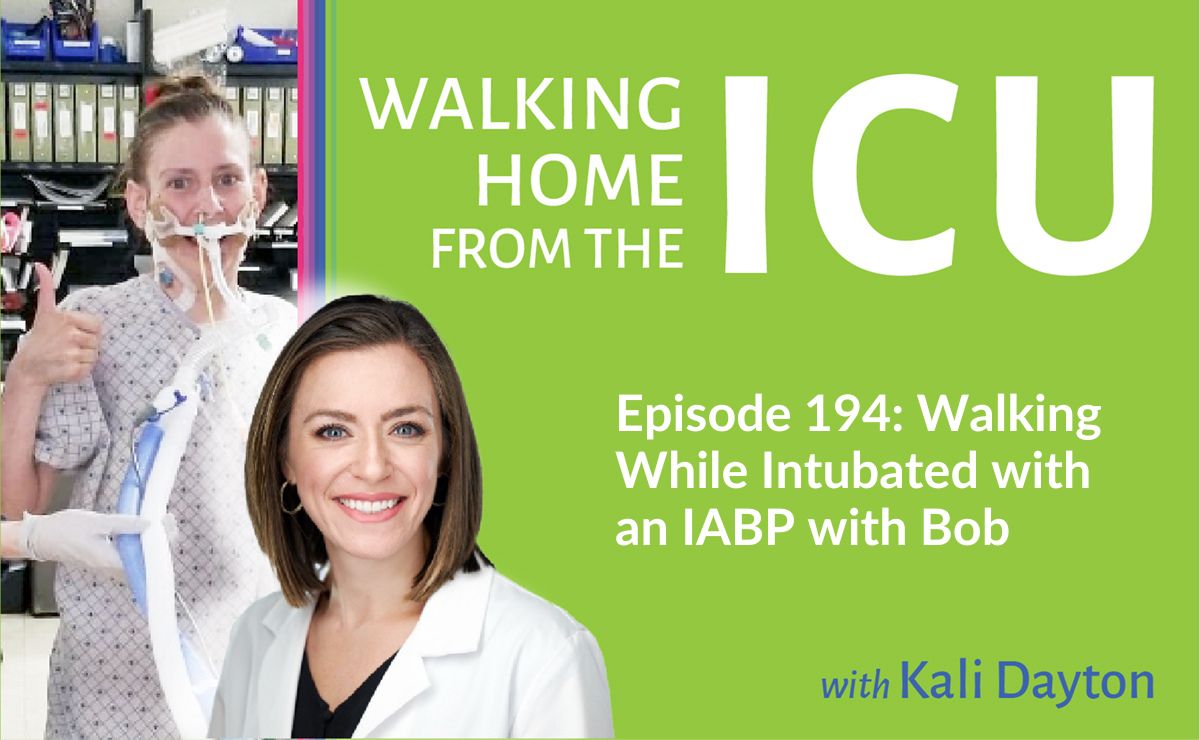
What it is like to wake up intubated with an intra aortic balloon pump and then have Teia, your physical therapist, get you walking? Bob shares with us how the ABCDEF Bundle helped him walk home from the ICU.
Episode Transcription
[00:00:00] This is the walking home from the ICU Podcast. I’m Kelly Dayton, a nurse practitioner and ICU consultant. I help teams create awake and walking ICUs through evidence-based sedation and mobility practices. By hearing from survivors, clinicians, and researchers, we’ll explore how to give ICU patients the best chance.
To walk out of the ICU and go home to survive and thrive. Welcome to the ICU Revolution.
I was just this Houston Shock Conference surrounded by over a thousand of brilliant minds in all things cardiogenic shock. As I listened to these very high level and niche [00:01:00] presentations on cardiac devices, medications, et cetera, I wondered if this audience was going to receive my message. Well, my prompt was non-pharmacological interventions during shock.
I worried that talking about communication, family engagement, mobility, et cetera. What seems silly to these people that were far more educated than I am and are focusing on placing LVADs balloon pumps, ECMO, cannulas, et cetera, I had seven minutes to essentially make the point of don’t forget that you are treating people.
Our patients are not just bags of physiology. Even once we’ve initially treated the shock, we can still drastically increase the risks of dying from delirium and icy acquired weakness, depending. And how we manage them, that their interventions absolutely save people from imminent death, but that the A-B-C-D-E-F bundle then gives them back lives worth living.
It’s time to circle back to our why, which is our patients. I’m [00:02:00] so proud of the revolutionists at HO Hospital that have really pulled their team together to move towards creating an awakened walking ICU. I got to meet some of them at the UCSF humanizing ICU Care conference in the fall. And was so inspired by them, I should and probably will have them on to talk about their journey.
But there is no greater witness to their expertise in powerful approach than their own survivor. This story is a great example of protecting the brain muscles and quality of this story is a great example of protecting the brain muscles and quality of life, even enduring cardiogenic shock, mechanical ventilation, and an in aortic balloon pump.
Bob, thank you so much for coming on the podcast. This is such a thrill. Can you introduce yourself to us? Hello. I am Bob Van Haslin. I am 72 years old. I live in Pismo Beach with my wife Victoria, and we have a brand new kitty that we’re trying to tame at the present. [00:03:00] My career was spent entirely with the city of Burbank down south.
I got out. Trade school, college where I, I guess you majored in, I majored in automotive and equipment repair, and luckily when I got out, Burbank was hiring three positions and I, I luckily got one of those. So I spent 10 years working on everything from chainsaws to bulldozers, everything in between, and then I promoted up into management.
And retired as what’s called an assistant public works director over the fleet vehicles and over building maintenance. I had 75 people that, and supervisors that took care of the city buildings and vehicles. And how old are you now? I’m 72. I retired at 55. I was lucky to get out early. You’ve been living a full life in retirement.
A little bored. [00:04:00] That job was. High paced, and when I retired it was a quieter time that maybe I’d rather have been more busy. But as time went on, I, I found things to volunteer for up here in Pinal Beach, so that, that keeps me busy. Good. And how did you end up in the ICU really quick? In 1995, I was diagnosed as a Marfan Syndrome Probable, some years later, I took the DNA test and it was actually a.
As yet, undefined familial connective tissue disorder. But for me, what it meant was at age 42, I think, or 43, I had an aortic root aneurysm already at 4.2 centimeters, and it should have been 3.7. So I got a, I got hooked up at Stanford with a surgeon and a cardiologist, and it was a time to operate because mortality rates then were about 3% on that surgery.
Surgeon said, Bob, let me [00:05:00] get some more of these under my belt, and you’re not at risk at dissecting right now. So we watched it for eight years. It finally grew to 5.2 centimeters and at that time, valves airing surgeries were coming into beam. So he says, if you wanna save your valve from stretching too far, we need to go now.
Well, I was begging him for eight years to get the surgery done ’cause I didn’t like having an aneurysm. So back to the connective tissue. So I’ve been washed ever since that surgery. And, and by the way, that surgery, I was out of the hospital in three days. Again, I was prepared. So I get an echo every year and over.
After the surgery in 2003, my mitral valve regurgitation increased. I mean, every couple years I went from moderate in the beginning to moderately severe. And then severe over the last five years. [00:06:00] But it wasn’t enough cut is what my cardiologist said. So last December of 23, our house was on a little bit of a slope.
I had, I started having trouble walking from the back of the house to the front of the house out outside. I would almost have to sit down and we’re talking 60 feet, and I didn’t really put two and two together, but evidently I had become symptomatic. The neo cords, I think they might be called on the mitral valve.
One had failed and I think others were loose. So I had gone into full symptomatic mitral valve regurgitation. It was building pressure, back pressure in my heart somewhere. I don’t quite get that, but, so I called my cardiologist who now had moved to Hoag in the Newport and got, he said he, we took imaging and he says, you need to go now.
So we need to have that surgery. So, uh, I had to do a couple pre things [00:07:00] and uh, April 10th came, and that was the day I was really, really excited because I figured I’d been losing a lot of energy because of my regurgitation. Less blood below, less oxygen. I thought, man, I’m gonna get done with this and I’m gonna be better than I ever have.
So the mitral valve repair went famously. By the way, it was a Stanford surgeon also who trained under my first surgeon. So I got Stanford service at Hope. When they went to take me off the bypass machine, my heart wouldn’t function correctly. Uh, I think the left ventricle was flopping around or something, not quite sure.
So they did all kinds of things to try and get me going during which time I lost kidney function. I had a partially collapsed left lung. They finally brought in the Impella pump [00:08:00] team and implanted the Impella in me. And that worked. Um, I think total time. I was in the operating room for about 11 hours or so.
I have an 11 page surgery report. It’s really long. I didn’t know any of this, so obviously I was taken down to ICU. I’m told my surgeon spent the night with me. Because he was concerned and interestingly enough, my first recollection of being coherent, I felt my body being manipulated all my, all my limbs being manipulated, and my brain told me that I wasn’t going to make it through the surgery.
And they were folding me into the standard position for euthanasia. They were going to finish by breaking my neck to put me out of my misery. Wow. And that’s while you were sedated, right? Yeah, I, but I think that was shortly after they wheeled me down, I think. Wow. So [00:09:00] that’s my story. In getting into the ICU, you were still intubated?
Yes. You had an Impella placed, I think I had the Impella for five days. And when did you start becoming coherent? When did they take sedation off and let you wake up? I remember. Multiple days having the appella in me. So if I were back, I’m going to speculate that I may have been sedated for one or two days.
That’s a guess. And what was it like to come outta that sedation? Uh, I couldn’t believe the weakness and the incoherency. Maybe it took a while for the, those drugs to wear off. And I just remember trying to lift an arm. It’s like I was newly born. I had no energy. Uh, and, and I, I just couldn’t believe it took that toll because I don’t remember that with the first surgery in oh three, but I’m 20 years [00:10:00] older, so yeah, I mean, at 72, that’s, that is a fragile age for a robust, healthy, 72-year-old.
But still, and even for younger people, those medications that propofol. Hit up. It’s the sodium channels of your muscles. So even after a day or two, it’s really hard for your brain to get your muscles to move to talk to this muscles, even if there’s still enough muscle mass. Everything just is slow. Yeah.
Or just not responsive to you and I, I had just in February of 2022, I was diagnosed with. The most aggressive prostate cancer there is. So I went through a prostatectomy and I went through 35 treatments of radiation and 17 months of testosterone removal therapy. So I was just coming off that when I went into this surgery, but I was still working out.
I was able to work out a little bit. So I think [00:11:00] that really helped me. Absolutely. But even after a day or two, it starts to quickly change. Was that scary for you? What were some of your feelings and thoughts when you realized that your body had changed so quickly? Well, I have maybe a reverse action or thought process of other people.
I take it as a challenge. I wanted to get up and start fixing myself. You know, I don’t wanna lay there in bed and be sedated. Get me up, walk me around. And that’s basically what they did. They gave me every opportunity to get up. In fact, the surgeon’s order standing order was, nobody stays in bed. They get up and they sit in the chair and they walk around.
Ventilator, no ventilator, doesn’t matter. Everybody’s up. And for context, your ICU has been really influenced by some IC Revolutionists. It’s what I call people that listen to the podcast and are pushing for these changes. So you’ve got [00:12:00] your PT Tia. Who is, she’s some of the videos online. She’s super animated, passionate.
I would never say no to her. You had also a team that had done a lot of training. They had developed this culture, and so they were prepared to mobilize you, even with the ventilator and even with the Impella, right? Yes. Yeah. And so what was that like getting up? You were very motivated. How did they talk to you about mobility?
Were you afraid? Considering all these lifesaving devices that were in you, if you’ve been listening to this podcast, you are likely convinced that sedation and mobility practices in the ICU need to change. The ICU community is facing incredible difficulty with the trauma from the Pandemic staffing crisis and burnout.
We cannot afford to continue practices that result in poor patient outcomes. More time in the ICU. Higher healthcare costs and greater workload for the [00:13:00] ICU team. Yet the prospect of changing decades of beliefs, practices, and culture across all disciplines of the ICU is a daunting task. How does this transformation start?
It can begin with a consultation with me to discuss your team’s current practices, barriers, and to formulate a plan to help your ICU become an AWAKE and walking ICUI help teams master the A-B-C-D-E-F bundle through education consulting, simulation training, and bedside support. Let’s work together to move your team into the future of evidence-based ICU care.
Click the link in the show notes of this episode to find out more.
No. No, not really. I’ve never been afraid of surgeries. I’ve welcomed them. As I said before, it’s a challenge to my physical body and I’m going to win. I’m very, very competitive, which is a great quality to have impatience because sometimes they’re [00:14:00] scared, they’re hesitant. What does a team do for you to help you tolerate that breathing tube?
That’s a very big concern for clinicians at that. It’ll be uncomfortable. It will be insufferable. When patients have been sedated for a long time and they’re confused, they cough, they gag, they try to pull it out. What helped you stay calm and tolerate that tube? My, my nature has, at least through my working career now, and now, my nature has been the more stressful or more emergency situations, the stronger the emergency is.
I don’t shut down. I slow down. And I start to really think things through. Yeah, I don’t get stressed very much. I’m not scared at all. I just, I look at what’s in front of me. Okay, here’s my priority list. This is what I do first. I don’t need to worry about three, four, and five. I’ll do this, then I’ll go to the next one.
I was never stressed or frightened [00:15:00] of the breathing tube. It was in there. It was a necessity. I do remember one, one night being awake. And for some reason, I, I had gone into breathing really shallow and really fast and thinking, how long can I do this? This is pretty uncomfortable. But it went away. I, I don’t know what, what was happening then, but that’s the only negative of my breathing tube experience.
It just, it wasn’t a huge deal. I just dealt with it. And how did you communicate with your wife? Your caregivers, what did you use that, that was interesting. I don’t know how much time we have, but uh, I’ll go into one small detail. Hopefully it’s not too long. When I met with a surgeon, when we met with a surgeon before the off, he handed me a, a pamphlet that for a hundred dollars a week could have a non-medical person in the operating room, and they would text updates to all my 20 people that I wanted updates to.
I remember getting [00:16:00] something in the mail prior to the op. And I thought it was some kind of a piece of plastic or something. My brain’s kind of really fuzzy on this, so when we checked in, we gave them this thing and their texting all worked fine, but when I came out, it probably had maybe nine of those pumps sitting alongside of me and some other stuff.
They were making noises that sounded, it was like 12 musical notes. Endless. It never stopped, and it was an ominous set of notes. I thought they had implanted that plastic thing in my head and it was still controlling me or wor working. So my first communication was I tried to write on a slate. My writing was pretty bad.
So then they brought in the alphabet letter piece of paper, and I was able to point and spell out. [00:17:00] Call my wife, tell her to tell them to turn this off. Wow. So I, it, I don’t know. I don’t know what that was. Maybe some leftover from May, maybe pain meds. I don’t know. Yeah, the sedation or the pain meds, it definitely alters how the brain works.
And a day or two of sedation, that can definitely give you some delirium. And I, I don’t really remember the breathing tube being in very long. I remember thinking it was going to be a little painful to get it out because I remember that from the first surgery years ago, they had it out in one or two seconds.
I didn’t even feel it, but it was such a relief to be able to say something. So were you having to use that letter board for very long? Probably a couple days. Okay. And did you end up being able to write once your body woke up more? I think the first day was the letters, and I think I had enough [00:18:00] coordination to start slowly writing on the second day.
And after that I was able to talk and how nice it was. Yes. And what did it mean to you to be able to communicate, to be in and to be involved in your journey? It goes along with my, I, I want to improve myself so. It had everything to do with voicing what I wanted to do for my own recovery, and I didn’t really have to push anybody.
I mean, they were pushing me at times, so, uh, they were on board with no sleep, no coma, no sedation, and had it not been for that, you know, I had a tough recovery. This is my toughest recovery I’ve ever had. And for the, from April through August. I wanted nothing to do with food. It wasn’t that it tasted terrible.
I just did not be it candy, be it dessert, be it [00:19:00] steak. I wanted nothing. I ate a little bit, but I kept myself alive by drinking three Net Pro brand shakes a day. I’m not sure where I’m going with that, but it was part of the tough, the very tough recovery. It really was. And I think that’s something that I hadn’t really considered is what if they have changes to appetite after?
You know, if we allow muscles to so quickly atrophy in the ICU and then they struggle with things like nutrition afterwards, it just exacerbates the loss of function. And I see a lot of times we assume that patients like you will go to rehab, pick a couple days, couple weeks, and then bounce right back to their normal lives.
So it doesn’t matter really what we do in the ICU. They can sleep and stay in bed for a few days, few weeks. It’s okay. Recovery is for the backend. But your team’s approach of preserving your muscle mass and your brain function, honoring your dignity, your autonomy, your right to be informed and make decisions and be [00:20:00] involved in your process, gave you such a huge leap ahead of the game so that when you did struggle with nutrition on the backend, you at least had the cognition to.
Will yourself to drink those things, and it wasn’t so hard to move and utilize your muscles because they fought so hard to preserve your function. I remember if we’d been picked up and put into another ICU even a few miles away, I think your experience and your outcomes would’ve been entirely different.
So you already had some confusion thinking that you were gonna be euthanized, thinking that you had this plastic card implanted in your brain, right? Just speculating. How would it have impacted where you’re at now? If you had been that confused and been living in those kind of realities for days to weeks, and it’d come out without the ability to lift a finger or get yourself out of bed and it’d spent months trying to recover from that, how would that impact you?
I would speculate [00:21:00] that, you know, I’m 10 months in now. I’m probably maybe 25% shy on my energy. I have other medical issues that are really taking all my thoughts off my surgery. I don’t even think of my surgery anymore. It was a nothing compared to what I have now, some back pain and whatnot. But if I didn’t have that right now, I would be a hundred percent, maybe even a month or two ago, a hundred percent.
I’m not because of these other things, but my speculation is that at the 10 months we’re at now. I still might be back in month two or three in recovery it, it would’ve really, really slowed it down, I think. Absolutely. And you may not have even survived. You shared that with your specific case, the survival rate or the mortality rate is about 67%.
Yes. That’s when a reigning on multiple capable websites and then add in IC acquired weakness, which increases [00:22:00] mortality by 30%. Delirium doubles the risk of dying. So those would’ve been just more complications that would’ve greatly impacted whether or not you even left that hospital, let alone whether or not you’d be able to go back home, live the life you’re living now, and have reserve to face other challenges and complications that you’ve had.
So this is such a huge testimonial to your ICU, your hospital. The culture and the process of care that they have developed over the past few years has. Saved your life and your quality of life, what would you say to eyes to clinicians that are really scared of getting someone like you awake and moving with a breathing tube ventilator, and especially an Impella?
What would you say to those that are scared of that? Probably the first thing I, I would use myself as an example. Look, look what I went through. Look where I’m at. I know some ICUs are policy restricted on that. And the first thing I’m gonna tell ’em on that is. You [00:23:00] have policies you have to follow, but dig into that policy as much as you can.
Exploit it as much as you can without getting yourself in trouble. And then if you’re interested, do not go advocate for what I do. That would be my suggestions. And Bobby, your testimonial, your personal experience. It’s so compelling and now it’ll be accessible to others to be able to share with their teams.
To say it’s possible. It’s not inhumane. In fact, it is much more ethical, humane, and dignified for our patients, and it achieves the objectives that we’re there for to save lives and send patients back the lives that they want to live. It lifted my spirits. You can’t even describe how wonderful it was to be able to carry out my priority list.
I need to get back to full shape and it was uplifting mentally, which is a big part that this controls so much. [00:24:00] I keep on saying, I wish we could measure the will to live, how much that impacts patient’s outcomes, and being able to communicate, know what’s going on, fight for your own life, that has to play into the increase in survival rate of these patients beyond just the brain function and the muscles that we can measure, but having your spirit understand what’s going on and drive.
Your progress forward. That plays a role that we have not measured, but it’s undeniable, especially when you’ve seen it in a patient like you. I agree a hundred percent. I can also add the first time he had came into the ICU and every other time you knew she was in the room there, there was a feeling of uplifting and, and happiness, hard to describe.
And now I didn’t know she was gonna be my therapist. She came into the room. My, my goodness. It just, it was, I don’t know, something was in the air. I don’t know. I just felt so uplifted. And then she said, we’re going to [00:25:00] get you up and walk in this thing. And she was right there, you know, hugging onto me in back of me while I walk.
The second day, I think I got down to the corner of the hall the next day, another worker there. Abe said, do you like music? And coincidentally, I had been, when I find a song I like. I listened to it nonstop for weeks, sometimes a month. No other song, just the one I had been listening to one and it just, it came flooding back to me.
Get my phone out. I need to play this music when I’m walking and I will tell you I could walk double the distance I had the previous day. It was absolutely amazing with Taya behind me in her coaching and the music, and not to leave out other people, Olivia and Megan, Eric. There was, I will say that. The ICU with regard to ICU staff.
It’s cliche. The sum is greater than the whole is. Greater than the sum of the parts. [00:26:00] They worked together unbelievably, it was, I might as well have been home with all my family. It was, they celebrated my birthday on my birthday. It was just, I can’t speak enough about everybody in the ICU and tia. It was fabulous.
And Tia and a few of the nurses have been huge drivers of this. They now run classes that anyone that comes onto the team gets educated on how to do this and why we do it. And it just done a great job in flipping some really old, antiquated habits and practices to be able to provide the kind of care that you’ve had.
And so it’s really nice for them to hear your perspective of it. They were just wonderful. I couldn’t have gone to a better place. You know, I’ve been a Stanford advocate for 30 years, but I don’t know if they would’ve compared with Hogue in the ICU there. Hogue is really excelling in early mobility, [00:27:00] keeping patients awake and walking, and it is exceptional.
Hopefully down the road, more teams follow their example, but it’s through your testimonial, your side, your perspective, that’s gonna really help empower more teams to do what HOA is doing. I hope so. For all the other patients. Absolutely. Thank you so much, Bob. You’re very welcome
To schedule a consultation for your ICU as well as, find supportive resources such as the free ebook, case studies, episode, citations, and transcripts, please check out the rest of my website.
Transcribed by https://otter.ai
SUBSCRIBE TO THE PODCAST