SUBSCRIBE TO THE PODCAST


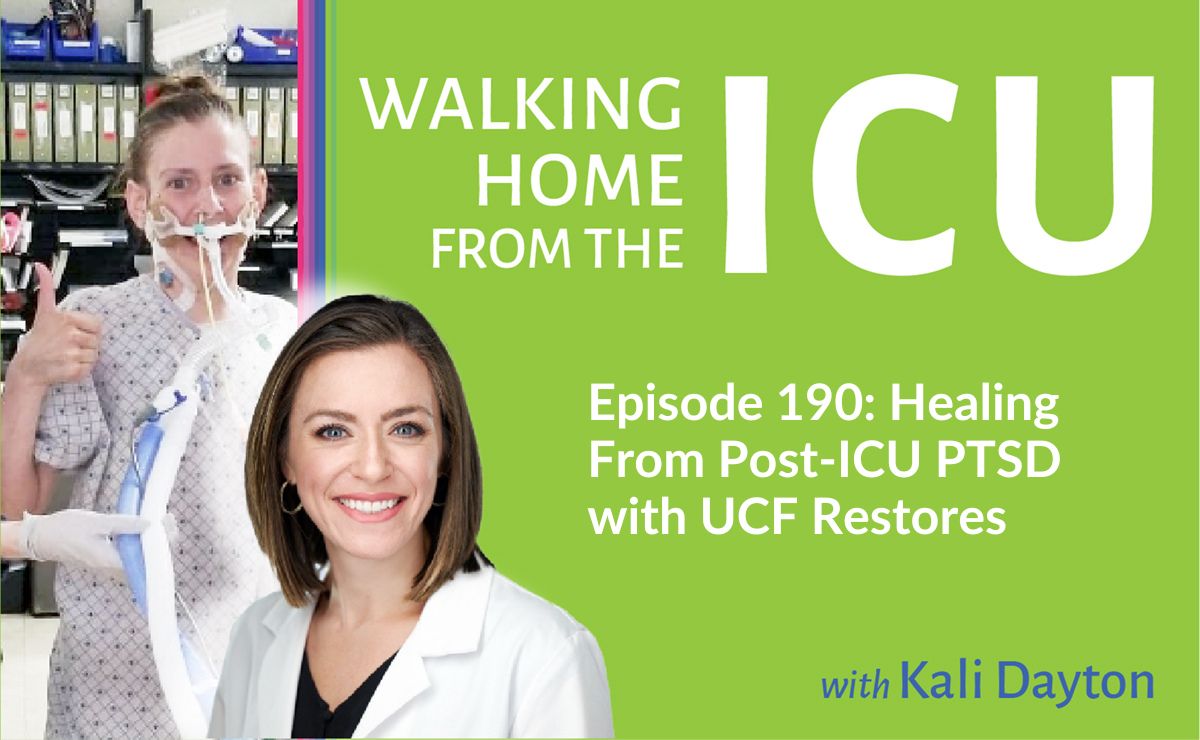
After 51 days of sedation and immobility in the ICU and on ECMO, Angela Leggett spent almost 2 decades battling post-ICU PTSD. She shares with us her journey and the impact of UCF Restores to give her a new chance at quality of life!
Episode Transcription
[00:00:00] This is the walking home from the ICU Podcast. I’m Kelly Dayton, a nurse practitioner and ICU consultant. I help teams create awake and walking ICUs through evidence-based sedation and mobility practices. By hearing from survivors, clinicians, and researchers, we’ll explore how to give ICU patients the best chance.
To walk out of the ICU and go home to survive and thrive. Welcome to the ICU Revolution.
For decades now, we have kindly sedated patients with a misinformed understanding that the less aware or responsive a patient seemed to be by the clinician side of the bed, [00:01:00] the less trauma they would carry with them long after the ICU. We saw in the Gerard 2008 Awakening and breathing trial. That by actually turning off sedation every day and therefore shortening the dose and duration of sedation.
The rates of PTSD went from 32% to 0%. We saw in the strong follow-up study of 2011 that no sedation did not increase PTSD compared to awakening trials. Other studies have shown that actual recall of a patient’s time and reality in the ICU is protective against PTSD. We know the delirium can lead to traumatic delusional memories.
And can be one of the main risk factors for Post I-C-U-P-T-S-D, the brain injury cognitive impairments, changes in physical function, independence, ability to work care for self, et cetera. All of these things affect mental health. When we think of delirium as acute brain failure, in the light of a brain injury, oftentimes a sedation induced brain injury, we can see similar outcomes [00:02:00] to that of traumatic brain injuries.
On average, the cognitive impairments from delirium. Are on the same level as moderate traumatic brain injuries. So it makes sense that a damaged brain also has psychological repercussions. In episode 142, Dr. Brian Peach shared with us his exciting research into post I-C-P-T-S-D treatments. Today we have Angela on the podcast to show with us her personal journey through prolonged sedation in mobility and post I-C-P-T-S-D.
She’s gonna tell us about how. Dr. Peach’s treatments have given her a new chance at full quality of life. Angela, thank you so much for coming on the podcast. Can you introduce yourself to us? Yes, I certainly can. And you’re welcome. I’m excited to be here. Uh, my name is Angela Leggett. I am currently 47 years old.
I live in Tallahassee, Florida. And you are an ICU survivor. Tell us what led you to be in the ICU. Okay, well. It starts at the very beginning. I was born with a five [00:03:00] heart defect, and in the seventies, seven, so this is big, really big. Then I had a transposition of the great arteries, uh, pulmonary stenosis really badly.
I had a ventricular septal defect, atrial septal defect, and also non-functioning left ventricle. I was born, uh, here and I was immediately airlifted to, um, shams in Gainesville, Florida. And they had to do an emergency, uh, they had to put a hole in between my wall so the blood could, could get through because my plumbing is backwards.
The surgery that I required was something they called the mustard repair, and they did that when I was nine months old. I had to be a little bit older, but you have to do it before a certain window. So nine months old is about the time they were doing that back then. I had it at nine months old. I was.
Blue cyanotic. I look, people call it me. I got called names in school, Smurf and grade babe and stuff like that. I was very blue. My oxygen just walking around [00:04:00] was like in the eighties and that’s just the way my life was. I had really blue lips, really blue cheeks. My fingernails are very boldest and blue and I had all that, but I still managed to get through school and I had.
Moments where it wasn’t so easy. It’s definitely not easy when all your friends are having summer fun and vacations and you have to go and have a, uh, catheterization or you’re sick and your friends are running around and you’re like, I don’t have the energy to do that. I want to, but I can’t. My body just won’t let me.
So fast forward, I graduated school. I got married. I found the love of my life, got married, and then I went into congestive heart failure really, really badly, like so, so bad. I had met with some, with a surgeon from Tampa to have my surgery, uh, in a hospital in Tampa. And I met with him in August and unfortunately three weeks later he was taking his son to college out Arizona and a Firestone Tire blew on on his.[00:05:00]
There and he was killed. The surgeon was killed. So it was like we had met with everyone and we were going down this path and we knew that I was gonna need two heart surgeries and this is what we’re gonna do. And then I had to start from scratch and that was the first big like panic, like, anxiety kind of thing.
Anyway, so we, anyway, I’m trying to make a long story short for you. We ended up settling with Boston Children’s Hospital. I went all the way up there, they did this workup and they’re like, yes, we can fix you. Because a lot of doctors were saying that they didn’t really wanna do the take down at that time.
So anyway, I had the open heart surgery there in uh, July of 2001, and I ended up that night, went into about arrhythmia, and I had to be placed on ecmo. Now. Boston Children’s Hospital. Yes, it is a children’s place, but I did go because it’s adult congenital program there, so some people are confused as So I would be at a children’s.
But anyway, so I was there, [00:06:00] but it was still mostly children. They, they had some adults, but at that time it mostly children’s, so they put me on ecmo. And I went into, I had sepsis, I had, I was gonna be on dialysis. It’s still hard to talk about to this, to this day. Um, that experience, it was very, very tough.
Had I was age, I was a 24-year-old. And even though I had it or I’d done, dealt with heart conditions and stuff all my life, I’d never. Dealt with anything like the ECMO that is like the scariest thing that anyone could see. I remember bits of things, but I do remember sounds, um, sounds are really. Like if a nurse hears the, the beeping noises, if they can turn that off as quickly as possible, that’s something I could always tell every nurse.
I see. If you can turn that off. I know you’re working, I know you’re running around, but if you could turn that off, because those beeping sounds and the sounds of like [00:07:00] people just coming in and you go from quiet to all these doctors around talking and everything and it. You don’t even realize that you’re hearing that when you try to recover, you’re afraid of noises you’re afraid of.
Sounds like, for instance, and I, it may sound silly to some people, but the bed moving, they have you on the bed, you know the bed would move. So it would keep you from, I guess from getting bedsores or whatever. Well, that to me and to many survivors, sounds like a lot more are in the distance. So. I hear a lawnmower, I immediately go back to that and I know that’s not something that the nurses or anything anyone can swap, but I’m just trying to capture what, what we do.
So that sounds like a lawnmower beeping sounds of any kind. And I’m talking like in restaurants, like we go to this bagel shop and they have. I don’t [00:08:00] know, their ovens or something are beeping and they sound like hospital beeping, and I’m like, I don’t wanna be in here. You know, I just, just like, it’s just beeping and then noise.
I used to seem like I was okay around like a lot of people and noises and now just people talking loud. It’s just like, it bothers me. My, you know, my husband said they would try to come in there and play music for me. My blood pressure would go like way up and way up and way up, and they, they finally just wouldn’t play any music for me anymore.
So not every patient enjoys the music. Not every patient wants that noise and that, and I don’t even know, it’s just like a blank noise, but it’s just noise. It’s like I can’t take all that coming at me from all different directions. This carried over for a long forever, and still with me. I mean, but it’s not, it’s not to where it was before where I couldn’t really overcome it.
It was like I wanted to just, I’m like, where can I move that doesn’t have that, don’t, I don’t move their lawn? You know, like literally that’s [00:09:00] how my mind would go. And I’m like, well, there’s no place that you can get mean. I like maybe you live on an iceberg or something, but there’s nowhere you can go.
And that is not something that a clinician can stop, but I’m just letting them know that. The slightest, the craziest sounds, sounds were my biggest, my biggest issue. Did you understand what those sounds were? I mean, I’m assuming you were sedated. This is 2011 ecmo. I was, I was sedated. I don’t know. I know, I, I don’t know if I knew what they were.
I was agitated. They did have to tie my hands down. From what I’m told, I don’t remember. I’m going by this part. I’m going by what I’m told. The next part I tell you I can go by whatever can work. Part I’m going by what I told and why I, what I felt. Now I, I know I was tied down, but I, I know I am. The noises were just, I don’t know, it was just, seemed like people were, it was just like a loud group of people talking loud.
And I surmised that was the doctors and nurses in there. [00:10:00] Yeah, I don’t truly know, but lights, right? Real bright lights also don’t love that. Uh, patient install. Want you come in and turn. I know you have to see, but. Think about it. When you come in there and they’re asleep and you’re just turning on the lights.
How that does when you’re trying to wake up in the morning, just think of someone that’s sedated and scared. So I think some of mine was just fear and I was definitely delirious. I remember seeing things they had and, and not all hospitals had this, but ’cause it was a children’s hospital said border up, like border on the ceiling.
On the top of the, and I remember like seeing things in that bad, like scary things like witches and things like, and like stuff that I would never see. And there were, it was like a perfectly beautiful pattern, but I remember seeing that and just all kinds of little things. I don’t know why that border would bother me.
I don’t know why the bed shifting would bother. I don’t know why. Light. I don’t know what they were [00:11:00] doing at that moment to do it, but it has stuck with me for decades. Those, those sounds and those, those just, all of that has stuck with me. And did anyone explain to you that you had delirium? Did they know?
They told, yeah. That was a long time ago. In 2000. This was in 2001, so that’s a long time ago. They were just saying, ’cause I would, apparently I would get more agitated as the day went on. Like I would get. And I felt like more scared. And I do have a memory of them putting in a eating tube down my nose and you know, I thought it was like switching.
I thought it was spaghetti. I know that’s funny, but, but I thought they had told my family at the time that I was sundowning and I was worsening at night. Now I know that’s an old term, but that was also what, over 20 years ago is what they were calling it. And I had some really bad episodes with that, and then I spent 51 days up there and I still wasn’t well enough.
[00:12:00] I spent 51 days up there, so I was air ambulanced back home, back to my home, not to my house that they, I, they immediately just took me to a, an inpatient rehab facility. And so I spent a couple of months there. Learning to do everything again, pretty much learning to crack ice trays and zip my clothes and button my clothes.
And, well, I mean, I remember first time I took a step, I, the lady was so kind and, and another thing I like to tell the clinicians is kindness. Like you don’t know how scared people truly are. And kindness goes a long way because I’ve had a couple of unkind ones, or if they seem unkind, they weren’t. Maybe they were just more busy or whatever, but ones that are kind and gentle you like remember forever.
And it really helped. I remember she just teared me on like, I had saved the world by walking a step and it was just amazing. It was a, she was amazing, amazing nurse. And I can’t [00:13:00] express enough about being just kind even. ’cause when people are being, uh, a lot know, some people are ugly. Sundowning or whatever they wanted to call it back then, but they don’t know they’re doing that.
They just don’t. You just don’t know you’re being like that. I would never behave like that and normal, you would never have to tie my arms down. I would. I’m always very compliant, but sometimes patients are not compliant and because they’re nervous and scared and these crazy sounds and lights and everything, anything can be a trigger.
Anything is a trigger. Not yourself at all. You’re a loss in an alternative reality. What we as clinicians see are not what you as a patient are seeing. Yes. Hearing, feeling, understanding. Yes. I mean, did you even know that you had an EC echo machine and a dialysis machine and a ventilator? Like you probably didn’t know that, that all that stuff was going on around you and that you needed to be careful and not pull out that stuff.
You have no idea, which is a really [00:14:00] scary and unsafe situation for you and the clinicians. Yes. Yes. It, it, it, it really, it really is. It, it’s, you know, it’s very, very scary. Yeah. We’re, we’re not doing, I, I want clinicians to understand that. Now, I’m not saying to everyone, but I say most patients are not doing that because they are mean or bad or hateful people.
They are truly just don’t know what all this is going on. I was gonna have open heart surgery and I was gonna go home in two weeks. Everything was gonna be great. They sell that to you and I understand things can go wrong and I’m not. I’m just saying, they say, you think everything’s gonna go well, and it didn’t go well and I, I don’t think my mind was prepared for what ended up happening either.
I was prepared, okay, I’m having surgery, I’ll be finished and be back home in a couple of weeks. And of course I’ll have some re you know, some have to get well, but not like this. And you weren’t allowed the opportunity to be a part of your [00:15:00] journey. It’s not like. They were waking you up and you were actually communicating with your husband and with the care team and explaining what’s going on, and you’re involved in that journey.
You were just muzzled tracked down along for the ride. If you’re along for the ride, you and you can’t. Speak. And when you do speak, you say crazy things. I literally thought my husband was like my grandfather. You are just out of your mind and you are muscled, but your mind is still there. In a way it’s like hard to explain like you’re there and you’re not there and it’s, it’s very, I don’t know, it’s a very dark kind of a place to be in, and most anyone would be scared in that situation.
I think many clinicians don’t fully realize what patients are experiencing. Yes, I was told that when we do awakening trials and patients come out agitated, sometimes it was even just restlessness, but they said, oh, they can’t tolerate the tube. It’s the tube. They can’t tolerate the ventilator. We gotta turn it back on.[00:16:00]
But I’ve learned so much from survivors where they’re saying, it wasn’t even about the tube. I just thought my kids were kidnapped. You know, there’s so many other things. And then I think we also. I don’t understand the month of rehabilitation that you as a young 24-year-old had to go through. Yes, yes.
And then I think we think, okay, well, they get back on their feet literally, and they move on with life. What was your life like physically, cognitively, and psychologically after that? Oh, it was, it was terrible. It, it was, it was terrible. I was afraid of everything. Everything I was afraid of. I even tried to drown it out.
I tried to go back to work too soon and I ended up having two mini strokes when I went back to work and I was just trying to push it. ’cause you’re trying to do anything you can to drown out that noise or whatever you wanna call it. I saw several different therapists. I tried [00:17:00] EMDR. I tried several different kinds of medications, depression medications, anxiety, medications.
Really strong ones. Some not so strong. I tried hypnosis. I tried anything that I could try to get rid of that. Being scared of everything being, I don’t even know how to describe, but I’m just, you’re just scared of everything. You’re scared to lay down. You’re not gonna wake back up. And even with a heart condition, you’re scared when you have heart palpitations.
Well, this is it. You know you’re scared when you don’t feel well. You’re like, is this gonna be, is this it? You know, you’re always waiting for that. I always told my husband, I felt like I had a dark cloud over me. I’m always waiting for it to rain. ’cause it always rains and as soon as you think you’re doing well, it’ll rain again.
So it was the deep, dark cloud that I just could not, you know, or not with medication, not with family friends, not [00:18:00] with your mom and dad. Not with any of it. I, I tried, like I said, I tried several different clinicians or, or therapists. They would have me like build like what I wanted my life to be and, you know, all kinds of different stuff.
And none of it, none of it worked. But I, I guess I slowly kind of just got used to, that was my new normal and that was just the way life was. And it didn’t make it any easier, but I just did it. Then just your, your daily routines and your lifestyle. You tried to go back to work, had many strokes. Yes. Were you able to eventually resume work?
Were you able to go, you did better live life. I mean, I did. I was able to eventually resume work on a part-time basis. It took a long, long time. Luckily, they were very patient with me therapy. It’s not just the physical therapy, it was also cognitive therapy. I was having issues reading and things under, understanding what I’m reading.[00:19:00]
I was doing speech therapy, they all those types of things. So when I finally overcame those, I would set, I mean, literally, I know this is crazy, but to me and my husband, we think that it took about five years to just kind of get to where I was not. Physically had an issue, like a physical or cognitive issue, but the depression worsened.
The anxiety worsened like every little, just like any little thing I could, I couldn’t handle anything. It’s like I couldn’t multitask, I couldn’t do the things that I could do prior to this. So then, like I said, I just got used to it being my new normal, and then fast forward, I, I think I’m doing okay. I’m traveling.
Little bits finally, like I could travel. I was afraid to travel. I was like, okay, well, I don’t wanna be away from a hospital and I don’t wanna be, I mean, it’s like things like that that you don’t think of. It’s like, okay. So I’m like looking where my hotel is. Okay. All [00:20:00] right. At the hospital, is this close?
They’re that close. I mean, literally, that’s what I’m just doing. I’m not planning a vacation. I was planning all the hospitals. So because I just knew that something bad was going to happen because of that, that I see that post ICU anxiety or whatever you guys want, wanna call it, it, it is real and it’s bad.
But I just, like I said, I tried different therapies. I did. They tried. Many, many years. Like I said, I tried hypnotherapy, I tried all of it. I think it helped some, but it didn’t get me to where I needed to be. And then we’re able to meet with Brian Peach, who we interviewed on episode 142. And he talked about this.
If you’ve been listening to this podcast, you are likely convinced that sedation and mobility practices in the ICU need to change. The ICU community is facing incredible difficulty with the trauma from the Pandemic staffing crisis and burnout. [00:21:00] We cannot afford to continue practices that result in poor patient outcomes, more time in the ICU, higher healthcare costs and greater workload for the ICU team.
Yet the prospect of changing decades of beliefs, practices, and culture across all disciplines of the ICU is a daunting task. How does this transformation start? It can begin with the consultation with me to discuss your team’s current practices, barriers, and to formulate a plan to help your ICU become an AWAKE and walking ICUI help teams master the A-B-C-D-E-F bundle through education consulting, simulation training, and bedside support.
Let’s work together to move your team into the future of evidence-based ICU care. Click the link in the show notes of this episode to find out more
study that they’re doing with this alternative therapy, kind of a version of exposure therapy, but specialized for post I-C-P-T-S-D. [00:22:00] What was that like for you and how has that impacted your life? Well. The way I got to that program is fast forward to 2021. I went into sudden cardiac arrest in my kitchen.
My husband had to do eight minutes of CPR. Me while waiting EMS, so I went. My husband says like every 20 years I like to get something going. That happened in November of 2021, and after the cardiac arrest, I immediately went, he, I was, went to my hospital obviously, and then when I got well enough, I went to my, to Boston where I’m seen and followed annually for Boston and I had an ICD put in as well as I had a heart ablation.
They wanted to find out what caused the cardiac arrest and we got to the bottom of that. What caused that? So when I was in there with a cardiac arrest in Boston, the doctor came in and like, I’m doing the ICD and I’m doing the ablation, and I wanna let you know, and I wanna let you know that we have an ECMO machine waiting if anything goes wrong.
Well, they’re just [00:23:00] trying to assure you. Well, that sent me into a tailspin. Like, I don’t wanna hear anything about ECMO machine. Why is he telling me this is, this is gonna be the end of it. And then they proceeded to stick and I know why they do this. But they had it at the end of my bed. I call it the clear cart.
The, yeah. Where they do the, the paddles or whatever, the a, the a ED things at the bed that the defibrillator, that the defibrillator at the end of my bed. So I’m looking at it the entire time that I’m in up there and I, I know why they had it. Oh. And I did have to wear the life vest to get up to this old, the little, little life vest to get me up there.
’cause they didn’t want me to have any trouble all the way to Boston because I had to fly up there. But. Anyway, back to Dr. Peach’s program. I, I joined a support group for cardiac arrest survivors. ’cause I went into a tailspin after that. It just, it was just too much. It, the cardiac arrest, the ecmo, bringing that up, just everything was just too much.
It was too much. So I was on a support group and I saw someone post about this program and [00:24:00] then they had done it, and if I wanted information to contact them. So I did. And I got in touch with Dr. Peach. Brian Peach, and of course there’s a criteria you have to, we all have criteria in order to be able to do this UCF restores research study and I, I fit the criteria.
So luckily I was able to go down for two weeks and undergo this, what, what they call it and what I would call it is exposure therapy. They put a virtual VR thing on your face and you get to watch and hear sounds from the hospital, and you get to watch nurses on the computer and you’re like, you’re in the hospital bed point of view type of thing.
And I’m telling you, that was some of the hardest stuff that I’ve ever done in my life. And I feel like I’ve done some hard stuff in my life, but those, at least the first three days were like. Awful. Like it makes you wanna quit. Like you’re like, this is so bad. Like, I want to, to not [00:25:00] go. And then by the fourth day you’re like, wow, I am better, getting better.
And then the, by then you’re on the fifth day and you’re like, I’m even better. And then you do the next week and you’re just like, I can live, I cannot turn the TV off when I see a medical something come on. And they’re doing CPRI was turning the TVs off. I, I didn’t get into that before, but. Literally, well, even watching TV shows, we were having to change it.
We were, my husband was like, well, I guess we’re just gonna be sticking to comedies because there was just nothing you could watch that didn’t have something like that in it, or something would surprise you and I could do that. I can travel. I have tra since this, since Dr. Peach’s stuff. I have traveled out of the country, out of the country overseas, and I didn’t worry about where the hospitals were.
Um, it has changed my life. It has utterly changed my life. I mean, I literally did 20 years of therapy and medications and try different things, and it did more for me in two weeks than 20 [00:26:00] years worth of those other things. And I am not kidding. Sing the praises of it. I’m truly, my husband said he got his wife back.
I feel like I got my life back also. That is amazing and such perseverance to keep trying to work on it. Uh, yes. I don’t think unless you’ve really experienced crippling depression and anxiety, I don’t think we really take it serious. Yeah. It’s an alternate, it can be life threatening. Yes, and that’s what we’ve seen in that post ICU U community is that it can be life threatening.
To live like that. Yes. And so that speaks a lot to your perseverance, the support group that you had, the support system that you had for those 20 years. But thank goodness for the amazing advances that we’re having in Dr. Peach’s work. And it just provides so much insight, the IC community, to know that life after the ICU, it’s never really the same things that we do unintentionally.
Can really radically impact [00:27:00] quality of life or duration of life for survivors for many years to come. Yes, exactly. Exactly. I don’t care if you’re in there for just a, a, a long time or a short time. ICU is a scary, scary place to be. It is. You just don’t understand. I’m so glad that there is more awareness about this now because even all these years ago when I was on ECMO all that, I did the therapy and yes, I had.
But they never really wrote down to it. They never drilled down to it like they’re doing now. They’re really getting down to like, okay, this is why they have this. Not just general depression or something. ’cause that’s not it. We really didn’t understand that You had a brain injury. Yes, and we just knew that we had kind of patched up your heart for a bit.
That physically you were rebuilding muscle. Those things are easy to measure, but we did not realize that you had a brain injury. Yes, and I’m sure you were on medications like Ed. Yes. Morphine drips, really [00:28:00] heavy stuff that we don’t even use now that are toxic to the brain. So I am so grateful that you did have speech therapy, cognitive therapy, physical therapy, because even still, that’s hard for survivors to access, but it’s desperately needed after such a traumatic assault to your brain being stated, tied down to a bed.
Hearing noises for weeks. I mean, you were there for over a month, right? Yeah. 51 days, yes. Mm-hmm. 51 days of just constant noise. No real sleep. How does that not change and alter your brain? And we see that with victims of war crimes, when they’re torture by sleep deprivation, they leave with PTSD and probably not just even for from like violent acts, but just the sleep deprivation.
Yes. That is trauma because they can develop delirium. Yes. They struggle with depression, anxiety, cognitive impairments. They’re much more likely to die after that period of sleep deprivation, and that usually doesn’t even last for 52 days. So that’s an analogy that’s really helped [00:29:00] me understand what you’ve gone through is what we see with people that are healthy, not in the ICU, not on ecmo, but they have sleep deprivation and their brains are injured.
Now just translating that to your situation where you had so much going on, it makes sense why you were so damaged, but how amazing. Be able to be moving forward and traveling and really living a full life. Yes. I, I finally feel like I’m living, I felt like I was existing before and then that’s how I describe it.
I felt like I was just existing and this exposure therapy, ’cause you don’t wanna be it, you don’t want to be exposed, you avoid it. I was avoiding everything on tv was avoiding I wanted to move away or I couldn’t hear, hear lawnmowers. I don’t wanna hear any beeping. I wanted to run outta the restaurants or anywhere that I heard that.
You can’t avoid those things, so you need to. Tackle it head on, and it has made, I’m telling you, I am a new person because of this therapy or this research that Dr. Beach is doing. I just can’t sing enough praises. I help more people get [00:30:00] access to it and can do it because it’s any, for any survivor listening, I’m telling you, it’s, it’s, it’s, it’s worth it.
What would you recommend to IIC clinicians as far as how they treat patients in the ICU and how they prepare them to leave the ICU? I would. Again, I’ll go back to just being kind and understanding. Those were big kind of things that were important to me. I’m actually still to this day, I see them every time I go to Boston.
I’m still friends with the two nurses that took care of me all those years ago. They have told me that people like me make their job easier and. They love to see people that do well because I know they don’t always see people do well. I understand that happens well, but they’re always, we’ve kept in touch all these years, Christmas cards, all this stuff, and now I, and I see them every time and even go out to dinner with them.
They’re amazing. So just, just being kind to your patients, it not only will it be be kind and noises, I’m, I’m telling you, [00:31:00] if you can get those machines to stop beeping. If you can just understand that people are not trying to fight you. They’re not trying to be, they’re just trying to understand what’s happening.
’cause they don’t, everything is, you’re in a fog, you’re in a cloud. You don’t remember most of it, but you just know that you feel that fight or flight. You’re scared all the time. So if they could just be kind and understanding. It will not only help the patient, but it’ll help them. Like I said, my nurses say that patients that like this, what they live for.
So do you think having been awake able to understand what was going on, being able to communicate, even move, not being tied down, do you think that would’ve impacted the level of trauma you left with? Yes, absolutely. Yes. I think not being tied down. And I understand why they did that. ’cause I, apparently, I was pulling at tubes and pulling out, I was just pulling at everything.
So I, I know why they did that, but at the same [00:32:00] time, it was just, obviously I was afraid. Um, and you just wanna get out of there. You wanna get away from whatever’s bad and that’s what your mind is telling you, just get away. So yes, being, not being tied down, if at all possible. Just to understand that they’re not fighting against you.
I, I think some people think that they’re just like that. They’re really not fighting against you. Yeah, they’re, yeah. They’re just afraid. They’re scared. Their life is altered for the rest of their life. For the rest of their life. It’s not just the surgery. Oh, they get to go home and live a great life. No, that anxiety follows them forever.
Like a dark cloud, I think. Not that I intentionally mean to patients, but I, I’m sure, looking back to my. 24-year-old self working four shifts, five shifts a week, sometimes being exhausted. I’m sure I could have been more kind, more patient, more understanding, but I had never heard from a survivor what it was like.
I didn’t realize how much of an impact I would have on people’s lives. So thank you so much for being willing [00:33:00] to share your insights and help protect future patients and guide more survivors to resources that will help. And get their lives back. You’re welcome. I’m so glad I was able to talk today and thank you so much for having me and talking with me.
Thank you so much, Angela.
To schedule a consultation for your ICU as well as find supportive resources such as the free ebook, case studies, episode, citations and transcripts. Please check out the rest of my website.
Transcribed by https://otter.ai
SUBSCRIBE TO THE PODCAST