SUBSCRIBE TO THE PODCAST


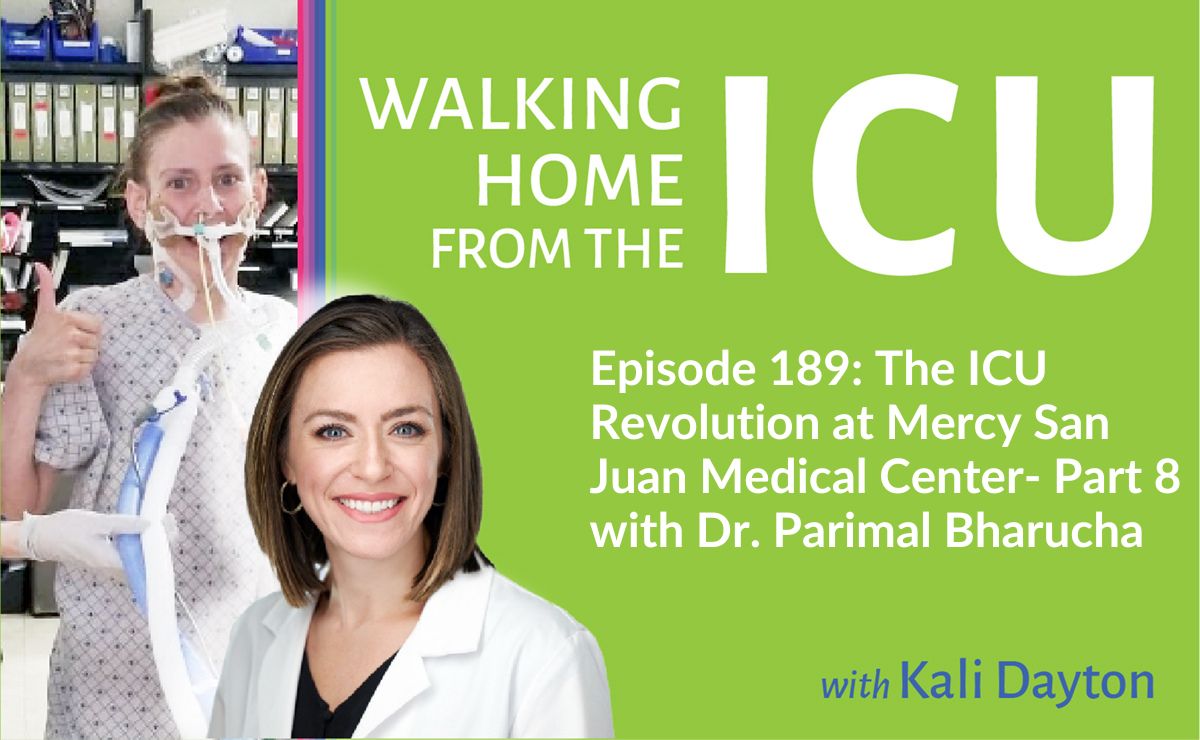
What is the ethical and moral responsibility of a medical director to personally practice, lead, and support their ICU to keep patients as awake and mobile as possible? Dr. Parimal Bharucha shares with us the incredible revolution that has happened in his ICU.
Episode Transcription
Kali Dayton: [00:00:00] This is the walking home from the ICU Podcast. I’m Kelly Dayton, a nurse practitioner and ICU consultant. I help teams create awake and walking ICUs through evidence-based sedation and mobility practices. By hearing from survivors, clinicians, and researchers, we’ll explore how to give ICU patients the best chance.
To walk out of the ICU and go home to survive and thrive. Welcome to the ICU Revolution.
Sorry for the lapse in episodes coming out. We have a lineup of incredible episodes coming up, but life has been fast and furious over here. For those of you going to the SCCM Congress, come join us at the Sedation and Mobility debates on Monday the [00:01:00] 24th at 3:00 PM We’ll also be having revolutionist meetups for breakfast on Sunday and Tuesday.
Come and or center colleagues that are coming. I can’t wait to meet everyone. This episode is another inspiring testimony with medical director Dr. Baruch. It is another witness to the power of medical directors that have open minds and are driven with compassion to save lives through revolutionizing the culture and care in their ICUs.
Dr. Baruch, thank you so much for coming on the podcast. Can you introduce yourself to us? Yes. Kaylee, first of all, thank you. You have been very kind, uh, not only to help us, but also to invite me to your podcast. Uh, I am Dr. Prucha. I am actually a international medical graduate from India. I did my medical school back home, and then I did my residency in St.
Barnabas, which is in New Jersey. From there, moved to Alban in New York, and from there I moved capital to capital to Sacramento and Dignity Health. In 2010. Since then I have been here, it’s 14 years. It’ll be [00:02:00] 15 in next June. And so throughout your training in all these different places and facilities, what were you taught and how did you practice in terms of sedation mobility and delirium management?
Oh man, that’s very, very loaded question. Okay. So in training, in residency, as well as in fellowship. Um, it was sedation, sedation, sedation. A patient gets intubated. The first thing the nurse will ask is, Hey, can you order the versa drip? Um, in training, actually going back, dating myself 2003 to 2006, tivan was a big deal.
We used to put everybody on Ativan trips and then, and then we figured out that, hey, that has a lot of toxicity, and so then we moved away from Ativan. And we moved on to, uh, verse said, so much better. So much better. I mean, it actually is better, but so much better. But yes, but still better. And [00:03:00] yes, and even in Fellowship we were still doing Propofol and Fentanyl or worse and Fentanyl.
Um, fast forward to 2010 to 2013, somewhere, we got rid of the Worsted trips mainly, and we started going to Propofol trips, but still during the entire training. I went in fellowship in 2007. Still almost until most recently. As I said, the first thing you do, you intubate the patient. And as soon as you are done intubating the patient, what goes on is a IV drip and a lot of myths, right?
I mean, we do something from anoc experiences and what others have told us. The first thing, the most important thing would be that, oh my God, the patient is now waking up and is coughing and gagging and fighting with the ventilator, and that is so uncomfortable and oh my God, we need restraints. And so as soon as, uh, you know, the, that’ll be two nurses, one will hang the drip and the second one will tie down the hands.
So that, that’s, that, [00:04:00] that’s where we come from. Um, you know, fast forward to today, that now after your training and your hard work for almost, what, like six months to a year now, things have changed and, and it’ll, it is so surprising that most of the nurses except who have joined newly. Um, most of the nurses will not even ask for restraints actually.
You have to say, Hey, where are the restraints? And they’ll be like, oh, oh, sorry, let me get it. So we have shifted that. They have, you know, they have stopped pulling with the intubation tray. They don’t bring the restraints in. They do not bring a bottle of propofol with them. So things have changed and I’m so proud that, that we are going this way.
From your perspective as a physician, how do you see this impacting the outcomes of your patients? I know we’re still like collecting data and things like that, but anecdotally, when you’re attending. What [00:05:00] changes have you seen? So let me tell you, um, few years back, um, I was doing a bronchoscopy, um, and I was giving sedation to the patient.
Of course, it’s conscious sedation. You do fentanyl oversight if need be. Uh, you know, the conscious sedation nurse then gets tired of pushing medicines and they’ll be like, doctor, can you just give propofol? And then. Yeah, you give a little bit of propofol and the guy kept on needing a lot of sedation because he was constantly moving and flailing his hands and coughing and you know, so you keep on giving them more medicine.
And then finally the procedure got done and I woke him up and then I’m like, dude, what the hell were you doing? Are you. Do you drink a lot of alcohol or take pain medicines that I had to give you so much sedation. And he is like, no, I’m a surfer. And I thought that I was, I was riding a wave in Hawaii and I was getting drowned and therefore I was trying to just get back to the, to the land.[00:06:00]
And I’m like, oh man. I mean, this is a effect just for a short term, like half an hour of procedure, OMG. Guess what they go through? When they wake up a week later of the sedation and Oh, oh man. So, you know, it is so, um, naive of me that at that time I just brushed him off and I’m like, oh yeah, I haven’t, that was funny.
Sorry, you had a bad dream. And then you completely forget about it until someone like you who comes along and opens our eyes and you’re like, oh man, this happened to me in a short term procedure a few years back. And I witnessed it. Hmm. Yeah, he was like, he was able to talk afterwards, he was intact. Have to tell you.
But not most of our patients in the ICU. Correct. But I mean, you know, the thing is that this is just a half an hour of procedure and if he had a bad dream and a delirium that, you know, that [00:07:00] caused me to give him more and more sedition to get the procedure done. Patients who are on this long term, propofol and Versed and Fentanyl.
Oh man. That whole life goes upside down. And then when we interview some of the patients, you know, it’ll bring tears to your eyes that, what have we done? And so for you as a physician, you know, you, you were bought into this much sooner than the rest of the entire communic uh, critical care department, right?
Yes. So how did it impact you to be having these awakenings and then to be trying to practice and trying to guide this care without the rest of your team bought in and prepared? So that, that was tough. Um, you know, when, when we start practicing, we get used to the culture that we are in, um, compared to, say for, from fellowship to when I came to Sacramento, there were a lot of changes.
And then you, you just go with the flow of [00:08:00] what is happening around you that becomes a part of your nature. And changing one person is easier than changing the whole crowd. And especially when the crowd has a lot of other disciplines like physical therapy, respiratory therapy, nursing, and again, it comes with years of experience.
There might be some nurse who has been there for 20 years who have done things in one way, and to change them, it’s very hard and you have to change them in a way that, hey. You are not stupid. This is what we did. We are all in the same boat, but things change. Medicine is an art. It changes every day. And so let’s go on step by step.
One step at a time, not an easy transition. Especially, you know, the nurses, the respiratory therapists, physical therapists, they don’t work every day. So they work three days a week. And so then when they come back, things are different. And [00:09:00] so it’s like every time they come in, there are a lot of bumps, but unless you fail, you don’t succeed.
So you keep on going with it. You keep on giving positive reinforcement, even if they get the patient out from the bed to the chair, Hey, if you give them kudos, it goes a long way. Right? As physician, we. We strive on success. We strive on a patient who is on multiple medicines, almost close to the death door, getting better, getting out of ICU.
That’s a huge accomplishment for us. And, and if nobody. Acknow us. Do we feel bad? Yeah, we do feel bad. Um, if, if, you know, if families or the nurses just say, Hey, you did not do this, or you did not do that, versus, oh my God, that was such a good thing that we, part of this, we worked as a team. Hey, the patient is so much better, then it goes a long way.
So I always, [00:10:00] always tell my team that, Hey. You and I, we cannot survive without the ancillary staff. Absolutely not. No matter how good a doctor you are, you cannot do anything yourself. It’s, it’s a village. It’s a, it’s a crowd. It’s, you need everybody’s help. And so let’s be positive. Let’s, let’s, you know, show whoever is working the positive impact that they have made.
Even if the patient moves a finger a day later, hey, that is better than not doing anything. So it’s better than being deeply sedated. Exactly. Comes in the right direction. Um, I wanna hear your thoughts on this. I had a, I referred into a previous episode about a medical director that I spoke to in 2019 that scoffed at the idea of an awaken walking ICU and said, yeah, the research show stuff about that.
And he said, but you will never get our nurses to do that. What are your thoughts? So. I would say that if you, as [00:11:00] the captain of the ship, do not buy into this, it’s not gonna happen. Um, you as a captain of the ship should know that you are captain because people look up to you, they trust you. So if you are not making the change that you want to see.
Then it won’t happen and that it is too, too narrow sightedness to know what other people can do unless you know, you just take them. You just write them off that, yeah, the nurses are not going to do this. You always think that, yes, it might not happen, but think about this, that, hey, what if. Happen. What if you start making the change and the nurses are going to follow you?
Yes, of course. Even in my own family, if I have to, like literally 10 minutes before this, my mom, my wife and I, we had a discussion about where to put the Christmas tree, but you have to start somewhere. If you would’ve just said, oh, forget it. We are not getting along and we are not going to [00:12:00] put the Christmas tree.
The Christmas tree will still be up in the garage. Now it’s out and it is already in a place where we all said, okay, let’s do it. So, so you have to start somewhere. You have to think that people that you work with are capable of doing miracles. You have to believe in it and then go with it. And again, positive reinforcement is very important, especially with the people that we work with.
They are all youngsters. They are generation Z and generation alpha. And if you do not give them feedback right away, then it won’t work. So that’s, that’s good points. So trust in yourself and trust in the team that you have, and without that happen. The best thing is that you are doing it with an intention that, that the patient that you are treating is going to have a good outcome, but without, you know, if you don’t give antibiotics thinking, then it’s not going to work.
[00:13:00] Guess what? It’ll not work. But if you give it a, it may work. So as a, as a captain of the ship, you have to have a brighter horizon and you, you need to have a lot of faith in your team. And if they’re not coming up to it, then it’s your responsibility to bring them up to the level it falls on you. You are a captain.
Ooh. Can’t hate all the medical directors. The, the gauntlet’s been thrown, right? Yes. But this, it’s. One, a huge undertaking, right? Yes. It’s an absolute overhaul of so many different, um, skill sets from different disciplines, culture, knowledge, and dynamics. So as a physician and a, as a medical director yourself, right, you are one of the medical directors, how, what was the value of having your entire team educated and trained?
Understanding their roles and being [00:14:00] prepared to practice this way. How, what was the value of that in being able to now lead your team to do this? The value is incredible. Even if we can save one life, and we have saved so many lives already, we have in so many people. Right. Um, it is humongous undertaking.
It is, it is a, I always tell my teammates that, Hey, at the. When you go home and you, you, you get fresh, look yourself in the mirror. If you are able to see yourself through your own eyes in the mirror, then it means you have done something good. If you’re not able to look at yourself, then that means that you have fallen short that day.
So this is a practice I have every day. If I can see myself, I try, then I know that, okay, I have done something today. Um, the value is incredible. Um, and I can tell from my own experiences. Um, like my [00:15:00] uncle, he just recently passed away like two weeks ago. He was in India, but a lot of things could have been done differently and they have been done here.
Um, this morning a nurse called me, um, that his brother is in one of the hospitals for a month. And this is in United States. Um, and he barely moves, but he is restrained 30 days later in the ICU. Um, he is very agitated. He has been on sedation. He got a tracheostomy, he still has a Foley, and he just got a UTI and he has not moved out of bed.
So now, if the same patient was in a different hospital, like for example, at our location. A, he would not be restraint if he’s not moving. Why does he need restraint? B? Why does he need a folic catheter? And C, why is it delirious? Do something to prevent the delirium. Now again, all those things will only be part of if you have trained your team, [00:16:00] if you have.
Told your team that, yeah, I’ll just leave the FO in. We’ll think about it. Or once the patient gets better, we’ll get it out. It’s somebody else’s problem on the floor, then guess what? They’re never going to leave the ICU. You are doing a disservice. But again, it’s, it’s a, it is not a one-man. She, as we said, physical therapy, respiratory therapy, fla, Orum is, everybody comes into play in this and to train them, um, didactic knowledge is very different.
Than a real practice. Um, that knowledge. They’ll be like, well, yeah, he is giving a lecture for an hour. Let us just goes off. Or we have to do it compulsory. We have to do it as a CME. Let us just get it done and check the boxes. But when it comes to doing bedside training like you did, like every few weeks for different ICUs, I think that goes a long way.
And including everybody, people from different teams put their hats together. [00:17:00] Then that makes a difference. For example, you can come and say, Hey, get the patient out of bed, and the nurse will be like, okay, let’s go on this. Let’s get out of bed. But guess what? If you have not trained the physical therapist, if you have not trained ancillary staff, how is that going to happen?
The nurse can keep on barking as much as she wants. Nobody will listen and the doctor can keep on barking to the nurse. They go, Hey, do this. But. Without knowledge, that is not going to happen. Everybody absorbs knowledge at a different pace, so patience is very important. Retraining them, reeducating them every now and then, every step of life is very important.
And again, you can train, you can talk about this to the nurses every day, which you should talk to the nurse every day and the whole team because education doesn’t stop. Okay, you got educated today. Now you are good for the entire life. Now we all forget there are new things every day. So it’s constant reminder of doing what is right for the [00:18:00] patient.
Um, so number one, education will take a long time because there are a lot of people you have to train, so you have to help patients. And you also need some, um, safety equipments, um, that needs. Little bit of green dollar bills. Um, and then you need support from your executive leadership to provide you with extra manpower to provide you with things you need for safety.
And I think that the return of investment on this is way higher than what you invest. Um, your team doubled your hospital or doubled their return on their. Savings compared to what they invested within a few months after training? Yes. We had a year mark. And you guys just, the savings were monumental before you had even mastered it like you have, or like you guys are almost there, but quickly there was a return on investment.
Yeah, because this is all safe [00:19:00] practices, good practices that we had just gone sideways, um, for years of, um. As I said earlier, you just go with the flow. It’s mainly cultural change. Yes, knowledge. Knowledge is, is very important. And as I said, knowledge, you keep on updating them. But again, what what would make a huge difference is the culture.
Um, if one nurse makes a difference and if they take the lead, then you’ll see all the other nurses that work with them will start falling the same thing, but. If the six, seven nurses that you work with, if all of them out of the same opinion that, oh, you know, this is my 13 in a row. The patient was delirious last night, let’s just let them sleep today.
The family’s not coming today. Let’s just take it easy. Then guess what? Nothing will happen. Uh, they’re not gonna get submitted today, so why wake them up? Exactly. Um. And [00:20:00] then so a is educational piece and education piece does not stop at didactics or going through the podcast or going through the, through the pathways that you are assigned to, but it is what you see day to day.
We keep on talking about delirium so much, and I have pointed out so many times, including last week, that hey, the clock has not been changed. It is still one hour difference. And then how can you expect the patient to not get confused? Mm-hmm. So I am very big. You can ask everybody. I’m very big. I just walk around randomly and then I’ll be like, Hey, this room needs a clock updated.
Uh, you have not updated the board because the doctor that you have on the board was there three days ago. The, we are three days later. The doctor have changed. The date has changed. Um, the day of the week has changed and it does not take that long to update the board. The board are meant. So that we can update the patients and keep everybody, you know, everybody informed of what is happening around them.
But if you don’t [00:21:00] change it, the patient and the, and you know, believe it or not, the boards are right in front of the patient right across the wall. That’s the first thing they will see. So yet the day wrong of they’re wrong. They think it’s Tuesday still. Oh my gosh. Like this has been the longest Tuesday.
Yes. Right. It’s confusing. Yeah. And then the lights are looking at not on, and I, I just keep on going and putting the, uh, you know, putting the switches on. I’m like, Hey, daytime 7:00 AM to 7:00 PM Let the lights be on if there is no sunlight. Mm-hmm. Right. I mean, those are small things we, yeah. We talk about this didactically that, hey, okay, we have to keep up with the sleep wake cycle.
We have to make sure we are not doing this or this sedation. But what about this routine stuff, normal stuff that is. So important. And then having a, having a physician, you know, a medical director that’s looking at the unit as a whole, looking at these [00:22:00] things beyond just, um, beyond just the orders. You’re not just putting in orders, you’re not just writing discharge, admission orders like you are looking at what is the environment that our patients are in.
And these things are usually. Nursing, right. This is a very holistic approach and perspective, and that’s not necessarily how physicians have been trained, but you’ve taken this onto yourself as a steward, as a director, as well as an attendee, and you’re looking at what does this patient need? And so just instead of saying, keeping siloed and saying, well, the nurses, if the nurse wants the lights off, then like that’s just the way it has to be.
You’re being a leader, you’re saying? Yeah. Remember what we’ve talked about. It applies to this. And, and how do these conversations go now compared to, let’s say, a year ago? Now that the nurses understand deeply delirium, when you make those suggestions and those reminders, how was that received now versus a year ago?
If you’ve been listening to this podcast, you are likely [00:23:00] convinced that sedation and mobility practices in the ICU need to change. The ICU community is facing incredible difficulty with the trauma from the Pandemic staffing crisis and burnout. We cannot afford to continue practices. That result in poor patient outcomes, more time in the ICU, higher healthcare costs and greater workload for the ICU team.
Yet the prospect of changing decades of beliefs, practices, and culture across all disciplines of the ICU is a daunting task. How does this transformation start? It can begin with a consultation with me to discuss your team’s current practices. Barriers and to formulate a plan to help your ICU become an AWAKE and walking ICUI help teams master the A-B-C-D-E-F bundle through education consulting, simulation training, and bedside support.
Let’s work together to move your team into the future of evidence-based ICU care. Click the link in the show notes of this episode to find out more. [00:24:00] Well, you will be surprised. It is all the way around now the nurses question us, so it has gone, it has gone a whole circle and which is so that makes me so happy that now the nurses are taking the lead and saying, Hey, Dr.
Uch. I don’t think that patient needs this sedation. Can we just take it off? Or they’ll be like, oh, why is the patient even on this? Versus a year ago they’ll be like, can we add this? Can we add that? Can we put this on? So it has gone a whole circle, and that makes me very proud. And I always tell, um, the nurses and physical therapists that education in United States is not easy.
You have gone through a lot. And I hate when they become just a, um, task oriented person and I’m like, I can get anybody to do my task. [00:25:00] Instead of that, you should be a part of the team. I want things that we are a team. Uh, let us all put our heads together versus that I’m just telling you to do something and you do it.
Oh, that was one of my objectives in the train was that. Each member of the team have the tool through, can’t hear. You can hear me? Yeah. That each member of the team would have the tools to critically think through their patients each day with each nuanced scenario. Because we did simulation training. We talked about case studies and didactic, but they’re going to meet all sorts of nuances different, every patient is different.
That’s one of the challenges. It’s easy to create a conveyor belt. If everyone gets sedation, everyone gets immobilized, rinse and repeat. Everyone’s the same. But this means that we now have to treat patients as the individuals they are and meet their individual needs and a lot more, have a lot more art and finesse in how we manage [00:26:00] them, A lot more humanization.
So I wanted them to have the tools to put their heads together and critically think through each patient as an individual to meet. The unified objective and vision that everyone has, and I’ve always known because I’m a nurse, I’m very biased, but nurses are so protective of their patients and once they understand the harm of sedation and immobility, they’ve had successes.
They see the impact to outcomes, that they become very protective and very hesitant to sedate their patients and use that very carefully. Yeah. And as I said, I, um, I, uh, you know, sometimes the nurses will come and say, Hey, the patient is short of breath, and that’s the sentence stops there. And then I’m like, uh, okay, what more?
And then they’ll be like, uh, I do not know, but the sad are low. And I’m like, yes, you are a nurse. Why don’t you think critically okay before you, to me, um. Have you [00:27:00] looked at the x-ray? Have you looked at the labs or something? So let’s make an informed decision versus I tell you that, oh, okay, I think the patient is over.
Give Lasix. But, but you are there for 12 hours. Maybe you might think something else is happening. Maybe there is something. Maybe, maybe you’re not thinking of pe, which I’m not thinking. So let’s work as a team. And so with this awakened walking ICU, it has become very interactive actually lately with the nursing.
The other day we extubated somebody that to the nurse said, Hey. Let’s just get the patient in the recliner. Let’s just stop everything and let’s see if the patient passes SBT, and guess what? The patient dead and we extubated the patient. And then after a little while he comes and tells me that Dr.
Baruch, I really think something is wrong with the patient’s neck and the cervical spine because the patient is not able to keep the head up. And he is like, I already put the sock collar. Can we do something about this? And I said, oh. That is a good thing. If we would have [00:28:00] not done SAT and SBT and we would’ve not put the patient in the recliner, guess what?
We would have never figured out. There’s something wrong with the neck. Mm-hmm. And what was wrong? Oh, I can’t tell, but, oh, okay. But maybe even if there nothing was wrong, that the important thing is that we would have missed this critical finding that. The patient is not able to keep the head up. There is no muscle tone.
There is something really wrong with the cervical spine. And this patient was able to stand, get to the chair, pivot everything else. We, we put them in the recliner. Uhhuh, yeah. Um, then unfortunately because of that, I mean, later on we had to reintubate the patient. But you know, that’s, and the patient had been sedated then?
Yes. The patient was sedated mainly because the patient gets very agitated and then desats and um, and then had lot of [00:29:00] arrhythmias. So she had a medical reason, um, to do that. Mm-hmm. Uh, but again, it was, it was not even that the patient was on sedation for a long time. It was like two days and that too was on precedex.
But still, um, sedation is sedation. Everything is, nothing is better than anything. So, but, but that same kind of patient easily could have been on propofol and deeply severe Oh, yes. A year ago. Um, easily and not extubated at that point. Not the chair not moving. And so, um, and the reintubation may have happened ’cause of other complications or other weakness, or maybe they, you know, yes, it could have gone so many different ways.
So. Being on that precedex just to keep them from Aras of three, toras of zero. That is a win. Yes, that is a win. That’s what I said, that it was good that the nurse stopped everything, even including Precedex, and we got them out of [00:30:00] recliner, out of bed in the recliner, and we ext excavated the patient because she passed in the recliner.
All the criteria in the recliner. I love it. I love excavating in the recliner. Um, and she passed SBT. And so we extubated and then of course, I mean, can patients fail? Yeah, but I mean, she had the medical reason that if she can’t keep the neck up and if she keeps on having a bobble head, then of course she’s going to have problems, anatomical problems, and which we would’ve not found.
Another nuance. Like I never would’ve included that into simulation training. Right. But yeah, that kind of collaboration, that kind of environment to be troubleshooting like that, and still she was reintubated, but doesn’t mean that she automatically got propofol. Mm-hmm. We could mobilize her or just protecting the airway while we figure out what’s going on and protect her from all the other harm that could happen.
Yes. While treating the current harm. Correct. And so, and I love the example of. Educating the clinicians this way. As a physician, I love that. [00:31:00] Instead of saying they’re short of breath, okay, I’ll just go fix it. But rather leading them to critically think through so that there is more safety throughout the team.
The more your clinicians are prepared and equipped to critically think through, be autonomous practice at the top of their license to stay for everyone’s going to be, and the easier it’s going to be for you. Yes, you’re the only one that can critically think through agitation. For example, if someone’s calling you.
For sedation because the patient’s agitated a year ago for, you know, and the team, I would’ve said, yeah, okay. Put them on propofol. Sure, yeah, fine. Just over the phone. I don’t need to say the patient. Yeah, yeah. Agitated. Maybe the rest of plus one, but no one’s thinking about what’s causing the agitation.
It’s just an auto set. ’cause there’s no critical thinking. Now, a year later, hopefully, if a nurse is calling you at this point, it’s because their arrest of three or four, there’s some sort of dangerous situation happening. They don’t really call you for a rasa plus one anymore, right? Mm-hmm. No. And if they call you for agitation, they’re, they’re able to specify [00:32:00] what RAs score it is.
Yes. They’re, I’m so, I’m so proud of them. You had such, oh, we’re very proud of mine, not my team. Yes, you and you should be. You have such a wonderful team. And, um, even by the time I showed up, they’d already been making so much progress just from the didactic and the things that they had learned and been working on.
And how have you seen, just taking it from. Light sedation. ’cause that’s about where you guys were at when I showed up to do simulation training, there was light sedation happening and mobility was a little bit later. It was like towards, yes, towards extubations. When we, you were starting to mobilize your patients.
Yes. Now you’re saying that you’re not even starting sedation on patients automatically. And if given it’s for an indication and it’s light and many patients are actually awake, do mobility earn earlier, more aggressively? Now, how does that play into this sustainability of this kind of program rather than trying to rehabilitate everyone [00:33:00] later on?
So, um, positive reinforcement helps. And then one of our patients, um, who was going to be, who was already tricked, um, who we all had told the family that, you know, he is not going to do well. Let’s just think about goals of care. Even though he is very young, he has made a remarkable recovery. He came the other day and he’s going to have a second baby.
Oh my goodness. So I think that that brought tears to a lot of nurses and they realize the impact that this is so powerful and. It is not that you are doing something extraordinary. It is something that you are supposed to do every day. You wake up, you get out of bed, and you walk. And you, and you go on with your normal [00:34:00] day to day.
Just because you are a patient does not mean you have to lay in the bed all day long, 24 hours a day. So that, that brought tears to my eyes that he’s expecting a second baby. Um, and you really saved his life with mobility. Yes. And that was the only significant difference that was made. Compared to what we were doing.
Everything else aggressively, you know, in terms of the medical management, but in terms of rehabilitating him as a person, that was the only thing that we did. And it has made wonders. So, um, I. So when stories like that come up, and again, I think that what makes a huge difference is the patients and or the families coming around.
Um, a to, to, to show that gratitude and b, to show what they are now, it makes a huge difference and that gives the nurses a. A triumph that, oh my God, this is who we [00:35:00] treated. Oh my God, look at the difference. And each and every person who touches the patient makes a difference. So, and the credit usually goes to one person, maybe the, maybe the doctor because it’s one person that the, that the patient or the family would remember compared to hundreds of other people who have touched.
And so I always tell the, you know, if somebody says thank you to me, then I’m like, no, it’s the whole entire team, um, that needs credit because it takes a village. And, and that’s, that’s how it has to be. Um. And I hope that in the next one year, two years, three years, we do not have to rehabilitate the, the, the nurses.
Um, because this is going to become so much ingrown culture that, that if somebody is laying in the bed, the nurses will be like, Hey, what’s wrong with this patient? What’s wrong with that [00:36:00] nurse? How come they are not? Walking, you know, my goal and my dream, you know we have the The garden right in the middle of San Juan.
Oh my God, that’s such a beautiful sing place. So peaceful. I would want my patients to be walking there. Oh, one day. Hopefully that can happen. I mean, we have portable vents. We can go there for at least five, 10 minutes. And why not? Why not? Why not? Absolutely. And I know that the trauma I see and they’re taking a lot of patients outside.
Yes. So we have been doing that for quite a while, including at other hospitals lately. Um, I even took a very sick patient who was about to, you know, not do well. I’m like, oh my God, this patient is not going to do well. He’s going to pass. Why don’t we just take the patient out in the bed? It’s okay. Let them see the day of the life.
Let them see where they are. And that was so much. Better in terms of the mood the patient was in. He perked up and [00:37:00] even though, I mean, of course he passed away later on, but, but that is what he’s going to remember, that, oh my God, he took a fresh breath air. Uh, he looked at the sun. His family was around.
There are pictures with him outside the hospital. I, where I come from, um, at least back in the day, it was a little bit of the wild west and we would take patients up to the helipad. And, um, I had a, one of my good friends there, she did a comfort care, um, a final extubation on the helipad at Sunset side.
Wow. Snuggling in the bed with him like it was, I mean, that’s the kind of stuff that you don’t necessarily get trained on, but when you open the doors for this kind of human care, you instinctively find those opportunities to do those special things. Yes. And that’s what brings us as clinicians fulfillment and keep us going.
Any, any cool stories or last thoughts that you would share with us? Oh, well, I just want to thank each and everyone. Um, and they all know, my [00:38:00] team knows that, that I look up to them and I cannot survive without them. What I am today is because of them. So, um, and I, I just want them to think. Each and every patient is our family member.
Treat them like you would treat your own mom or dad or wife or kids, right? I mean, things are very different when, when that comes into perspective. One of the coolest stories is, oh my God, so this guy, and this has nothing to do with the, with the Walking and Awake ICU, but because we work for dignity, human kindness, and I think that that at the end of the day, the crux of the still Walking and awake ICU, yes, it has medical reasoning and a lot of other things, important things, and money saving and the outcomes are better, but you would only do this.
If at the end of the day you touch each other as a human being. And, um, so this gentleman was on BiPAP again, [00:39:00] on COPD, not doing well, and I saw him in the morning on the BiPAP. Again, he was not restrained, so that is good. He was not sedated. That is good. But then later on in the day, of course you, you know, the buck doesn’t stop only with the patients who are sedated.
The buck stops with each and every patient. So this patient was later on, taken off the BiPAP and he walked like five steps and then he was sitting and I happened to go with a medical student to teach the medical student about the BiPAP. And the gentleman happens to say, oh my God, I love your sweater.
And it was like this, this timeframe, because I was wearing a sweater. It was November, December. Last, last year? Yes. Or, or the year before. Um, and he is like, will you give it to me? And I’m like. Yes, I would. The only thing is I was very honest. I said, listen, I am only wearing a vest. I’m not wearing a shirt inside.
So when I go home, I’ll change into scrubs and I’ll give it to you. And um, [00:40:00] and he is like, well, if you will not come by then, you know, I’ll think that you are just. Making up stories and I’m going to die without it. And I said, oh no. I said, no. Oh my God. So I went, it was around four o’clock, I went to the, OR got the scrubs and gave it to him.
And then his wife visits him and she is like, Hey, who sweater is this? And, and he is like, well, it is mine. I got it from the doctor. And I had, before that I spoken. I’m like, Hey, it is not gonna affect you, right? And he was like, well, it’s okay. I’ll give it to my son. So after that I go home, my wife takes a sweater home.
Um, I come next day and he’s not there. He passed away that night. Um, that was a very touching story. Um, and I’m like, oh my God, if I would have just brushed him off or if I would’ve not gone back to see him with a medical student. I would have not been able to be [00:41:00] so much of an integral part of his life.
Like now I am a, a part of his family. I am like, my sweater is in his house. His son is suppo, supposedly bearing it. I hope so. Um, wow. But again, you know, such things connect you to each other, not as a patient doctor, just as a human being. I mean, you know, it’s. That that always brings tears to my eyes. But again, I was very happy that we were able to take him off the Bio Bible for a few hours at least.
He walked for a few minutes in his room and he was able to communicate, and he was able to talk, and he was able to tell me what his likings were. Otherwise, I mean, have you ever asked a patient, Hey. What clothes you like or No, we always see them in that stupid torn down, which is not completely covered and, and we, we don’t care at that.
Most of the time we just let them be [00:42:00] exposed, you know, which I hate. I always try to make sure that as much as possible, I cover them. Dignity is very important when you are in such a vulnerable state. And that also comes, you know. In the same flow of track. Now, if we are going to make them walk in the ICU gown, you know, we should make sure that, hey, let’s give them pens.
Let’s give them something or like give them two gowns wear inside out. They’re human beings. We cannot just let the dignity go. So yes, walking is very important. Getting them out of bed is very important. But hey, guess what? At the same time, it’s very important to preserve their dignity. Yeah. Allow them to communicate and be themselves even.
Yeah. Someone like that, it would’ve been easy to just give him Ativan pushes. Yeah. And then put them on the BiPAP on top. Yeah. Yep. And, and he wouldn’t maybe have been cognitive enough to talk to his wife, those final moments. This, yeah. I talk about his son talk about mechanical ventilation because that is such a [00:43:00] huge barrier.
And a lot of times we throw these things out the window when someone’s intubated. But my hope is that we. See that this can be done with our sickest patients, down to our most stable patients. That yes, they’re still human. When they’re terminal. When they’re severely critically ill that they should be able to tell us things.
Yeah. And so, yeah, thank you so much for bringing this humanization to your ICUs and for helping lead this huge revolution that’s happened at Merc Hand, not without your help. You have integral part, you know, you’ll go down in the history at San Juan. Well, it’s, it wouldn’t have happened without Revolutionists fighting for years to get this to happen.
Yes. And an incredible group of, so such compassionate and skilled clinicians that we willing to give this a chance. Yes. And we’ll continue to do it. Thank you so much. I’ll be [00:44:00] sending people to come to you. You’re awake and walking. I see you. Yes, please. And as I said, I, my dream is to see patients in that garden.
Oh my God. I just can’t wait. Well, let’s make it happen. Yes. Thank you, Dr. Bcia. Thank you. Kay. You have a good day.
To schedule a consultation for your ICU as well as find supportive resources such as the free ebook. Case studies, episode, citations, and transcripts. Please check out the rest of my website.
Transcribed by https://otter.ai
SUBSCRIBE TO THE PODCAST