SUBSCRIBE TO THE PODCAST


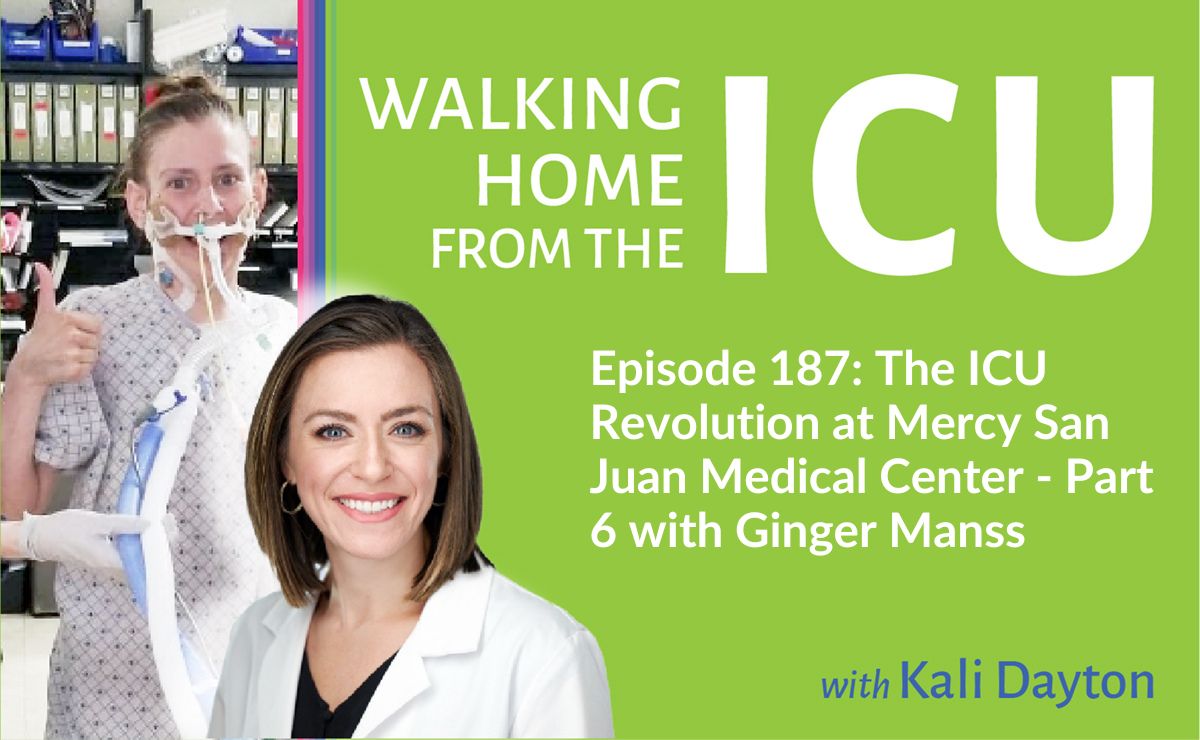
What is the role of the critical care director in leading ICU teams to become Awake and Walking ICUs? How can directors use the evidence to win executive leadership support for their teams to have what they need to succeed? Ginger Manss, DNP shares with us her key role as senior director of critical care in the revolution at MSJMC.
Episode Transcription
[00:00:00] This is the walking home from the ICU Podcast. I’m Kelly Dayton, a nurse practitioner and ICU consultant. I help teams create awake and walking ICUs through evidence-based sedation and mobility practices by hearing from survivors, clinicians, and researchers. We’ll explore how to give ICU patients the best chance to walk out of the ICU and go home to survive and thrive.
Welcome to the ICU Revolution.
Throughout the years, I have had innumerable revolutionists. Reach out to me to talk about how to get their teams even bought in With the idea of having patients awake and mobile, there is so much a bedside clinician can do. To help their own patients and to bring awareness throughout the [00:01:00] team. Yet setting a team wide standard still requires strong leadership from leadership of each discipline of rehab, respiratory therapy, nursing and medical director, as well as the director of Critical Care and executive leadership team.
I have spoken to directors of critical care about awakened walking ICUs, and their eyes get huge. And I can tell they are overwhelmed by trying to even fathom leading such a big change, a totally new process of care. Team dynamics and skills that they have never personally done, let alone taken leadership of.
They are already so burdened with so many other tasks, initiatives, audits, hiring, et cetera. Such a huge. Transformation is more than they can often even think about this episode. I’m excited for you to listen to Dr. Ginger Mons talk about her role as a new critical care director, how she did her own research, sought out expert, help use the evidence and financial proof to build a bridge between the needs of bedside [00:02:00] clinicians and patients.
And the executive leadership team, she exemplifies a leader that is driven by compassion and division and opens the way for my team to come in and provide the tools and support to make these changes possible in her five ICUs. Ginger, welcome to the podcast. I am so excited to dissect your leadership at Dignity Health Mercy of San Juan.
Can you introduce yourself to us please? Sure. I am Dr. Ginger Mans. I am. Really the senior director for critical care here at Mercy San Juan, and I’ve been doing this for about two and a half years. Long career. I’m almost getting ready to retire, but I became an LVN at the age of 19, and an RN at the age of 20.
I’ve done a lot of different specialties, including oncology, critical care, cardiac telemetry. Quality and um, one full job I had was really focused on patient engagement. So this project was really, goes along with patient [00:03:00] engagement. I have also been an a chief nursing officer for a federally qualified health center, so went a few years in the ambulatory world.
So I have a lot of different leadership experience, but I really love, what I love about critical care nurses is they’re so focused on the patients. Yeah, and it’s just really high level nursing, but it’s amazing to bring in such a spectrum of experience into a very niche, little isolated world because I feel like critical care is usually very territorial or like you just stay there.
And tell me more about the role of a critical care director. Sure. At uh, dignity Health Mercy Center one, I do have oversight of five ICUs. We have 56 beds. I see my role. Really, I quote Erie Chapman to take care of the people who take care of the people. Dr. Chapman had written a book about radical loving care, and that’s really a core precept here at Mercy San Juan.
Um, but I see my role, I, I, I really am [00:04:00] very into patient rounds. I say prayers of patients if that’s appropriate. I make sure I check in with every single day and night staff that I come across and ask them how they’re doing. What can I do to help support them in their role? Haley, you and I talked. I’m not a critical care nurse by training, but it’s that love of leadership and the, the love of our patients and staff that I feel keeps me at work.
And that was so impressive to me when I first went to Dignity Health Merc San Juan in August of 2022. August of 2023, you were giving me a tour of the unit, but I just tack along while you went room to room to each patient. And you introduced yourself and when it was appropriate, you prayed for them. You shared a scripture like it was really sweet that you were, again, very focused on the patients and the patient care.
And even though you were fairly new in your role, you already knew your clinicians really well. It was fun for me to watch and learn about leadership from you, and I also [00:05:00] thought it was so brave of you. I think for any director to take on a huge initiative like this. To transform some of the pillars of our culture and our practice is daunting.
I think that I felt from many leaders that I’ve talked with, whether it’s medical directors, CNOs, or critical care directors in general, their eyes just get big and they fill the weight of the magnitude of this kind of change and what that’s gonna take as a leader to push that forward. And I was especially in awe that ICU wasn’t even your main thing.
Like you didn’t spend 25 years being an ICU nurse. Easy for someone to say, I’ve done balloon pumps for 25 years. I’m gonna be the director of a CV ICU and make sure they have good balloon pump protocols for you to come in and say, not my expertise, but this needs to happen for the patients and for clinicians.
And as a critical care director, I’m gonna make it happen. Ginger blows my mind. I just think it’s so brave, and I also have always said that people that come in with a fresh [00:06:00] perspective. Like new grads people come from, coming from other specialties can be so powerful in the ICU because you don’t necessarily have the clouded vision like those that have done it for so long.
You don’t just assume that patients are gonna be sedated because you treated sedated patients for last 20 years. You’ve had experiences in oncology and inpatient, outpatient, and interacting with patients in a different way that a lot of critical care clinicians have not. So to bring that in, to build that bridge as a leader, to bring in patient experience.
It just blows my mind. And so what made you brave enough and willing to take on such a huge initiative? Well, when I was hired, probably in every single interview that I had, somebody mentioned the awaken walking. I knew it was a big ask for me. That man, we started. So I started, I’m pretty methodical. I started with understanding the Ada F bundle and looked at what we were doing, what counted for points in the A DF bundle.
We did education with the [00:07:00] staff, worked with Gina Flakes, a critical care educator and the managers to make sure we signed everybody off on what the AAB a bundle was and what the timeframes were. We did improve those scores from about the 60th percentile to the 70th percentile in the first year. And then I still remember Dr.
Murphy calling me one day and saying, we are harming patients. You have to get this program started. We get no pressure. So I remember I called you Kaylee and we had a conversation and this was in the summer of, of 23 and brought you to assess where we were. And we had had really some pretty awesome pockets of success.
The Russell ICU, which is the heavy medical unit, it had some loudly stories of patients on ventilators outside enjoying the sunshine. But it wasn’t consistent and it wasn’t interdisciplinary, multidisciplinary. And I think that was our biggest, um, learning in all of that early talk. I did sit down and [00:08:00] read, we e’s book Every Deep Dawn, best Twice.
The first time I perused different chapters and stuff, and then I just read it from start to finish and mark pages and really got excited about the whole project. So I think that got us motivated. To get the project off the ground. So as a critical care director, you could be totally bought in. You didn’t have to necessarily know how to make these changes, so you were willing to bring in help from outside parties myself.
But then there’s the whole huge barrier of how do you get executive leadership buy-in. So how did you make that case to the ELT? Because I think that’s where a lot of teams get hung up and don’t get to excel. Well, I think one of the things as a leader that I am very much into evidence-based practice and it’s taking the evidence-based practice that makes sense at the bedside and finding a way to quantify it.
And we all know ICU Care is very, very [00:09:00] costly. And as I was looking through the literature, it’s okay, well if we can reduce delirium this many times, how much can we save? If we can reduce, oh this many times, how much can I save? And, and my team and I actually sat down and tried to put, put numbers on that.
We kind of had a joke about it. ’cause I had this audacious goal of saving $6 million and I put that to, okay, well what are we gonna spend to save $6 million? You know, the contract for the consultants, I wanted to buy a new chair. Mobility checks, an idea that we had that was gonna be important to this project, that multidisciplinary collaboration.
So I quantified that and I did take a proposal to the executive leadership team saying, this is what it’s gonna cost. 350,000. But I’m gonna give you 6 million back. And they all after me. But it, it, it made people sit up and look. And then we looked at the literature and, and I did [00:10:00] have to make a proposal, not just to the executive team, but I had to take that also to the Regional Dignity Health team to get buy-in from both levels.
And they did approve it as a trial project, but since we’ve been so successful, there’s no talk about it being a trial project. Like it’s just gonna be the standard. Absolutely. I know there was concern, people were saying, well, they might give us mobility tech now, but they could take them away later. But I, I just can’t imagine that happening because even within the first few months, you’ve already seen hundreds of thousands of dollars of savings.
I mean, you’ve already at least doubled what you, what the hospital put into it, right? Correct. And what are you measuring for those savings? So you’re doing a special study, right? What are you, we have a couple of different things that we’re doing through Common Spirit Health. We have a fantastic dashboard that gives us stuff like mean ICU days and percentage of patients greater than seven days mean days on event.
It helps us to look at that within our own hospital, within [00:11:00] our system and compare ourselves year to year. So have a lot of data coming through that just shows one snapshot and we sat down and we are looking at the A to F bundle. The choice of sedation doesn’t always tell you whether they’re on sedation or not.
So we wanted to devise and, and I put together with my quality team a special study, and it was real time asking the nursing ship manager, okay, are they out of bed? Are they on restraints? What’s their sedation? What’s their cam? What’s the rats? And we did rolled out this study in the middle of 2023 to get some baseline data about.
If patients are eligible for mobility, are they dangling? Are they in a chair? Are they absolutely walking? So trying to capture that data real time. And we have that study ongoing as a longitudinal study that’s within our own system, our own. That was really helpful for me [00:12:00] to have that conversation with your executive leadership team to say, here’s the amount of mobility actually happening in your ICU.
That is a common gap, is that our ability to track mobility as far as how often it’s happening, what kind of mobility, if they’re ambulating, how far are they’re ambulating, that doesn’t easily sink into an EHR dashboard. So it’s nice that you would already been looking at that and you could show what was actually happening.
Because by the end of that presentation, when I’m showing the cost of failing to mobilize patients, cost benefits, the savings of mobilizing patients, and then what’s actually happening in their. Hospital, it all just clicked. I could just see the CFO being like, oh, shoot. And that I think really sparked their interest.
So you as a leader to have gathered that data already be pulling that together was really helpful to even guide that conversation. And that’s oftentimes one of the gaps, even getting that kind of executive leadership buy-in, is not even knowing what is actually going on in our units. Because we can anecdotally [00:13:00] say we, we hardly ever mobilize our patients.
They’re often sedated, they’re deeply sedated. It’s all very subjective. We’ve gotta have numbers. We have to measure it. And so as a leader, that’s amazing that you, even before I ever got involved, you were already trying to quantify the gap. Right, right. Thank you. And what other, so you got the buy-in you, we got to get started as a leader.
What other barriers did you hit along the way? Wondering? I just wanna say it’s not just one leader that does this. This is absolutely a team. And I have been so blessed to have not only a great nursing team, a great respiratory therapy team, and a great rehab team, and strong physicians. So all of us coming together to, to work on things.
And as I was driving in for work the other day, I was thinking about how change is hard and how do you tell people for change? And there’s a lot of theories about change, but one that I like, I don’t know if you’re familiar with it, but is by, uh, two Brothers, chip and Dan [00:14:00] Heath. You know that one? I don’t.
It’s a, they wrote a book called Switch probably a dozen years ago or something, but it’s about a, they, they have a really wonderful analogy that just resonates with me and a writer on an elephant, on a crooked path. And the writer is kind of that mental aspect of, this is the change I wanna have happen.
But if you don’t have the elephant going the way you wanna go, you’re never gonna make it. Or if you have branches in the path, you’re never going to make it. How the Heat Brothers talk about is that educate the mind, but you motivate the heart. You get that passion from the staff and you have champions in each unit and not just in each unit, in each specialty.
We had wonderful champions in respiratory therapy with Handen. We have Wonder champions in rehab therapy with Tom and Lou, and we had wonderful nursing and physician champions. So you get the people to motivate. Each other and to build [00:15:00] that passion. And then the last part of the analogy is the crooked path.
How do you straighten the path? How do you get rid of barriers? How do you, uh, give them the resources to do what you wanna do to make this change happen? And I see that, and you mentioned the mobility tech, and. We did not get the Mobility Techs at the beginning of this project, and part of it was we were trying to figure out how, if they were gonna be in nursing or if they’re gonna be CNAs or mobility techs, and we did come on to mobility techs centered through respiratory, the through the rehab services department, where they count their ivu and everything because the worry in a big hospital.
Oh, we have a CNA here. You know what? We need this sitter. Let’s pull ’em to do that. Oh, we need this. Let’s pull ’em to do that. And by putting it in the mobility, tech fashion, it helped keep them out of the scoop of everybody else. Probably shouldn’t say that. I did. But the other part is [00:16:00] how to, by the fact that we didn’t get these people started until after the consultation was done and everybody had that education.
I didn’t want, I wanted the nurses opponent. Because even though it’s multidisciplinary, the people are at the bedside. 24 7 are the RNs and they, they needed to own this and be the pivot point and have the additional resources with rehab and respiratory and mobility tech. So I think that’s another thing that I think works well with change.
I think it’s so nice to have the highest up leadership. Be a nurse and you can speak nursing. You understand? If you’ve been listening to this podcast, you are likely convinced that sedation and mobility practices in the ICU need to change. The ICU community is facing incredible difficulty with the trauma from the Pandemic staffing crisis and burnout.
We cannot afford to continue practices. That result in poor patient outcomes, more time in the ICU, higher healthcare costs and greater [00:17:00] workload for the ICU team. Yet the prospect of changing decades of beliefs, practices, and culture across all disciplines of the ICU is a daunting task. How does this transformation start?
It can begin with a consultation with me to discuss your team’s current practices. Barriers and to formulate a plan to help your ICU become an awake and walking ICUI help teams master the A-B-C-D-E-F bundle through education consulting, simulation training, and bedside support. Let’s work together to move your team into the future of evidence-based ICU care.
Click the link in the show notes of this episode to find out more
nurses to having the nurses be. Leading and advocating this. Maybe I’m biased, I know I’m biased, but I do love having nurses lead this and having the rest of the team come in and support. We talked to the trauma team and they felt initially that they would be very left alone in it. [00:18:00] That initially it was just sedation off and everyone else walks away and it’s, they’re left to deal with it.
But starting the patient and the whole team off on the right path of, we’re not even gonna start sedation unless we have to. We’re gonna prevent delirium and the whole team is gonna be playing their part. Really empower the nurses to take leadership to take ownership, and so it’s fun to listen to them talk about being the advocates for this now and protecting their patients from maybe visiting physicians that aren’t playing by the same rules.
It’s really cool to watch that shift. I know that as a leader, you probably took a lot of heat, especially initially. Who is this Ginger coming in and telling, like making these big changes and she doesn’t know critical care and she’s never done this before. She’s just thought like drinking the Kool-Aid, but for you to Yeah, I think we a few barriers with the nursing union.
I think in doing it differently, I would say we should have gotten our nurse union reps on board earlier. We had some worries about our protocol with early mobility. And how we [00:19:00] define that. And are we gonna get everybody with an open belly outta bed? And how are we gonna do that? And it’s gonna put nurses at risk.
And I think that’s one learning that I have from this. That was one barrier. And then we also had some pushback about using the verticalization beds. Well, we have to sit and watch ’em for 20 minutes. How are we gonna do that? And how are we gonna staff for that? Do we have a one-to-one? And so I think having the union representatives on board early would’ve helped.
Honestly, once we took it to the union and we showed the evidence-based practice totally bought on it that that this is the right thing for a patient and for patients who aren’t even strong enough to dangle, if we could get them in a vertical position, that’s gonna really help drop that diagram and help us get ’em excavated earlier.
And so I think that was, uh, a big learning that I had with this. And I as well, because I had never worked with a hospital that was part of a union and so. That’s one of my takeaways as well, is I can now approach it saying we’re gonna get the [00:20:00] union involved right away. Make sure that everyone’s on the same page and up to date, and that we’re not blind sighting anyone because anything new is scary.
But from the union perspective, with good for the patients and good for the nurses. It’s totally, this is the kind of thing that we wanna work together on and and make it, because if you can get patients up earlier, you’re not getting ’em outta bed when they’re five days laying in bed. And it’s harder to do that.
So definitely I think that was a great learning for me and some of your nurses did a really good job scouring the hospital policies and making sure word for word that this was not going against policy. That’s something that I look at beforehand to say. What are their policies and protocols, and then when I’m teaching, I’m like, this is within your policy policies and protocols.
But a lot of times they say that they don’t think that it is when what, in reality, what’s happening is that it is oftentimes part of the hospital policy and protocol that they’re not practicing. So where they’re afraid of going against policy and being vulnerable to legal problems and things like that.
It’s [00:21:00] ironic that what they’re currently doing, the current practice is oftentimes the deeper sedation failing to. Screen their patients for delirium. Failing to mobilize them is actually more of a legal liability and is going against hospital policy and protocol. But when we culturally have this accepted norm, we think that those cultural practices are policy.
It was interesting to go through that with your team and figure out what’s that’s real. Yeah. What actually needs to change in this protocols or is this just a perception, um, or do we need to build a protocol to make sure that we know what we’re doing? I think another barrier that I think is sometimes there’s so many competing, uh, priorities in healthcare that taking your foot off the gas, that we have joint commission over here and CDPH over here and everything.
So how do we keep this going? And we have put some things in place for sustainability and accountability and, um, with our rounds and making sure that we are. Sharing what we’re doing. And I mentioned to Daily before the podcast, even these [00:22:00] podcasts and going out and helping other hospitals and we made a video to share and be excited about.
And those are different ways to keep that momentum going and keep this, have it be an embedded change in the culture. Yes. And tell me about that video. What inspired that and how did you execute that? Oh, I am so proud of that video. It’s definitely a project love. My managers and educator and I were sitting around the table one day and we were talking about how can we take these stories and make people excited?
And we thought about this one patient that we had in Russell ICU and his name was, and could we get him on video? Oh, what about this patient? We just brainstormed and it came together. Actually, we just got it produced and we started it in August of 2023, so it was a 15 month long project. We interviewed a couple of physicians, a nurse champion, and six patients and families primarily about, you know, it felt to be in delirium, early [00:23:00] mobility or late mobility and that family engagement and staff engagement.
We had a couple of glitches along the way. Our first videographer, we taped about 10 hours worth of sessions. And then she was unable to complete the project, so we had to start from scratch. Luckily, I knew a guy who was really good at videos. Uh, his name is Bill Dodge and he worked for Corporate Dignity Health and invited him and got approval from his boss and his boss’s boss, and we sat and reviewed all 10 hours of, of the taping.
It gave us chills, the power of the testimonies of some of these patients. Got it down to about an hour and 50 minutes, and we knew that was way too long. So we just kept editing it down. And then Bill had the thought, we need to make it a story arc. We need to have the bigger picture. So I sat down and wrote a script, and I’m not a writer, but I just wrote a script.
And Dr. Bcha, one of our physicians who hadn’t been interviewed, said the story from start to finish. [00:24:00] It is a 19 minute video. We have it on a private YouTube now, and I’ve sent it to all of our patients and, and have gotten wonderful responses. And my favorite was Tangs, who I asked if he might be willing to sit down and talk with you, Kayley, and he said yes, but they’re expecting their second child.
This is a, a young gentleman who nearly died who nearly needed a lung transplant during COVID, who is now. More than awake and watching, but is thriving and succeeding, and it’s been wonderful and chilling to share that story. He was one of the first patients to really be awake and mobile on a ventilator in Russell.
Right. And your team’s heroism totally set him off in a different trajectory for his life. And that was. Great example, and we always talked about him in simulation training. How was this video received for your current staff and how will you use it for future staff members? We started at the September staff meeting, and there was probably, we have 180 staff, so probably 120 of ’em saw it then.
[00:25:00] They loved it. The chats were just, oh, I didn’t even recognize Adam until I saw his toenails. Oh my gosh. That’s Joel. I took, he was one of our, our first COVID patients and it was just pretty, pretty wonderful. And I think now that we have it on the YouTube and can share it more readily, it’s been been fun because we didn’t use any paid actors.
It’s all our nurses and therapists and techs in the video, and they had a lot of fun with that. So we’re keeping it as we are. Bringing new staff on board. We do have the requirement for them to have to, to see webinars that you and your team created, but not, I don’t want ’em doing it on pathways while they’re doing the dishes.
We are having them do that in a group together, stopping the tape, talking about things and making it real and making it live for people. So having that, and then we’re also showing this video at our education for all of our new staff. I love it. We’ll put the link into the show notes so that everyone go in and watch Dignity Health Video.
It’s beautiful and it was fun [00:26:00] for me to watch some of your charge nurses play the patient and see them just be so involved in this. Those are some of the key leaders to have picking stewardship of this. How many patients, even just this year, we’ll pass through your whole critical care department? Well, I mean, when we did our baseline study, our volume was about 4,300.
Looking at, we have done some pretty good, I do have some results for our first five months of our project, from May 1st to September 30th and our annualized volume this year, looking at what we’ve done in the last five months is gonna be about 6,200 patients. So a lot of people to be impacted by this. I don’t want initiative, this transformation, I don’t like to call it a project ’cause that sounds so short term, but these changes that you have led, that’s a lot of souls.
Impact within just the first year. And this is not something that’s just gonna go away. Yeah. And uh, one of the things that I shared at our National Common Spirit Health Critical care team [00:27:00] is we have seen a decrease in our mean ICU days, probably a lot, but by 0.1, we’ve seen, uh, less percentage of patients greater in the ICU greater than seven days.
A little na mean days on event is about similar, but one really cool statistic. Is our number of patients who went from ICU vent to trait in our baseline period in FY 23, it was 4.1% of all of our patients. In this first five months, it’s 3.4%, so that 0.7% drop when you analyze it on 6,000 patients is 26 lives that have not gone from min to trach.
And so that is changing the trajectory of these people. The other really cool. If you could also measure readmissions during this next year, you could see what percentage of your current patients end up coming back to the hospital. Oh, readmissions. That’s beautiful. Yes. You might hit your 6 million with those costs, [00:28:00] especially.
Yes. Maybe We’ve also seen a 2.1%, uh, drop in mortality. Wow. These five months compared to the whole year of, and that’s again, within the first few months. And what I see is it takes about six months to really get momentum going and to really excel. Also, I think it’s important to note that. You guys had initial series of webinars back in 21.
By the time I showed up, you guys were lightly sedating your patients for the most part, using very little benzodiazepines, and were doing some mobility now. A lot of your patients are off sedation and doing a lot more mobility, so your baseline wasn’t quite as extreme as other teams because you guys had already started making so much headway.
Still. Again, it just reinforces that this is a dose dependent. Absolutely. The more you strive for, awaken doing their highest level of mobility, the more you can impact their outcomes and the cost savings. Do you have an estimate of what you saved in those first five months? Yes. Uh, I worked with our finance department and we looked at our, um, [00:29:00] ICU variable cost per patient day and took again, the FY 23 data and these five months, and we decrease that by $123 per patient.
But if you multiply that on 6,200 patients, that’s a cost savings annualized for one year of $766,000. We did get a hundred percent return, more than a hundred percent return on our investment for the first five months. And moving forward, we’re not gonna be buying more recliners. A lot of the stuff we already have going, the only ongoing cost really is the mobility tax.
And they are worse, their weight and gold. Absolutely. And you haven’t even hit the most expensive part of the year, which is respiratory season where you can really change. The trajectory or the time. You have a lot of your summer problems, but the winters, when you really have patients end up there for a long time, depending on how we care for them.
It’s so early it’s mean to see that kind of outcome and those [00:30:00] kind of numbers even early, early on in the game. But you guys will wrap your study up when the plan is to go through the end of June, 2025. So you wanna do full year to full year comparisons. Okay. Wonderful. Well, ginger, any last thoughts for critical care directors?
How they can approach making this, this kind of transformation. Think, put your heart in it. Think about that analogy with the elephant and get that passion going. I’ve done a lot of cool things in my career. This has been something that has been multidi dimensionality, uh, seeing it in the patient, seeing the change in the staff, seeing the change in the leadership team.
I feel like I’ve been a nurse for 42 years and I’ve been blessed to help drive this transformation here and just wanna see it. Keep, keep moving and keep sustaining. And if anybody would like to sit down and talk with somebody who’s been there, done it, I’d be very happy to offer my [00:31:00] services in my retirement.
Yes, and congratulations on your retirement. This is really going out with a bang. This is a good note to end on, even though I’ve already got plans. You’re gonna be busy doing hobby kind of. Presentations and things. Right. But thank you so much for everything that you’ve done and happy retirement. Well, thank you very much for allowing me to share my small part in this wonderful story.
So I appreciate your leadership and vision in taking this nationwide because we want every ICU to be awake and walking. You guys have set the standard. Thanks, ginger. Thank you
to schedule a consultation for your ICU as well as find supportive brief. Sources such as the [00:32:00] free ebook, case studies, episode, citations, and transcripts. Please check out the website at www.daytonicuconsulting.com
Transcribed by https://otter.ai
SUBSCRIBE TO THE PODCAST